
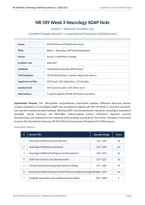
NR 509 Week 3 Neurology SOAP Note (Version 1) - 2026/2027 Chamberlain University MSN Program
NR 509 Week 3 Neurology SOAP Note
Version 1 - 2026/2027 Academic Year
Complete Template Solutions - Comprehensive Examination (100 Questions)
Course NR 509 Advanced Physical Assessment
Week Week 3 - Neurology SOAP Note Development
Format Version 1 SOAP Note Template
Academic Year 2026/2027
Institution Chamberlain University MSN Program
Total Questions 100 (Multiple Choice, 4 options, single best answer)
Cognitive Level Mix 30% Recall / 50% Application / 20% Analysis
Question Style 75% Scenario-based / 25% Direct recall
Total Sections 7 sections aligned with NR 509 Week 3 curriculum
Examination Purpose: This 100-question comprehensive examination assesses MSN-level advanced practice
nursing competency in neurological SOAP note development aligned with NR 509 Week 3 curriculum standards.
Each question includes detailed rationale reflecting SOAP note documentation standards, neurological assessment
principles, clinical reasoning, and 2026/2027 evidence-based practice. Distractors represent common
documentation and assessment errors observed at the graduate nursing level. The Version 1 template is structured
to mirror the Chamberlain University NR 509 SOAP note format used throughout the MSN program.
Examination Sections:
# Section Title Question Range Count
1 Neurological Subjective Data Collection Q1 - Q18 18
2 Neurological Objective Assessment Q19 - Q38 20
3 Neurological Differential Diagnosis and Assessment Q39 - Q54 16
4 SOAP Note Structure and Documentation Q55 - Q70 16
5 Clinical Reasoning and Diagnostic Decision-Making Q71 - Q84 14
6 Neurological Pharmacological and Non-Pharmacological ManagementQ85 - Q94 10
7 Template Application and Complete Documentation Q95 - Q100 6
Advanced Physical Assessment - Complete Template Solutions Page 1
,NR 509 Week 3 Neurology SOAP Note (Version 1) - 2026/2027 Chamberlain University MSN Program
Section 1: Neurological Subjective Data Collection
Chief Complaint, HPI, PMH, Medications, Allergies, & ROS - Questions 1-18
Q1: A 42-year-old female presents to the clinic with a chief complaint of recurrent headaches. When
documenting the chief complaint in the SOAP note, which of the following entries is most appropriate per
the NR 509 Version 1 template standards?
A. Headache x 3 days, described as throbbing, located bilaterally, associated with photophobia, rated 7/10.
B. Patient reports she has been having severe headaches for the past three days and is very uncomfortable.
C. Recurrent headaches for 3 days. [CORRECT]
D. Patient presents with bilateral throbbing headaches rated 7/10 with photophobia, lasting 4-6 hours,
occurring 2-3 times weekly for the past month.
Correct Answer: C
Rationale:
The chief complaint (CC) must be documented in the patient's own words or as a concise statement, typically fewer than
10 words. Including HPI elements (throbbing, bilateral, photophobia, severity) within the CC is incorrect because those
details belong in the HPI. Lengthy narrative descriptions and editorial commentary ('very uncomfortable') violate SOAP
note documentation standards, which require concise, factual CC entries that direct the differential diagnosis. The most
appropriate CC is the brief statement 'Recurrent headaches for 3 days.'
Q2: When eliciting the HPI using OLDCARTS for a patient with migraine headaches, which element captures
factors that make the headache worse?
A. Onset
B. Character
C. Aggravating factors [CORRECT]
D. Timing
Correct Answer: C
Rationale:
In the OLDCARTS mnemonic (Onset, Location, Duration, Character, Aggravating factors, Relieving factors, Timing,
Associated symptoms), 'Aggravating factors' specifically captures elements that worsen the symptom, such as light,
noise, activity, or stress. Onset refers to when the symptom began, Character describes the quality (throbbing, pressure),
and Timing refers to pattern (continuous, intermittent). The NR 509 Version 1 template requires all OLDCARTS elements
for a complete HPI; omitting aggravating factors limits differential prioritization and impairs clinical reasoning.
Q3: A 55-year-old male presents with new-onset neurological symptoms. When documenting the past
medical history (PMH) component of the SOAP note, which historical element is most critical to include for
neurological differential diagnosis?
A. Remote appendectomy at age 22
B. History of hypertension, diabetes mellitus, and prior stroke [CORRECT]
C. Childhood chickenpox infection
D. History of seasonal allergic rhinitis
Correct Answer: B
Rationale:
Advanced Physical Assessment - Complete Template Solutions Page 2
,NR 509 Week 3 Neurology SOAP Note (Version 1) - 2026/2027 Chamberlain University MSN Program
Hypertension, diabetes mellitus, and prior stroke are major vascular risk factors directly relevant to neurological
differential diagnosis because they significantly increase the risk of cerebrovascular disease, TIA, and recurrent stroke.
The NR 509 Version 1 template requires PMH to include conditions pertinent to the chief complaint; including irrelevant
remote surgical history, childhood infections, or seasonal allergies without neurological relevance clutters
documentation and fails to support clinical reasoning. Pertinent PMH drives differential prioritization and guides
decisions about urgent neuroimaging and referral.
Q4: A patient with chronic migraines is being evaluated. When documenting medications during the
subjective portion of the SOAP note, which entry best reflects the NR 509 documentation standard?
A. Takes medication for headaches as needed
B. Sumatriptan 50 mg PO PRN for migraine; propranolol 40 mg PO BID for migraine prophylaxis [CORRECT]
C. Pain pills and a beta blocker
D. Patient is on multiple medications for her migraines
Correct Answer: B
Rationale:
The medication list must include drug name, dose, route, frequency, and indication for each medication; this is a
non-negotiable documentation standard in the NR 509 Version 1 template. Vague references like 'pain pills,' 'multiple
medications,' or 'as needed' omit critical information needed for clinical decision-making, drug interaction screening, and
identifying medication overuse headache. Complete medication documentation supports differential diagnosis (e.g.,
identifying overuse of acute migraine medications) and ensures interprofessional communication for safe prescribing.
Q5: When documenting allergies in the SOAP note for a patient with a reported penicillin allergy, which
entry best meets NR 509 documentation standards?
A. Allergic to penicillin
B. PCN allergy
C. Penicillin - hives and shortness of breath after oral dose in 2018 [CORRECT]
D. Patient has a penicillin allergy that she has had for years
Correct Answer: C
Rationale:
Allergy documentation must include the allergen, the specific reaction, and ideally the timing or context of the reaction.
'Hives and shortness of breath' distinguishes a true IgE-mediated reaction (anaphylaxis risk) from a non-allergic
intolerance, which directly influences prescribing decisions for cephalosporins and carbapenems. Brief entries like 'PCN
allergy' or 'allergic to penicillin' omit reaction details needed for safe alternative selection. The NR 509 Version 1
template requires this level of detail to support interprofessional communication and patient safety.
Q6: During the review of systems (ROS), a patient denies headaches, dizziness, syncope, seizures,
numbness, weakness, tremor, and gait changes. How should this be documented in the SOAP note per NR
509 Version 1 standards?
A. Neurologic: negative
B. ROS: Neurologic system reviewed and unremarkable
C. Neurologic ROS: Denies headaches, dizziness, syncope, seizures, numbness, weakness, tremor, or gait
changes. All other systems reviewed and negative. [CORRECT]
D. Neuro ROS normal
Advanced Physical Assessment - Complete Template Solutions Page 3
, NR 509 Week 3 Neurology SOAP Note (Version 1) - 2026/2027 Chamberlain University MSN Program
Correct Answer: C
Rationale:
The NR 509 Version 1 template requires the ROS to explicitly enumerate the symptoms reviewed (headaches, dizziness,
syncope, seizures, numbness, weakness, tremor, gait changes) and to indicate that all other systems were reviewed and
negative. This demonstrates a complete review, supports billing at the appropriate E/M level, and provides medico-legal
documentation. Brief entries such as 'neuro negative' or 'ROS normal' fail to demonstrate the breadth of the review, may
not support the level of service billed, and increase liability exposure.
Q7: A patient describes 'a spinning sensation when rolling over in bed' lasting less than one minute. When
documenting the HPI for dizziness, which OLDCARTS element is most diagnostically valuable for
distinguishing BPPV from other causes?
A. Onset
B. Character
C. Timing and Aggravating factors [CORRECT]
D. Location
Correct Answer: C
Rationale:
For dizziness, the timing (episodic, lasting < 1 minute) and aggravating factors (provoked by head movement, rolling over)
are the most diagnostically valuable OLDCARTS elements because they are pathognomonic for benign paroxysmal
positional vertigo (BPPV). The Hallpike-Dix maneuver reproduces these symptoms. Other causes of dizziness (Meniere's
disease, vestibular neuritis, presyncope, disequilibrium) have distinct timing and provocation patterns. The NR 509
Version 1 template requires explicit documentation of these elements to support differential diagnosis and determine
whether canalith repositioning maneuvers, pharmacotherapy, or urgent imaging is warranted.
Q8: A 68-year-old patient reports 'passing out' while standing up quickly. When documenting this syncopal
episode, which historical feature is a red flag warranting urgent cardiovascular and neurological evaluation?
A. Episode occurred after standing for less than 2 minutes and resolved with lying flat
B. Episode occurred during exertion, with palpitations preceding the event, and the patient has a family
history of sudden cardiac death [CORRECT]
C. Episode occurred after prolonged standing in a hot environment with inadequate hydration
D. Episode was preceded by nausea and resolved spontaneously within seconds
Correct Answer: B
Rationale:
Exertional syncope, palpitations, and family history of sudden cardiac death are red flag features suggesting
arrhythmogenic syncope (e.g., hypertrophic cardiomyopathy, long QT syndrome, arrhythmogenic right ventricular
cardiomyopathy) which carries significant mortality risk without intervention. Vasovagal, orthostatic, and
dehydration-related syncope typically have benign triggers and resolution patterns. The NR 509 Version 1 template
requires the advanced practice nurse to recognize red flags that mandate urgent referral for ECG, echocardiography, and
cardiology evaluation rather than routine follow-up.
Q9: A patient reports a 'seizure-like' episode witnessed by a family member. When obtaining the HPI for
this presentation, which element is most critical to differentiate a true epileptic seizure from syncope or
psychogenic nonepileptic events?
A. Patient's recollection of the event onset
Advanced Physical Assessment - Complete Template Solutions Page 4
NR 509 Week 3 Neurology SOAP Note
Version 1 - 2026/2027 Academic Year
Complete Template Solutions - Comprehensive Examination (100 Questions)
Course NR 509 Advanced Physical Assessment
Week Week 3 - Neurology SOAP Note Development
Format Version 1 SOAP Note Template
Academic Year 2026/2027
Institution Chamberlain University MSN Program
Total Questions 100 (Multiple Choice, 4 options, single best answer)
Cognitive Level Mix 30% Recall / 50% Application / 20% Analysis
Question Style 75% Scenario-based / 25% Direct recall
Total Sections 7 sections aligned with NR 509 Week 3 curriculum
Examination Purpose: This 100-question comprehensive examination assesses MSN-level advanced practice
nursing competency in neurological SOAP note development aligned with NR 509 Week 3 curriculum standards.
Each question includes detailed rationale reflecting SOAP note documentation standards, neurological assessment
principles, clinical reasoning, and 2026/2027 evidence-based practice. Distractors represent common
documentation and assessment errors observed at the graduate nursing level. The Version 1 template is structured
to mirror the Chamberlain University NR 509 SOAP note format used throughout the MSN program.
Examination Sections:
# Section Title Question Range Count
1 Neurological Subjective Data Collection Q1 - Q18 18
2 Neurological Objective Assessment Q19 - Q38 20
3 Neurological Differential Diagnosis and Assessment Q39 - Q54 16
4 SOAP Note Structure and Documentation Q55 - Q70 16
5 Clinical Reasoning and Diagnostic Decision-Making Q71 - Q84 14
6 Neurological Pharmacological and Non-Pharmacological ManagementQ85 - Q94 10
7 Template Application and Complete Documentation Q95 - Q100 6
Advanced Physical Assessment - Complete Template Solutions Page 1
,NR 509 Week 3 Neurology SOAP Note (Version 1) - 2026/2027 Chamberlain University MSN Program
Section 1: Neurological Subjective Data Collection
Chief Complaint, HPI, PMH, Medications, Allergies, & ROS - Questions 1-18
Q1: A 42-year-old female presents to the clinic with a chief complaint of recurrent headaches. When
documenting the chief complaint in the SOAP note, which of the following entries is most appropriate per
the NR 509 Version 1 template standards?
A. Headache x 3 days, described as throbbing, located bilaterally, associated with photophobia, rated 7/10.
B. Patient reports she has been having severe headaches for the past three days and is very uncomfortable.
C. Recurrent headaches for 3 days. [CORRECT]
D. Patient presents with bilateral throbbing headaches rated 7/10 with photophobia, lasting 4-6 hours,
occurring 2-3 times weekly for the past month.
Correct Answer: C
Rationale:
The chief complaint (CC) must be documented in the patient's own words or as a concise statement, typically fewer than
10 words. Including HPI elements (throbbing, bilateral, photophobia, severity) within the CC is incorrect because those
details belong in the HPI. Lengthy narrative descriptions and editorial commentary ('very uncomfortable') violate SOAP
note documentation standards, which require concise, factual CC entries that direct the differential diagnosis. The most
appropriate CC is the brief statement 'Recurrent headaches for 3 days.'
Q2: When eliciting the HPI using OLDCARTS for a patient with migraine headaches, which element captures
factors that make the headache worse?
A. Onset
B. Character
C. Aggravating factors [CORRECT]
D. Timing
Correct Answer: C
Rationale:
In the OLDCARTS mnemonic (Onset, Location, Duration, Character, Aggravating factors, Relieving factors, Timing,
Associated symptoms), 'Aggravating factors' specifically captures elements that worsen the symptom, such as light,
noise, activity, or stress. Onset refers to when the symptom began, Character describes the quality (throbbing, pressure),
and Timing refers to pattern (continuous, intermittent). The NR 509 Version 1 template requires all OLDCARTS elements
for a complete HPI; omitting aggravating factors limits differential prioritization and impairs clinical reasoning.
Q3: A 55-year-old male presents with new-onset neurological symptoms. When documenting the past
medical history (PMH) component of the SOAP note, which historical element is most critical to include for
neurological differential diagnosis?
A. Remote appendectomy at age 22
B. History of hypertension, diabetes mellitus, and prior stroke [CORRECT]
C. Childhood chickenpox infection
D. History of seasonal allergic rhinitis
Correct Answer: B
Rationale:
Advanced Physical Assessment - Complete Template Solutions Page 2
,NR 509 Week 3 Neurology SOAP Note (Version 1) - 2026/2027 Chamberlain University MSN Program
Hypertension, diabetes mellitus, and prior stroke are major vascular risk factors directly relevant to neurological
differential diagnosis because they significantly increase the risk of cerebrovascular disease, TIA, and recurrent stroke.
The NR 509 Version 1 template requires PMH to include conditions pertinent to the chief complaint; including irrelevant
remote surgical history, childhood infections, or seasonal allergies without neurological relevance clutters
documentation and fails to support clinical reasoning. Pertinent PMH drives differential prioritization and guides
decisions about urgent neuroimaging and referral.
Q4: A patient with chronic migraines is being evaluated. When documenting medications during the
subjective portion of the SOAP note, which entry best reflects the NR 509 documentation standard?
A. Takes medication for headaches as needed
B. Sumatriptan 50 mg PO PRN for migraine; propranolol 40 mg PO BID for migraine prophylaxis [CORRECT]
C. Pain pills and a beta blocker
D. Patient is on multiple medications for her migraines
Correct Answer: B
Rationale:
The medication list must include drug name, dose, route, frequency, and indication for each medication; this is a
non-negotiable documentation standard in the NR 509 Version 1 template. Vague references like 'pain pills,' 'multiple
medications,' or 'as needed' omit critical information needed for clinical decision-making, drug interaction screening, and
identifying medication overuse headache. Complete medication documentation supports differential diagnosis (e.g.,
identifying overuse of acute migraine medications) and ensures interprofessional communication for safe prescribing.
Q5: When documenting allergies in the SOAP note for a patient with a reported penicillin allergy, which
entry best meets NR 509 documentation standards?
A. Allergic to penicillin
B. PCN allergy
C. Penicillin - hives and shortness of breath after oral dose in 2018 [CORRECT]
D. Patient has a penicillin allergy that she has had for years
Correct Answer: C
Rationale:
Allergy documentation must include the allergen, the specific reaction, and ideally the timing or context of the reaction.
'Hives and shortness of breath' distinguishes a true IgE-mediated reaction (anaphylaxis risk) from a non-allergic
intolerance, which directly influences prescribing decisions for cephalosporins and carbapenems. Brief entries like 'PCN
allergy' or 'allergic to penicillin' omit reaction details needed for safe alternative selection. The NR 509 Version 1
template requires this level of detail to support interprofessional communication and patient safety.
Q6: During the review of systems (ROS), a patient denies headaches, dizziness, syncope, seizures,
numbness, weakness, tremor, and gait changes. How should this be documented in the SOAP note per NR
509 Version 1 standards?
A. Neurologic: negative
B. ROS: Neurologic system reviewed and unremarkable
C. Neurologic ROS: Denies headaches, dizziness, syncope, seizures, numbness, weakness, tremor, or gait
changes. All other systems reviewed and negative. [CORRECT]
D. Neuro ROS normal
Advanced Physical Assessment - Complete Template Solutions Page 3
, NR 509 Week 3 Neurology SOAP Note (Version 1) - 2026/2027 Chamberlain University MSN Program
Correct Answer: C
Rationale:
The NR 509 Version 1 template requires the ROS to explicitly enumerate the symptoms reviewed (headaches, dizziness,
syncope, seizures, numbness, weakness, tremor, gait changes) and to indicate that all other systems were reviewed and
negative. This demonstrates a complete review, supports billing at the appropriate E/M level, and provides medico-legal
documentation. Brief entries such as 'neuro negative' or 'ROS normal' fail to demonstrate the breadth of the review, may
not support the level of service billed, and increase liability exposure.
Q7: A patient describes 'a spinning sensation when rolling over in bed' lasting less than one minute. When
documenting the HPI for dizziness, which OLDCARTS element is most diagnostically valuable for
distinguishing BPPV from other causes?
A. Onset
B. Character
C. Timing and Aggravating factors [CORRECT]
D. Location
Correct Answer: C
Rationale:
For dizziness, the timing (episodic, lasting < 1 minute) and aggravating factors (provoked by head movement, rolling over)
are the most diagnostically valuable OLDCARTS elements because they are pathognomonic for benign paroxysmal
positional vertigo (BPPV). The Hallpike-Dix maneuver reproduces these symptoms. Other causes of dizziness (Meniere's
disease, vestibular neuritis, presyncope, disequilibrium) have distinct timing and provocation patterns. The NR 509
Version 1 template requires explicit documentation of these elements to support differential diagnosis and determine
whether canalith repositioning maneuvers, pharmacotherapy, or urgent imaging is warranted.
Q8: A 68-year-old patient reports 'passing out' while standing up quickly. When documenting this syncopal
episode, which historical feature is a red flag warranting urgent cardiovascular and neurological evaluation?
A. Episode occurred after standing for less than 2 minutes and resolved with lying flat
B. Episode occurred during exertion, with palpitations preceding the event, and the patient has a family
history of sudden cardiac death [CORRECT]
C. Episode occurred after prolonged standing in a hot environment with inadequate hydration
D. Episode was preceded by nausea and resolved spontaneously within seconds
Correct Answer: B
Rationale:
Exertional syncope, palpitations, and family history of sudden cardiac death are red flag features suggesting
arrhythmogenic syncope (e.g., hypertrophic cardiomyopathy, long QT syndrome, arrhythmogenic right ventricular
cardiomyopathy) which carries significant mortality risk without intervention. Vasovagal, orthostatic, and
dehydration-related syncope typically have benign triggers and resolution patterns. The NR 509 Version 1 template
requires the advanced practice nurse to recognize red flags that mandate urgent referral for ECG, echocardiography, and
cardiology evaluation rather than routine follow-up.
Q9: A patient reports a 'seizure-like' episode witnessed by a family member. When obtaining the HPI for
this presentation, which element is most critical to differentiate a true epileptic seizure from syncope or
psychogenic nonepileptic events?
A. Patient's recollection of the event onset
Advanced Physical Assessment - Complete Template Solutions Page 4


