
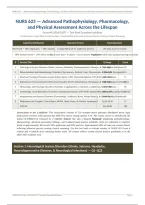
NURS 623 — Advanced Pathophysiology, Pharmacology, and Physical Assessment Across the Lifespan Exam #4 • Test-Bank Complete Solutions
NURS 623 — Advanced Pathophysiology, Pharmacology,
and Physical Assessment Across the Lifespan
Exam #4 (2026/2027) — Test-Bank Complete Solutions
130 Questions • Eight Body-System Sections • Detailed Rationales with Advanced Practice Nursing Clinical Reasoning
Cognitive Distribution Question Format Total Questions
30% Recall • 50% Application • 20% Analysis 4-option MCQ (A–D, single best answer) 130 items across 8 sections
80% Scenario-based • 20% Direct recallEach item: stem + 4 options + correct answer Aligned
+ rationale
with 2026–2027 graduate nursing curriculum
# Section Title Q Range Count
1 Neurological System Disorders (Stroke, Seizures, Headache, Neurodegenerative Diseases, & Neurological
Q1–Q22 Infections) 22
2 Musculoskeletal and Rheumatologic Disorders (Osteoporosis, Arthritis, Gout, Fibromyalgia, &Q23–Q38
Muscular Dystrophies) 16
3 Renal and Urological Disorders (Acute Kidney Injury, CKD, Glomerulonephritis, UTI, & Prostate
Q39–Q55
Disorders) 17
4 Reproductive System Disorders (Menstrual Disorders, PCOS, Endometriosis, Menopause, & Male
Q56–Q70
Reproductive Disorders)
15
5 Hematologic and Oncologic Disorders (Anemias, Coagulopathies, Leukemias, Lymphomas, &Q71–Q88
Solid Tumors) 18
6 Immunologic and Inflammatory Disorders (Autoimmune Diseases, HIV/AIDS, Immunodeficiencies,
Q89–Q103& Transplant Rejection)
15
7 Integumentary and Sensory Disorders (Dermatologic Conditions, Burns, Wound Healing, & Visual/Hearing
Q104–Q117 Disorders)14
8 Multisystem and Complex Cases (Sepsis, MODS, Shock States, & Geriatric Syndromes) Q118–Q130 13
TOTAL Q1–Q130 130
Instructions to the Candidate: This examination consists of 130 multiple-choice questions distributed across eight
body-system sections. Each question has ONE best answer among options A–D. The correct answer is identified by the
marker [CORRECT], followed by a Correct Answer line and a detailed Rationale integrating pathophysiology,
pharmacology, advanced assessment findings, and evidence-based practice standards. Items are calibrated to cognitive
levels of approximately 30% recall, 50% application, and 20% analysis. Approximately 80% of items are scenario-based,
reflecting advanced practice nursing clinical reasoning. Use this test bank to evaluate mastery of NURS 623 Exam 4
content and to identify areas requiring further study. All content reflects current clinical practice guidelines as of the
2026–2027 academic year.
Section 1: Neurological System Disorders (Stroke, Seizures, Headache,
Neurodegenerative Diseases, & Neurological Infections) — Q1–Q22
NURS 623 Exam 4 (2026/2027) • Graduate Nursing Education Page 1
,NURS 623 — Advanced Pathophysiology, Pharmacology, and Physical Assessment Across the Lifespan Exam #4 • Test-Bank Complete Solutions
Q1. A 68-year-old male presents to the emergency department 90 minutes after sudden onset of right-sided
weakness and aphasia. CT scan shows no hemorrhage. NIHSS score is 14. Past medical history is significant
for hypertension and type 2 diabetes. Which intervention is the priority at this time?
A. Initiate aspirin 325 mg orally
B. Administer intravenous alteplase 0.9 mg/kg [CORRECT]
C. Start clopidogrel 75 mg daily
D. Begin heparin infusion per protocol
Correct Answer: B
Rationale: IV alteplase (tPA) is indicated for acute ischemic stroke when administered within 4.5 hours of symptom onset
in eligible patients without contraindications. The patient is within the therapeutic window (90 minutes), has a significant
NIHSS score (14), and CT excludes hemorrhage. Aspirin is initiated at 24-48 hours post-tPA but is not the priority.
Heparin is contraindicated in acute ischemic stroke due to hemorrhagic transformation risk. Clopidogrel is used for
secondary prevention, not acute management.
Q2. A 72-year-old female with atrial fibrillation is admitted with an acute ischemic stroke. She was taking
warfarin but her INR was subtherapeutic at 1.4 on admission. After stabilization, which long-term
anticoagulation strategy is most appropriate for secondary stroke prevention?
A. Switch to aspirin 81 mg daily
B. Continue warfarin with target INR 2.0-3.0
C. Initiate dabigatran 150 mg twice daily [CORRECT]
D. Add clopidogrel to warfarin therapy
Correct Answer: C
Rationale: Direct oral anticoagulants (DOACs) such as dabigatran are preferred over warfarin for stroke prevention in
non-valvular atrial fibrillation per current guidelines, with similar or lower stroke rates and significantly lower intracranial
hemorrhage risk. Aspirin alone is insufficient for cardioembolic prevention. Adding clopidogrel to warfarin increases
bleeding without improving outcomes. While warfarin remains acceptable, DOACs are first-line when not
contraindicated.
Q3. A 55-year-old male with a ruptured cerebral aneurysm is being managed post-coiling. His blood
pressure is currently 180/95 mmHg. What is the most appropriate target for blood pressure management in
this patient?
A. Allow permissive hypertension to maintain cerebral perfusion
B. Maintain SBP < 160 mmHg to prevent rebleeding [CORRECT]
C. Target SBP 140-180 mmHg for cerebral autoregulation
D. Aggressively lower SBP below 120 mmHg
Correct Answer: B
Rationale: Following aneurysm securement (clipping or coiling), blood pressure should be controlled to prevent
rebleeding while maintaining cerebral perfusion. Guidelines recommend maintaining SBP < 160 mmHg after aneurysm
treatment. Permissive hypertension is appropriate BEFORE aneurysm securing but not after. Aggressive lowering risks
cerebral ischemia. SBP 140-180 mmHg is too permissive post-treatment.
NURS 623 Exam 4 (2026/2027) • Graduate Nursing Education Page 2
,NURS 623 — Advanced Pathophysiology, Pharmacology, and Physical Assessment Across the Lifespan Exam #4 • Test-Bank Complete Solutions
Q4. A 64-year-old patient with hemorrhagic stroke has intracranial pressure (ICP) of 25 mmHg. Which
finding requires immediate intervention?
A. Pupils 3 mm bilaterally and reactive
B. Cushing's triad with bradycardia and irregular respirations [CORRECT]
C. Headache rated 6/10 with photophobia
D. Blood pressure 150/90 mmHg
Correct Answer: B
Rationale: Cushing's triad (bradycardia, irregular respirations, widening pulse pressure) indicates critical intracranial
hypertension with impending brain herniation requiring emergent intervention with osmotic agents (mannitol or
hypertonic saline), elevation of head of bed, and possible sedation/paralysis. Normal ICP is 5-15 mmHg; values above 20
mmHg warrant treatment. Bilateral reactive pupils, mild headache, and BP 150/90 are concerning but not immediately
life-threatening.
Q5. A 78-year-old female with history of TIA presents with transient monocular blindness (amaurosis
fugax) lasting 5 minutes with full resolution. Carotid Doppler shows 75% stenosis of the left internal carotid
artery. What is the recommended management?
A. Antiplatelet therapy only with annual monitoring
B. Carotid endarterectomy within 2 weeks [CORRECT]
C. Carotid artery stenting as first-line therapy
D. Anticoagulation with warfarin for 6 months
Correct Answer: B
Rationale: Symptomatic carotid stenosis of 70-99% benefits from carotid endarterectomy (CEA) within 2 weeks of
symptom onset to reduce stroke risk, combined with optimal medical therapy. CEA reduces 5-year stroke risk by
approximately 16% compared to medical therapy alone in this population. Stenting is reserved for high surgical risk
patients. Anticoagulation is not indicated for carotid stenosis. Antiplatelet alone is insufficient for symptomatic high-grade
stenosis.
Q6. A 24-year-old female with known epilepsy on levetiracetam presents after a generalized tonic-clonic
seizure lasting 4 minutes. She is postictal but recovering. The most important next step in management is
to:
A. Increase levetiracetam dose immediately
B. Obtain STAT EEG to rule out status epilepticus
C. Assess medication adherence and recent triggers [CORRECT]
D. Switch to lacosamide for better seizure control
Correct Answer: C
Rationale: The most common cause of breakthrough seizures in known epilepsy is medication non-adherence or recent
triggers such as sleep deprivation, infection, or alcohol. Assessing adherence and triggers guides both acute and long-term
management. While levetiracetam dose adjustment may be needed, this should follow adherence assessment. STAT EEG
is unnecessary if patient is recovering normally. Switching medications is premature without identifying the cause.
NURS 623 Exam 4 (2026/2027) • Graduate Nursing Education Page 3
, NURS 623 — Advanced Pathophysiology, Pharmacology, and Physical Assessment Across the Lifespan Exam #4 • Test-Bank Complete Solutions
Q7. A 32-year-old male presents in generalized convulsive status epilepticus after 3 doses of IV lorazepam
failed to terminate seizure activity. What is the next pharmacological intervention per evidence-based
guidelines?
A. Phenytoin 20 mg/kg IV at 50 mg/min [CORRECT]
B. Propofol infusion at 30 mcg/kg/min
C. Additional lorazepam 8 mg IV push
D. Levetiracetam 60 mg/kg IV over 10 minutes
Correct Answer: A
Rationale: After failure of benzodiazepines (first-line), the next step per Neurocritical Care Society guidelines is IV
loading with an antiseizure medication such as fosphenytoin/phenytoin (20 mg PE/kg), valproate, or levetiracetam.
Phenytoin/fosphenytoin is the traditional second-line agent. Propofol is reserved for refractory status epilepticus
(third-line). Additional lorazepam risks respiratory depression. Levetiracetam is an alternative but evidence supports
fosphenytoin efficacy in established status epilepticus.
Q8. A 28-year-old female with epilepsy is planning pregnancy. She is currently well-controlled on valproic
acid. What is the most appropriate pharmacotherapeutic recommendation?
A. Continue valproic acid with high-dose folic acid supplementation
B. Switch to lamotrigine or levetiracetam prior to conception [CORRECT]
C. Discontinue all antiepileptic drugs before pregnancy
D. Add levetiracetam to valproic acid for better coverage
Correct Answer: B
Rationale: Valproic acid is teratogenic, with up to 10% risk of major congenital malformations and adverse
neurodevelopmental outcomes including autism spectrum disorders. Guidelines strongly recommend switching to
lamotrigine or levetiracetam, which have lower teratogenic profiles, prior to conception with adequate time for seizure
control. High-dose folic acid (4-5 mg daily) is recommended but does not mitigate valproate teratogenicity.
Discontinuation risks uncontrolled seizures which are also harmful to fetus.
Q9. A 35-year-old female reports recurrent unilateral throbbing headaches lasting 4-12 hours, associated
with photophobia, phonophobia, and nausea. Attacks occur 6 times monthly and are partially responsive to
OTC analgesics. She has no cardiovascular risk factors. Which preventive therapy is most appropriate?
A. Topiramate 25 mg titrated to 100 mg daily [CORRECT]
B. Sumatriptan 100 mg at headache onset
C. Ibuprofen 600 mg every 6 hours daily
D. Verapamil 80 mg three times daily
Correct Answer: A
Rationale: Patients with ≥4 monthly migraine days warrant preventive therapy. Topiramate is FDA-approved for
migraine prophylaxis and reduces attack frequency by ~50%. Triptans are acute abortive medications, not preventives.
Daily NSAIDs risk medication-overuse headache and renal/GI toxicity. Verapamil is preferred for cluster headache
prophylaxis, not migraine. Other options include propranolol, amitriptyline, or candesartan.
NURS 623 Exam 4 (2026/2027) • Graduate Nursing Education Page 4
NURS 623 — Advanced Pathophysiology, Pharmacology,
and Physical Assessment Across the Lifespan
Exam #4 (2026/2027) — Test-Bank Complete Solutions
130 Questions • Eight Body-System Sections • Detailed Rationales with Advanced Practice Nursing Clinical Reasoning
Cognitive Distribution Question Format Total Questions
30% Recall • 50% Application • 20% Analysis 4-option MCQ (A–D, single best answer) 130 items across 8 sections
80% Scenario-based • 20% Direct recallEach item: stem + 4 options + correct answer Aligned
+ rationale
with 2026–2027 graduate nursing curriculum
# Section Title Q Range Count
1 Neurological System Disorders (Stroke, Seizures, Headache, Neurodegenerative Diseases, & Neurological
Q1–Q22 Infections) 22
2 Musculoskeletal and Rheumatologic Disorders (Osteoporosis, Arthritis, Gout, Fibromyalgia, &Q23–Q38
Muscular Dystrophies) 16
3 Renal and Urological Disorders (Acute Kidney Injury, CKD, Glomerulonephritis, UTI, & Prostate
Q39–Q55
Disorders) 17
4 Reproductive System Disorders (Menstrual Disorders, PCOS, Endometriosis, Menopause, & Male
Q56–Q70
Reproductive Disorders)
15
5 Hematologic and Oncologic Disorders (Anemias, Coagulopathies, Leukemias, Lymphomas, &Q71–Q88
Solid Tumors) 18
6 Immunologic and Inflammatory Disorders (Autoimmune Diseases, HIV/AIDS, Immunodeficiencies,
Q89–Q103& Transplant Rejection)
15
7 Integumentary and Sensory Disorders (Dermatologic Conditions, Burns, Wound Healing, & Visual/Hearing
Q104–Q117 Disorders)14
8 Multisystem and Complex Cases (Sepsis, MODS, Shock States, & Geriatric Syndromes) Q118–Q130 13
TOTAL Q1–Q130 130
Instructions to the Candidate: This examination consists of 130 multiple-choice questions distributed across eight
body-system sections. Each question has ONE best answer among options A–D. The correct answer is identified by the
marker [CORRECT], followed by a Correct Answer line and a detailed Rationale integrating pathophysiology,
pharmacology, advanced assessment findings, and evidence-based practice standards. Items are calibrated to cognitive
levels of approximately 30% recall, 50% application, and 20% analysis. Approximately 80% of items are scenario-based,
reflecting advanced practice nursing clinical reasoning. Use this test bank to evaluate mastery of NURS 623 Exam 4
content and to identify areas requiring further study. All content reflects current clinical practice guidelines as of the
2026–2027 academic year.
Section 1: Neurological System Disorders (Stroke, Seizures, Headache,
Neurodegenerative Diseases, & Neurological Infections) — Q1–Q22
NURS 623 Exam 4 (2026/2027) • Graduate Nursing Education Page 1
,NURS 623 — Advanced Pathophysiology, Pharmacology, and Physical Assessment Across the Lifespan Exam #4 • Test-Bank Complete Solutions
Q1. A 68-year-old male presents to the emergency department 90 minutes after sudden onset of right-sided
weakness and aphasia. CT scan shows no hemorrhage. NIHSS score is 14. Past medical history is significant
for hypertension and type 2 diabetes. Which intervention is the priority at this time?
A. Initiate aspirin 325 mg orally
B. Administer intravenous alteplase 0.9 mg/kg [CORRECT]
C. Start clopidogrel 75 mg daily
D. Begin heparin infusion per protocol
Correct Answer: B
Rationale: IV alteplase (tPA) is indicated for acute ischemic stroke when administered within 4.5 hours of symptom onset
in eligible patients without contraindications. The patient is within the therapeutic window (90 minutes), has a significant
NIHSS score (14), and CT excludes hemorrhage. Aspirin is initiated at 24-48 hours post-tPA but is not the priority.
Heparin is contraindicated in acute ischemic stroke due to hemorrhagic transformation risk. Clopidogrel is used for
secondary prevention, not acute management.
Q2. A 72-year-old female with atrial fibrillation is admitted with an acute ischemic stroke. She was taking
warfarin but her INR was subtherapeutic at 1.4 on admission. After stabilization, which long-term
anticoagulation strategy is most appropriate for secondary stroke prevention?
A. Switch to aspirin 81 mg daily
B. Continue warfarin with target INR 2.0-3.0
C. Initiate dabigatran 150 mg twice daily [CORRECT]
D. Add clopidogrel to warfarin therapy
Correct Answer: C
Rationale: Direct oral anticoagulants (DOACs) such as dabigatran are preferred over warfarin for stroke prevention in
non-valvular atrial fibrillation per current guidelines, with similar or lower stroke rates and significantly lower intracranial
hemorrhage risk. Aspirin alone is insufficient for cardioembolic prevention. Adding clopidogrel to warfarin increases
bleeding without improving outcomes. While warfarin remains acceptable, DOACs are first-line when not
contraindicated.
Q3. A 55-year-old male with a ruptured cerebral aneurysm is being managed post-coiling. His blood
pressure is currently 180/95 mmHg. What is the most appropriate target for blood pressure management in
this patient?
A. Allow permissive hypertension to maintain cerebral perfusion
B. Maintain SBP < 160 mmHg to prevent rebleeding [CORRECT]
C. Target SBP 140-180 mmHg for cerebral autoregulation
D. Aggressively lower SBP below 120 mmHg
Correct Answer: B
Rationale: Following aneurysm securement (clipping or coiling), blood pressure should be controlled to prevent
rebleeding while maintaining cerebral perfusion. Guidelines recommend maintaining SBP < 160 mmHg after aneurysm
treatment. Permissive hypertension is appropriate BEFORE aneurysm securing but not after. Aggressive lowering risks
cerebral ischemia. SBP 140-180 mmHg is too permissive post-treatment.
NURS 623 Exam 4 (2026/2027) • Graduate Nursing Education Page 2
,NURS 623 — Advanced Pathophysiology, Pharmacology, and Physical Assessment Across the Lifespan Exam #4 • Test-Bank Complete Solutions
Q4. A 64-year-old patient with hemorrhagic stroke has intracranial pressure (ICP) of 25 mmHg. Which
finding requires immediate intervention?
A. Pupils 3 mm bilaterally and reactive
B. Cushing's triad with bradycardia and irregular respirations [CORRECT]
C. Headache rated 6/10 with photophobia
D. Blood pressure 150/90 mmHg
Correct Answer: B
Rationale: Cushing's triad (bradycardia, irregular respirations, widening pulse pressure) indicates critical intracranial
hypertension with impending brain herniation requiring emergent intervention with osmotic agents (mannitol or
hypertonic saline), elevation of head of bed, and possible sedation/paralysis. Normal ICP is 5-15 mmHg; values above 20
mmHg warrant treatment. Bilateral reactive pupils, mild headache, and BP 150/90 are concerning but not immediately
life-threatening.
Q5. A 78-year-old female with history of TIA presents with transient monocular blindness (amaurosis
fugax) lasting 5 minutes with full resolution. Carotid Doppler shows 75% stenosis of the left internal carotid
artery. What is the recommended management?
A. Antiplatelet therapy only with annual monitoring
B. Carotid endarterectomy within 2 weeks [CORRECT]
C. Carotid artery stenting as first-line therapy
D. Anticoagulation with warfarin for 6 months
Correct Answer: B
Rationale: Symptomatic carotid stenosis of 70-99% benefits from carotid endarterectomy (CEA) within 2 weeks of
symptom onset to reduce stroke risk, combined with optimal medical therapy. CEA reduces 5-year stroke risk by
approximately 16% compared to medical therapy alone in this population. Stenting is reserved for high surgical risk
patients. Anticoagulation is not indicated for carotid stenosis. Antiplatelet alone is insufficient for symptomatic high-grade
stenosis.
Q6. A 24-year-old female with known epilepsy on levetiracetam presents after a generalized tonic-clonic
seizure lasting 4 minutes. She is postictal but recovering. The most important next step in management is
to:
A. Increase levetiracetam dose immediately
B. Obtain STAT EEG to rule out status epilepticus
C. Assess medication adherence and recent triggers [CORRECT]
D. Switch to lacosamide for better seizure control
Correct Answer: C
Rationale: The most common cause of breakthrough seizures in known epilepsy is medication non-adherence or recent
triggers such as sleep deprivation, infection, or alcohol. Assessing adherence and triggers guides both acute and long-term
management. While levetiracetam dose adjustment may be needed, this should follow adherence assessment. STAT EEG
is unnecessary if patient is recovering normally. Switching medications is premature without identifying the cause.
NURS 623 Exam 4 (2026/2027) • Graduate Nursing Education Page 3
, NURS 623 — Advanced Pathophysiology, Pharmacology, and Physical Assessment Across the Lifespan Exam #4 • Test-Bank Complete Solutions
Q7. A 32-year-old male presents in generalized convulsive status epilepticus after 3 doses of IV lorazepam
failed to terminate seizure activity. What is the next pharmacological intervention per evidence-based
guidelines?
A. Phenytoin 20 mg/kg IV at 50 mg/min [CORRECT]
B. Propofol infusion at 30 mcg/kg/min
C. Additional lorazepam 8 mg IV push
D. Levetiracetam 60 mg/kg IV over 10 minutes
Correct Answer: A
Rationale: After failure of benzodiazepines (first-line), the next step per Neurocritical Care Society guidelines is IV
loading with an antiseizure medication such as fosphenytoin/phenytoin (20 mg PE/kg), valproate, or levetiracetam.
Phenytoin/fosphenytoin is the traditional second-line agent. Propofol is reserved for refractory status epilepticus
(third-line). Additional lorazepam risks respiratory depression. Levetiracetam is an alternative but evidence supports
fosphenytoin efficacy in established status epilepticus.
Q8. A 28-year-old female with epilepsy is planning pregnancy. She is currently well-controlled on valproic
acid. What is the most appropriate pharmacotherapeutic recommendation?
A. Continue valproic acid with high-dose folic acid supplementation
B. Switch to lamotrigine or levetiracetam prior to conception [CORRECT]
C. Discontinue all antiepileptic drugs before pregnancy
D. Add levetiracetam to valproic acid for better coverage
Correct Answer: B
Rationale: Valproic acid is teratogenic, with up to 10% risk of major congenital malformations and adverse
neurodevelopmental outcomes including autism spectrum disorders. Guidelines strongly recommend switching to
lamotrigine or levetiracetam, which have lower teratogenic profiles, prior to conception with adequate time for seizure
control. High-dose folic acid (4-5 mg daily) is recommended but does not mitigate valproate teratogenicity.
Discontinuation risks uncontrolled seizures which are also harmful to fetus.
Q9. A 35-year-old female reports recurrent unilateral throbbing headaches lasting 4-12 hours, associated
with photophobia, phonophobia, and nausea. Attacks occur 6 times monthly and are partially responsive to
OTC analgesics. She has no cardiovascular risk factors. Which preventive therapy is most appropriate?
A. Topiramate 25 mg titrated to 100 mg daily [CORRECT]
B. Sumatriptan 100 mg at headache onset
C. Ibuprofen 600 mg every 6 hours daily
D. Verapamil 80 mg three times daily
Correct Answer: A
Rationale: Patients with ≥4 monthly migraine days warrant preventive therapy. Topiramate is FDA-approved for
migraine prophylaxis and reduces attack frequency by ~50%. Triptans are acute abortive medications, not preventives.
Daily NSAIDs risk medication-overuse headache and renal/GI toxicity. Verapamil is preferred for cluster headache
prophylaxis, not migraine. Other options include propranolol, amitriptyline, or candesartan.
NURS 623 Exam 4 (2026/2027) • Graduate Nursing Education Page 4


