
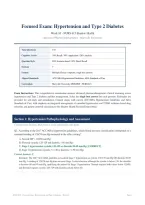
Focused Exam: Hypertension and Type 2 Diabetes
Week 10 - NURS 615 Shadow Health
Advanced Pharmacotherapeutics - Maryville University
Total Questions 110
Cognitive Levels 30% Recall / 50% Application / 20% Analysis
Question Style 80% Scenario-based / 20% Direct Recall
Sections 7
Format Multiple Choice (4 options, single best answer)
Aligned Standards ACC/AHA Hypertension Guidelines, ADA Standards of Care
Curriculum Maryville University MSN/DNP - NURS 615
Exam Instructions: This comprehensive examination assesses advanced pharmacotherapeutics clinical reasoning across
hypertension and Type 2 diabetes mellitus management. Select the single best answer for each question. Rationales are
provided for self-study and remediation. Content aligns with current ACC/AHA Hypertension Guidelines and ADA
Standards of Care, with emphasis on integrated management of comorbid hypertension and T2DM, evidence-based drug
selection, and patient-centered education per the Shadow Health Focused Exam format.
Section 1: Hypertension Pathophysiology and Assessment
Classification, Etiology, Risk Factors, and Complications (Q1-Q16)
Q1: According to the 2017 ACC/AHA hypertension guidelines, which blood pressure classification corresponds to a
sustained reading of 128/78 mm Hg measured in the office setting?
A. Normal (BP < 120/80 mm Hg)
B. Elevated (systolic 120-129 and diastolic < 80 mm Hg)
C. Stage 1 hypertension (systolic 130-139 or diastolic 80-89 mm Hg) [CORRECT]
D. Stage 2 hypertension (systolic >= 140 or diastolic >= 90 mm Hg)
Correct Answer: C
Rationale: The 2017 ACC/AHA guideline reclassified Stage 1 hypertension as systolic 130-139 mm Hg OR diastolic 80-89
mm Hg. A reading of 128/78 mm Hg does not meet Stage 1 criteria because although the systolic is below 130, the diastolic
is between 80 and 89 mm Hg, qualifying the patient for Stage 1 hypertension. Normal requires both values below 120/80,
and Elevated requires systolic 120-129 with diastolic strictly below 80.
NURS 615 - Focused Exam: Hypertension and Type 2 Diabetes - Week 10 Page 1
, Q2: A 54-year-old male presents to the emergency department with a blood pressure of 184/112 mm Hg, severe
headache, and chest pain but no acute target organ damage on initial labs and ECG. Which classification best
describes his presentation?
A. Stage 2 hypertension without complications
B. Hypertensive urgency requiring rapid IV antihypertensive infusion
C. Hypertensive emergency requiring immediate BP reduction to normal
D. Hypertensive urgency managed with oral agents and close follow-up [CORRECT]
Correct Answer: D
Rationale: Hypertensive urgency is defined as BP >= 180/120 mm Hg WITHOUT acute target organ damage, and is
managed with oral agents and close outpatient follow-up rather than rapid IV reduction. A hypertensive emergency requires
evidence of acute target organ damage (encephalopathy, MI, pulmonary edema, AKI, eclampsia, aortic dissection). Rapid
IV reduction in urgency risks cerebral hypoperfusion and is contraindicated. Option C is incorrect because the patient lacks
evidence of end-organ damage.
Q3: In the renin-angiotensin-aldosterone system (RAAS), which physiologic stimulus most directly triggers renin
release from juxtaglomerular cells of the kidney?
A. Increased renal perfusion pressure and increased NaCl delivery to the macula densa
B. Decreased renal perfusion pressure and decreased NaCl delivery to the macula densa [CORRECT]
C. Increased circulating angiotensin II levels via positive feedback
D. Increased sympathetic beta-2 stimulation of afferent arterioles
Correct Answer: B
Rationale: Renin release is stimulated by decreased renal perfusion pressure (sensed by baroreceptors in the afferent
arteriole), decreased NaCl delivery to the macula densa, and increased sympathetic beta-1 stimulation. Options A and C
describe mechanisms that INHIBIT renin release through negative feedback loops. Beta-2 (option D) is incorrect; the
sympathetic stimulus for renin release occurs via beta-1 receptors on juxtaglomerular cells, not beta-2. Understanding this
pathway underpins ACE inhibitor and ARB pharmacology.
Q4: Which best describes the role of the sympathetic nervous system (SNS) in the long-term maintenance of
essential hypertension?
A. SNS activation is solely a transient acute response with no role in chronic BP elevation
B. Chronic SNS overactivity increases cardiac output and vascular resistance, contributing to sustained HTN
and target organ remodeling [CORRECT]
C. SNS activity is downregulated in chronic hypertension as a compensatory mechanism
D. SNS contributes only to salt-sensitive hypertension via alpha-2 receptor desensitization
Correct Answer: B
Rationale: Chronic sympathetic overactivity is now recognized as a key contributor to sustained essential hypertension
through increased cardiac output, enhanced renin release, increased total peripheral resistance, and promotion of vascular
and cardiac remodeling (LVH). This rationale supports beta-blocker use in selected patients (post-MI, HFrEF) and central
alpha-2 agonists in resistant hypertension. Option A is incorrect - SNS contributes to both acute and chronic BP elevation.
The SNS is upregulated, not downregulated, in chronic HTN.
NURS 615 - Focused Exam: Hypertension and Type 2 Diabetes - Week 10 Page 2
, Q5: A 62-year-old female with untreated hypertension for 8 years undergoes echocardiography. Which finding most
directly reflects chronic pressure-overload vascular remodeling and cardiac adaptation?
A. Decreased left ventricular wall thickness with eccentric dilation
B. Concentric left ventricular hypertrophy (LVH) with increased relative wall thickness [CORRECT]
C. Apical ballooning resembling takotsubo cardiomyopathy
D. Right ventricular hypertrophy with normal left ventricular geometry
Correct Answer: B
Rationale: Chronic pressure overload from sustained hypertension produces concentric LVH (increased wall thickness with
preserved cavity size) as the myocardium adapts to reduce wall stress - a predictor of adverse cardiovascular outcomes
including HF, AF, and sudden cardiac death. Eccentric hypertrophy (option A) results from volume overload (e.g.,
regurgitant lesions). Apical ballooning (option C) describes takotsubo, an acute stress cardiomyopathy unrelated to chronic
HTN. RVH (option D) is associated with pulmonary, not systemic, hypertension.
Q6: Which laboratory or physiologic marker best reflects endothelial dysfunction, an early pathophysiologic
hallmark of hypertension?
A. Elevated serum LDL cholesterol
B. Decreased nitric oxide bioavailability with increased asymmetric dimethylarginine (ADMA) [CORRECT]
C. Increased serum creatinine and BUN
D. Increased serum aldosterone-to-renin ratio
Correct Answer: B
Rationale: Endothelial dysfunction in hypertension is characterized by reduced nitric oxide (NO) bioavailability and
elevated ADMA, an endogenous NOS inhibitor. This promotes vasoconstriction, platelet aggregation, and vascular smooth
muscle proliferation. While elevated LDL (A) contributes to atherosclerosis and elevated creatinine (C) reflects renal injury,
neither is a direct marker of endothelial dysfunction. The aldosterone-to-renin ratio (D) is a marker of secondary
hyperaldosteronism, not endothelial dysfunction.
Q7: A Shadow Health patient is being evaluated for hypertension. According to recommended BP measurement
technique, which sequence is correct?
A. Patient supine for 2 minutes, arm above heart level, use first Korotkoff sound only
B. Patient seated quietly for at least 5 minutes with feet flat on floor, arm supported at heart level, average of
>= 2 readings at least 1 minute apart [CORRECT]
C. Patient standing for 1 minute, arm dependent, single reading sufficient if < 140/90
D. Patient seated immediately after walking, arm unsupported, document only the diastolic value
Correct Answer: B
Rationale: Proper technique: seated quietly for >= 5 minutes, feet flat on floor, arm supported at heart level, correct cuff
size, average of >= 2 readings taken at least 1 minute apart. Improper positioning, recent activity, talking, unsupported arm,
and single readings all falsely elevate BP. The 2017 ACC/AHA guideline emphasizes proper technique to avoid
misclassification. First Korotkoff sound (systolic) and fifth sound (disappearance - diastolic) are both documented.
NURS 615 - Focused Exam: Hypertension and Type 2 Diabetes - Week 10 Page 3
, Q8: A 48-year-old male has clinic BP averaging 152/96 mm Hg over 3 visits, but home BP readings are consistently
122-128/76-82 mm Hg. Which next step best aligns with current guidelines?
A. Diagnose stage 2 HTN and start dual antihypertensive therapy
B. Order ambulatory blood pressure monitoring (ABPM) to evaluate for white-coat hypertension
[CORRECT]
C. Reassure the patient and discharge from care without further evaluation
D. Increase cuff size and recheck in 12 months
Correct Answer: B
Rationale: Discrepancy between elevated office BP and normal home BP suggests white-coat hypertension, which is best
confirmed by 24-hour ABPM. The 2017 ACC/AHA guideline recommends ABPM when suspected white-coat effect,
masked HTN, or episodic/medication-resistant HTN. Premature diagnosis and treatment (A) risks overtreatment.
Discharging (C) is unsafe without confirmation. Masked HTN - normal clinic but elevated home readings - carries even
higher CV risk and also warrants ABPM.
Q9: A 38-year-old female with new-onset hypertension (BP 168/102 mm Hg), hypokalemia (3.1 mEq/L) despite no
diuretic use, and abdominal bruit prompts suspicion of secondary hypertension. Which test is the most appropriate
initial evaluation for renovascular hypertension?
A. Urinary free cortisol and overnight dexamethasone suppression
B. Duplex renal artery Doppler ultrasound or CT angiography of renal arteries [CORRECT]
C. 24-hour urine for fractionated metanephrines
D. Serum TSH and free T4
Correct Answer: B
Rationale: Premature-onset HTN, severe/refractory HTN, abdominal bruit, and unexplained hypokalemia suggest
renovascular disease (most commonly atherosclerotic in older adults or fibromuscular dysplasia in young females). Duplex
Doppler or CT angiography is the preferred initial imaging. Option A evaluates Cushing syndrome. Option C evaluates
pheochromocytoma. Option D evaluates thyroid disease. Recognizing patterns of secondary HTN is essential before
initiating multiple antihypertensives unnecessarily.
Q10: A 45-year-old male with resistant hypertension (BP 168/104 on 3 agents), serum potassium 3.2 mEq/L on no
diuretic, and metabolic alkalosis undergoes evaluation. Which laboratory pattern is most consistent with primary
aldosteronism?
A. Elevated plasma aldosterone concentration (PAC), elevated plasma renin activity (PRA), low PAC:PRA ratio
B. Elevated PAC, suppressed PRA, elevated PAC:PRA ratio (> 20-30) [CORRECT]
C. Suppressed PAC, elevated PRA, normal PAC:PRA ratio
D. Normal PAC, normal PRA, undetectable PAC:PRA ratio
Correct Answer: B
Rationale: Primary aldosteronism (Conn syndrome) is characterized by autonomous aldosterone secretion producing sodium
retention, HTN, potassium wasting, and metabolic alkalosis. The hallmark is elevated PAC with suppressed PRA (loss of
negative feedback on renin) and a PAC:PRA ratio > 20-30. Bilateral adrenal hyperplasia and unilateral
aldosterone-producing adenoma are common etiologies. Option A describes secondary hyperaldosteronism. Untreated
primary aldosteronism carries higher cardiovascular risk than essential HTN at the same BP level.
NURS 615 - Focused Exam: Hypertension and Type 2 Diabetes - Week 10 Page 4
Week 10 - NURS 615 Shadow Health
Advanced Pharmacotherapeutics - Maryville University
Total Questions 110
Cognitive Levels 30% Recall / 50% Application / 20% Analysis
Question Style 80% Scenario-based / 20% Direct Recall
Sections 7
Format Multiple Choice (4 options, single best answer)
Aligned Standards ACC/AHA Hypertension Guidelines, ADA Standards of Care
Curriculum Maryville University MSN/DNP - NURS 615
Exam Instructions: This comprehensive examination assesses advanced pharmacotherapeutics clinical reasoning across
hypertension and Type 2 diabetes mellitus management. Select the single best answer for each question. Rationales are
provided for self-study and remediation. Content aligns with current ACC/AHA Hypertension Guidelines and ADA
Standards of Care, with emphasis on integrated management of comorbid hypertension and T2DM, evidence-based drug
selection, and patient-centered education per the Shadow Health Focused Exam format.
Section 1: Hypertension Pathophysiology and Assessment
Classification, Etiology, Risk Factors, and Complications (Q1-Q16)
Q1: According to the 2017 ACC/AHA hypertension guidelines, which blood pressure classification corresponds to a
sustained reading of 128/78 mm Hg measured in the office setting?
A. Normal (BP < 120/80 mm Hg)
B. Elevated (systolic 120-129 and diastolic < 80 mm Hg)
C. Stage 1 hypertension (systolic 130-139 or diastolic 80-89 mm Hg) [CORRECT]
D. Stage 2 hypertension (systolic >= 140 or diastolic >= 90 mm Hg)
Correct Answer: C
Rationale: The 2017 ACC/AHA guideline reclassified Stage 1 hypertension as systolic 130-139 mm Hg OR diastolic 80-89
mm Hg. A reading of 128/78 mm Hg does not meet Stage 1 criteria because although the systolic is below 130, the diastolic
is between 80 and 89 mm Hg, qualifying the patient for Stage 1 hypertension. Normal requires both values below 120/80,
and Elevated requires systolic 120-129 with diastolic strictly below 80.
NURS 615 - Focused Exam: Hypertension and Type 2 Diabetes - Week 10 Page 1
, Q2: A 54-year-old male presents to the emergency department with a blood pressure of 184/112 mm Hg, severe
headache, and chest pain but no acute target organ damage on initial labs and ECG. Which classification best
describes his presentation?
A. Stage 2 hypertension without complications
B. Hypertensive urgency requiring rapid IV antihypertensive infusion
C. Hypertensive emergency requiring immediate BP reduction to normal
D. Hypertensive urgency managed with oral agents and close follow-up [CORRECT]
Correct Answer: D
Rationale: Hypertensive urgency is defined as BP >= 180/120 mm Hg WITHOUT acute target organ damage, and is
managed with oral agents and close outpatient follow-up rather than rapid IV reduction. A hypertensive emergency requires
evidence of acute target organ damage (encephalopathy, MI, pulmonary edema, AKI, eclampsia, aortic dissection). Rapid
IV reduction in urgency risks cerebral hypoperfusion and is contraindicated. Option C is incorrect because the patient lacks
evidence of end-organ damage.
Q3: In the renin-angiotensin-aldosterone system (RAAS), which physiologic stimulus most directly triggers renin
release from juxtaglomerular cells of the kidney?
A. Increased renal perfusion pressure and increased NaCl delivery to the macula densa
B. Decreased renal perfusion pressure and decreased NaCl delivery to the macula densa [CORRECT]
C. Increased circulating angiotensin II levels via positive feedback
D. Increased sympathetic beta-2 stimulation of afferent arterioles
Correct Answer: B
Rationale: Renin release is stimulated by decreased renal perfusion pressure (sensed by baroreceptors in the afferent
arteriole), decreased NaCl delivery to the macula densa, and increased sympathetic beta-1 stimulation. Options A and C
describe mechanisms that INHIBIT renin release through negative feedback loops. Beta-2 (option D) is incorrect; the
sympathetic stimulus for renin release occurs via beta-1 receptors on juxtaglomerular cells, not beta-2. Understanding this
pathway underpins ACE inhibitor and ARB pharmacology.
Q4: Which best describes the role of the sympathetic nervous system (SNS) in the long-term maintenance of
essential hypertension?
A. SNS activation is solely a transient acute response with no role in chronic BP elevation
B. Chronic SNS overactivity increases cardiac output and vascular resistance, contributing to sustained HTN
and target organ remodeling [CORRECT]
C. SNS activity is downregulated in chronic hypertension as a compensatory mechanism
D. SNS contributes only to salt-sensitive hypertension via alpha-2 receptor desensitization
Correct Answer: B
Rationale: Chronic sympathetic overactivity is now recognized as a key contributor to sustained essential hypertension
through increased cardiac output, enhanced renin release, increased total peripheral resistance, and promotion of vascular
and cardiac remodeling (LVH). This rationale supports beta-blocker use in selected patients (post-MI, HFrEF) and central
alpha-2 agonists in resistant hypertension. Option A is incorrect - SNS contributes to both acute and chronic BP elevation.
The SNS is upregulated, not downregulated, in chronic HTN.
NURS 615 - Focused Exam: Hypertension and Type 2 Diabetes - Week 10 Page 2
, Q5: A 62-year-old female with untreated hypertension for 8 years undergoes echocardiography. Which finding most
directly reflects chronic pressure-overload vascular remodeling and cardiac adaptation?
A. Decreased left ventricular wall thickness with eccentric dilation
B. Concentric left ventricular hypertrophy (LVH) with increased relative wall thickness [CORRECT]
C. Apical ballooning resembling takotsubo cardiomyopathy
D. Right ventricular hypertrophy with normal left ventricular geometry
Correct Answer: B
Rationale: Chronic pressure overload from sustained hypertension produces concentric LVH (increased wall thickness with
preserved cavity size) as the myocardium adapts to reduce wall stress - a predictor of adverse cardiovascular outcomes
including HF, AF, and sudden cardiac death. Eccentric hypertrophy (option A) results from volume overload (e.g.,
regurgitant lesions). Apical ballooning (option C) describes takotsubo, an acute stress cardiomyopathy unrelated to chronic
HTN. RVH (option D) is associated with pulmonary, not systemic, hypertension.
Q6: Which laboratory or physiologic marker best reflects endothelial dysfunction, an early pathophysiologic
hallmark of hypertension?
A. Elevated serum LDL cholesterol
B. Decreased nitric oxide bioavailability with increased asymmetric dimethylarginine (ADMA) [CORRECT]
C. Increased serum creatinine and BUN
D. Increased serum aldosterone-to-renin ratio
Correct Answer: B
Rationale: Endothelial dysfunction in hypertension is characterized by reduced nitric oxide (NO) bioavailability and
elevated ADMA, an endogenous NOS inhibitor. This promotes vasoconstriction, platelet aggregation, and vascular smooth
muscle proliferation. While elevated LDL (A) contributes to atherosclerosis and elevated creatinine (C) reflects renal injury,
neither is a direct marker of endothelial dysfunction. The aldosterone-to-renin ratio (D) is a marker of secondary
hyperaldosteronism, not endothelial dysfunction.
Q7: A Shadow Health patient is being evaluated for hypertension. According to recommended BP measurement
technique, which sequence is correct?
A. Patient supine for 2 minutes, arm above heart level, use first Korotkoff sound only
B. Patient seated quietly for at least 5 minutes with feet flat on floor, arm supported at heart level, average of
>= 2 readings at least 1 minute apart [CORRECT]
C. Patient standing for 1 minute, arm dependent, single reading sufficient if < 140/90
D. Patient seated immediately after walking, arm unsupported, document only the diastolic value
Correct Answer: B
Rationale: Proper technique: seated quietly for >= 5 minutes, feet flat on floor, arm supported at heart level, correct cuff
size, average of >= 2 readings taken at least 1 minute apart. Improper positioning, recent activity, talking, unsupported arm,
and single readings all falsely elevate BP. The 2017 ACC/AHA guideline emphasizes proper technique to avoid
misclassification. First Korotkoff sound (systolic) and fifth sound (disappearance - diastolic) are both documented.
NURS 615 - Focused Exam: Hypertension and Type 2 Diabetes - Week 10 Page 3
, Q8: A 48-year-old male has clinic BP averaging 152/96 mm Hg over 3 visits, but home BP readings are consistently
122-128/76-82 mm Hg. Which next step best aligns with current guidelines?
A. Diagnose stage 2 HTN and start dual antihypertensive therapy
B. Order ambulatory blood pressure monitoring (ABPM) to evaluate for white-coat hypertension
[CORRECT]
C. Reassure the patient and discharge from care without further evaluation
D. Increase cuff size and recheck in 12 months
Correct Answer: B
Rationale: Discrepancy between elevated office BP and normal home BP suggests white-coat hypertension, which is best
confirmed by 24-hour ABPM. The 2017 ACC/AHA guideline recommends ABPM when suspected white-coat effect,
masked HTN, or episodic/medication-resistant HTN. Premature diagnosis and treatment (A) risks overtreatment.
Discharging (C) is unsafe without confirmation. Masked HTN - normal clinic but elevated home readings - carries even
higher CV risk and also warrants ABPM.
Q9: A 38-year-old female with new-onset hypertension (BP 168/102 mm Hg), hypokalemia (3.1 mEq/L) despite no
diuretic use, and abdominal bruit prompts suspicion of secondary hypertension. Which test is the most appropriate
initial evaluation for renovascular hypertension?
A. Urinary free cortisol and overnight dexamethasone suppression
B. Duplex renal artery Doppler ultrasound or CT angiography of renal arteries [CORRECT]
C. 24-hour urine for fractionated metanephrines
D. Serum TSH and free T4
Correct Answer: B
Rationale: Premature-onset HTN, severe/refractory HTN, abdominal bruit, and unexplained hypokalemia suggest
renovascular disease (most commonly atherosclerotic in older adults or fibromuscular dysplasia in young females). Duplex
Doppler or CT angiography is the preferred initial imaging. Option A evaluates Cushing syndrome. Option C evaluates
pheochromocytoma. Option D evaluates thyroid disease. Recognizing patterns of secondary HTN is essential before
initiating multiple antihypertensives unnecessarily.
Q10: A 45-year-old male with resistant hypertension (BP 168/104 on 3 agents), serum potassium 3.2 mEq/L on no
diuretic, and metabolic alkalosis undergoes evaluation. Which laboratory pattern is most consistent with primary
aldosteronism?
A. Elevated plasma aldosterone concentration (PAC), elevated plasma renin activity (PRA), low PAC:PRA ratio
B. Elevated PAC, suppressed PRA, elevated PAC:PRA ratio (> 20-30) [CORRECT]
C. Suppressed PAC, elevated PRA, normal PAC:PRA ratio
D. Normal PAC, normal PRA, undetectable PAC:PRA ratio
Correct Answer: B
Rationale: Primary aldosteronism (Conn syndrome) is characterized by autonomous aldosterone secretion producing sodium
retention, HTN, potassium wasting, and metabolic alkalosis. The hallmark is elevated PAC with suppressed PRA (loss of
negative feedback on renin) and a PAC:PRA ratio > 20-30. Bilateral adrenal hyperplasia and unilateral
aldosterone-producing adenoma are common etiologies. Option A describes secondary hyperaldosteronism. Untreated
primary aldosteronism carries higher cardiovascular risk than essential HTN at the same BP level.
NURS 615 - Focused Exam: Hypertension and Type 2 Diabetes - Week 10 Page 4


