
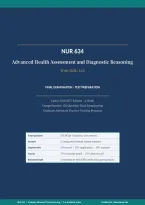
NUR 634
Advanced Health Assessment and Diagnostic Reasoning
With Skills Lab
FINAL EXAMINATION - TEST PREPARATION
Latest 2026/2027 Edition - A Work
Comprehensive 150-Question Final Examination
Graduate Advanced Practice Nursing Program
Total Questions 150 MCQs (4 options, one correct)
Sections 11 integrated clinical system sections
Cognitive Mix 25% recall / 55% application / 20% analysis
Format 75% scenario-based / 25% direct recall
Rationale Depth 2-4 sentences with EBP justification per question
NUR 634 | Graduate Advanced Practice Nursing | Z.ai Academic Series Confidential - Educational Use
,NUR 634 - Advanced Health Assessment and Diagnostic Reasoning - Final Exam Test Prep Latest 2026/2027 - A Work
Final Examination Overview
Purpose: This comprehensive 150-question examination is designed to assess graduate-level
advanced practice nursing competence in advanced health assessment and diagnostic
reasoning. The examination integrates didactic content with skills-lab application, reflecting
current 2026/2027 evidence-based practice standards, advanced clinical reasoning, and the
National Organization of Nurse Practitioner Faculties (NONPF) core competencies. Each
question includes a detailed rationale with assessment technique, diagnostic reasoning, and
evidence-based justification to support remediation and skills mastery.
How to use this document: Attempt all 150 questions across 11 sections. Verify each answer
against the rationale provided. Pay special attention to clinical reasoning questions marked
"What is the MOST likely diagnosis?" and "What is the NEXT best step?" because these test
integration of assessment findings into clinical decision-making. Cognitive level is calibrated
to 25% recall, 55% application, and 20% analysis per the graduate examination blueprint.
Section Title Q Range # Qs
Section 1 Advanced Health Assessment Foundations Q1-Q14 14
Section 2 General Survey, Vital Signs, and Pain Assessment Q15-Q26 12
Section 3 Skin, Hair, Nails, and Lymphatic System Q27-Q40 14
Section 4 Head, Eyes, Ears, Nose, Throat, and Neck Q41-Q56 16
Section 5 Cardiovascular System Q57-Q72 16
Section 6 Respiratory System Q73-Q86 14
Section 7 Abdominal and Gastrointestinal System Q87-Q100 14
Section 8 Musculoskeletal and Neurological Systems Q101-Q120 20
Section 9 Genitourinary, Breast, and Rectal Assessment Q121-Q132 12
Section 10 Diagnostic Reasoning, Differential Diagnosis, and Documentation
Q133-Q144 12
Section 11 Skills Lab Integration and Clinical Application Q145-Q150 6
TOTAL 150
NUR 634 Final Exam Page 2 150 Questions
, Section 1: Advanced Health Assessment Foundations
Comprehensive History, Cultural Competence, & Clinical Reasoning
Q1. A 62-year-old Vietnamese-speaking woman presents with vague abdominal
discomfort. Her adult son accompanies her and immediately offers to translate.
Which action by the advanced practice registered nurse (APRN) BEST demonstrates
culturally competent, ethically sound history-taking?
A. Proceed with the son as interpreter to respect the family hierarchy and avoid delaying
care.
B. Decline the son's offer, obtain a certified medical interpreter, and ask the son to
remain in the waiting room unless the patient requests otherwise. [CORRECT]
C. Use the son as interpreter but verify key symptoms with a telephone language line
afterward.
D. Defer the history until a family elder is present to authorize disclosure of sensitive
symptoms.
Correct Answer: B
Rationale: Certified medical interpreters are required for accurate, unbiased, and confidential
communication; family members may filter, omit, or alter information due to power
dynamics, stigma, or privacy concerns, and their use violates HIPAA-aligned confidentiality
and Joint Commission standards. The APRN should also offer the patient the choice of whether
family remains present. Telephone language lines are an acceptable backup only when an
in-person certified interpreter is unavailable, not as a verification layer for an untrained
relative.
Q2. When eliciting the History of Present Illness (HPI) using the OLDCARTS
framework in a patient with atypical chest pressure, which element is MOST critical
to capture for accurate diagnostic reasoning and triage acuity?
A. Timing — whether the pain occurs only at night
B. Radiation — whether discomfort moves to the right shoulder only
C. Treatment — what over-the-counter antacid the patient tried
D. Onset — sudden versus gradual, and the exact activity at the moment symptoms
began [CORRECT]
Correct Answer: D
Rationale: Onset is the single most predictive element for life-threatening etiologies:
sudden-onset chest pressure suggests acute coronary syndrome, aortic dissection, or
pulmonary embolism, whereas gradual onset is more consistent with stable angina, GERD, or
musculoskeletal causes. The exact activity at onset (e.g., exertion vs. rest) further stratifies
cardiac risk. Timing, radiation, and self-treatment are useful adjuncts but do not carry the
same discriminating weight in triage acuity.
, Q3. An APRN is using the hypothetico-deductive clinical reasoning model to evaluate
a 45-year-old with dyspnea. Which sequence BEST reflects this model?
A. Gather all possible data first, then generate a single diagnosis that explains every
finding.
B. Pattern-match the presentation to a memorized script and discharge the patient if it does
not match.
C. Generate early hypotheses from initial cues, then selectively collect data to confirm
or refute each hypothesis. [CORRECT]
D. Delay hypothesis generation until laboratory and imaging results are returned.
Correct Answer: C
Rationale: Hypothetico-deductive reasoning — the dominant expert model — generates early
hypotheses (illness scripts) from key cues, then tests them through targeted questions and
exams, refining the differential as data accumulate. Gathering exhaustive data before
reasoning (option A) reflects novice behavior and wastes time; pattern recognition (option C) is
appropriate for common, straightforward cases but unsafe for atypical presentations;
deferring reasoning until test results (option D) prolongs diagnostic latency and is unsafe.
Q4. Which statement by a graduate nurse about the difference between a
comprehensive health history and a focused history is MOST accurate?
A. A comprehensive history is required at every encounter, while a focused history is used
only in emergencies.
B. A focused history excludes the past medical history because it is not relevant to the chief
complaint.
C. A comprehensive history omits the review of systems because the ROS duplicates the
HPI.
D. A comprehensive history collects biographic data, CC, HPI, PMH, medications,
family, social, and ROS; a focused history narrows to systems relevant to the CC.
[CORRECT]
Correct Answer: D
Rationale: A comprehensive history is appropriate for new patients, annual wellness, or
complex presentations, and includes all standard components (biographic data, CC, HPI, PMH,
medications/allergies, family, social, and a complete ROS). A focused (problem-oriented)
history is appropriate for follow-up or acute visits and limits PMH and ROS to the system(s)
related to the CC. The PMH and ROS are never wholesale omitted — relevant elements must
still be captured.
Q5. An APRN is assessing a 70-year-old Navajo patient who avoids direct eye contact
and pauses for long periods before answering. The culturally competent
interpretation is that this behavior MOST likely reflects:
A. Cognitive impairment warranting an immediate Mini-Cog screen.
B. Cultural norms of respect, listening, and reflective thinking that should not be
misinterpreted as pathology. [CORRECT]
C. Depression requiring a PHQ-9 and referral to behavioral health.
D. Hearing loss requiring Weber and Rinne testing before continuing.
Advanced Health Assessment and Diagnostic Reasoning
With Skills Lab
FINAL EXAMINATION - TEST PREPARATION
Latest 2026/2027 Edition - A Work
Comprehensive 150-Question Final Examination
Graduate Advanced Practice Nursing Program
Total Questions 150 MCQs (4 options, one correct)
Sections 11 integrated clinical system sections
Cognitive Mix 25% recall / 55% application / 20% analysis
Format 75% scenario-based / 25% direct recall
Rationale Depth 2-4 sentences with EBP justification per question
NUR 634 | Graduate Advanced Practice Nursing | Z.ai Academic Series Confidential - Educational Use
,NUR 634 - Advanced Health Assessment and Diagnostic Reasoning - Final Exam Test Prep Latest 2026/2027 - A Work
Final Examination Overview
Purpose: This comprehensive 150-question examination is designed to assess graduate-level
advanced practice nursing competence in advanced health assessment and diagnostic
reasoning. The examination integrates didactic content with skills-lab application, reflecting
current 2026/2027 evidence-based practice standards, advanced clinical reasoning, and the
National Organization of Nurse Practitioner Faculties (NONPF) core competencies. Each
question includes a detailed rationale with assessment technique, diagnostic reasoning, and
evidence-based justification to support remediation and skills mastery.
How to use this document: Attempt all 150 questions across 11 sections. Verify each answer
against the rationale provided. Pay special attention to clinical reasoning questions marked
"What is the MOST likely diagnosis?" and "What is the NEXT best step?" because these test
integration of assessment findings into clinical decision-making. Cognitive level is calibrated
to 25% recall, 55% application, and 20% analysis per the graduate examination blueprint.
Section Title Q Range # Qs
Section 1 Advanced Health Assessment Foundations Q1-Q14 14
Section 2 General Survey, Vital Signs, and Pain Assessment Q15-Q26 12
Section 3 Skin, Hair, Nails, and Lymphatic System Q27-Q40 14
Section 4 Head, Eyes, Ears, Nose, Throat, and Neck Q41-Q56 16
Section 5 Cardiovascular System Q57-Q72 16
Section 6 Respiratory System Q73-Q86 14
Section 7 Abdominal and Gastrointestinal System Q87-Q100 14
Section 8 Musculoskeletal and Neurological Systems Q101-Q120 20
Section 9 Genitourinary, Breast, and Rectal Assessment Q121-Q132 12
Section 10 Diagnostic Reasoning, Differential Diagnosis, and Documentation
Q133-Q144 12
Section 11 Skills Lab Integration and Clinical Application Q145-Q150 6
TOTAL 150
NUR 634 Final Exam Page 2 150 Questions
, Section 1: Advanced Health Assessment Foundations
Comprehensive History, Cultural Competence, & Clinical Reasoning
Q1. A 62-year-old Vietnamese-speaking woman presents with vague abdominal
discomfort. Her adult son accompanies her and immediately offers to translate.
Which action by the advanced practice registered nurse (APRN) BEST demonstrates
culturally competent, ethically sound history-taking?
A. Proceed with the son as interpreter to respect the family hierarchy and avoid delaying
care.
B. Decline the son's offer, obtain a certified medical interpreter, and ask the son to
remain in the waiting room unless the patient requests otherwise. [CORRECT]
C. Use the son as interpreter but verify key symptoms with a telephone language line
afterward.
D. Defer the history until a family elder is present to authorize disclosure of sensitive
symptoms.
Correct Answer: B
Rationale: Certified medical interpreters are required for accurate, unbiased, and confidential
communication; family members may filter, omit, or alter information due to power
dynamics, stigma, or privacy concerns, and their use violates HIPAA-aligned confidentiality
and Joint Commission standards. The APRN should also offer the patient the choice of whether
family remains present. Telephone language lines are an acceptable backup only when an
in-person certified interpreter is unavailable, not as a verification layer for an untrained
relative.
Q2. When eliciting the History of Present Illness (HPI) using the OLDCARTS
framework in a patient with atypical chest pressure, which element is MOST critical
to capture for accurate diagnostic reasoning and triage acuity?
A. Timing — whether the pain occurs only at night
B. Radiation — whether discomfort moves to the right shoulder only
C. Treatment — what over-the-counter antacid the patient tried
D. Onset — sudden versus gradual, and the exact activity at the moment symptoms
began [CORRECT]
Correct Answer: D
Rationale: Onset is the single most predictive element for life-threatening etiologies:
sudden-onset chest pressure suggests acute coronary syndrome, aortic dissection, or
pulmonary embolism, whereas gradual onset is more consistent with stable angina, GERD, or
musculoskeletal causes. The exact activity at onset (e.g., exertion vs. rest) further stratifies
cardiac risk. Timing, radiation, and self-treatment are useful adjuncts but do not carry the
same discriminating weight in triage acuity.
, Q3. An APRN is using the hypothetico-deductive clinical reasoning model to evaluate
a 45-year-old with dyspnea. Which sequence BEST reflects this model?
A. Gather all possible data first, then generate a single diagnosis that explains every
finding.
B. Pattern-match the presentation to a memorized script and discharge the patient if it does
not match.
C. Generate early hypotheses from initial cues, then selectively collect data to confirm
or refute each hypothesis. [CORRECT]
D. Delay hypothesis generation until laboratory and imaging results are returned.
Correct Answer: C
Rationale: Hypothetico-deductive reasoning — the dominant expert model — generates early
hypotheses (illness scripts) from key cues, then tests them through targeted questions and
exams, refining the differential as data accumulate. Gathering exhaustive data before
reasoning (option A) reflects novice behavior and wastes time; pattern recognition (option C) is
appropriate for common, straightforward cases but unsafe for atypical presentations;
deferring reasoning until test results (option D) prolongs diagnostic latency and is unsafe.
Q4. Which statement by a graduate nurse about the difference between a
comprehensive health history and a focused history is MOST accurate?
A. A comprehensive history is required at every encounter, while a focused history is used
only in emergencies.
B. A focused history excludes the past medical history because it is not relevant to the chief
complaint.
C. A comprehensive history omits the review of systems because the ROS duplicates the
HPI.
D. A comprehensive history collects biographic data, CC, HPI, PMH, medications,
family, social, and ROS; a focused history narrows to systems relevant to the CC.
[CORRECT]
Correct Answer: D
Rationale: A comprehensive history is appropriate for new patients, annual wellness, or
complex presentations, and includes all standard components (biographic data, CC, HPI, PMH,
medications/allergies, family, social, and a complete ROS). A focused (problem-oriented)
history is appropriate for follow-up or acute visits and limits PMH and ROS to the system(s)
related to the CC. The PMH and ROS are never wholesale omitted — relevant elements must
still be captured.
Q5. An APRN is assessing a 70-year-old Navajo patient who avoids direct eye contact
and pauses for long periods before answering. The culturally competent
interpretation is that this behavior MOST likely reflects:
A. Cognitive impairment warranting an immediate Mini-Cog screen.
B. Cultural norms of respect, listening, and reflective thinking that should not be
misinterpreted as pathology. [CORRECT]
C. Depression requiring a PHQ-9 and referral to behavioral health.
D. Hearing loss requiring Weber and Rinne testing before continuing.


