
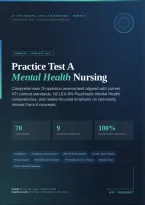
ATI RN MENTAL HEALTH NURSING · FORM A
Latest · Retake & Updated Edition
SUMMARY · COMPLETE Q&A
Practice Test A
Mental Health Nursing
Comprehensive 70-question assessment aligned with current
ATI content standards, NCLEX-RN Psychiatric-Mental Health
competencies, and retake-focused emphasis on commonly
missed Form A concepts.
70 9 100%
QUESTIONS CONTENT DOMAINS R AT I O N A L E S I N C L U D E D
Foundations Therapeutic Communication MSE & Risk Assessment Anxiety / OCD / Trauma
Mood & Suicide Schizophrenia & Psychotic Personality / Somatic / Eating Substance Use
Crisis & Special Populations
Format: 80% Scenario-based · 20% Direct Recall PRACTICE ASSESSMENT
Cognitive Levels: 30% Recall · 50% Application · 20% Analysis AT I · 2 0 2 0 2 7
,ATI RN Mental Health Nursing — Form A Practice Test 2026/2027 70 Questions · Complete Q&A with Rationales
ATI RN Mental Health Nursing — Form A
Practice Test
Latest · Retake & Updated Edition · Complete Questions & Answers
Test Information & Instructions
Total Questions 70 multiple-choice items (4 options, 1 correct)
Sections 9 content domains aligned with ATI RN Mental Health Form A blueprint
Cognitive Levels 30% Recall · 50% Application · 20% Analysis
Item Style 80% Scenario-based · 20% Direct recall of concepts & medications
Format Key Correct option is marked [CORRECT]; rationale follows each item in a tinted box
Strategy Hints ATI test-taking strategies embedded in every rationale (priority, safety, therapeutic
communication, psychopharmacology, legal/ethical)
Retake Emphasis High-yield concepts most frequently missed on ATI Mental Health Form A retakes are
highlighted throughout
Q1–Q8 · Mental Health Concepts · Therapeutic Milieu · Nursing Roles
Section 1: Foundations of Psychiatric-Mental Health Nursing
Q1: A nurse is caring for a client who states, "I'm not sick, I just have a different way of seeing the world."
Which concept of the mental health recovery model is the client demonstrating?
A. Denial of illness requiring confrontation by the nurse
B. Empowerment and self-definition of wellness, central to the recovery model [CORRECT]
C. Cognitive distortion requiring reality reorientation
D. Resistance to treatment requiring firm limit-setting
Correct Answer: B
Rationale: The recovery model emphasizes client empowerment, hope, self-direction, and the client's own definition of
wellness and a meaningful life, rather than a strict medical model of "cure." Confronting or reorienting the client is
non-therapeutic and dismissive. ATI test-taking strategy: look for the option that supports client autonomy and
self-determination.
Retake & Updated Edition · Aligned with current ATI content standards Page 1
, ATI RN Mental Health Nursing — Form A Practice Test 2026/2027 70 Questions · Complete Q&A with Rationales
Q2: Which statement best reflects the principle of a therapeutic milieu?
A. A controlled environment where staff make all decisions to ensure patient safety
B. A structured environment that promotes safety, security, and client growth through community norms
and expectations [CORRECT]
C. A permissive environment that allows clients to act out feelings without limits
D. A medical environment focused primarily on medication administration and physical care
Correct Answer: B
Rationale: A therapeutic milieu is a structured, safe, and supportive environment that uses community norms,
expectations, and activities to promote client growth and stability. The other options describe either overly controlling,
overly permissive, or purely biomedical environments that miss the therapeutic community component. ATI strategy: the
milieu balances safety with therapeutic structure, not extremes.
Q3: A psychiatric-mental health nurse is planning care for a client newly admitted with major depressive
disorder. Which nursing action best reflects the nurse's role in the recovery-oriented model?
A. Deciding the client's daily schedule to ensure participation in all unit activities
B. Collaborating with the client to identify personal goals and meaningful activities [CORRECT]
C. Encouraging the client to defer all decisions to the treatment team until symptoms resolve
D. Focusing interventions exclusively on symptom reduction through medication management
Correct Answer: B
Rationale: Recovery-oriented care is collaborative, client-centered, and goal-focused; the nurse partners with the client
rather than deciding for them. Making all decisions, deferring to the team, or focusing only on medication contradicts
client autonomy and holistic care. ATI strategy: choose the option that includes the client as an active partner.
Q4: During a community meeting on an inpatient psychiatric unit, several clients are arguing about the
television volume. Which action by the nurse best promotes a therapeutic milieu?
A. Setting the volume at a level the nurse deems appropriate for the unit
B. Facilitating a discussion where clients negotiate and agree on a volume level [CORRECT]
C. Turning off the television to prevent further conflict among clients
D. Assigning one client to control the remote for the entire day
Correct Answer: B
Rationale: The milieu uses community meetings to teach negotiation, problem-solving, and respect for norms. Facilitating
client discussion supports autonomy and skill-building; staff-imposed decisions, removal of privileges, or unilateral control
undermine the therapeutic purpose. ATI strategy: select the option that empowers clients to solve problems collaboratively.
Retake & Updated Edition · Aligned with current ATI content standards Page 2
Latest · Retake & Updated Edition
SUMMARY · COMPLETE Q&A
Practice Test A
Mental Health Nursing
Comprehensive 70-question assessment aligned with current
ATI content standards, NCLEX-RN Psychiatric-Mental Health
competencies, and retake-focused emphasis on commonly
missed Form A concepts.
70 9 100%
QUESTIONS CONTENT DOMAINS R AT I O N A L E S I N C L U D E D
Foundations Therapeutic Communication MSE & Risk Assessment Anxiety / OCD / Trauma
Mood & Suicide Schizophrenia & Psychotic Personality / Somatic / Eating Substance Use
Crisis & Special Populations
Format: 80% Scenario-based · 20% Direct Recall PRACTICE ASSESSMENT
Cognitive Levels: 30% Recall · 50% Application · 20% Analysis AT I · 2 0 2 0 2 7
,ATI RN Mental Health Nursing — Form A Practice Test 2026/2027 70 Questions · Complete Q&A with Rationales
ATI RN Mental Health Nursing — Form A
Practice Test
Latest · Retake & Updated Edition · Complete Questions & Answers
Test Information & Instructions
Total Questions 70 multiple-choice items (4 options, 1 correct)
Sections 9 content domains aligned with ATI RN Mental Health Form A blueprint
Cognitive Levels 30% Recall · 50% Application · 20% Analysis
Item Style 80% Scenario-based · 20% Direct recall of concepts & medications
Format Key Correct option is marked [CORRECT]; rationale follows each item in a tinted box
Strategy Hints ATI test-taking strategies embedded in every rationale (priority, safety, therapeutic
communication, psychopharmacology, legal/ethical)
Retake Emphasis High-yield concepts most frequently missed on ATI Mental Health Form A retakes are
highlighted throughout
Q1–Q8 · Mental Health Concepts · Therapeutic Milieu · Nursing Roles
Section 1: Foundations of Psychiatric-Mental Health Nursing
Q1: A nurse is caring for a client who states, "I'm not sick, I just have a different way of seeing the world."
Which concept of the mental health recovery model is the client demonstrating?
A. Denial of illness requiring confrontation by the nurse
B. Empowerment and self-definition of wellness, central to the recovery model [CORRECT]
C. Cognitive distortion requiring reality reorientation
D. Resistance to treatment requiring firm limit-setting
Correct Answer: B
Rationale: The recovery model emphasizes client empowerment, hope, self-direction, and the client's own definition of
wellness and a meaningful life, rather than a strict medical model of "cure." Confronting or reorienting the client is
non-therapeutic and dismissive. ATI test-taking strategy: look for the option that supports client autonomy and
self-determination.
Retake & Updated Edition · Aligned with current ATI content standards Page 1
, ATI RN Mental Health Nursing — Form A Practice Test 2026/2027 70 Questions · Complete Q&A with Rationales
Q2: Which statement best reflects the principle of a therapeutic milieu?
A. A controlled environment where staff make all decisions to ensure patient safety
B. A structured environment that promotes safety, security, and client growth through community norms
and expectations [CORRECT]
C. A permissive environment that allows clients to act out feelings without limits
D. A medical environment focused primarily on medication administration and physical care
Correct Answer: B
Rationale: A therapeutic milieu is a structured, safe, and supportive environment that uses community norms,
expectations, and activities to promote client growth and stability. The other options describe either overly controlling,
overly permissive, or purely biomedical environments that miss the therapeutic community component. ATI strategy: the
milieu balances safety with therapeutic structure, not extremes.
Q3: A psychiatric-mental health nurse is planning care for a client newly admitted with major depressive
disorder. Which nursing action best reflects the nurse's role in the recovery-oriented model?
A. Deciding the client's daily schedule to ensure participation in all unit activities
B. Collaborating with the client to identify personal goals and meaningful activities [CORRECT]
C. Encouraging the client to defer all decisions to the treatment team until symptoms resolve
D. Focusing interventions exclusively on symptom reduction through medication management
Correct Answer: B
Rationale: Recovery-oriented care is collaborative, client-centered, and goal-focused; the nurse partners with the client
rather than deciding for them. Making all decisions, deferring to the team, or focusing only on medication contradicts
client autonomy and holistic care. ATI strategy: choose the option that includes the client as an active partner.
Q4: During a community meeting on an inpatient psychiatric unit, several clients are arguing about the
television volume. Which action by the nurse best promotes a therapeutic milieu?
A. Setting the volume at a level the nurse deems appropriate for the unit
B. Facilitating a discussion where clients negotiate and agree on a volume level [CORRECT]
C. Turning off the television to prevent further conflict among clients
D. Assigning one client to control the remote for the entire day
Correct Answer: B
Rationale: The milieu uses community meetings to teach negotiation, problem-solving, and respect for norms. Facilitating
client discussion supports autonomy and skill-building; staff-imposed decisions, removal of privileges, or unilateral control
undermine the therapeutic purpose. ATI strategy: select the option that empowers clients to solve problems collaboratively.
Retake & Updated Edition · Aligned with current ATI content standards Page 2


