
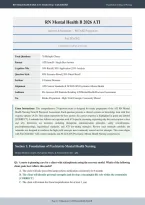
RN Mental Health B 2026 ATI - Retake Prep - Fall 2026/2027 Chamberlain College of Nursing
RN Mental Health B 2026 ATI
Answers & Rationales — RETAKE Preparation
Fall 2026/2027
Chamberlain College of Nursing
Total Questions 70 Multiple Choice
Format ATI Form B - Single Best Answer
Cognitive Mix 30% Recall | 50% Application | 20% Analysis
Question Style 80% Scenario-Based | 20% Direct Recall
Sections 9 Content Domains
Alignment ATI Content Standards & NCLEX-RN Psychiatric-Mental Health
Audience Pre-licensure RN Students Retaking ATI Mental Health Proctored Assessment
Use Retake Preparation - High-Yield Concepts Commonly Missed
Exam Instructions: This comprehensive 70-question exam is designed for retake preparation of the ATI RN Mental
Health Nursing Form B Proctored Assessment. Each question presents a clinical scenario or knowledge item with four
response options (A-D). One option represents the best answer; the correct response is highlighted in green and labeled
[CORRECT]. A rationale box follows each question with ATI-specific reasoning explaining why the correct option is best
and why distractors are incorrect, including therapeutic communication principles, safety considerations,
psychopharmacology, legal/ethical standards, and ATI test-taking strategies. Review each rationale carefully; the
rationales are designed to reinforce the high-yield concepts most commonly missed on first attempts. This exam aligns
with Fall 2026/2027 ATI content standards and NCLEX-RN Psychiatric-Mental Health Nursing competencies.
Section 1: Foundations of Psychiatric-Mental Health Nursing
Mental Health Concepts, Therapeutic Milieu, & Nursing Roles (Q1 - Q8)
Q1: A nurse is planning care for a client with schizophrenia using the recovery model. Which of the following
client goals best reflects this model?
A. The client will take prescribed antipsychotic medication consistently for 6 months
B. The client will identify personal strengths and develop a meaningful life role within the community
[CORRECT]
C. The client will remain free from hospitalization for at least 1 year
Page 1 | 70 Questions | ATI Mental Health Form B
,RN Mental Health B 2026 ATI - Retake Prep - Fall 2026/2027 Chamberlain College of Nursing
D. The client will comply with all prescribed treatment recommendations
Correct Answer: B — The client will identify personal strengths and develop a meaningfu...
Rationale: The recovery model emphasizes client empowerment, hope, identity, and meaningful life roles rather than mere
symptom management or compliance. Option B reflects empowerment, self-determination, and community integration. Options
A, C, and D focus on compliance and absence of illness, which reflect the traditional medical model rather than
recovery-oriented care. ATI test-taking strategy: when the stem mentions 'recovery model,' look for the option emphasizing client
strengths, hope, and meaningful roles.
Q2: Which statement by the nurse best describes the mental health-mental illness continuum?
A. Mental illness is a permanent state that prevents individuals from functioning
B. Mental health and mental illness are opposite ends of a single continuum [CORRECT]
C. Clients either have mental health or mental illness, with no overlap
D. Mental illness begins only when symptoms meet DSM-5 criteria
Correct Answer: B — Mental health and mental illness are opposite ends of a single cont...
Rationale: Mental health and mental illness exist on a single continuum; individuals move along this continuum based on
biopsychosocial factors, stress, coping, and support. Option B accurately reflects this dynamic concept. Options A, C, and D are
rigid and inaccurate. Mental states are fluid, and DSM-5 diagnoses represent points on the continuum rather than fixed categories.
ATI test-taking strategy: the continuum concept always implies movement and integration, not static categories.
Q3: A client with major depressive disorder tells the nurse, 'I'm afraid to tell my employer about my
diagnosis because they'll think I'm dangerous.' The nurse's best response is:
A. 'You should not tell your employer; it's none of their business'
B. 'Mental illness stigma often stems from misunderstanding and lack of education about mental health'
[CORRECT]
C. 'Most employers are very understanding about mental health conditions'
D. 'Your fear is irrational; depression does not make people dangerous'
Correct Answer: B — 'Mental illness stigma often stems from misunderstanding and lack o...
Rationale: Option B acknowledges the client's concern while providing accurate psychoeducation about stigma rooted in
misunderstanding. The therapeutic response validates the client's experience and opens discussion. Option A gives advice and
removes client autonomy; Option C is false reassurance; Option D dismisses the client's feelings as 'irrational,' a non-therapeutic
technique. ATI test-taking strategy: choose the response that validates the client's feelings and provides accurate information
without giving advice or false reassurance.
Q4: Which action by the nurse best promotes a therapeutic milieu on an inpatient psychiatric unit?
A. Allowing clients to set their own schedules to encourage autonomy
B. Enforcing consistent unit rules, structure, and norms for all clients [CORRECT]
C. Minimizing staff interaction to encourage client independence
D. Discouraging client interaction to prevent conflict
Correct Answer: B — Enforcing consistent unit rules, structure, and norms for all clients
Page 2 | 70 Questions | ATI Mental Health Form B
, RN Mental Health B 2026 ATI - Retake Prep - Fall 2026/2027 Chamberlain College of Nursing
Rationale: A therapeutic milieu requires structure, safety, consistency, and predictable norms that promote adaptive behavior
and recovery. Option B reflects these core elements. Option A removes needed structure; Options C and D eliminate the
therapeutic community and interpersonal learning that milieu provides. ATI test-taking strategy: milieu questions always
emphasize safety, structure, norms, and community interaction.
Q5: During a community meeting on an inpatient unit, a client becomes verbally aggressive toward another
client. The nurse's best action is to:
A. Immediately escort the aggressive client to seclusion
B. Set limits on the behavior and remind the group of meeting norms [CORRECT]
C. Ask the aggressive client to leave the meeting without processing the event
D. Ignore the behavior to allow clients to resolve conflicts independently
Correct Answer: B — Set limits on the behavior and remind the group of meeting norms
Rationale: Setting limits and redirecting to established norms maintains safety while preserving the therapeutic value of the
community meeting. Option A is an overreaction violating the least-restrictive principle; Option C removes the learning
opportunity; Option D endangers other clients. ATI test-taking strategy: choose least-restrictive interventions that maintain safety
while preserving the therapeutic community.
Q6: A registered nurse (RN) on an inpatient psychiatric unit is caring for four clients. Which client should the
RN assign to the licensed practical nurse (LPN)?
A. A client with acute mania requiring constant one-to-one observation
B. A client with stable schizophrenia receiving routine antipsychotic therapy [CORRECT]
C. A client with new-onset suicidal ideation requiring risk assessment
D. A client experiencing command hallucinations to harm self
Correct Answer: B — A client with stable schizophrenia receiving routine antipsychotic ...
Rationale: The LPN can care for stable clients with predictable outcomes and established care plans; Option B fits these criteria.
Options A, C, and D involve complex assessment, unstable conditions, or high-risk presentations requiring RN scope of practice.
ATI test-taking strategy: delegate stable, predictable, low-risk clients to LPNs; reserve assessment, unstable clients, and teaching
for the RN.
Q7: A client with bipolar disorder is being involuntarily admitted to a psychiatric unit. Which client right
must the nurse protect?
A. The right to refuse all medications regardless of competency
B. The right to receive treatment in the least restrictive environment [CORRECT]
C. The right to immediate discharge upon request
D. The right to choose assigned nursing staff
Correct Answer: B — The right to receive treatment in the least restrictive environment
Rationale: Involuntarily admitted clients retain the right to least-restrictive treatment and the least intrusive interventions that
ensure safety. Option B reflects this principle. Option A is incorrect because medication can be administered involuntarily under
specific legal criteria in emergencies. Options C and D are not established client rights. ATI test-taking strategy: least-restrictive
environment is a core legal/ethical principle tested frequently.
Page 3 | 70 Questions | ATI Mental Health Form B
RN Mental Health B 2026 ATI
Answers & Rationales — RETAKE Preparation
Fall 2026/2027
Chamberlain College of Nursing
Total Questions 70 Multiple Choice
Format ATI Form B - Single Best Answer
Cognitive Mix 30% Recall | 50% Application | 20% Analysis
Question Style 80% Scenario-Based | 20% Direct Recall
Sections 9 Content Domains
Alignment ATI Content Standards & NCLEX-RN Psychiatric-Mental Health
Audience Pre-licensure RN Students Retaking ATI Mental Health Proctored Assessment
Use Retake Preparation - High-Yield Concepts Commonly Missed
Exam Instructions: This comprehensive 70-question exam is designed for retake preparation of the ATI RN Mental
Health Nursing Form B Proctored Assessment. Each question presents a clinical scenario or knowledge item with four
response options (A-D). One option represents the best answer; the correct response is highlighted in green and labeled
[CORRECT]. A rationale box follows each question with ATI-specific reasoning explaining why the correct option is best
and why distractors are incorrect, including therapeutic communication principles, safety considerations,
psychopharmacology, legal/ethical standards, and ATI test-taking strategies. Review each rationale carefully; the
rationales are designed to reinforce the high-yield concepts most commonly missed on first attempts. This exam aligns
with Fall 2026/2027 ATI content standards and NCLEX-RN Psychiatric-Mental Health Nursing competencies.
Section 1: Foundations of Psychiatric-Mental Health Nursing
Mental Health Concepts, Therapeutic Milieu, & Nursing Roles (Q1 - Q8)
Q1: A nurse is planning care for a client with schizophrenia using the recovery model. Which of the following
client goals best reflects this model?
A. The client will take prescribed antipsychotic medication consistently for 6 months
B. The client will identify personal strengths and develop a meaningful life role within the community
[CORRECT]
C. The client will remain free from hospitalization for at least 1 year
Page 1 | 70 Questions | ATI Mental Health Form B
,RN Mental Health B 2026 ATI - Retake Prep - Fall 2026/2027 Chamberlain College of Nursing
D. The client will comply with all prescribed treatment recommendations
Correct Answer: B — The client will identify personal strengths and develop a meaningfu...
Rationale: The recovery model emphasizes client empowerment, hope, identity, and meaningful life roles rather than mere
symptom management or compliance. Option B reflects empowerment, self-determination, and community integration. Options
A, C, and D focus on compliance and absence of illness, which reflect the traditional medical model rather than
recovery-oriented care. ATI test-taking strategy: when the stem mentions 'recovery model,' look for the option emphasizing client
strengths, hope, and meaningful roles.
Q2: Which statement by the nurse best describes the mental health-mental illness continuum?
A. Mental illness is a permanent state that prevents individuals from functioning
B. Mental health and mental illness are opposite ends of a single continuum [CORRECT]
C. Clients either have mental health or mental illness, with no overlap
D. Mental illness begins only when symptoms meet DSM-5 criteria
Correct Answer: B — Mental health and mental illness are opposite ends of a single cont...
Rationale: Mental health and mental illness exist on a single continuum; individuals move along this continuum based on
biopsychosocial factors, stress, coping, and support. Option B accurately reflects this dynamic concept. Options A, C, and D are
rigid and inaccurate. Mental states are fluid, and DSM-5 diagnoses represent points on the continuum rather than fixed categories.
ATI test-taking strategy: the continuum concept always implies movement and integration, not static categories.
Q3: A client with major depressive disorder tells the nurse, 'I'm afraid to tell my employer about my
diagnosis because they'll think I'm dangerous.' The nurse's best response is:
A. 'You should not tell your employer; it's none of their business'
B. 'Mental illness stigma often stems from misunderstanding and lack of education about mental health'
[CORRECT]
C. 'Most employers are very understanding about mental health conditions'
D. 'Your fear is irrational; depression does not make people dangerous'
Correct Answer: B — 'Mental illness stigma often stems from misunderstanding and lack o...
Rationale: Option B acknowledges the client's concern while providing accurate psychoeducation about stigma rooted in
misunderstanding. The therapeutic response validates the client's experience and opens discussion. Option A gives advice and
removes client autonomy; Option C is false reassurance; Option D dismisses the client's feelings as 'irrational,' a non-therapeutic
technique. ATI test-taking strategy: choose the response that validates the client's feelings and provides accurate information
without giving advice or false reassurance.
Q4: Which action by the nurse best promotes a therapeutic milieu on an inpatient psychiatric unit?
A. Allowing clients to set their own schedules to encourage autonomy
B. Enforcing consistent unit rules, structure, and norms for all clients [CORRECT]
C. Minimizing staff interaction to encourage client independence
D. Discouraging client interaction to prevent conflict
Correct Answer: B — Enforcing consistent unit rules, structure, and norms for all clients
Page 2 | 70 Questions | ATI Mental Health Form B
, RN Mental Health B 2026 ATI - Retake Prep - Fall 2026/2027 Chamberlain College of Nursing
Rationale: A therapeutic milieu requires structure, safety, consistency, and predictable norms that promote adaptive behavior
and recovery. Option B reflects these core elements. Option A removes needed structure; Options C and D eliminate the
therapeutic community and interpersonal learning that milieu provides. ATI test-taking strategy: milieu questions always
emphasize safety, structure, norms, and community interaction.
Q5: During a community meeting on an inpatient unit, a client becomes verbally aggressive toward another
client. The nurse's best action is to:
A. Immediately escort the aggressive client to seclusion
B. Set limits on the behavior and remind the group of meeting norms [CORRECT]
C. Ask the aggressive client to leave the meeting without processing the event
D. Ignore the behavior to allow clients to resolve conflicts independently
Correct Answer: B — Set limits on the behavior and remind the group of meeting norms
Rationale: Setting limits and redirecting to established norms maintains safety while preserving the therapeutic value of the
community meeting. Option A is an overreaction violating the least-restrictive principle; Option C removes the learning
opportunity; Option D endangers other clients. ATI test-taking strategy: choose least-restrictive interventions that maintain safety
while preserving the therapeutic community.
Q6: A registered nurse (RN) on an inpatient psychiatric unit is caring for four clients. Which client should the
RN assign to the licensed practical nurse (LPN)?
A. A client with acute mania requiring constant one-to-one observation
B. A client with stable schizophrenia receiving routine antipsychotic therapy [CORRECT]
C. A client with new-onset suicidal ideation requiring risk assessment
D. A client experiencing command hallucinations to harm self
Correct Answer: B — A client with stable schizophrenia receiving routine antipsychotic ...
Rationale: The LPN can care for stable clients with predictable outcomes and established care plans; Option B fits these criteria.
Options A, C, and D involve complex assessment, unstable conditions, or high-risk presentations requiring RN scope of practice.
ATI test-taking strategy: delegate stable, predictable, low-risk clients to LPNs; reserve assessment, unstable clients, and teaching
for the RN.
Q7: A client with bipolar disorder is being involuntarily admitted to a psychiatric unit. Which client right
must the nurse protect?
A. The right to refuse all medications regardless of competency
B. The right to receive treatment in the least restrictive environment [CORRECT]
C. The right to immediate discharge upon request
D. The right to choose assigned nursing staff
Correct Answer: B — The right to receive treatment in the least restrictive environment
Rationale: Involuntarily admitted clients retain the right to least-restrictive treatment and the least intrusive interventions that
ensure safety. Option B reflects this principle. Option A is incorrect because medication can be administered involuntarily under
specific legal criteria in emergencies. Options C and D are not established client rights. ATI test-taking strategy: least-restrictive
environment is a core legal/ethical principle tested frequently.
Page 3 | 70 Questions | ATI Mental Health Form B


