
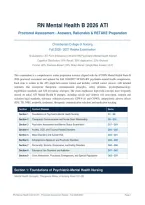
RN Mental Health B 2026 ATI
Proctored Assessment - Answers, Rationales & RETAKE Preparation
Chamberlain College of Nursing
Fall Retake Examination
70 Questions | ATI Form B Structure | NCLEX-RN Psychiatric-Mental Health Aligned
Cognitive Distribution: 30% Recall | 50% Application | 20% Analysis
Format: 80% Scenario-Based | 20% Direct Recall | Single Best Answer (A-D)
This examination is a comprehensive retake preparation resource aligned with the ATI RN Mental Health Form B
2026 proctored assessment and updated for Fall 2026/2027 NCLEX-RN psychiatric-mental health competencies.
Each item is written in the ATI single-best-answer format and includes verified correct answers with detailed
rationales that incorporate therapeutic communication principles, safety priorities, psychopharmacology,
legal/ethical standards, and ATI test-taking strategies. The exam emphasizes high-yield concepts most frequently
missed on initial ATI Mental Health B attempts, including suicide and violence risk assessment, restraint and
seclusion legal standards, substance withdrawal protocols (CIWA-Ar and COWS), antipsychotic adverse effects
(EPS, TD, NMS, metabolic syndrome), therapeutic communication selection, and medication teaching.
Section Content Domain Items
Section 1 Foundations of Psychiatric-Mental Health Nursing Q1 - Q8
Section 2 Therapeutic Communication and Nurse-Client Relationship Q9 - Q16
Section 3 Psychiatric Assessment and Mental Status Examination Q17 - Q24
Section 4 Anxiety, OCD, and Trauma-Related Disorders Q25 - Q32
Section 5 Mood Disorders and Suicide Risk Q33 - Q41
Section 6 Schizophrenia Spectrum and Psychotic Disorders Q42 - Q49
Section 7 Personality, Somatic, Dissociative, and Eating Disorders Q50 - Q56
Section 8 Substance Use Disorders and Addiction Q57 - Q62
Section 9 Crisis Intervention, Psychiatric Emergencies, and Special Populations Q63 - Q70
Section 1: Foundations of Psychiatric-Mental Health Nursing
Mental Health Concepts, Therapeutic Milieu, & Nursing Roles (Q1-Q8)
RN Mental Health B 2016 ATI - Proctored Assessment Retake - Fall 2026/2027 Page 1
, Q1: A nursing student is preparing a community education presentation on the mental health
continuum. Which statement best reflects the recovery model of mental health that the student
should emphasize?
A. Recovery is defined as the complete absence of psychiatric symptoms and return to premorbid
functioning.
B. Recovery is a personal journey of healing and self-directed growth, even when symptoms
persist. [CORRECT]
C. Recovery requires full adherence to prescribed psychotropic medication to be considered
successful.
D. Recovery occurs only when the client is able to return to full-time competitive employment.
Correct Answer: B
Rationale: The SAMHSA recovery model defines recovery as a process of change through which individuals improve
health and wellness, live self-directed lives, and strive to reach their full potential-even in the presence of a chronic
mental illness. A is incorrect because symptom elimination is not required for recovery; the model embraces hope and
growth despite persistent illness. C and D reflect outdated cure-oriented frameworks and exclude many clients who
recover meaningfully without employment or full medication adherence. ATI test-taking strategy: focus on the
client-centered, strengths-based language ("personal journey," "self-directed") that aligns with current
psychiatric-mental health nursing standards.
Q2: A client with schizophrenia tells the nurse, "I do not want to attend the unit community
meeting because people in the lobby stare at me and think I am crazy." Which nursing action best
addresses stigma within the therapeutic milieu?
A. Reassure the client that no one is staring and that the meeting is mandatory for everyone.
B. Allow the client to skip the meeting indefinitely to avoid escalating anxiety.
C. Explore the client's feelings, validate the impact of stigma, and gradually encourage
participation using a structured support approach. [CORRECT]
D. Confront the other clients at the meeting about their behavior toward the client.
Correct Answer: C
Rationale: Stigma is a major barrier to recovery and must be addressed therapeutically by exploring the client's
perception, validating the impact, and using graduated exposure and structured support to promote participation. A is
non-therapeutic false reassurance and dismisses the client's experience. B avoids the problem and reinforces isolation,
undermining milieu therapy goals. D is confrontational and breaches therapeutic boundaries with other clients. ATI
strategy: identify the option that combines validation, empowerment, and gradual re-engagement with the therapeutic
community.
RN Mental Health B 2016 ATI - Proctored Assessment Retake - Fall 2026/2027 Page 2
, Q3: Which element is the foundational priority when establishing a therapeutic milieu on an
inpatient psychiatric unit?
A. Aesthetically pleasing decor to promote client comfort and relaxation.
B. A predictable daily schedule with structured groups and activities.
C. Physical and psychological safety for clients, staff, and visitors. [CORRECT]
D. A large communal dining area to encourage social interaction at meals.
Correct Answer: C
Rationale: Safety is the cornerstone of any therapeutic milieu; without physical and psychological safety, no other
milieu element (structure, norms, community, containment) can be effective. According to Maslow's hierarchy and ATI
priority-setting frameworks, safety and security must be established before higher-level needs such as belonging,
esteem, or self-actualization. A, B, and D are important milieu components but are secondary to and dependent on a
safe environment. ATI strategy: when "safety" appears as an option in milieu questions, it is almost always the priority
answer.
Q4: A newly admitted client repeatedly interrupts other clients during the daily community
meeting. Which intervention by the nurse best reflects the use of milieu norms?
A. Immediately escort the client out of the meeting and document the behavior in the chart.
B. Calmly remind the client of the unit norm that each person speaks one at a time without
interruption, and reinforce the expectation. [CORRECT]
C. Ignore the behavior so the client does not feel singled out in front of peers.
D. Tell the client they will lose unit privileges if they cannot behave appropriately.
Correct Answer: B
Rationale: Milieu norms are shared expectations established collaboratively with clients at community meetings; the
nurse reinforces them consistently and respectfully. B uses the established norm ("one person speaks at a time") as a
therapeutic teaching tool rather than as punishment. A is exclusionary and removes the client from a therapeutic
opportunity. C ignores the behavior and undermines norm consistency. D uses threats and violates the principle that
norms are reinforced, not used punitively. ATI strategy: look for the option that combines limit-setting with teaching
and consistency.
RN Mental Health B 2016 ATI - Proctored Assessment Retake - Fall 2026/2027 Page 3
, Q5: A psychiatric-mental health RN is planning care for four clients. Which task is most
appropriate to delegate to a licensed practical nurse (LPN) under the RN's supervision?
A. Conducting the initial comprehensive psychiatric assessment of a newly admitted client.
B. Developing the nursing plan of care for a client with new-onset suicidal ideation.
C. Administering scheduled oral psychotropic medications and observing the client afterward.
[CORRECT]
D. Providing psychoeducation to family members about a client's recent diagnosis of schizophrenia.
Correct Answer: C
Rationale: Within the RN scope of practice and the five rights of delegation, the RN may delegate routine, predictable,
low-complexity tasks such as administration of scheduled oral medications with post-administration observation to a
competent LPN. A, B, and D require RN-level synthesis, clinical judgment, initial assessment, care planning, and
complex psychoeducation, which are outside the LPN scope per state nurse practice acts and ATI delegation guidelines.
ATI strategy: identify the task that is stable, routine, and uses standard procedures with predictable outcomes.
Q6: A nurse is caring for a client who has just been involuntarily admitted under an emergency
psychiatric hold. Which action by the nurse best protects the client's legal rights?
A. Withhold all information about the admission process to avoid agitating the client.
B. Inform the client of the reason for the hold, the expected duration, and the right to legal
representation and appeal. [CORRECT]
C. Tell the client they have no rights because the admission is involuntary.
D. Allow the client to leave the unit whenever they choose to demonstrate respect for autonomy.
Correct Answer: B
Rationale: Involuntarily admitted clients retain all rights except those specifically restricted by court order; the nurse
must inform the client of the reason for hold, length of hold (varies by state statute), and rights to legal counsel and a
hearing. A and C are incorrect because withholding information or stating the client has no rights violates informed
consent and due process. D ignores the legal authority of the involuntary hold and creates a safety risk. ATI strategy: in
legal/ethical questions, the option that respects the least restrictive environment while preserving safety and due process
is the priority.
RN Mental Health B 2016 ATI - Proctored Assessment Retake - Fall 2026/2027 Page 4
Proctored Assessment - Answers, Rationales & RETAKE Preparation
Chamberlain College of Nursing
Fall Retake Examination
70 Questions | ATI Form B Structure | NCLEX-RN Psychiatric-Mental Health Aligned
Cognitive Distribution: 30% Recall | 50% Application | 20% Analysis
Format: 80% Scenario-Based | 20% Direct Recall | Single Best Answer (A-D)
This examination is a comprehensive retake preparation resource aligned with the ATI RN Mental Health Form B
2026 proctored assessment and updated for Fall 2026/2027 NCLEX-RN psychiatric-mental health competencies.
Each item is written in the ATI single-best-answer format and includes verified correct answers with detailed
rationales that incorporate therapeutic communication principles, safety priorities, psychopharmacology,
legal/ethical standards, and ATI test-taking strategies. The exam emphasizes high-yield concepts most frequently
missed on initial ATI Mental Health B attempts, including suicide and violence risk assessment, restraint and
seclusion legal standards, substance withdrawal protocols (CIWA-Ar and COWS), antipsychotic adverse effects
(EPS, TD, NMS, metabolic syndrome), therapeutic communication selection, and medication teaching.
Section Content Domain Items
Section 1 Foundations of Psychiatric-Mental Health Nursing Q1 - Q8
Section 2 Therapeutic Communication and Nurse-Client Relationship Q9 - Q16
Section 3 Psychiatric Assessment and Mental Status Examination Q17 - Q24
Section 4 Anxiety, OCD, and Trauma-Related Disorders Q25 - Q32
Section 5 Mood Disorders and Suicide Risk Q33 - Q41
Section 6 Schizophrenia Spectrum and Psychotic Disorders Q42 - Q49
Section 7 Personality, Somatic, Dissociative, and Eating Disorders Q50 - Q56
Section 8 Substance Use Disorders and Addiction Q57 - Q62
Section 9 Crisis Intervention, Psychiatric Emergencies, and Special Populations Q63 - Q70
Section 1: Foundations of Psychiatric-Mental Health Nursing
Mental Health Concepts, Therapeutic Milieu, & Nursing Roles (Q1-Q8)
RN Mental Health B 2016 ATI - Proctored Assessment Retake - Fall 2026/2027 Page 1
, Q1: A nursing student is preparing a community education presentation on the mental health
continuum. Which statement best reflects the recovery model of mental health that the student
should emphasize?
A. Recovery is defined as the complete absence of psychiatric symptoms and return to premorbid
functioning.
B. Recovery is a personal journey of healing and self-directed growth, even when symptoms
persist. [CORRECT]
C. Recovery requires full adherence to prescribed psychotropic medication to be considered
successful.
D. Recovery occurs only when the client is able to return to full-time competitive employment.
Correct Answer: B
Rationale: The SAMHSA recovery model defines recovery as a process of change through which individuals improve
health and wellness, live self-directed lives, and strive to reach their full potential-even in the presence of a chronic
mental illness. A is incorrect because symptom elimination is not required for recovery; the model embraces hope and
growth despite persistent illness. C and D reflect outdated cure-oriented frameworks and exclude many clients who
recover meaningfully without employment or full medication adherence. ATI test-taking strategy: focus on the
client-centered, strengths-based language ("personal journey," "self-directed") that aligns with current
psychiatric-mental health nursing standards.
Q2: A client with schizophrenia tells the nurse, "I do not want to attend the unit community
meeting because people in the lobby stare at me and think I am crazy." Which nursing action best
addresses stigma within the therapeutic milieu?
A. Reassure the client that no one is staring and that the meeting is mandatory for everyone.
B. Allow the client to skip the meeting indefinitely to avoid escalating anxiety.
C. Explore the client's feelings, validate the impact of stigma, and gradually encourage
participation using a structured support approach. [CORRECT]
D. Confront the other clients at the meeting about their behavior toward the client.
Correct Answer: C
Rationale: Stigma is a major barrier to recovery and must be addressed therapeutically by exploring the client's
perception, validating the impact, and using graduated exposure and structured support to promote participation. A is
non-therapeutic false reassurance and dismisses the client's experience. B avoids the problem and reinforces isolation,
undermining milieu therapy goals. D is confrontational and breaches therapeutic boundaries with other clients. ATI
strategy: identify the option that combines validation, empowerment, and gradual re-engagement with the therapeutic
community.
RN Mental Health B 2016 ATI - Proctored Assessment Retake - Fall 2026/2027 Page 2
, Q3: Which element is the foundational priority when establishing a therapeutic milieu on an
inpatient psychiatric unit?
A. Aesthetically pleasing decor to promote client comfort and relaxation.
B. A predictable daily schedule with structured groups and activities.
C. Physical and psychological safety for clients, staff, and visitors. [CORRECT]
D. A large communal dining area to encourage social interaction at meals.
Correct Answer: C
Rationale: Safety is the cornerstone of any therapeutic milieu; without physical and psychological safety, no other
milieu element (structure, norms, community, containment) can be effective. According to Maslow's hierarchy and ATI
priority-setting frameworks, safety and security must be established before higher-level needs such as belonging,
esteem, or self-actualization. A, B, and D are important milieu components but are secondary to and dependent on a
safe environment. ATI strategy: when "safety" appears as an option in milieu questions, it is almost always the priority
answer.
Q4: A newly admitted client repeatedly interrupts other clients during the daily community
meeting. Which intervention by the nurse best reflects the use of milieu norms?
A. Immediately escort the client out of the meeting and document the behavior in the chart.
B. Calmly remind the client of the unit norm that each person speaks one at a time without
interruption, and reinforce the expectation. [CORRECT]
C. Ignore the behavior so the client does not feel singled out in front of peers.
D. Tell the client they will lose unit privileges if they cannot behave appropriately.
Correct Answer: B
Rationale: Milieu norms are shared expectations established collaboratively with clients at community meetings; the
nurse reinforces them consistently and respectfully. B uses the established norm ("one person speaks at a time") as a
therapeutic teaching tool rather than as punishment. A is exclusionary and removes the client from a therapeutic
opportunity. C ignores the behavior and undermines norm consistency. D uses threats and violates the principle that
norms are reinforced, not used punitively. ATI strategy: look for the option that combines limit-setting with teaching
and consistency.
RN Mental Health B 2016 ATI - Proctored Assessment Retake - Fall 2026/2027 Page 3
, Q5: A psychiatric-mental health RN is planning care for four clients. Which task is most
appropriate to delegate to a licensed practical nurse (LPN) under the RN's supervision?
A. Conducting the initial comprehensive psychiatric assessment of a newly admitted client.
B. Developing the nursing plan of care for a client with new-onset suicidal ideation.
C. Administering scheduled oral psychotropic medications and observing the client afterward.
[CORRECT]
D. Providing psychoeducation to family members about a client's recent diagnosis of schizophrenia.
Correct Answer: C
Rationale: Within the RN scope of practice and the five rights of delegation, the RN may delegate routine, predictable,
low-complexity tasks such as administration of scheduled oral medications with post-administration observation to a
competent LPN. A, B, and D require RN-level synthesis, clinical judgment, initial assessment, care planning, and
complex psychoeducation, which are outside the LPN scope per state nurse practice acts and ATI delegation guidelines.
ATI strategy: identify the task that is stable, routine, and uses standard procedures with predictable outcomes.
Q6: A nurse is caring for a client who has just been involuntarily admitted under an emergency
psychiatric hold. Which action by the nurse best protects the client's legal rights?
A. Withhold all information about the admission process to avoid agitating the client.
B. Inform the client of the reason for the hold, the expected duration, and the right to legal
representation and appeal. [CORRECT]
C. Tell the client they have no rights because the admission is involuntary.
D. Allow the client to leave the unit whenever they choose to demonstrate respect for autonomy.
Correct Answer: B
Rationale: Involuntarily admitted clients retain all rights except those specifically restricted by court order; the nurse
must inform the client of the reason for hold, length of hold (varies by state statute), and rights to legal counsel and a
hearing. A and C are incorrect because withholding information or stating the client has no rights violates informed
consent and due process. D ignores the legal authority of the involuntary hold and creates a safety risk. ATI strategy: in
legal/ethical questions, the option that respects the least restrictive environment while preserving safety and due process
is the priority.
RN Mental Health B 2016 ATI - Proctored Assessment Retake - Fall 2026/2027 Page 4


