
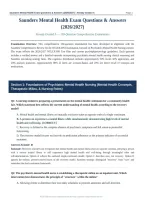
Saunders Mental Health Exam Questions & Answers (2026/2027) - Already Graded A Page 1
Saunders Mental Health Exam Questions & Answers
(2026/2027)
Already Graded A — 150-Question Comprehensive Examination
Examination Overview: This comprehensive 150-question examination has been developed in alignment with the
Saunders Comprehensive Review for the NCLEX-RN Examination, focused on Psychiatric-Mental Health Nursing content.
The exam reflects the 2026/2027 NCLEX-RN Test Plan and current psychopharmacology guidelines. Each question
includes a verified answer and a detailed rationale incorporating psychiatric-mental health nursing clinical reasoning and
Saunders test-taking strategy hints. The cognitive distribution includes approximately 30% recall, 50% application, and
20% analysis questions. Approximately 80% of items are scenario-based, and 20% are direct recall of concepts and
medications.
Section 1: Foundations of Psychiatric-Mental Health Nursing (Mental Health Concepts,
Therapeutic Milieu, & Nursing Roles)
Q1: A nursing student is preparing a presentation on the mental health continuum for a community health
fair. Which statement best reflects the current understanding of mental health according to the recovery
model?
A. Mental health and mental illness are mutually exclusive states at opposite ends of a single continuum.
B. A person can experience a mental illness while simultaneously demonstrating high levels of mental
health and well-being. [CORRECT]
C. Recovery is defined as the complete absence of psychiatric symptoms and full return to premorbid
functioning.
D. The recovery model focuses exclusively on medication adherence as the primary indicator of successful
treatment.
Correct Answer: B
Rationale: Recovery-oriented care recognizes that mental health and mental illness exist on separate continua, allowing a person
with a serious mental illness to still experience high mental health and well-being through meaningful roles and
self-determination. Option A reflects the outdated single-continuum model. Option C describes cure, not recovery. Option D
ignores the holistic, person-centered focus of the recovery model. Saunders strategy: distinguish "recovery" from "cure" and
remember the dual-continuum framework.
Q2: The psychiatric-mental health nurse is establishing a therapeutic milieu on an inpatient unit. Which
intervention best demonstrates the principle of "structure" within the milieu?
A. Allowing clients to determine their own daily schedules to promote autonomy and self-direction.
NCLEX-RN Psychiatric-Mental Health Nursing | Saunders Comprehensive Review
,Saunders Mental Health Exam Questions & Answers (2026/2027) - Already Graded A Page 2
B. Posting a daily schedule of structured activities, meal times, and group therapy sessions that clients are
expected to attend. [CORRECT]
C. Permitting clients to choose whether or not they wish to participate in any scheduled unit activities.
D. Allowing the unit environment to evolve organically based on the changing preferences of the current client
group.
Correct Answer: B
Rationale: Structure in a therapeutic milieu involves a predictable, organized daily schedule that provides containment, support,
and validation through consistent routines. Posting and adhering to a daily schedule of activities, meals, and groups is the clearest
demonstration of structure. Options A, C, and D lack the consistency and boundaries clients with psychiatric illness need for
stabilization. Saunders strategy: "structure" equals predictable routine, not unlimited autonomy.
Q3: A newly licensed nurse asks the charge nurse about the primary goal of community meetings held on the
psychiatric unit. Which response by the charge nurse is most accurate?
A. "Community meetings are primarily designed to allow staff to monitor clients for delusional content and
disorganized thinking."
B. "Community meetings provide a forum for clients to discuss unit issues, practice interpersonal skills,
and participate in decision-making about the milieu." [CORRECT]
C. "Community meetings are held mainly to ensure that all clients have been informed of unit rules and
consequences for violations."
D. "Community meetings give the psychiatric staff an opportunity to update clients on their treatment plans and
medication changes."
Correct Answer: B
Rationale: Community meetings are a core component of the therapeutic milieu designed to promote client involvement, peer
interaction, problem-solving, and a sense of responsibility for the unit environment. While rules and treatment may be discussed,
the primary purpose is client empowerment and skill-building through democratic participation. Options A, C, and D position
staff as the central actors rather than the clients. Saunders strategy: focus on client-centered, peer-driven processes in milieu
interventions.
Q4: A client with severe depression is admitted to an inpatient psychiatric unit. Which action by the nurse best
reflects the principle of "safety" as the foundation of the therapeutic milieu?
A. Encouraging the client to verbalize feelings of hopelessness during the initial nursing assessment.
B. Conducting a thorough environmental scan to remove potential ligature points and hazardous objects
before the client enters the room. [CORRECT]
C. Asking the client to sign a no-suicide contract upon admission to the unit.
D. Documenting the client's stated intent to harm self and notifying the on-call provider within 24 hours.
Correct Answer: B
Rationale: Safety is the foundational principle of the therapeutic milieu and requires proactive environmental management,
including removal of ligature points and hazardous objects before client admission. Verbalization (A) is therapeutic but secondary
to environmental safety. No-suicide contracts (C) are not evidence-based and do not ensure safety. Delayed documentation (D) is
inappropriate for acute risk. Saunders strategy: when the stem asks about safety in the milieu, environmental management takes
priority over verbal interventions.
NCLEX-RN Psychiatric-Mental Health Nursing | Saunders Comprehensive Review
,Saunders Mental Health Exam Questions & Answers (2026/2027) - Already Graded A Page 3
Q5: A nurse is caring for a client who states, "I am not crazy. I do not belong here." The client appears
suspicious and refuses to take prescribed medication. Which nursing role is most appropriate in this situation?
A. Advocate [CORRECT]
B. Teacher
C. Counselor
D. Medication administrator
Correct Answer: A
Rationale: The advocate role involves protecting the client's rights, ensuring informed consent, and supporting the client's
autonomous decision-making regarding treatment, including the right to refuse medication unless court-ordered. The client's
expression of not belonging and refusal of medication requires the nurse to advocate for the client's rights while continuing to
provide education and support. The other roles may be relevant later but do not address the immediate ethical and rights-based
nature of the situation. Saunders strategy: identify advocacy when client rights, autonomy, or informed consent are central.
Q6: A psychiatric-mental health nurse is working with a client who has repeatedly been readmitted for
decompensation related to medication nonadherence. Which nursing role is most directly involved in teaching
the client about the illness, medications, and relapse prevention?
A. Counselor
B. Teacher [CORRECT]
C. Case manager
D. Advocate
Correct Answer: B
Rationale: The teacher role involves educating the client and family about the psychiatric illness, prescribed medications, side
effects, and relapse prevention strategies, which directly addresses the medication nonadherence issue. The counselor role focuses
on emotional support and problem exploration. The case manager role coordinates services across the continuum of care. The
advocate role protects client rights. Saunders strategy: teaching equals health education about illness and treatment.
Q7: The psychiatric nurse understands that stigma surrounding mental illness often prevents individuals from
seeking treatment. Which intervention by the nurse best combats stigma at the community level?
A. Encouraging clients to keep their psychiatric diagnoses confidential to avoid discrimination.
B. Providing community education programs that present mental illness as a treatable medical condition
and share recovery stories. [CORRECT]
C. Avoiding discussion of mental illness in public settings to prevent discomfort among community members.
D. Referring clients only to specialized mental health providers and discouraging primary care involvement.
Correct Answer: B
Rationale: Community education that frames mental illness as treatable and highlights recovery narratives is the most effective
evidence-based intervention to reduce stigma, including self-stigma and public stigma. Encouraging secrecy (A) reinforces
stigma. Avoiding discussion (C) perpetuates silence and shame. Limiting care to specialists (D) restricts access and reinforces
separation. Saunders strategy: anti-stigma work requires visible, educational, recovery-oriented public messaging.
NCLEX-RN Psychiatric-Mental Health Nursing | Saunders Comprehensive Review
, Saunders Mental Health Exam Questions & Answers (2026/2027) - Already Graded A Page 4
Q8: A nurse is explaining the concept of "norms" in the therapeutic milieu to a group of new staff members.
Which statement by the nurse best describes unit norms?
A. "Norms are the formal written policies and procedures that govern all client behavior on the unit."
B. "Norms are the unwritten expectations for behavior that evolve within the client community and guide
acceptable conduct." [CORRECT]
C. "Norms are established by the nursing staff and enforced through disciplinary action when violated."
D. "Norms are determined by the medical staff and are primarily focused on medication compliance."
Correct Answer: B
Rationale: Norms in a therapeutic milieu are the unwritten, shared expectations for behavior that develop within the client
community and shape acceptable conduct, such as respect, punctuality, and participation. They differ from formal rules and
policies (A) and are not imposed by staff (C) or physicians (D). Norms support the social climate of the unit. Saunders strategy:
norms are peer-developed, informal, behavior-guiding expectations, distinct from formal policies.
Q9: A client on the psychiatric unit says to the nurse, "I have been on this unit for 3 days and I still do not
understand the rules here." Which response by the nurse best demonstrates the role of the teacher in the
therapeutic milieu?
A. "Why do you feel confused about the rules? Let's explore your feelings about being hospitalized."
B. "Let me review the unit rules and expectations with you, and provide you with a written copy for
reference." [CORRECT]
C. "You should already know the rules by now. Have you been paying attention during community meetings?"
D. "The rules are the same as other hospitals, so you should be familiar with them."
Correct Answer: B
Rationale: The teacher role involves providing clear information and education about unit rules, which directly addresses the
client's stated confusion. Providing both verbal review and a written reference promotes understanding and retention. Option A
uses "why" which is non-therapeutic and does not address the need for information. Option C is confrontational and judgmental.
Option D assumes knowledge and dismisses the client. Saunders strategy: when a client requests information, the teaching role is
activated.
Q10: Which statement by the nurse best reflects the concept of "containment" in the therapeutic milieu?
A. "We encourage clients to express all feelings openly, regardless of how others might be affected."
B. "The unit provides a safe, structured environment where clients' intense emotions can be managed
with staff support." [CORRECT]
C. "Clients are responsible for managing their own emotional states without staff intervention."
D. "Containment refers to physically restraining clients who become agitated on the unit."
Correct Answer: B
Rationale: Containment in the therapeutic milieu refers to the provision of a safe, structured environment with adequate staff
support to hold and manage clients' intense emotions and behaviors that they cannot manage alone. It is a psychological and
environmental concept, not physical restraint (D). Unrestricted emotional expression (A) can overwhelm others. Self-management
without staff support (C) contradicts the purpose of containment. Saunders strategy: containment equals safe holding
environment, not restraint.
NCLEX-RN Psychiatric-Mental Health Nursing | Saunders Comprehensive Review
Saunders Mental Health Exam Questions & Answers
(2026/2027)
Already Graded A — 150-Question Comprehensive Examination
Examination Overview: This comprehensive 150-question examination has been developed in alignment with the
Saunders Comprehensive Review for the NCLEX-RN Examination, focused on Psychiatric-Mental Health Nursing content.
The exam reflects the 2026/2027 NCLEX-RN Test Plan and current psychopharmacology guidelines. Each question
includes a verified answer and a detailed rationale incorporating psychiatric-mental health nursing clinical reasoning and
Saunders test-taking strategy hints. The cognitive distribution includes approximately 30% recall, 50% application, and
20% analysis questions. Approximately 80% of items are scenario-based, and 20% are direct recall of concepts and
medications.
Section 1: Foundations of Psychiatric-Mental Health Nursing (Mental Health Concepts,
Therapeutic Milieu, & Nursing Roles)
Q1: A nursing student is preparing a presentation on the mental health continuum for a community health
fair. Which statement best reflects the current understanding of mental health according to the recovery
model?
A. Mental health and mental illness are mutually exclusive states at opposite ends of a single continuum.
B. A person can experience a mental illness while simultaneously demonstrating high levels of mental
health and well-being. [CORRECT]
C. Recovery is defined as the complete absence of psychiatric symptoms and full return to premorbid
functioning.
D. The recovery model focuses exclusively on medication adherence as the primary indicator of successful
treatment.
Correct Answer: B
Rationale: Recovery-oriented care recognizes that mental health and mental illness exist on separate continua, allowing a person
with a serious mental illness to still experience high mental health and well-being through meaningful roles and
self-determination. Option A reflects the outdated single-continuum model. Option C describes cure, not recovery. Option D
ignores the holistic, person-centered focus of the recovery model. Saunders strategy: distinguish "recovery" from "cure" and
remember the dual-continuum framework.
Q2: The psychiatric-mental health nurse is establishing a therapeutic milieu on an inpatient unit. Which
intervention best demonstrates the principle of "structure" within the milieu?
A. Allowing clients to determine their own daily schedules to promote autonomy and self-direction.
NCLEX-RN Psychiatric-Mental Health Nursing | Saunders Comprehensive Review
,Saunders Mental Health Exam Questions & Answers (2026/2027) - Already Graded A Page 2
B. Posting a daily schedule of structured activities, meal times, and group therapy sessions that clients are
expected to attend. [CORRECT]
C. Permitting clients to choose whether or not they wish to participate in any scheduled unit activities.
D. Allowing the unit environment to evolve organically based on the changing preferences of the current client
group.
Correct Answer: B
Rationale: Structure in a therapeutic milieu involves a predictable, organized daily schedule that provides containment, support,
and validation through consistent routines. Posting and adhering to a daily schedule of activities, meals, and groups is the clearest
demonstration of structure. Options A, C, and D lack the consistency and boundaries clients with psychiatric illness need for
stabilization. Saunders strategy: "structure" equals predictable routine, not unlimited autonomy.
Q3: A newly licensed nurse asks the charge nurse about the primary goal of community meetings held on the
psychiatric unit. Which response by the charge nurse is most accurate?
A. "Community meetings are primarily designed to allow staff to monitor clients for delusional content and
disorganized thinking."
B. "Community meetings provide a forum for clients to discuss unit issues, practice interpersonal skills,
and participate in decision-making about the milieu." [CORRECT]
C. "Community meetings are held mainly to ensure that all clients have been informed of unit rules and
consequences for violations."
D. "Community meetings give the psychiatric staff an opportunity to update clients on their treatment plans and
medication changes."
Correct Answer: B
Rationale: Community meetings are a core component of the therapeutic milieu designed to promote client involvement, peer
interaction, problem-solving, and a sense of responsibility for the unit environment. While rules and treatment may be discussed,
the primary purpose is client empowerment and skill-building through democratic participation. Options A, C, and D position
staff as the central actors rather than the clients. Saunders strategy: focus on client-centered, peer-driven processes in milieu
interventions.
Q4: A client with severe depression is admitted to an inpatient psychiatric unit. Which action by the nurse best
reflects the principle of "safety" as the foundation of the therapeutic milieu?
A. Encouraging the client to verbalize feelings of hopelessness during the initial nursing assessment.
B. Conducting a thorough environmental scan to remove potential ligature points and hazardous objects
before the client enters the room. [CORRECT]
C. Asking the client to sign a no-suicide contract upon admission to the unit.
D. Documenting the client's stated intent to harm self and notifying the on-call provider within 24 hours.
Correct Answer: B
Rationale: Safety is the foundational principle of the therapeutic milieu and requires proactive environmental management,
including removal of ligature points and hazardous objects before client admission. Verbalization (A) is therapeutic but secondary
to environmental safety. No-suicide contracts (C) are not evidence-based and do not ensure safety. Delayed documentation (D) is
inappropriate for acute risk. Saunders strategy: when the stem asks about safety in the milieu, environmental management takes
priority over verbal interventions.
NCLEX-RN Psychiatric-Mental Health Nursing | Saunders Comprehensive Review
,Saunders Mental Health Exam Questions & Answers (2026/2027) - Already Graded A Page 3
Q5: A nurse is caring for a client who states, "I am not crazy. I do not belong here." The client appears
suspicious and refuses to take prescribed medication. Which nursing role is most appropriate in this situation?
A. Advocate [CORRECT]
B. Teacher
C. Counselor
D. Medication administrator
Correct Answer: A
Rationale: The advocate role involves protecting the client's rights, ensuring informed consent, and supporting the client's
autonomous decision-making regarding treatment, including the right to refuse medication unless court-ordered. The client's
expression of not belonging and refusal of medication requires the nurse to advocate for the client's rights while continuing to
provide education and support. The other roles may be relevant later but do not address the immediate ethical and rights-based
nature of the situation. Saunders strategy: identify advocacy when client rights, autonomy, or informed consent are central.
Q6: A psychiatric-mental health nurse is working with a client who has repeatedly been readmitted for
decompensation related to medication nonadherence. Which nursing role is most directly involved in teaching
the client about the illness, medications, and relapse prevention?
A. Counselor
B. Teacher [CORRECT]
C. Case manager
D. Advocate
Correct Answer: B
Rationale: The teacher role involves educating the client and family about the psychiatric illness, prescribed medications, side
effects, and relapse prevention strategies, which directly addresses the medication nonadherence issue. The counselor role focuses
on emotional support and problem exploration. The case manager role coordinates services across the continuum of care. The
advocate role protects client rights. Saunders strategy: teaching equals health education about illness and treatment.
Q7: The psychiatric nurse understands that stigma surrounding mental illness often prevents individuals from
seeking treatment. Which intervention by the nurse best combats stigma at the community level?
A. Encouraging clients to keep their psychiatric diagnoses confidential to avoid discrimination.
B. Providing community education programs that present mental illness as a treatable medical condition
and share recovery stories. [CORRECT]
C. Avoiding discussion of mental illness in public settings to prevent discomfort among community members.
D. Referring clients only to specialized mental health providers and discouraging primary care involvement.
Correct Answer: B
Rationale: Community education that frames mental illness as treatable and highlights recovery narratives is the most effective
evidence-based intervention to reduce stigma, including self-stigma and public stigma. Encouraging secrecy (A) reinforces
stigma. Avoiding discussion (C) perpetuates silence and shame. Limiting care to specialists (D) restricts access and reinforces
separation. Saunders strategy: anti-stigma work requires visible, educational, recovery-oriented public messaging.
NCLEX-RN Psychiatric-Mental Health Nursing | Saunders Comprehensive Review
, Saunders Mental Health Exam Questions & Answers (2026/2027) - Already Graded A Page 4
Q8: A nurse is explaining the concept of "norms" in the therapeutic milieu to a group of new staff members.
Which statement by the nurse best describes unit norms?
A. "Norms are the formal written policies and procedures that govern all client behavior on the unit."
B. "Norms are the unwritten expectations for behavior that evolve within the client community and guide
acceptable conduct." [CORRECT]
C. "Norms are established by the nursing staff and enforced through disciplinary action when violated."
D. "Norms are determined by the medical staff and are primarily focused on medication compliance."
Correct Answer: B
Rationale: Norms in a therapeutic milieu are the unwritten, shared expectations for behavior that develop within the client
community and shape acceptable conduct, such as respect, punctuality, and participation. They differ from formal rules and
policies (A) and are not imposed by staff (C) or physicians (D). Norms support the social climate of the unit. Saunders strategy:
norms are peer-developed, informal, behavior-guiding expectations, distinct from formal policies.
Q9: A client on the psychiatric unit says to the nurse, "I have been on this unit for 3 days and I still do not
understand the rules here." Which response by the nurse best demonstrates the role of the teacher in the
therapeutic milieu?
A. "Why do you feel confused about the rules? Let's explore your feelings about being hospitalized."
B. "Let me review the unit rules and expectations with you, and provide you with a written copy for
reference." [CORRECT]
C. "You should already know the rules by now. Have you been paying attention during community meetings?"
D. "The rules are the same as other hospitals, so you should be familiar with them."
Correct Answer: B
Rationale: The teacher role involves providing clear information and education about unit rules, which directly addresses the
client's stated confusion. Providing both verbal review and a written reference promotes understanding and retention. Option A
uses "why" which is non-therapeutic and does not address the need for information. Option C is confrontational and judgmental.
Option D assumes knowledge and dismisses the client. Saunders strategy: when a client requests information, the teaching role is
activated.
Q10: Which statement by the nurse best reflects the concept of "containment" in the therapeutic milieu?
A. "We encourage clients to express all feelings openly, regardless of how others might be affected."
B. "The unit provides a safe, structured environment where clients' intense emotions can be managed
with staff support." [CORRECT]
C. "Clients are responsible for managing their own emotional states without staff intervention."
D. "Containment refers to physically restraining clients who become agitated on the unit."
Correct Answer: B
Rationale: Containment in the therapeutic milieu refers to the provision of a safe, structured environment with adequate staff
support to hold and manage clients' intense emotions and behaviors that they cannot manage alone. It is a psychological and
environmental concept, not physical restraint (D). Unrestricted emotional expression (A) can overwhelm others. Self-management
without staff support (C) contradicts the purpose of containment. Saunders strategy: containment equals safe holding
environment, not restraint.
NCLEX-RN Psychiatric-Mental Health Nursing | Saunders Comprehensive Review


