
NURSING 326 - Psychiatric Mental Health Nursing - Test Bank Fall 2026/2027 - Grade A+
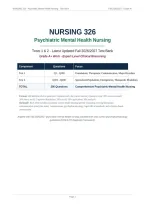
NURSING 326
Psychiatric Mental Health Nursing
Tests 1 & 2 - Latest Updated Fall 2026/2027 Test Bank
Grade A+ Work - Expert-Level Clinical Reasoning
Component Questions Focus
Test 1 Q1 - Q100 Foundations, Therapeutic Communication, Major Disorders
Test 2 Q101 - Q200 Specialized Populations, Emergencies, Therapeutic Modalities
TOTAL 200 Questions Comprehensive Psychiatric-Mental Health Nursing
Format: 200 multiple-choice questions (4 options each, one correct answer). Question style: 80% scenario-based,
20% direct recall. Cognitive distribution: 30% recall, 50% application, 20% analysis.
Rationale: Each item includes psychiatric-mental health nursing-specific reasoning covering therapeutic
communication principles, safety considerations, psychopharmacology, legal/ethical standards, and evidence-based
interventions.
Aligned with Fall 2026/2027 psychiatric-mental health nursing competencies and current psychopharmacology
guidelines (DSM-5-TR diagnostic framework).
Page 1
,NURSING 326 - Psychiatric Mental Health Nursing - Test Bank Fall 2026/2027 - Grade A+
TEST 1 (Questions 1 - 100)
Sections 1A - 8A: Foundations, Therapeutic Communication, Assessment, Legal/Ethical, Anxiety/OCD/Trauma, Mood
Disorders & Suicide, Schizophrenia, and Psychopharmacology Foundations.
Section 1A: Foundations of Psychiatric-Mental Health Nursing (Mental Health
Concepts, Recovery Model, Therapeutic Milieu, & Nursing Roles)
Q1: A nursing student asks how the mental health continuum differs from the medical model of
mental illness. Which response by the clinical instructor best reflects the continuum concept?
A. Mental health and mental illness are mutually exclusive states that a person moves between.
B. Mental health exists on a spectrum from optimal functioning to severe dysfunction, and an individual
can simultaneously experience wellness and symptoms. [CORRECT]
C. Mental illness is permanent once diagnosed, while mental health is a temporary state.
D. Mental health requires complete absence of symptoms, whereas mental illness is defined by medication use.
Correct Answer: B
Rationale: The mental health continuum views wellness and illness as coexisting on a spectrum rather than as binary
opposites. A person can experience meaningful recovery and wellness while still managing symptoms. The other options
reflect outdated, dichotomous thinking that contradicts recovery-oriented, person-centered psychiatric nursing practice.
Q2: A psychiatric nurse is planning care using the Recovery Model. Which intervention best
demonstrates application of this model?
A. Designing a daily schedule for the client that eliminates all unstructured time.
B. Developing goals collaboratively with the client based on the client’s stated values, hopes, and lived
experience. [CORRECT]
C. Requiring the client to participate in group therapy as a condition of discharge.
D. Making medication decisions for the client when the client expresses ambivalence.
Correct Answer: B
Rationale: The Recovery Model emphasizes client-directed care, hope, empowerment, and respect for lived experience.
Collaborative, client-driven goal setting is the hallmark of recovery-oriented practice. The other options impose provider
control, undermining autonomy and contradicting recovery principles of self-determination and partnership.
Q3: A client newly diagnosed with schizophrenia tells the nurse, "I am broken. I will never be
normal again." Which therapeutic response best addresses stigma and promotes resilience?
A. Let’s not talk about that right now; we need to focus on your medication.
B. Many people with schizophrenia live meaningful, productive lives with the right support and
treatment. [CORRECT]
C. You should try not to think about being broken; that kind of thinking makes it worse.
D. Schizophrenia is a chronic illness, so you will need to accept your limitations.
Correct Answer: B
Rationale: Reframing the illness narrative with realistic hope counters internalized stigma and supports resilience.
Acknowledging the diagnosis while offering evidence of recovery validates the client and activates hope. Changing the
subject, dismissing feelings, or emphasizing chronicity without hope are non-therapeutic and reinforce stigma.
Page 2
,NURSING 326 - Psychiatric Mental Health Nursing - Test Bank Fall 2026/2027 - Grade A+
Q4: Which nursing role is unique to psychiatric-mental health nursing compared with other
specialties, when considering the therapeutic milieu?
A. Administering prescribed medications on schedule.
B. Using the therapeutic use of self as the primary tool to structure a healing environment. [CORRECT]
C. Coordinating physical therapy consultations for clients.
D. Documenting vital signs and intake/output accurately.
Correct Answer: B
Rationale: The therapeutic use of self - the deliberate, purposeful application of the nurse’s personality and communication as
a therapeutic tool - is central and distinctive to psychiatric-mental health nursing. Medication administration, vital signs, and
care coordination occur in all specialties and are not uniquely psychiatric nursing roles.
Q5: A nurse manager is orienting new staff to a psychiatric inpatient unit. Which statement by a
new nurse indicates correct understanding of the therapeutic milieu?
A. The milieu is primarily the physical design of the unit, including furniture and lighting.
B. The milieu is the total structured environment - physical, social, and interpersonal - that supports
therapeutic change. [CORRECT]
C. The milieu refers only to the rules clients must follow on the unit.
D. The milieu is the schedule of activities that nurses plan for clients each day.
Correct Answer: B
Rationale: Therapeutic milieu encompasses the entire structured treatment environment: physical safety, predictable routines,
social norms, community interactions, and interpersonal atmosphere. Viewing the milieu as only physical design, rules, or
activities is reductionist and overlooks the dynamic, healing environment that supports recovery.
Q6: During a community meeting on an inpatient psychiatric unit, several clients complain that the
evening snack is served too early. Which response by the nurse best reflects milieu therapy
principles?
A. I will change the snack time to whatever the group prefers starting tonight.
B. Let’s discuss this as a community. What time would best meet most people’s needs while keeping the
evening routine predictable? [CORRECT]
C. The snack time is set by administration and cannot be changed.
D. Each of you can keep snacks in your room to eat whenever you want.
Correct Answer: B
Rationale: Milieu therapy uses community meetings to teach problem-solving, negotiation, and shared responsibility, while
maintaining structure and predictability. Facilitating group discussion that balances client input with unit norms is
therapeutic. Capitulating, rigid refusal, or permitting unsafe practices (food in rooms) undermine the therapeutic structure.
Page 3
, NURSING 326 - Psychiatric Mental Health Nursing - Test Bank Fall 2026/2027 - Grade A+
Q7: A client asks the nurse to explain the difference between mental health and mental illness
using the wellness-illness continuum. Which statement is most accurate?
A. A person is either mentally healthy or mentally ill at any given time.
B. A person can experience varying degrees of wellness and illness simultaneously along a continuum.
[CORRECT]
C. Mental illness begins only when a person is hospitalized.
D. Mental health is achieved only when all psychiatric symptoms are eliminated.
Correct Answer: B
Rationale: The wellness-illness continuum recognizes that mental health and mental illness coexist on a spectrum; individuals
may have symptoms yet still function with strengths and wellness. This view supports recovery-oriented care. Binary,
hospitalization-based, or symptom-free definitions are inaccurate and stigmatizing.
Q8: A nurse is caring for a client who recently attempted suicide. The client has a strong spiritual
faith and a supportive partner. How should the nurse incorporate these protective factors into
care?
A. Ignore spiritual beliefs because they are not part of evidence-based care.
B. Explore how the client’s faith and partner relationship can be mobilized as protective resources in the
safety plan. [CORRECT]
C. Tell the client their faith should have prevented the suicide attempt.
D. Avoid involving the partner because families can worsen suicidality.
Correct Answer: B
Rationale: Protective factors such as spirituality and social support reduce suicide risk and should be integrated into the safety
plan. Mobilizing these resources is evidence-based and person-centered. Dismissing spirituality, blaming the client, or
excluding supports ignores recovery principles and weakens safety planning.
Q9: Which statement by a psychiatric nurse best reflects the principle of least restrictive care?
A. I placed the client in seclusion because the unit was short-staffed today.
B. I attempted verbal de-escalation and offered PRN medication before considering any physical
restraint. [CORRECT]
C. I applied restraints immediately because the client raised a fist.
D. I use seclusion routinely for any client diagnosed with schizophrenia to prevent incidents.
Correct Answer: B
Rationale: Least restrictive care requires attempting the least invasive interventions first - verbal de-escalation, PRN
medication, environmental modification - before escalating to restraint or seclusion. Routine or convenience-based use of
restrictive measures violates ethical and legal standards and patient rights.
Page 4
NURSING 326
Psychiatric Mental Health Nursing
Tests 1 & 2 - Latest Updated Fall 2026/2027 Test Bank
Grade A+ Work - Expert-Level Clinical Reasoning
Component Questions Focus
Test 1 Q1 - Q100 Foundations, Therapeutic Communication, Major Disorders
Test 2 Q101 - Q200 Specialized Populations, Emergencies, Therapeutic Modalities
TOTAL 200 Questions Comprehensive Psychiatric-Mental Health Nursing
Format: 200 multiple-choice questions (4 options each, one correct answer). Question style: 80% scenario-based,
20% direct recall. Cognitive distribution: 30% recall, 50% application, 20% analysis.
Rationale: Each item includes psychiatric-mental health nursing-specific reasoning covering therapeutic
communication principles, safety considerations, psychopharmacology, legal/ethical standards, and evidence-based
interventions.
Aligned with Fall 2026/2027 psychiatric-mental health nursing competencies and current psychopharmacology
guidelines (DSM-5-TR diagnostic framework).
Page 1
,NURSING 326 - Psychiatric Mental Health Nursing - Test Bank Fall 2026/2027 - Grade A+
TEST 1 (Questions 1 - 100)
Sections 1A - 8A: Foundations, Therapeutic Communication, Assessment, Legal/Ethical, Anxiety/OCD/Trauma, Mood
Disorders & Suicide, Schizophrenia, and Psychopharmacology Foundations.
Section 1A: Foundations of Psychiatric-Mental Health Nursing (Mental Health
Concepts, Recovery Model, Therapeutic Milieu, & Nursing Roles)
Q1: A nursing student asks how the mental health continuum differs from the medical model of
mental illness. Which response by the clinical instructor best reflects the continuum concept?
A. Mental health and mental illness are mutually exclusive states that a person moves between.
B. Mental health exists on a spectrum from optimal functioning to severe dysfunction, and an individual
can simultaneously experience wellness and symptoms. [CORRECT]
C. Mental illness is permanent once diagnosed, while mental health is a temporary state.
D. Mental health requires complete absence of symptoms, whereas mental illness is defined by medication use.
Correct Answer: B
Rationale: The mental health continuum views wellness and illness as coexisting on a spectrum rather than as binary
opposites. A person can experience meaningful recovery and wellness while still managing symptoms. The other options
reflect outdated, dichotomous thinking that contradicts recovery-oriented, person-centered psychiatric nursing practice.
Q2: A psychiatric nurse is planning care using the Recovery Model. Which intervention best
demonstrates application of this model?
A. Designing a daily schedule for the client that eliminates all unstructured time.
B. Developing goals collaboratively with the client based on the client’s stated values, hopes, and lived
experience. [CORRECT]
C. Requiring the client to participate in group therapy as a condition of discharge.
D. Making medication decisions for the client when the client expresses ambivalence.
Correct Answer: B
Rationale: The Recovery Model emphasizes client-directed care, hope, empowerment, and respect for lived experience.
Collaborative, client-driven goal setting is the hallmark of recovery-oriented practice. The other options impose provider
control, undermining autonomy and contradicting recovery principles of self-determination and partnership.
Q3: A client newly diagnosed with schizophrenia tells the nurse, "I am broken. I will never be
normal again." Which therapeutic response best addresses stigma and promotes resilience?
A. Let’s not talk about that right now; we need to focus on your medication.
B. Many people with schizophrenia live meaningful, productive lives with the right support and
treatment. [CORRECT]
C. You should try not to think about being broken; that kind of thinking makes it worse.
D. Schizophrenia is a chronic illness, so you will need to accept your limitations.
Correct Answer: B
Rationale: Reframing the illness narrative with realistic hope counters internalized stigma and supports resilience.
Acknowledging the diagnosis while offering evidence of recovery validates the client and activates hope. Changing the
subject, dismissing feelings, or emphasizing chronicity without hope are non-therapeutic and reinforce stigma.
Page 2
,NURSING 326 - Psychiatric Mental Health Nursing - Test Bank Fall 2026/2027 - Grade A+
Q4: Which nursing role is unique to psychiatric-mental health nursing compared with other
specialties, when considering the therapeutic milieu?
A. Administering prescribed medications on schedule.
B. Using the therapeutic use of self as the primary tool to structure a healing environment. [CORRECT]
C. Coordinating physical therapy consultations for clients.
D. Documenting vital signs and intake/output accurately.
Correct Answer: B
Rationale: The therapeutic use of self - the deliberate, purposeful application of the nurse’s personality and communication as
a therapeutic tool - is central and distinctive to psychiatric-mental health nursing. Medication administration, vital signs, and
care coordination occur in all specialties and are not uniquely psychiatric nursing roles.
Q5: A nurse manager is orienting new staff to a psychiatric inpatient unit. Which statement by a
new nurse indicates correct understanding of the therapeutic milieu?
A. The milieu is primarily the physical design of the unit, including furniture and lighting.
B. The milieu is the total structured environment - physical, social, and interpersonal - that supports
therapeutic change. [CORRECT]
C. The milieu refers only to the rules clients must follow on the unit.
D. The milieu is the schedule of activities that nurses plan for clients each day.
Correct Answer: B
Rationale: Therapeutic milieu encompasses the entire structured treatment environment: physical safety, predictable routines,
social norms, community interactions, and interpersonal atmosphere. Viewing the milieu as only physical design, rules, or
activities is reductionist and overlooks the dynamic, healing environment that supports recovery.
Q6: During a community meeting on an inpatient psychiatric unit, several clients complain that the
evening snack is served too early. Which response by the nurse best reflects milieu therapy
principles?
A. I will change the snack time to whatever the group prefers starting tonight.
B. Let’s discuss this as a community. What time would best meet most people’s needs while keeping the
evening routine predictable? [CORRECT]
C. The snack time is set by administration and cannot be changed.
D. Each of you can keep snacks in your room to eat whenever you want.
Correct Answer: B
Rationale: Milieu therapy uses community meetings to teach problem-solving, negotiation, and shared responsibility, while
maintaining structure and predictability. Facilitating group discussion that balances client input with unit norms is
therapeutic. Capitulating, rigid refusal, or permitting unsafe practices (food in rooms) undermine the therapeutic structure.
Page 3
, NURSING 326 - Psychiatric Mental Health Nursing - Test Bank Fall 2026/2027 - Grade A+
Q7: A client asks the nurse to explain the difference between mental health and mental illness
using the wellness-illness continuum. Which statement is most accurate?
A. A person is either mentally healthy or mentally ill at any given time.
B. A person can experience varying degrees of wellness and illness simultaneously along a continuum.
[CORRECT]
C. Mental illness begins only when a person is hospitalized.
D. Mental health is achieved only when all psychiatric symptoms are eliminated.
Correct Answer: B
Rationale: The wellness-illness continuum recognizes that mental health and mental illness coexist on a spectrum; individuals
may have symptoms yet still function with strengths and wellness. This view supports recovery-oriented care. Binary,
hospitalization-based, or symptom-free definitions are inaccurate and stigmatizing.
Q8: A nurse is caring for a client who recently attempted suicide. The client has a strong spiritual
faith and a supportive partner. How should the nurse incorporate these protective factors into
care?
A. Ignore spiritual beliefs because they are not part of evidence-based care.
B. Explore how the client’s faith and partner relationship can be mobilized as protective resources in the
safety plan. [CORRECT]
C. Tell the client their faith should have prevented the suicide attempt.
D. Avoid involving the partner because families can worsen suicidality.
Correct Answer: B
Rationale: Protective factors such as spirituality and social support reduce suicide risk and should be integrated into the safety
plan. Mobilizing these resources is evidence-based and person-centered. Dismissing spirituality, blaming the client, or
excluding supports ignores recovery principles and weakens safety planning.
Q9: Which statement by a psychiatric nurse best reflects the principle of least restrictive care?
A. I placed the client in seclusion because the unit was short-staffed today.
B. I attempted verbal de-escalation and offered PRN medication before considering any physical
restraint. [CORRECT]
C. I applied restraints immediately because the client raised a fist.
D. I use seclusion routinely for any client diagnosed with schizophrenia to prevent incidents.
Correct Answer: B
Rationale: Least restrictive care requires attempting the least invasive interventions first - verbal de-escalation, PRN
medication, environmental modification - before escalating to restraint or seclusion. Routine or convenience-based use of
restrictive measures violates ethical and legal standards and patient rights.
Page 4


