
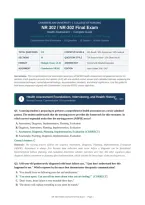
CHAMBERLAIN UNIVERSITY | COLLEGE OF NURSING
NR 302 / NR-302 Final Exam
Health Assessment - Complete Guide
Latest Update | Questions & Verified Answers | 100% Correct
Comprehensive Final Examination - 150 Questions - 10 Sections - All Body Systems
TOTAL QUESTIONS 150 COGNITIVE LEVELS 30% Recall / 50% Application / 20% Analysis
SECTIONS 10 QUESTION STYLE 75% Scenario-based / 25% Direct Recall
FORMAT Multiple Choice (A-D) ANSWER KEY Verified with Detailed Rationales
ALIGNMENT Chamberlain NR302 EDITION Latest Update
Instructions: This comprehensive final examination assesses all NR302 Health Assessment competencies across 10
sections. Each question presents four options (A-D) with one verified correct answer and a detailed rationale explaining the
assessment technique, normal/abnormal findings, documentation standards, and clinical significance. Use this guide for
final-exam preparation aligned with Chamberlain University NR302 course objectives.
Health Assessment Foundations, Interviewing, and Health History
1 Q1 - Q15
Nursing Process, Communication, & Documentation
Q1: A nursing student is preparing to perform a comprehensive health assessment on a newly admitted
patient. The student understands that the nursing process provides the framework for this encounter. In
which correct sequential order does the nursing process (ADPIE) occur?
A. Assessment, Diagnosis, Implementation, Planning, Evaluation
B. Diagnosis, Assessment, Planning, Implementation, Evaluation
C. Assessment, Diagnosis, Planning, Implementation, Evaluation [CORRECT]
D. Assessment, Planning, Diagnosis, Implementation, Evaluation
Correct Answer: C
Rationale: The nursing process follows the sequence Assessment, Diagnosis, Planning, Implementation, Evaluation
(ADPIE). Assessment is always first because data collection must occur before a diagnosis can be formulated.
Implementation follows planning, and evaluation determines whether outcomes were met. The other sequences place
diagnosis before assessment or planning after implementation, which violates the linear logic of the nursing process.
Q2: A 68-year-old patient newly diagnosed with heart failure says, "I just don't understand how this
happened to me." Which response by the nurse best demonstrates therapeutic communication?
A. "You should focus on following your diet and medications."
B. "You seem upset. Can you tell me more about what you are feeling?" [CORRECT]
C. "Don't worry, heart failure is very treatable these days."
D. "The doctor will explain everything to you when he rounds."
NR 302 Health Assessment Final Exam - Page 1
,NR 302 Final Exam | Health Assessment | 2026/2027 Chamberlain University
Correct Answer: B
Rationale: The therapeutic response acknowledges the patient's feelings ("You seem upset") and uses an open-ended
prompt to encourage further expression. False reassurance ("Don't worry"), passing the responsibility to the physician,
and giving advice are all non-therapeutic communication blocks that shut down dialogue. Therapeutic communication
focuses on the patient's feelings and uses active listening and open-ended questions.
Q3: The nurse is preparing to obtain a complete health history from a patient. Which component of the health
history should the nurse collect FIRST?
A. History of present illness (HPI)
B. Review of systems (ROS)
C. Biographical data [CORRECT]
D. Functional assessment
Correct Answer: C
Rationale: Biographical data (name, age, gender, occupation, etc.) is collected first because it establishes the patient's
identity and provides context for the rest of the interview. The HPI follows to explore the chief complaint, the ROS reviews
each body system, and the functional assessment evaluates activities of daily living. Beginning with ROS or functional
assessment before establishing identity and the chief complaint disrupts the logical flow of a complete health history.
Q4: A nurse is caring for a patient from a culture that values family decision-making in healthcare. The
patient's eldest son insists on speaking for his mother. Which action by the nurse best demonstrates cultural
competence?
A. Acknowledge the son's role and ask the patient how she prefers to participate in decisions [CORRECT]
B. Ask the son to leave the room so the nurse can speak directly with the patient
C. Document that the patient is non-compliant because she will not speak for herself
D. Tell the patient she must answer questions herself to receive care
Correct Answer: A
Rationale: Cultural competence requires the nurse to respect the family's decision-making structure while still
empowering the patient. Asking the patient how she prefers to participate honors both cultural norms and patient
autonomy. Forcing the son to leave, demanding the patient speak, or labeling her non-compliant are culturally insensitive
and may damage the nurse-patient relationship. The LEARN model (Listen, Explain, Acknowledge, Recommend,
Negotiate) supports this approach.
Q5: A nurse documents the following: "Patient reports abdominal pain rated 8/10, localized to the right lower
quadrant, described as sharp and constant. Abdomen firm and tender to palpation in RLQ." Which
documentation format does this entry best represent?
A. Focus charting
B. SOAP (Subjective, Objective, Assessment, Plan) [CORRECT]
C. PIE (Problem, Intervention, Evaluation)
D. DAR (Data, Action, Response)
Correct Answer: B
Rationale: The entry contains both subjective data (patient's report of pain) and objective data (firm, tender abdomen on
palpation), which are the "S" and "O" of SOAP charting. Although the full SOAP note would also include Assessment and
Plan, the structure is clearly SOAP-based. PIE charting combines problem, intervention, and evaluation without
NR 302 Health Assessment Final Exam - Page 2
,NR 302 Final Exam | Health Assessment | 2026/2027 Chamberlain University
separating subjective and objective data, and DAR/Focus charting organize around a specific focus rather than S/O/A/P
categories.
Q6: A nurse assesses a patient and notes the following findings: blood pressure 168/94 mmHg, headache, and
blurred vision. The patient states, "I stopped taking my blood pressure medicine last week because I felt fine."
Which critical thinking skill is the nurse demonstrating when integrating these findings to determine the
priority action?
A. Explanation
B. Self-correction
C. Self-regulation
D. Analysis [CORRECT]
Correct Answer: D
Rationale: Analysis involves breaking down data, examining relationships, and identifying patterns—in this case
connecting the elevated BP, symptoms, and medication nonadherence to recognize a potential hypertensive crisis.
Self-regulation is reflecting on one's own thinking, explanation is justifying reasoning to others, and self-correction is
adjusting one's approach. The nurse is actively interpreting and connecting assessment data to prioritize, which is the
analytic phase of critical thinking.
Q7: A nurse is reviewing a hospital policy that requires routine shaving of the surgical site before surgery. The
nurse locates a current research study showing that clipping (not shaving) reduces surgical site infections.
Using evidence-based practice, which action should the nurse take FIRST?
A. Continue shaving until the hospital formally changes the written policy
B. Ignore the study because hospital policy takes precedence over research
C. Immediately change the patient preparation technique without consulting anyone
D. Bring the research findings to the unit-based council to review and integrate with clinical expertise and
patient preferences [CORRECT]
Correct Answer: D
Rationale: Evidence-based practice integrates the best research evidence with clinical expertise and patient
preferences/values. The nurse should bring the research to the interdisciplinary team to evaluate and integrate all three
components before changing practice. Acting unilaterally ignores the team approach, ignoring research is not EBP, and
continuing outdated practice when better evidence exists is not patient-centered. EBP requires synthesis of all three
elements.
Q8: During a health history interview, a nurse needs to obtain detailed information about a patient's
experience with chronic pain. Which type of question is MOST appropriate to begin this portion of the
interview?
A. "You don't have pain, do you?"
B. "Do you have pain right now?"
C. "Is your pain worse in the morning or evening?"
D. "Can you describe what your pain has been like over the past week?" [CORRECT]
Correct Answer: D
Rationale: An open-ended question ("Can you describe...") allows the patient to share detailed, rich information in their
own words, which is ideal for exploring subjective experiences like pain. "Do you have pain?" and the morning/evening
NR 302 Health Assessment Final Exam - Page 3
, NR 302 Final Exam | Health Assessment | 2026/2027 Chamberlain University
question are closed-ended (yes/no or forced choice) and limit responses. "You don't have pain, do you?" is a leading
question that biases the patient's answer. Open-ended questions are the foundation of therapeutic interviewing.
Q9: A nurse is conducting an admission interview. The patient is a 76-year-old with mild cognitive
impairment who is accompanied by her daughter. The patient's answers are vague and inconsistent. Which is
the BEST source of the health history in this situation?
A. The patient is the primary source, with the daughter serving as a secondary source to supplement and
clarify information [CORRECT]
B. The medical record is the primary source; do not interview either person
C. The daughter is the only source because the patient is unreliable
D. The patient is the only source; do not involve the daughter
Correct Answer: A
Rationale: The patient is always the primary source of the health history whenever possible, even with cognitive
impairment, because the patient's perspective is valuable. However, when reliability is questionable, a secondary source
(the daughter) supplements and clarifies information. Excluding the patient entirely ignores her perspective and
autonomy, while relying only on the daughter loses the patient's voice. The medical record is a secondary data source, not
the primary one.
Q10: While collecting biographical data, the nurse learns the patient works as a coal miner. How should the
nurse use this information during the assessment?
A. Disregard it because occupational data is collected by social work, not nursing
B. Notify human resources so the employer can be contacted
C. Document it only on the face sheet; it has no assessment relevance
D. Use it to guide focused assessment of the respiratory system and occupational exposure history
[CORRECT]
Correct Answer: D
Rationale: Occupational history often reveals exposure risks that warrant focused assessment. A coal miner has
significant risk for pneumoconiosis, so the nurse should perform a more detailed respiratory assessment and occupational
exposure history. Documenting only on the face sheet misses the clinical relevance, and the data is certainly within
nursing scope. Contacting the employer violates patient confidentiality. Biographical data informs the depth and focus of
the physical assessment.
Q11: A patient presents to the emergency department with chest pain. The nurse is completing the history of
present illness using the OLDCARTS framework. Which letter of OLDCARTS is the nurse exploring when
asking, "What makes the pain better or worse?"
A. D (Duration)
B. T (Treating factors / Provoking-Palliative) [CORRECT]
C. L (Location)
D. O (Onset)
Correct Answer: B
Rationale: In OLDCARTS, "T" represents treating factors (also interpreted as provoking/palliative factors)—what brings
on the symptom or relieves it. Asking what makes the pain better or worse directly assesses palliative and provoking
factors. Onset (O) addresses when it began, Location (L) is where it is, and Duration (D) is how long it lasts. The
NR 302 Health Assessment Final Exam - Page 4
NR 302 / NR-302 Final Exam
Health Assessment - Complete Guide
Latest Update | Questions & Verified Answers | 100% Correct
Comprehensive Final Examination - 150 Questions - 10 Sections - All Body Systems
TOTAL QUESTIONS 150 COGNITIVE LEVELS 30% Recall / 50% Application / 20% Analysis
SECTIONS 10 QUESTION STYLE 75% Scenario-based / 25% Direct Recall
FORMAT Multiple Choice (A-D) ANSWER KEY Verified with Detailed Rationales
ALIGNMENT Chamberlain NR302 EDITION Latest Update
Instructions: This comprehensive final examination assesses all NR302 Health Assessment competencies across 10
sections. Each question presents four options (A-D) with one verified correct answer and a detailed rationale explaining the
assessment technique, normal/abnormal findings, documentation standards, and clinical significance. Use this guide for
final-exam preparation aligned with Chamberlain University NR302 course objectives.
Health Assessment Foundations, Interviewing, and Health History
1 Q1 - Q15
Nursing Process, Communication, & Documentation
Q1: A nursing student is preparing to perform a comprehensive health assessment on a newly admitted
patient. The student understands that the nursing process provides the framework for this encounter. In
which correct sequential order does the nursing process (ADPIE) occur?
A. Assessment, Diagnosis, Implementation, Planning, Evaluation
B. Diagnosis, Assessment, Planning, Implementation, Evaluation
C. Assessment, Diagnosis, Planning, Implementation, Evaluation [CORRECT]
D. Assessment, Planning, Diagnosis, Implementation, Evaluation
Correct Answer: C
Rationale: The nursing process follows the sequence Assessment, Diagnosis, Planning, Implementation, Evaluation
(ADPIE). Assessment is always first because data collection must occur before a diagnosis can be formulated.
Implementation follows planning, and evaluation determines whether outcomes were met. The other sequences place
diagnosis before assessment or planning after implementation, which violates the linear logic of the nursing process.
Q2: A 68-year-old patient newly diagnosed with heart failure says, "I just don't understand how this
happened to me." Which response by the nurse best demonstrates therapeutic communication?
A. "You should focus on following your diet and medications."
B. "You seem upset. Can you tell me more about what you are feeling?" [CORRECT]
C. "Don't worry, heart failure is very treatable these days."
D. "The doctor will explain everything to you when he rounds."
NR 302 Health Assessment Final Exam - Page 1
,NR 302 Final Exam | Health Assessment | 2026/2027 Chamberlain University
Correct Answer: B
Rationale: The therapeutic response acknowledges the patient's feelings ("You seem upset") and uses an open-ended
prompt to encourage further expression. False reassurance ("Don't worry"), passing the responsibility to the physician,
and giving advice are all non-therapeutic communication blocks that shut down dialogue. Therapeutic communication
focuses on the patient's feelings and uses active listening and open-ended questions.
Q3: The nurse is preparing to obtain a complete health history from a patient. Which component of the health
history should the nurse collect FIRST?
A. History of present illness (HPI)
B. Review of systems (ROS)
C. Biographical data [CORRECT]
D. Functional assessment
Correct Answer: C
Rationale: Biographical data (name, age, gender, occupation, etc.) is collected first because it establishes the patient's
identity and provides context for the rest of the interview. The HPI follows to explore the chief complaint, the ROS reviews
each body system, and the functional assessment evaluates activities of daily living. Beginning with ROS or functional
assessment before establishing identity and the chief complaint disrupts the logical flow of a complete health history.
Q4: A nurse is caring for a patient from a culture that values family decision-making in healthcare. The
patient's eldest son insists on speaking for his mother. Which action by the nurse best demonstrates cultural
competence?
A. Acknowledge the son's role and ask the patient how she prefers to participate in decisions [CORRECT]
B. Ask the son to leave the room so the nurse can speak directly with the patient
C. Document that the patient is non-compliant because she will not speak for herself
D. Tell the patient she must answer questions herself to receive care
Correct Answer: A
Rationale: Cultural competence requires the nurse to respect the family's decision-making structure while still
empowering the patient. Asking the patient how she prefers to participate honors both cultural norms and patient
autonomy. Forcing the son to leave, demanding the patient speak, or labeling her non-compliant are culturally insensitive
and may damage the nurse-patient relationship. The LEARN model (Listen, Explain, Acknowledge, Recommend,
Negotiate) supports this approach.
Q5: A nurse documents the following: "Patient reports abdominal pain rated 8/10, localized to the right lower
quadrant, described as sharp and constant. Abdomen firm and tender to palpation in RLQ." Which
documentation format does this entry best represent?
A. Focus charting
B. SOAP (Subjective, Objective, Assessment, Plan) [CORRECT]
C. PIE (Problem, Intervention, Evaluation)
D. DAR (Data, Action, Response)
Correct Answer: B
Rationale: The entry contains both subjective data (patient's report of pain) and objective data (firm, tender abdomen on
palpation), which are the "S" and "O" of SOAP charting. Although the full SOAP note would also include Assessment and
Plan, the structure is clearly SOAP-based. PIE charting combines problem, intervention, and evaluation without
NR 302 Health Assessment Final Exam - Page 2
,NR 302 Final Exam | Health Assessment | 2026/2027 Chamberlain University
separating subjective and objective data, and DAR/Focus charting organize around a specific focus rather than S/O/A/P
categories.
Q6: A nurse assesses a patient and notes the following findings: blood pressure 168/94 mmHg, headache, and
blurred vision. The patient states, "I stopped taking my blood pressure medicine last week because I felt fine."
Which critical thinking skill is the nurse demonstrating when integrating these findings to determine the
priority action?
A. Explanation
B. Self-correction
C. Self-regulation
D. Analysis [CORRECT]
Correct Answer: D
Rationale: Analysis involves breaking down data, examining relationships, and identifying patterns—in this case
connecting the elevated BP, symptoms, and medication nonadherence to recognize a potential hypertensive crisis.
Self-regulation is reflecting on one's own thinking, explanation is justifying reasoning to others, and self-correction is
adjusting one's approach. The nurse is actively interpreting and connecting assessment data to prioritize, which is the
analytic phase of critical thinking.
Q7: A nurse is reviewing a hospital policy that requires routine shaving of the surgical site before surgery. The
nurse locates a current research study showing that clipping (not shaving) reduces surgical site infections.
Using evidence-based practice, which action should the nurse take FIRST?
A. Continue shaving until the hospital formally changes the written policy
B. Ignore the study because hospital policy takes precedence over research
C. Immediately change the patient preparation technique without consulting anyone
D. Bring the research findings to the unit-based council to review and integrate with clinical expertise and
patient preferences [CORRECT]
Correct Answer: D
Rationale: Evidence-based practice integrates the best research evidence with clinical expertise and patient
preferences/values. The nurse should bring the research to the interdisciplinary team to evaluate and integrate all three
components before changing practice. Acting unilaterally ignores the team approach, ignoring research is not EBP, and
continuing outdated practice when better evidence exists is not patient-centered. EBP requires synthesis of all three
elements.
Q8: During a health history interview, a nurse needs to obtain detailed information about a patient's
experience with chronic pain. Which type of question is MOST appropriate to begin this portion of the
interview?
A. "You don't have pain, do you?"
B. "Do you have pain right now?"
C. "Is your pain worse in the morning or evening?"
D. "Can you describe what your pain has been like over the past week?" [CORRECT]
Correct Answer: D
Rationale: An open-ended question ("Can you describe...") allows the patient to share detailed, rich information in their
own words, which is ideal for exploring subjective experiences like pain. "Do you have pain?" and the morning/evening
NR 302 Health Assessment Final Exam - Page 3
, NR 302 Final Exam | Health Assessment | 2026/2027 Chamberlain University
question are closed-ended (yes/no or forced choice) and limit responses. "You don't have pain, do you?" is a leading
question that biases the patient's answer. Open-ended questions are the foundation of therapeutic interviewing.
Q9: A nurse is conducting an admission interview. The patient is a 76-year-old with mild cognitive
impairment who is accompanied by her daughter. The patient's answers are vague and inconsistent. Which is
the BEST source of the health history in this situation?
A. The patient is the primary source, with the daughter serving as a secondary source to supplement and
clarify information [CORRECT]
B. The medical record is the primary source; do not interview either person
C. The daughter is the only source because the patient is unreliable
D. The patient is the only source; do not involve the daughter
Correct Answer: A
Rationale: The patient is always the primary source of the health history whenever possible, even with cognitive
impairment, because the patient's perspective is valuable. However, when reliability is questionable, a secondary source
(the daughter) supplements and clarifies information. Excluding the patient entirely ignores her perspective and
autonomy, while relying only on the daughter loses the patient's voice. The medical record is a secondary data source, not
the primary one.
Q10: While collecting biographical data, the nurse learns the patient works as a coal miner. How should the
nurse use this information during the assessment?
A. Disregard it because occupational data is collected by social work, not nursing
B. Notify human resources so the employer can be contacted
C. Document it only on the face sheet; it has no assessment relevance
D. Use it to guide focused assessment of the respiratory system and occupational exposure history
[CORRECT]
Correct Answer: D
Rationale: Occupational history often reveals exposure risks that warrant focused assessment. A coal miner has
significant risk for pneumoconiosis, so the nurse should perform a more detailed respiratory assessment and occupational
exposure history. Documenting only on the face sheet misses the clinical relevance, and the data is certainly within
nursing scope. Contacting the employer violates patient confidentiality. Biographical data informs the depth and focus of
the physical assessment.
Q11: A patient presents to the emergency department with chest pain. The nurse is completing the history of
present illness using the OLDCARTS framework. Which letter of OLDCARTS is the nurse exploring when
asking, "What makes the pain better or worse?"
A. D (Duration)
B. T (Treating factors / Provoking-Palliative) [CORRECT]
C. L (Location)
D. O (Onset)
Correct Answer: B
Rationale: In OLDCARTS, "T" represents treating factors (also interpreted as provoking/palliative factors)—what brings
on the symptom or relieves it. Asking what makes the pain better or worse directly assesses palliative and provoking
factors. Onset (O) addresses when it began, Location (L) is where it is, and Duration (D) is how long it lasts. The
NR 302 Health Assessment Final Exam - Page 4


