
NEXPHYRA / EXAM STUDY PACK
One Dimensional Kinematics
NEXPHYRA / EXAM STUDY PACK
Motion, graphs, and free fall
An algebra-based guide for upper high school and introductory college physics.
Position Velocity Acceleration
x (m) v (m/s) a (m/s2)
8 4 2
1
0 0 0
0 2 4 0 2 4 0 2 4
t (s) t (s) t (s)
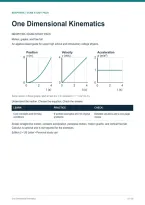
Same motion in three graphs: start at rest at x = 0; constant a = +1 m/s2 for 4 s.
Understand the motion. Choose the equation. Check the answer.
LEARN PRACTICE CHECK
Core concepts and formula 6 worked examples and 18 original Detailed solutions and a one-page
conditions problems review
Scope: straight-line motion, constant acceleration, piecewise motion, motion graphs, and vertical free fall.
Calculus is optional and is not required for the exercises.
Edition 2 • US Letter • Personal study use
One Dimensional Kinematics
,NEXPHYRA / EXAM STUDY PACK
Quick Start
Use this pack to identify why a problem is difficult, then practice the relevant skill. You will need algebra, a
calculator, and paper for working. Every answer should include units and a stated direction when direction
matters.
Choose a study route
Time available Suggested route
30 minutes Read pages 5, 8, 12, and 28. Attempt P4, P8, and P11;
review their solutions.
90 minutes Read pages 3–12, work through examples W2, W4,
and W6, then attempt P1–P12.
Two sessions Complete all examples and P1–P18. Reattempt missed
problems without looking at the solutions.
Contents
Section Pages
Key concepts, definitions, symbols, and SI units 3–4
Formula sheet and formula cards 5–7
Choosing a method and reading motion graphs 8–10
Free fall and common mistakes 11–12
Worked examples W1–W6 13–15
Practice problems P1–P18 16–18
Detailed solutions P1–P18 19–25
Measurement skills 26
Exam checklist, sources, and printing 27
Final one-page review 28
Throughout this pack, g = 9.80 m/s2 is the positive magnitude of gravitational acceleration. Upward is positive
in vertical problems, so a = −9.80 m/s2. Ignore air resistance unless a question explicitly says otherwise.
Timing is a study suggestion, not a promise about exam readiness. Check your own course syllabus for
additional topics.
One Dimensional Kinematics
, NEXPHYRA / EXAM STUDY PACK
Key Concepts
Describe motion before calculating
Kinematics describes where an object is and how its motion changes. It does not identify the forces causing
that change. In one dimension, choose an origin and one positive direction along a straight line. Keep both
choices fixed throughout the calculation.
Position and displacement
Position x is a signed coordinate relative to the origin. Displacement Δx is the change in that coordinate.
Distance traveled d counts the total path length. A trip can have zero displacement and a positive distance.
Example: moving 5 m right and then 5 m left returns you to the starting point. Displacement is 0 m; distance is
10 m.
Velocity and speed
Velocity includes direction. In one dimension its sign tells you which way the object moves. Speed is the
magnitude of velocity, |v|, and cannot be negative. Negative position does not imply negative velocity: an
object left of the origin can move right.
Acceleration changes velocity
Acceleration measures the rate of change of velocity. A negative acceleration is not automatically slowing
down. Compare the signs of velocity and acceleration.
Velocity Acceleration What happens to speed
Positive Positive Increases
Positive Negative Decreases until v reaches zero
Negative Negative Increases
Negative Positive Decreases until v reaches zero
At an instant when v = 0, the object is momentarily at rest. If velocity changes sign through that instant, the
object reverses direction. Acceleration can remain nonzero.
Constant acceleration is a model
The familiar motion equations require acceleration to stay constant over the interval being analyzed. For a trip
with different stages, solve each stage separately and pass its final position and velocity to the next.
One Dimensional Kinematics
One Dimensional Kinematics
NEXPHYRA / EXAM STUDY PACK
Motion, graphs, and free fall
An algebra-based guide for upper high school and introductory college physics.
Position Velocity Acceleration
x (m) v (m/s) a (m/s2)
8 4 2
1
0 0 0
0 2 4 0 2 4 0 2 4
t (s) t (s) t (s)
Same motion in three graphs: start at rest at x = 0; constant a = +1 m/s2 for 4 s.
Understand the motion. Choose the equation. Check the answer.
LEARN PRACTICE CHECK
Core concepts and formula 6 worked examples and 18 original Detailed solutions and a one-page
conditions problems review
Scope: straight-line motion, constant acceleration, piecewise motion, motion graphs, and vertical free fall.
Calculus is optional and is not required for the exercises.
Edition 2 • US Letter • Personal study use
One Dimensional Kinematics
,NEXPHYRA / EXAM STUDY PACK
Quick Start
Use this pack to identify why a problem is difficult, then practice the relevant skill. You will need algebra, a
calculator, and paper for working. Every answer should include units and a stated direction when direction
matters.
Choose a study route
Time available Suggested route
30 minutes Read pages 5, 8, 12, and 28. Attempt P4, P8, and P11;
review their solutions.
90 minutes Read pages 3–12, work through examples W2, W4,
and W6, then attempt P1–P12.
Two sessions Complete all examples and P1–P18. Reattempt missed
problems without looking at the solutions.
Contents
Section Pages
Key concepts, definitions, symbols, and SI units 3–4
Formula sheet and formula cards 5–7
Choosing a method and reading motion graphs 8–10
Free fall and common mistakes 11–12
Worked examples W1–W6 13–15
Practice problems P1–P18 16–18
Detailed solutions P1–P18 19–25
Measurement skills 26
Exam checklist, sources, and printing 27
Final one-page review 28
Throughout this pack, g = 9.80 m/s2 is the positive magnitude of gravitational acceleration. Upward is positive
in vertical problems, so a = −9.80 m/s2. Ignore air resistance unless a question explicitly says otherwise.
Timing is a study suggestion, not a promise about exam readiness. Check your own course syllabus for
additional topics.
One Dimensional Kinematics
, NEXPHYRA / EXAM STUDY PACK
Key Concepts
Describe motion before calculating
Kinematics describes where an object is and how its motion changes. It does not identify the forces causing
that change. In one dimension, choose an origin and one positive direction along a straight line. Keep both
choices fixed throughout the calculation.
Position and displacement
Position x is a signed coordinate relative to the origin. Displacement Δx is the change in that coordinate.
Distance traveled d counts the total path length. A trip can have zero displacement and a positive distance.
Example: moving 5 m right and then 5 m left returns you to the starting point. Displacement is 0 m; distance is
10 m.
Velocity and speed
Velocity includes direction. In one dimension its sign tells you which way the object moves. Speed is the
magnitude of velocity, |v|, and cannot be negative. Negative position does not imply negative velocity: an
object left of the origin can move right.
Acceleration changes velocity
Acceleration measures the rate of change of velocity. A negative acceleration is not automatically slowing
down. Compare the signs of velocity and acceleration.
Velocity Acceleration What happens to speed
Positive Positive Increases
Positive Negative Decreases until v reaches zero
Negative Negative Increases
Negative Positive Decreases until v reaches zero
At an instant when v = 0, the object is momentarily at rest. If velocity changes sign through that instant, the
object reverses direction. Acceleration can remain nonzero.
Constant acceleration is a model
The familiar motion equations require acceleration to stay constant over the interval being analyzed. For a trip
with different stages, solve each stage separately and pass its final position and velocity to the next.
One Dimensional Kinematics


