1) Place the following in order of decreasing X-A-X bond angle, where A represents the
central atom and X represents the out atoms in each molecule.
N2 O NCl3 NO2-
a. NO2- > N2O > NCl3
b. N2O > NO2 > NCl3
c. NCl3 > N2O > NO2-
d. NCl3 > NO2- > N2O
e. N2O > NCl3 > NO2-
2) Which of the following atoms has the greatest electronegativity value?
a. I
b. Sr
c. Ne
d. P
e. Cl
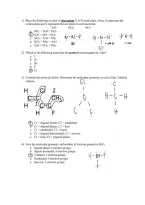
3) Consider the molecule below. Determine the molecular geometry at each of the 2 labeled
carbons.
a. C1 = trigonal planar, C2 = tetrahedral
b. C1 = trigonal planar, C2 = bent
c. C1 = tetrahedral, C2 = linear
d. C1 = trigonal bipyramidal, C2 = see-saw
e. C1 = bent, C2 = trigonal planar
4) Give the molecular geometry and number of electron groups for BrF3.
a. Square planar, 6 electron groups
b. Square pyramidal, 6 electron groups
c. T-shaped, 5 electron groups
d. Octahedral, 6 electron groups
e. See-saw, 5 electron groups
, 5) How many of the following elements can accommodate more than an octet of electrons?
B As N Kr H
a. 1
b. 2
c. 3
d. 4
e. 5
6) The total number of valence electrons in a molecule of SOF2 is ______?
a. 19
b. 20
c. 26
d. 18
7) A(n) _______ results from a transfer of one or more electrons from one atom or molecule
to another.
a. Covalent bond
b. Molecular bond
c. Nonpolar bond
d. Ionic bond
8) How many of the following molecules are nonpolar?
H2 S NF3 XeCl4 SO2
a. 4
b. 0
c. 1
d. 3
e. 2
9) Identify the fourth-row element X that forms the ion.
a. Br
b. Ge
c. Se
d. Kr
e. As
central atom and X represents the out atoms in each molecule.
N2 O NCl3 NO2-
a. NO2- > N2O > NCl3
b. N2O > NO2 > NCl3
c. NCl3 > N2O > NO2-
d. NCl3 > NO2- > N2O
e. N2O > NCl3 > NO2-
2) Which of the following atoms has the greatest electronegativity value?
a. I
b. Sr
c. Ne
d. P
e. Cl
3) Consider the molecule below. Determine the molecular geometry at each of the 2 labeled
carbons.
a. C1 = trigonal planar, C2 = tetrahedral
b. C1 = trigonal planar, C2 = bent
c. C1 = tetrahedral, C2 = linear
d. C1 = trigonal bipyramidal, C2 = see-saw
e. C1 = bent, C2 = trigonal planar
4) Give the molecular geometry and number of electron groups for BrF3.
a. Square planar, 6 electron groups
b. Square pyramidal, 6 electron groups
c. T-shaped, 5 electron groups
d. Octahedral, 6 electron groups
e. See-saw, 5 electron groups
, 5) How many of the following elements can accommodate more than an octet of electrons?
B As N Kr H
a. 1
b. 2
c. 3
d. 4
e. 5
6) The total number of valence electrons in a molecule of SOF2 is ______?
a. 19
b. 20
c. 26
d. 18
7) A(n) _______ results from a transfer of one or more electrons from one atom or molecule
to another.
a. Covalent bond
b. Molecular bond
c. Nonpolar bond
d. Ionic bond
8) How many of the following molecules are nonpolar?
H2 S NF3 XeCl4 SO2
a. 4
b. 0
c. 1
d. 3
e. 2
9) Identify the fourth-row element X that forms the ion.
a. Br
b. Ge
c. Se
d. Kr
e. As