
E X A M R E V I E W M AT E R I A L S · 2 0 2 0 2 7 U P D AT E ★ A+ VERIFIED
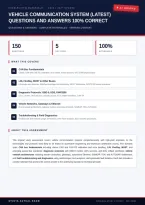
VEHICLE COMMUNICATION SYSTEM (LATEST)
QUESTIONS AND ANSWERS 100% CORRECT
QUESTIONS & ANSWERS · COMPLETE RATIONALES · VERIFIED CONTENT
150 5 100%
QUESTIONS SECTIONS R AT I O N A L E S
W H AT T H I S C O V E R S
CAN Bus Fundamentals
01
Classic CAN and CAN FD: arbitration, error states, frame structure, ISO 11898 physical layer
LIN, FlexRay, MOST & Other Buses
02
LIN single-wire networks, FlexRay time-triggered redundancy, MOST multimedia, SENT/PSI5 sensor interfaces
Diagnostic Protocols: OBD-II, UDS, KWP2000
03
DTCs, modes, UDS services, security access, ECU reflash workflows, CAN-TP
Vehicle Networks, Gateways & Ethernet
04
Domain/zonal architectures, gateway routing, automotive Ethernet, SOME/IP, TSN, AUTOSAR
Troubleshooting & Field Diagnostics
05
Oscilloscope and analyzer usage, termination, error frame analysis, ECU recovery procedures
ABOUT THIS ASSESSMENT
This original study assessment covers vehicle communication systems comprehensively, with high-yield emphasis on the
technologies and protocols most likely to be tested on automotive engineering and technician certification exams. Five domains
span: CAN bus fundamentals including classic CAN and CAN FD arbitration and error handling; LIN, FlexRay, MOST, and
emerging sensor-bus standards; diagnostic protocols with OBD-II modes, UDS services, and ECU reflash workflows; vehicle
network architectures including domain controllers, gateways, automotive Ethernet, SOME/IP, TSN, and AUTOSAR middleware;
and field troubleshooting and diagnostics using oscilloscopes, bus analyzers, and systematic fault isolation. Each item includes a
concise rationale that anchors the correct answer to the underlying standard or technical principle.
STUVIA ACTUAL EXAM ORIGINAL STUDY CONTENT · 150 ITEMS
,VEHICLE COMMUNICATION SYSTEM (LATEST) QUESTIONS AND ANSWERSOriginal
100%Study
CORRECT
Materials | 2026/2027
Section 1: CAN Bus Fundamentals
Classic CAN and CAN FD: arbitration, error states, frame structure, ISO 11898 physical layer | 30 questions
1. In a CAN bus, the dominant bit is logically represented by which electrical state?
A. CAN_H rising toward ~3.5 V and CAN_L falling toward ~1.5 V
B. Both CAN_H and CAN_L at 2.5 V (recessive)
C. CAN_H at 5 V and CAN_L at 0 V
D. Both lines at 0 V
CORRECT ANSWER: A
RATIONALE: In classic CAN, the recessive state is both lines at ~2.5 V (no driver active). The dominant
state drives CAN_H up toward 3.5 V and CAN_L down toward 1.5 V, producing a ~2 V differential. This
non-return-to-zero scheme allows non-destructive bit-wise arbitration.
2. CAN bus arbitration uses which principle to determine the winner when two nodes transmit
simultaneously?
A. The node with the highest message ID wins
B. The node with the lowest message ID wins (dominant 0 overwrites recessive 1)
C. The node that started transmitting first wins
D. The node with the highest clock speed wins
CORRECT ANSWER: B
RATIONALE: CAN uses bit-wise arbitration: each transmitter monitors the bus while sending. If a node
sends a recessive bit (1) but reads a dominant bit (0), it knows another node is sending a higher-priority
(lower binary value) identifier and stops transmitting. The lowest ID wins.
3. The standard CAN ID field in classic CAN (Base Frame Format) is how many bits?
A. 8 bits
B. 32 bits
C. 29 bits
D. 11 bits
CORRECT ANSWER: D
RATIONALE: Classic CAN Base Frame Format uses an 11-bit identifier, allowing 2^11 = 2,048 unique
IDs. The Extended Frame Format adds an 18-bit extension to allow 29-bit identifiers, dramatically
increasing the ID space. CAN FD supports both 11-bit and 29-bit IDs as well.
STUVIA ACTUAL EXAM Passing Score: 75% Page 1
,VEHICLE COMMUNICATION SYSTEM (LATEST) QUESTIONS AND ANSWERSOriginal
100%Study
CORRECT
Materials | 2026/2027
4. Which error condition causes a CAN controller to enter the 'bus-off' state?
A. A single bit error
B. REC (Receive Error Counter) exceeds 32
C. TEC (Transmit Error Counter) exceeds 255
D. A CRC error in a single message
CORRECT ANSWER: C
RATIONALE: CAN controllers track Transmit and Receive Error Counters. When the TEC exceeds 255,
the controller enters bus-off state, disabling further transmission. Recovery requires observing 128
occurrences of 11 consecutive recessive bits. This protects the bus from a faulty node flooding it with
errors.
5. The bit-stuffing rule in CAN requires inserting which bit after five consecutive same-value
bits?
A. A same-value bit
B. A dominant (0) bit always
C. A recessive (1) bit always
D. A complementary (opposite) bit
CORRECT ANSWER: D
RATIONALE: CAN uses non-return-to-zero (NRZ) encoding. To ensure the receiver can stay
synchronized despite the lack of explicit clock, the transmitter inserts a complementary bit after 5
consecutive same-value bits. The receiver removes (de-stuffs) these added bits during frame
processing.
6. The CAN CRC polynomial used is:
A. CRC-15 with polynomial 0x459
B. CRC-8 (0x07)
C. CRC-16-CCITT
D. CRC-32
CORRECT ANSWER: A
RATIONALE: Classic CAN uses a 15-bit CRC with the generator polynomial x^15 + x^14 + x^10 + x^8
+ x^7 + x^4 + x^3 + 1 (0x459). The 15-bit CRC field provides strong detection for typical payload
sizes (0-8 bytes). CAN FD uses the same polynomial but with a longer field for larger payloads.
STUVIA ACTUAL EXAM Passing Score: 75% Page 2
, VEHICLE COMMUNICATION SYSTEM (LATEST) QUESTIONS AND ANSWERSOriginal
100%Study
CORRECT
Materials | 2026/2027
7. In a CAN frame, the ACK slot is:
A. An idle period of unspecified length
B. A dominant bit sent by all receivers
C. A recessive bit sent by the transmitter that any receiving node may overwrite with a dominant
bit to acknowledge
D. A 7-bit interframe space
CORRECT ANSWER: C
RATIONALE: After the CRC, the transmitter sends a 1-bit ACK slot in the recessive state. Any node that
correctly received the frame drives it dominant to acknowledge. If the transmitter reads recessive (no
acknowledger), it flags an ACK error. This guarantees at least one other node received the frame.
8. CAN FD (Flexible Data-rate) supports which maximum payload size?
A. 8 bytes
B. 64 bytes
C. 256 bytes
D. 1024 bytes
CORRECT ANSWER: B
RATIONALE: CAN FD allows payloads up to 64 bytes per frame (versus 8 for classic CAN). It also
supports dual bit rates: a slower nominal rate for the arbitration phase and a faster data-phase rate (up
to 5-8 Mbps) for the data segment. This dramatically increases effective bandwidth.
9. The end-of-frame (EOF) field in a CAN frame consists of:
A. 7 consecutive recessive bits
B. 1 recessive bit
C. 3 dominant bits
D. A 5-bit CRC
CORRECT ANSWER: A
RATIONALE: Each CAN frame ends with 7 consecutive recessive bits. This EOF field marks the end of
the frame. After the EOF, the intermission field (3 recessive bits) follows before the next frame or idle.
The strict EOF pattern prevents corruption from being interpreted as continued frame data.
10. Which termination is used for a standard CAN bus topology?
A. No termination required
B. A single 60 ohm terminator at the midpoint
C. 50 ohm termination at each node
D. 120 ohm termination at each end of the bus (two terminators total)
CORRECT ANSWER: D
RATIONALE: Standard CAN uses a linear bus topology with two 120-ohm terminators at each physical
end. This matches the characteristic impedance of the twisted-pair cable and prevents signal reflections.
Without proper termination, signal reflections cause communication errors at higher bit rates.
STUVIA ACTUAL EXAM Passing Score: 75% Page 3
VEHICLE COMMUNICATION SYSTEM (LATEST)
QUESTIONS AND ANSWERS 100% CORRECT
QUESTIONS & ANSWERS · COMPLETE RATIONALES · VERIFIED CONTENT
150 5 100%
QUESTIONS SECTIONS R AT I O N A L E S
W H AT T H I S C O V E R S
CAN Bus Fundamentals
01
Classic CAN and CAN FD: arbitration, error states, frame structure, ISO 11898 physical layer
LIN, FlexRay, MOST & Other Buses
02
LIN single-wire networks, FlexRay time-triggered redundancy, MOST multimedia, SENT/PSI5 sensor interfaces
Diagnostic Protocols: OBD-II, UDS, KWP2000
03
DTCs, modes, UDS services, security access, ECU reflash workflows, CAN-TP
Vehicle Networks, Gateways & Ethernet
04
Domain/zonal architectures, gateway routing, automotive Ethernet, SOME/IP, TSN, AUTOSAR
Troubleshooting & Field Diagnostics
05
Oscilloscope and analyzer usage, termination, error frame analysis, ECU recovery procedures
ABOUT THIS ASSESSMENT
This original study assessment covers vehicle communication systems comprehensively, with high-yield emphasis on the
technologies and protocols most likely to be tested on automotive engineering and technician certification exams. Five domains
span: CAN bus fundamentals including classic CAN and CAN FD arbitration and error handling; LIN, FlexRay, MOST, and
emerging sensor-bus standards; diagnostic protocols with OBD-II modes, UDS services, and ECU reflash workflows; vehicle
network architectures including domain controllers, gateways, automotive Ethernet, SOME/IP, TSN, and AUTOSAR middleware;
and field troubleshooting and diagnostics using oscilloscopes, bus analyzers, and systematic fault isolation. Each item includes a
concise rationale that anchors the correct answer to the underlying standard or technical principle.
STUVIA ACTUAL EXAM ORIGINAL STUDY CONTENT · 150 ITEMS
,VEHICLE COMMUNICATION SYSTEM (LATEST) QUESTIONS AND ANSWERSOriginal
100%Study
CORRECT
Materials | 2026/2027
Section 1: CAN Bus Fundamentals
Classic CAN and CAN FD: arbitration, error states, frame structure, ISO 11898 physical layer | 30 questions
1. In a CAN bus, the dominant bit is logically represented by which electrical state?
A. CAN_H rising toward ~3.5 V and CAN_L falling toward ~1.5 V
B. Both CAN_H and CAN_L at 2.5 V (recessive)
C. CAN_H at 5 V and CAN_L at 0 V
D. Both lines at 0 V
CORRECT ANSWER: A
RATIONALE: In classic CAN, the recessive state is both lines at ~2.5 V (no driver active). The dominant
state drives CAN_H up toward 3.5 V and CAN_L down toward 1.5 V, producing a ~2 V differential. This
non-return-to-zero scheme allows non-destructive bit-wise arbitration.
2. CAN bus arbitration uses which principle to determine the winner when two nodes transmit
simultaneously?
A. The node with the highest message ID wins
B. The node with the lowest message ID wins (dominant 0 overwrites recessive 1)
C. The node that started transmitting first wins
D. The node with the highest clock speed wins
CORRECT ANSWER: B
RATIONALE: CAN uses bit-wise arbitration: each transmitter monitors the bus while sending. If a node
sends a recessive bit (1) but reads a dominant bit (0), it knows another node is sending a higher-priority
(lower binary value) identifier and stops transmitting. The lowest ID wins.
3. The standard CAN ID field in classic CAN (Base Frame Format) is how many bits?
A. 8 bits
B. 32 bits
C. 29 bits
D. 11 bits
CORRECT ANSWER: D
RATIONALE: Classic CAN Base Frame Format uses an 11-bit identifier, allowing 2^11 = 2,048 unique
IDs. The Extended Frame Format adds an 18-bit extension to allow 29-bit identifiers, dramatically
increasing the ID space. CAN FD supports both 11-bit and 29-bit IDs as well.
STUVIA ACTUAL EXAM Passing Score: 75% Page 1
,VEHICLE COMMUNICATION SYSTEM (LATEST) QUESTIONS AND ANSWERSOriginal
100%Study
CORRECT
Materials | 2026/2027
4. Which error condition causes a CAN controller to enter the 'bus-off' state?
A. A single bit error
B. REC (Receive Error Counter) exceeds 32
C. TEC (Transmit Error Counter) exceeds 255
D. A CRC error in a single message
CORRECT ANSWER: C
RATIONALE: CAN controllers track Transmit and Receive Error Counters. When the TEC exceeds 255,
the controller enters bus-off state, disabling further transmission. Recovery requires observing 128
occurrences of 11 consecutive recessive bits. This protects the bus from a faulty node flooding it with
errors.
5. The bit-stuffing rule in CAN requires inserting which bit after five consecutive same-value
bits?
A. A same-value bit
B. A dominant (0) bit always
C. A recessive (1) bit always
D. A complementary (opposite) bit
CORRECT ANSWER: D
RATIONALE: CAN uses non-return-to-zero (NRZ) encoding. To ensure the receiver can stay
synchronized despite the lack of explicit clock, the transmitter inserts a complementary bit after 5
consecutive same-value bits. The receiver removes (de-stuffs) these added bits during frame
processing.
6. The CAN CRC polynomial used is:
A. CRC-15 with polynomial 0x459
B. CRC-8 (0x07)
C. CRC-16-CCITT
D. CRC-32
CORRECT ANSWER: A
RATIONALE: Classic CAN uses a 15-bit CRC with the generator polynomial x^15 + x^14 + x^10 + x^8
+ x^7 + x^4 + x^3 + 1 (0x459). The 15-bit CRC field provides strong detection for typical payload
sizes (0-8 bytes). CAN FD uses the same polynomial but with a longer field for larger payloads.
STUVIA ACTUAL EXAM Passing Score: 75% Page 2
, VEHICLE COMMUNICATION SYSTEM (LATEST) QUESTIONS AND ANSWERSOriginal
100%Study
CORRECT
Materials | 2026/2027
7. In a CAN frame, the ACK slot is:
A. An idle period of unspecified length
B. A dominant bit sent by all receivers
C. A recessive bit sent by the transmitter that any receiving node may overwrite with a dominant
bit to acknowledge
D. A 7-bit interframe space
CORRECT ANSWER: C
RATIONALE: After the CRC, the transmitter sends a 1-bit ACK slot in the recessive state. Any node that
correctly received the frame drives it dominant to acknowledge. If the transmitter reads recessive (no
acknowledger), it flags an ACK error. This guarantees at least one other node received the frame.
8. CAN FD (Flexible Data-rate) supports which maximum payload size?
A. 8 bytes
B. 64 bytes
C. 256 bytes
D. 1024 bytes
CORRECT ANSWER: B
RATIONALE: CAN FD allows payloads up to 64 bytes per frame (versus 8 for classic CAN). It also
supports dual bit rates: a slower nominal rate for the arbitration phase and a faster data-phase rate (up
to 5-8 Mbps) for the data segment. This dramatically increases effective bandwidth.
9. The end-of-frame (EOF) field in a CAN frame consists of:
A. 7 consecutive recessive bits
B. 1 recessive bit
C. 3 dominant bits
D. A 5-bit CRC
CORRECT ANSWER: A
RATIONALE: Each CAN frame ends with 7 consecutive recessive bits. This EOF field marks the end of
the frame. After the EOF, the intermission field (3 recessive bits) follows before the next frame or idle.
The strict EOF pattern prevents corruption from being interpreted as continued frame data.
10. Which termination is used for a standard CAN bus topology?
A. No termination required
B. A single 60 ohm terminator at the midpoint
C. 50 ohm termination at each node
D. 120 ohm termination at each end of the bus (two terminators total)
CORRECT ANSWER: D
RATIONALE: Standard CAN uses a linear bus topology with two 120-ohm terminators at each physical
end. This matches the characteristic impedance of the twisted-pair cable and prevents signal reflections.
Without proper termination, signal reflections cause communication errors at higher bit rates.
STUVIA ACTUAL EXAM Passing Score: 75% Page 3


