
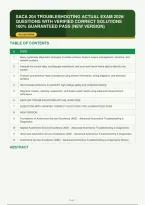
SACA 204 TROUBLESHOOTING ACTUAL EXAM 2026/
QUESTIONS WITH VERIFIED CORRECT SOLUTIONS
100% GUARANTEED PASS (NEW VERSION)
48 QUESTIONS
TABLE OF CONTENTS
# TOPIC
1 Apply systematic diagnostic strategies to isolate complex faults in engine management, electrical, and
network systems
2 Interpret live sensor data, oscilloscope waveforms, and scan-tool freeze-frame data to identify root
causes
3 Evaluate and prioritize repair procedures using service information, wiring diagrams, and technical
bulletins
4 Demonstrate proficiency in hybrid/EV high-voltage safety and component testing
5 Diagnose chassis, steering, suspension, and brake system faults using advanced measurement
techniques
6 SACA 204 TROUBLESHOOTING ACTUAL EXAM 2026
7 QUESTIONS WITH VERIFIED CORRECT SOLUTIONS 100% GUARANTEED PASS
8 NEW VERSION
9 Foundations of Automotive Service Excellence (ASE) - Advanced Automotive Troubleshooting &
Diagnostics
10 Applied Automotive Service Excellence (ASE) - Advanced Automotive Troubleshooting & Diagnostics
11 Advanced Automotive Service Excellence (ASE) - Advanced Automotive Troubleshooting & Diagnostics
12 Automotive Service Excellence (ASE) - Advanced Automotive Troubleshooting & Diagnostics Review
ABSTRACT
Page 1
,This study document brings together 48 carefully worded exam questions drawn from SACA 204
TROUBLESHOOTING ACTUAL EXAM 2026/ QUESTIONS WITH VERIFIED CORRECT
SOLUTIONS 100% GUARANTEED PASS (NEW VERSION), with the strongest emphasis placed
on Apply systematic diagnostic strategies to isolate complex faults in engine management,
electrical, and network systems, Interpret live sensor data, oscilloscope waveforms, and scan-tool
freeze-frame data to identify root causes, Evaluate and prioritize repair procedures using service
information, wiring diagrams and and technical bulletins. Every item follows the wording style and
level of reasoning you meet in the real paper, and each one is paired with a clear rationale so the
correct choice is never a guess. Work through the set at your own pace, mark the questions that
slow you down, then come back to them until the reasoning feels automatic. Learners who revise
this way walk into the exam room recognising the pattern behind the questions instead of meeting
them for the first time. Keep going - steady, honest practice is what turns a difficult paper into a
comfortable pass.
Q1 APPLY SYSTEMATIC DIAGNOSTIC STRATEGIES TO ISOLATE COMPLEX FAULTS IN
ENGINE MANAGEMENT, ELECTRICAL, AND NETWORK SYSTEMS
A vehicle exhibits a P0300 random misfire code with no other DTCs. Live data
shows fuel trims: STFT +18% and LTFT +12% at idle, but both trims normalize at
2500 rpm. Which is the most likely root cause?
A. Leaking fuel injector
B. Vacuum leak at intake manifold gasket CORRECT
C. Weak ignition coil
D. Restricted fuel filter
RATIONALE: Positive fuel trims at idle that normalize at higher rpm indicate a vacuum leak
(unmetered air) that is proportionally less significant as airflow increases. A leaking injector would
cause negative trims, a weak coil would not affect fuel trims, and a restricted fuel filter would
cause lean condition under load, not idle-specific.
Page 2
, Q2 APPLY SYSTEMATIC DIAGNOSTIC STRATEGIES TO ISOLATE COMPLEX FAULTS IN
ENGINE MANAGEMENT, ELECTRICAL, AND NETWORK SYSTEMS
An oscilloscope captures a secondary ignition waveform showing a burn time of
2.5 ms and a firing line of 2.0 kV. Which condition is indicated?
A. Lean air-fuel mixture
B. Rich air-fuel mixture CORRECT
C. High resistance in secondary circuit
D. Normal combustion
RATIONALE: A short burn time (2.5 ms) with a low firing line (2.0 kV) indicates a rich mixture, as
less voltage is required to ionize the gap and combustion is faster. Lean mixture would show
longer burn time and higher firing line. High resistance would increase firing voltage and shorten
burn time. Normal combustion typically has burn time 1.5-2.5 ms and firing line 5-15 kV, so this is
not normal.
Q3 APPLY SYSTEMATIC DIAGNOSTIC STRATEGIES TO ISOLATE COMPLEX FAULTS IN
ENGINE MANAGEMENT, ELECTRICAL, AND NETWORK SYSTEMS
A vehicle with CAN bus communication issues has DTC U0100 (Lost
Communication with ECM/PCM). A breakout box is installed at the DLC. With
ignition on, pins 6 and 14 both show 2.5V. Which is the most appropriate next
step?
A. Check for short to ground on CAN high
B. Check for short to voltage on CAN low
C. Measure resistance between pins 6 and 14 CORRECT
D. Replace the ECM
RATIONALE: Both CAN high and CAN low at 2.5V indicates the bus is likely in a 'bus off' or
shorted condition. Measuring resistance between pins 6 and 14 (should be ~60 ohms) will
identify if the bus is shorted or open. Checking for shorts to ground/voltage is less direct, and
replacing ECM is premature without diagnosis.
Page 3


