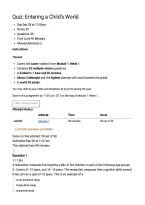
Quiz: Entering a Child’s World
Due Sep 28 at 11:59pm
Points 30
Questions 30
Time Limit 90 Minutes
Allowed Attempts 3
Instructions
The quiz:
Covers the Learn material from Module 1: Week 1.
Contains 30 multiple-choice questions.
Is limited to 1 hour and 30 minutes.
Allows 3 attempts and the highest attempt will count towards the grade.
Is worth 30 points.
You may refer to your notes and textbooks at any time during the quiz.
Submit this assignment by 11:59 p.m. (ET) on Monday of Module 1: Week 1.
TAKE THE QUIZ AGAIN
Attempt History
Attempt Time Score
LATEST Attempt 1 48 minutes 30 out of 30
Correct answers are hidden.
Score for this attempt: 30 out of 30
Submitted Sep 28 at 11:27am
This attempt took 48 minutes.
Question 1
pts
A researcher measures the cognitive skills of five children in each of the following age groups:
2–5 years, 8–12 years, and 14–16 years. The researcher measures their cognitive skills several
times across a span of 10 years. This is an example of a
cross-sectional study.
longitudinal study.
sequential study.
, correlational study.
Question 2
pts
Which of the following proposes that human behavior results from the operation of biological
parts in response to external or internal stimuli?
mechanistic model
organismic model
qualitative change
discontinuous change
Question 3
pts
________ is defined as inborn traits or characteristics inherited from a child's biological parents.
Heredity
Heritability
Eugenics
Ethnicity
Question 4
pts
Jeremy is conducting a study on the stressors faced by firefighters. He collects data by joining
a team of firefighters and observing them while they are at work. For his research, he is using
the
case study method.
laboratory observation method.
self-report method.
participant observation method.
Question 5
pts
A two-generational household unit generally consisting of one or two parents and their
biological children, adopted children, or stepchildren is called a(n)
joint family.
nuclear family.
extended family.
polyandrous family.
Due Sep 28 at 11:59pm
Points 30
Questions 30
Time Limit 90 Minutes
Allowed Attempts 3
Instructions
The quiz:
Covers the Learn material from Module 1: Week 1.
Contains 30 multiple-choice questions.
Is limited to 1 hour and 30 minutes.
Allows 3 attempts and the highest attempt will count towards the grade.
Is worth 30 points.
You may refer to your notes and textbooks at any time during the quiz.
Submit this assignment by 11:59 p.m. (ET) on Monday of Module 1: Week 1.
TAKE THE QUIZ AGAIN
Attempt History
Attempt Time Score
LATEST Attempt 1 48 minutes 30 out of 30
Correct answers are hidden.
Score for this attempt: 30 out of 30
Submitted Sep 28 at 11:27am
This attempt took 48 minutes.
Question 1
pts
A researcher measures the cognitive skills of five children in each of the following age groups:
2–5 years, 8–12 years, and 14–16 years. The researcher measures their cognitive skills several
times across a span of 10 years. This is an example of a
cross-sectional study.
longitudinal study.
sequential study.
, correlational study.
Question 2
pts
Which of the following proposes that human behavior results from the operation of biological
parts in response to external or internal stimuli?
mechanistic model
organismic model
qualitative change
discontinuous change
Question 3
pts
________ is defined as inborn traits or characteristics inherited from a child's biological parents.
Heredity
Heritability
Eugenics
Ethnicity
Question 4
pts
Jeremy is conducting a study on the stressors faced by firefighters. He collects data by joining
a team of firefighters and observing them while they are at work. For his research, he is using
the
case study method.
laboratory observation method.
self-report method.
participant observation method.
Question 5
pts
A two-generational household unit generally consisting of one or two parents and their
biological children, adopted children, or stepchildren is called a(n)
joint family.
nuclear family.
extended family.
polyandrous family.