
CFA® Level I Summary Notes: November 2026 Exam
All 10 topic areas · 2026 curriculum · formulas, worked examples, exam traps
0. Exam Snapshot and How to Use These Notes
November 2026 examination tests the 2026 curriculum (93 learning modules).
• 180 multiple-choice questions, three answer choices each (A, B, C)
• Two sessions of 135 minutes, 90 questions each, so about 90 seconds per question
• No negative marking. So, never leave a question blank.
• Permitted calculators: TI BA II Plus (any version) and HP 12C (any version)
• Recommended study time from CFA Institute: about 300 hours
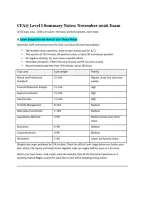
Topic area Exam weight Priority
Ethical and Professional 15–20% Highest. Study first and revise
Standards weekly.
Financial Statement Analysis 11–14% High
Equity Investments 11–14% High
Fixed Income 11–14% High
Portfolio Management 8–12% Medium
Alternative Investments 7–10% Medium
Quantitative Methods 6–9% Medium (feeds every other
topic)
Economics 6–9% Medium
Corporate Issuers 6–9% Medium
Derivatives 5–8% Lower, but formula-heavy
Weights are ranges published by CFA Institute. Check the official Level I page before you finalize your
plan. Ethics, FSA, Equity and Fixed Income together make up roughly half the exam or a bit more.
How to use these notes: read a topic, work the example, then do 20–30 practice questions on it.
Anything marked Trap is a point the exam likes to test with a tempting wrong answer.
,1. Ethical and Professional Standards
Code of Ethics (six points)
1. Act with integrity, competence, diligence, respect, and in an ethical manner with the public,
clients, prospective clients, employers, employees, colleagues, and other market participants.
2. Place the integrity of the investment profession and the interests of clients above your own
personal interests.
3. Use reasonable care and exercise independent professional judgment.
4. Practice and encourage others to practice in a professional and ethical way.
5. Promote the integrity and viability of global capital markets.
6. Maintain and improve your professional competence and that of other investment
professionals.
Standards of Professional Conduct (seven standards)
I. Professionalism
• I(A) Knowledge of the Law: follow the stricter of the law and the Code/Standards. Dissociate
from violations you can't stop. Reporting to authorities is not required, though it can be
prudent.
• I(B) Independence and Objectivity: no gifts or compensation that compromise judgment.
Modest gifts are fine. Disclose them. Issuer-paid research and investment-banking ties need
disclosure.
• I(C) Misrepresentation: no false statements about qualifications, performance or services, no
plagiarism, and no guaranteeing return. Factual data from recognized financial reporting
services may be used without attribution. Another analyst's report may not.
• I(D) Misconduct: no dishonesty, fraud or deceit, including in conduct that harms your
professional reputation.
II. Integrity of Capital Markets
• II(A) Material Nonpublic Information: don't act, or cause others to act, on it. Material means it
would move the price, or a reasonable investor would want it. Nonpublic means it hasn't
reached the market.
• Mosaic theory is allowed. You can combine public information with nonmaterial nonpublic
information.
• Best response to MNPI: encourage the company to disclose it. If that is impractical, stop trading
and tell compliance. Use firewalls (information barriers) plus watch and restricted lists.
• II(B) Market Manipulation: information-based (spreading false rumours) and transaction-based
(trading to distort price or volume). Strategies that exploit legitimate price differences are fine.
III. Duties to Clients
• III(A) Loyalty, Prudence and Care: put clients ahead of employer and self. Identify who the client
really is (for trust, the beneficiaries). Commissions belong to the client, so seek best execution.
Vote proxies with the client's interest in mind.
, • III(B) Fair Dealing: treat clients fairly, which doesn't mean identical outcomes. Different service
levels are allowed if disclosed and no one is disadvantaged. Share recommendations with all
affected clients at the same time. Allocate IPO shares pro rata.
• III(C) Suitability: gather client objectives and constraints (the IPS), judge suitability in the context
of the whole portfolio, and update at least annually. Follow the mandate for pooled funds.
• III(D) Performance Presentation: fair, accurate and complete. No cherry-picking.
• III(E) Preservation of Confidentiality: keep client information confidential unless (1) the client
permits disclosure, (2) the law requires it, or (3) the information concerns illegal activity.
IV. Duties to Employers
• IV(A) Loyalty: don't harm the employer. Independent practice needs written permission. Before
leaving, you may plan a new firm but not solicit clients or take client records. After leaving, you
may contact former clients from memory or public sources.
• IV(B) Additional Compensation Arrangements: get written employer consent before accepting
outside compensation that could create a conflict.
• IV(C) Responsibilities of Supervisors: make reasonable efforts to prevent and detect violations.
Have compliance procedures and respond promptly when a violation is found. If your firm has
no compliance system, decline supervisory duties in writing until it does.
V. Investment Analysis, Recommendations and Actions
• V(A) Diligence and Reasonable Basis: thorough analysis, and due diligence on third-party
research and quantitative models. If you disagree with group research, dissociate your name.
• V(B) Communication: describe your process, state limitations and risks, and separate facts from
opinion.
• V(C) Record Retention: keep records at least 7 years, unless local rules are stricter. Records
belong to the firm.
VI. Conflicts of Interest
• VI(A) Disclosure of Conflicts: full, fair, prominent and in plain language. Covers stock ownership,
board seats, banking relationships and compensation.
• VI(B) Priority of Transactions: clients first, then employer, then personal. Pre-clear personal
participation in IPOs and private placements.
• VI(C) Referral Fees: disclose to the employer, clients and prospects before any agreement.
VII. Responsibilities as a CFA Institute Member or Candidate
• VII(A) Conduct as Participants in the CFA Program: no cheating, no sharing exam content, no
using unauthorized material.
• VII(B) Reference to CFA Institute, the CFA Designation and the CFA Program: no overselling.
Passing all three levels first time may be stated as fact but must not imply superior ability. You
can say you are a candidate in the CFA Program or that you passed Level I. You may not present
'CFA Level I' as a designation or claim partial designation.
Trap: Standard I(A) says follow the stricter rule. If local law is less strict than the Code, you follow the
Code. If local law is stricter, you follow the law.
All 10 topic areas · 2026 curriculum · formulas, worked examples, exam traps
0. Exam Snapshot and How to Use These Notes
November 2026 examination tests the 2026 curriculum (93 learning modules).
• 180 multiple-choice questions, three answer choices each (A, B, C)
• Two sessions of 135 minutes, 90 questions each, so about 90 seconds per question
• No negative marking. So, never leave a question blank.
• Permitted calculators: TI BA II Plus (any version) and HP 12C (any version)
• Recommended study time from CFA Institute: about 300 hours
Topic area Exam weight Priority
Ethical and Professional 15–20% Highest. Study first and revise
Standards weekly.
Financial Statement Analysis 11–14% High
Equity Investments 11–14% High
Fixed Income 11–14% High
Portfolio Management 8–12% Medium
Alternative Investments 7–10% Medium
Quantitative Methods 6–9% Medium (feeds every other
topic)
Economics 6–9% Medium
Corporate Issuers 6–9% Medium
Derivatives 5–8% Lower, but formula-heavy
Weights are ranges published by CFA Institute. Check the official Level I page before you finalize your
plan. Ethics, FSA, Equity and Fixed Income together make up roughly half the exam or a bit more.
How to use these notes: read a topic, work the example, then do 20–30 practice questions on it.
Anything marked Trap is a point the exam likes to test with a tempting wrong answer.
,1. Ethical and Professional Standards
Code of Ethics (six points)
1. Act with integrity, competence, diligence, respect, and in an ethical manner with the public,
clients, prospective clients, employers, employees, colleagues, and other market participants.
2. Place the integrity of the investment profession and the interests of clients above your own
personal interests.
3. Use reasonable care and exercise independent professional judgment.
4. Practice and encourage others to practice in a professional and ethical way.
5. Promote the integrity and viability of global capital markets.
6. Maintain and improve your professional competence and that of other investment
professionals.
Standards of Professional Conduct (seven standards)
I. Professionalism
• I(A) Knowledge of the Law: follow the stricter of the law and the Code/Standards. Dissociate
from violations you can't stop. Reporting to authorities is not required, though it can be
prudent.
• I(B) Independence and Objectivity: no gifts or compensation that compromise judgment.
Modest gifts are fine. Disclose them. Issuer-paid research and investment-banking ties need
disclosure.
• I(C) Misrepresentation: no false statements about qualifications, performance or services, no
plagiarism, and no guaranteeing return. Factual data from recognized financial reporting
services may be used without attribution. Another analyst's report may not.
• I(D) Misconduct: no dishonesty, fraud or deceit, including in conduct that harms your
professional reputation.
II. Integrity of Capital Markets
• II(A) Material Nonpublic Information: don't act, or cause others to act, on it. Material means it
would move the price, or a reasonable investor would want it. Nonpublic means it hasn't
reached the market.
• Mosaic theory is allowed. You can combine public information with nonmaterial nonpublic
information.
• Best response to MNPI: encourage the company to disclose it. If that is impractical, stop trading
and tell compliance. Use firewalls (information barriers) plus watch and restricted lists.
• II(B) Market Manipulation: information-based (spreading false rumours) and transaction-based
(trading to distort price or volume). Strategies that exploit legitimate price differences are fine.
III. Duties to Clients
• III(A) Loyalty, Prudence and Care: put clients ahead of employer and self. Identify who the client
really is (for trust, the beneficiaries). Commissions belong to the client, so seek best execution.
Vote proxies with the client's interest in mind.
, • III(B) Fair Dealing: treat clients fairly, which doesn't mean identical outcomes. Different service
levels are allowed if disclosed and no one is disadvantaged. Share recommendations with all
affected clients at the same time. Allocate IPO shares pro rata.
• III(C) Suitability: gather client objectives and constraints (the IPS), judge suitability in the context
of the whole portfolio, and update at least annually. Follow the mandate for pooled funds.
• III(D) Performance Presentation: fair, accurate and complete. No cherry-picking.
• III(E) Preservation of Confidentiality: keep client information confidential unless (1) the client
permits disclosure, (2) the law requires it, or (3) the information concerns illegal activity.
IV. Duties to Employers
• IV(A) Loyalty: don't harm the employer. Independent practice needs written permission. Before
leaving, you may plan a new firm but not solicit clients or take client records. After leaving, you
may contact former clients from memory or public sources.
• IV(B) Additional Compensation Arrangements: get written employer consent before accepting
outside compensation that could create a conflict.
• IV(C) Responsibilities of Supervisors: make reasonable efforts to prevent and detect violations.
Have compliance procedures and respond promptly when a violation is found. If your firm has
no compliance system, decline supervisory duties in writing until it does.
V. Investment Analysis, Recommendations and Actions
• V(A) Diligence and Reasonable Basis: thorough analysis, and due diligence on third-party
research and quantitative models. If you disagree with group research, dissociate your name.
• V(B) Communication: describe your process, state limitations and risks, and separate facts from
opinion.
• V(C) Record Retention: keep records at least 7 years, unless local rules are stricter. Records
belong to the firm.
VI. Conflicts of Interest
• VI(A) Disclosure of Conflicts: full, fair, prominent and in plain language. Covers stock ownership,
board seats, banking relationships and compensation.
• VI(B) Priority of Transactions: clients first, then employer, then personal. Pre-clear personal
participation in IPOs and private placements.
• VI(C) Referral Fees: disclose to the employer, clients and prospects before any agreement.
VII. Responsibilities as a CFA Institute Member or Candidate
• VII(A) Conduct as Participants in the CFA Program: no cheating, no sharing exam content, no
using unauthorized material.
• VII(B) Reference to CFA Institute, the CFA Designation and the CFA Program: no overselling.
Passing all three levels first time may be stated as fact but must not imply superior ability. You
can say you are a candidate in the CFA Program or that you passed Level I. You may not present
'CFA Level I' as a designation or claim partial designation.
Trap: Standard I(A) says follow the stricter rule. If local law is less strict than the Code, you follow the
Code. If local law is stricter, you follow the law.


