
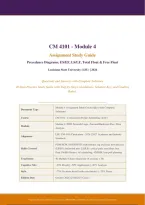
CM 4101 - Module 4
Assignment Study Guide
Precedence Diagrams, ES/EF, LS/LF, Total Float & Free Float
Louisiana State University (LSU) | 2026
Questions and Answers with Complete Solutions
40-Item Practice Study Guide with Step-by-Step Calculations, Solution Key, and Grading
Rubric
Module 4 Assignment Study Guide (Q&A with Complete
Document Type
Solutions)
Course CM 4101 - Construction Project Scheduling (LSU)
Module 4: PDM Network Logic, Forward/Backward Pass, Float
Module
Analysis
LSU CM 4101 Curriculum - 2026 | 2027 Academic and Industry
Alignment
Standards
PDM/AON; FS/SS/FF/SF relationships; lag and lead; forward pass
Skills Covered (ES/EF); backward pass (LS/LF); critical path; total float; free
float; P6/MS Project; AI scheduling; 4D BIM; lean pull planning
Total Items 40 Multiple-Choice Questions (4 sections x 10)
Cognitive Mix ~30% Recall | ~50% Application | ~20% Analysis
Style ~75% Scenario-based (with calculations) | ~25% Direct
Edition Date October 2026 (2026/2027 Cycle)
Aligned with LSU CM 4101 Curriculum - PDM/CPM - 2026/2027 Academic and Industry Standards
,CM 4101 Module 4 Assignment - Precedence Diagrams, ES/EF, LS/LF, Float - LSU - 2026 Construction Scheduling
Abstract
This study guide presents a 40-item multiple-choice assignment aligned with the LSU CM 4101
Module 4 curriculum and the 2026/2027 academic and industry cycle, focused on the Precedence
Diagramming Method (PDM), Critical Path Method (CPM), forward and backward pass
calculations, and float analysis. Items are distributed across four domains: PDM and network logic
(FS, SS, FF, SF relationships, lag/lead, loops, and dangling activities); forward pass calculations (ES
+ Duration = EF, merge-point MAX rule, project duration); backward pass calculations (LF -
Duration = LS, burst-point MIN rule, critical-path identification); and float analysis (Total Float and
Free Float, near-critical paths, negative float) with 2026/2027 updates on Primavera P6 and MS
Project, AI-assisted schedule optimization, BIM-integrated 4D scheduling, and lean pull planning.
Each item provides a four-option stem with a single best answer and a layered rationale that shows
the exact calculation step or network-logic rule and identifies why each distractor represents a
common computational or conceptual scheduling error. The instrument targets a cognitive
distribution of approximately 30% recall, 50% application, and 20% analysis, with roughly 75% of
items scenario-based to mirror real construction scheduling practice. A complete solution key and a
100-point grading rubric (2.5 points per item, with partial-credit guidance for CPM calculation
scenarios) accompany the assignment, and a mastery threshold of 75% is recommended for
passing/proficient performance on the CM 4101 Module 4 Assignment.
Keywords
Precedence Diagramming Method (PDM); Critical Path Method (CPM); Activity-on-Node (AON); forward
pass; backward pass; Early Start (ES); Early Finish (EF); Late Start (LS); Late Finish (LF); Total Float; Free
Float; critical path; Primavera P6; 4D BIM; lean pull planning; LSU CM 4101; 2026/2027.
How to Use This Guide
Candidates should attempt all 40 items under timed conditions (approximately 45 seconds per recall item and
90 seconds per scenario or calculation item, for a total of roughly 45 minutes) before consulting the rationales.
For calculation items, work the forward and backward pass on scratch paper before selecting an answer. After
scoring, items answered incorrectly should be re-studied by reading both the correct rationale and the distractor
explanations, because the distractors in this instrument are deliberately engineered to reflect common
computational and conceptual scheduling errors (e.g., using MIN at a merge point, MAX at a burst point, or
confusing FS with SS). The solution key and grading rubric that follow the assignment support both
self-assessment and instructor-led administration.
Part 1 - Practice Assignment (40 Items)
Instructions: Select the single best answer (A-D) for each item. Scenario-based items require step-by-step CPM
calculation or network-logic analysis. Answers and full rationales are printed immediately beneath each item to
support study-mode learning.
Section 1: Precedence Diagramming Method (PDM) & Network Logic
Page 2
, CM 4101 Module 4 Assignment - Precedence Diagrams, ES/EF, LS/LF, Float - LSU - 2026 Construction Scheduling
Q1: In the Precedence Diagramming Method (PDM), the Activity-on-Node (AON) convention represents
activities as: (Recall) (Direct)
A. Nodes (boxes), with arrows showing logical dependencies between activities [CORRECT]
B. Arrows, with nodes representing only events or milestones
C. Bars on a Gantt chart
D. Lines on a calendar timeline
Correct Answer: A
Rationale: PDM uses AON, where activities are nodes and arrows show precedence. Option B describes
Activity-on-Arrow (AOA), the older PERT/CPM convention; C and D describe Gantt-chart visualization, not
network logic.
Q2: A Finish-to-Start (FS) relationship with no lag means: (Recall) (Direct)
A. The successor cannot start until the predecessor finishes [CORRECT]
B. The successor cannot start until the predecessor starts
C. The successor cannot finish until the predecessor finishes
D. The successor cannot finish until the predecessor starts
Correct Answer: A
Rationale: FS governs the start of the successor against the finish of the predecessor. B is SS; C is FF; D is SF.
FS is the default and most common relationship in construction scheduling.
Q3: A Start-to-Start (SS) relationship with a 5-day lag means: (Recall) (Direct)
A. The successor may start 5 days after the predecessor starts [CORRECT]
B. The successor may finish 5 days after the predecessor finishes
C. The successor must wait 5 days after the predecessor finishes
D. The successor starts 5 days before the predecessor starts
Correct Answer: A
Rationale: SS with positive lag means the successor starts lag days after the predecessor starts. Option B
describes FF; C describes FS with lag; D describes a lead (negative lag).
Q4: A Finish-to-Finish (FF) relationship means: (Recall) (Direct)
A. The successor cannot finish until the predecessor has finished [CORRECT]
B. The successor cannot start until the predecessor finishes
C. The successor cannot start until the predecessor starts
D. The successor cannot finish until the predecessor starts
Correct Answer: A
Rationale: FF governs the finish of the successor against the finish of the predecessor. B is FS; C is SS; D is SF.
FF is common when two activities can run concurrently but must finish together.
Q5: The Start-to-Finish (SF) relationship, the least common in construction scheduling, means: (Recall)
(Direct)
A. The successor's finish depends on the predecessor's start [CORRECT]
B. The successor's start depends on the predecessor's finish
C. The successor's start depends on the predecessor's start
D. The successor's finish depends on the predecessor's finish
Correct Answer: A
Rationale: SF is rarely used in construction but means the successor cannot finish until the predecessor starts. B,
C, and D describe FS, SS, and FF respectively.
Page 3
Assignment Study Guide
Precedence Diagrams, ES/EF, LS/LF, Total Float & Free Float
Louisiana State University (LSU) | 2026
Questions and Answers with Complete Solutions
40-Item Practice Study Guide with Step-by-Step Calculations, Solution Key, and Grading
Rubric
Module 4 Assignment Study Guide (Q&A with Complete
Document Type
Solutions)
Course CM 4101 - Construction Project Scheduling (LSU)
Module 4: PDM Network Logic, Forward/Backward Pass, Float
Module
Analysis
LSU CM 4101 Curriculum - 2026 | 2027 Academic and Industry
Alignment
Standards
PDM/AON; FS/SS/FF/SF relationships; lag and lead; forward pass
Skills Covered (ES/EF); backward pass (LS/LF); critical path; total float; free
float; P6/MS Project; AI scheduling; 4D BIM; lean pull planning
Total Items 40 Multiple-Choice Questions (4 sections x 10)
Cognitive Mix ~30% Recall | ~50% Application | ~20% Analysis
Style ~75% Scenario-based (with calculations) | ~25% Direct
Edition Date October 2026 (2026/2027 Cycle)
Aligned with LSU CM 4101 Curriculum - PDM/CPM - 2026/2027 Academic and Industry Standards
,CM 4101 Module 4 Assignment - Precedence Diagrams, ES/EF, LS/LF, Float - LSU - 2026 Construction Scheduling
Abstract
This study guide presents a 40-item multiple-choice assignment aligned with the LSU CM 4101
Module 4 curriculum and the 2026/2027 academic and industry cycle, focused on the Precedence
Diagramming Method (PDM), Critical Path Method (CPM), forward and backward pass
calculations, and float analysis. Items are distributed across four domains: PDM and network logic
(FS, SS, FF, SF relationships, lag/lead, loops, and dangling activities); forward pass calculations (ES
+ Duration = EF, merge-point MAX rule, project duration); backward pass calculations (LF -
Duration = LS, burst-point MIN rule, critical-path identification); and float analysis (Total Float and
Free Float, near-critical paths, negative float) with 2026/2027 updates on Primavera P6 and MS
Project, AI-assisted schedule optimization, BIM-integrated 4D scheduling, and lean pull planning.
Each item provides a four-option stem with a single best answer and a layered rationale that shows
the exact calculation step or network-logic rule and identifies why each distractor represents a
common computational or conceptual scheduling error. The instrument targets a cognitive
distribution of approximately 30% recall, 50% application, and 20% analysis, with roughly 75% of
items scenario-based to mirror real construction scheduling practice. A complete solution key and a
100-point grading rubric (2.5 points per item, with partial-credit guidance for CPM calculation
scenarios) accompany the assignment, and a mastery threshold of 75% is recommended for
passing/proficient performance on the CM 4101 Module 4 Assignment.
Keywords
Precedence Diagramming Method (PDM); Critical Path Method (CPM); Activity-on-Node (AON); forward
pass; backward pass; Early Start (ES); Early Finish (EF); Late Start (LS); Late Finish (LF); Total Float; Free
Float; critical path; Primavera P6; 4D BIM; lean pull planning; LSU CM 4101; 2026/2027.
How to Use This Guide
Candidates should attempt all 40 items under timed conditions (approximately 45 seconds per recall item and
90 seconds per scenario or calculation item, for a total of roughly 45 minutes) before consulting the rationales.
For calculation items, work the forward and backward pass on scratch paper before selecting an answer. After
scoring, items answered incorrectly should be re-studied by reading both the correct rationale and the distractor
explanations, because the distractors in this instrument are deliberately engineered to reflect common
computational and conceptual scheduling errors (e.g., using MIN at a merge point, MAX at a burst point, or
confusing FS with SS). The solution key and grading rubric that follow the assignment support both
self-assessment and instructor-led administration.
Part 1 - Practice Assignment (40 Items)
Instructions: Select the single best answer (A-D) for each item. Scenario-based items require step-by-step CPM
calculation or network-logic analysis. Answers and full rationales are printed immediately beneath each item to
support study-mode learning.
Section 1: Precedence Diagramming Method (PDM) & Network Logic
Page 2
, CM 4101 Module 4 Assignment - Precedence Diagrams, ES/EF, LS/LF, Float - LSU - 2026 Construction Scheduling
Q1: In the Precedence Diagramming Method (PDM), the Activity-on-Node (AON) convention represents
activities as: (Recall) (Direct)
A. Nodes (boxes), with arrows showing logical dependencies between activities [CORRECT]
B. Arrows, with nodes representing only events or milestones
C. Bars on a Gantt chart
D. Lines on a calendar timeline
Correct Answer: A
Rationale: PDM uses AON, where activities are nodes and arrows show precedence. Option B describes
Activity-on-Arrow (AOA), the older PERT/CPM convention; C and D describe Gantt-chart visualization, not
network logic.
Q2: A Finish-to-Start (FS) relationship with no lag means: (Recall) (Direct)
A. The successor cannot start until the predecessor finishes [CORRECT]
B. The successor cannot start until the predecessor starts
C. The successor cannot finish until the predecessor finishes
D. The successor cannot finish until the predecessor starts
Correct Answer: A
Rationale: FS governs the start of the successor against the finish of the predecessor. B is SS; C is FF; D is SF.
FS is the default and most common relationship in construction scheduling.
Q3: A Start-to-Start (SS) relationship with a 5-day lag means: (Recall) (Direct)
A. The successor may start 5 days after the predecessor starts [CORRECT]
B. The successor may finish 5 days after the predecessor finishes
C. The successor must wait 5 days after the predecessor finishes
D. The successor starts 5 days before the predecessor starts
Correct Answer: A
Rationale: SS with positive lag means the successor starts lag days after the predecessor starts. Option B
describes FF; C describes FS with lag; D describes a lead (negative lag).
Q4: A Finish-to-Finish (FF) relationship means: (Recall) (Direct)
A. The successor cannot finish until the predecessor has finished [CORRECT]
B. The successor cannot start until the predecessor finishes
C. The successor cannot start until the predecessor starts
D. The successor cannot finish until the predecessor starts
Correct Answer: A
Rationale: FF governs the finish of the successor against the finish of the predecessor. B is FS; C is SS; D is SF.
FF is common when two activities can run concurrently but must finish together.
Q5: The Start-to-Finish (SF) relationship, the least common in construction scheduling, means: (Recall)
(Direct)
A. The successor's finish depends on the predecessor's start [CORRECT]
B. The successor's start depends on the predecessor's finish
C. The successor's start depends on the predecessor's start
D. The successor's finish depends on the predecessor's finish
Correct Answer: A
Rationale: SF is rarely used in construction but means the successor cannot finish until the predecessor starts. B,
C, and D describe FS, SS, and FF respectively.
Page 3


