
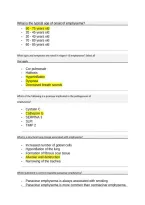
What is the typical age of onset of emphysema?
• 50 - 75 years old
• 20 - 45 years old
• 30 - 40 years old
• 70 - 80 years old
• 60 - 85 years old
What signs and symptoms are noted in stages I- III emphysema? Select all
that apply.
• Cor pulmonale
• Halitosis
• Hyperinflation
• Dyspnea
• Decreased breath sounds
Which of the following is a protease implicated in the pathogenesis of
emphysema?
• Cystatin C
• Cathepsin G
• SERPINA 3
• SLPI
• TIMP 2
What is a structural lung change associated with emphysema?
• Increased number of goblet cells
• Hypoinflation of the lung
• Formation of fibrous scar tissue
• Alveolar wall destruction
• Narrowing of the trachea
Which statement is correct regarding panacinar emphysema?
• Panacinar emphysema is always associated with smoking.
• Panacinar emphysema is more common than centriacinar emphysema.
, • Respiratory failure is not a complication of panacinar emphysema.
• Panacinar emphysema progresses in the centrilobular region.
• Panacinar emphysema is associated with AAT deficiency.
Based on the given mortality rate, which category best describes the risk level
for non-cardiogenic pulmonary edema?
• Low risk (5%–15% mortality)
• Very low risk (less than 5% mortality)
• Moderate risk (15%–30% mortality)
• Very high risk (over 50% mortality)
• High risk (30%–50% mortality)
In the diagnosis of ARDS, which condition is most crucial to exclude due to its
similar presentation?
• Bacterial pneumonia
• Chronic obstructive pulmonary disease (COPD)
• Acute cardiogenic pulmonary edema
• Pulmonary embolism
• Pneumothorax
Which of the following components is a hallmark of the inflammatory process
in ARDS and contributes to the compromised gas exchange?
• Red blood cells
• Fibrin
• Edema fluid
• Neutrophils
• Macrophages
Which phase of ARDS is characterized by alveolar epithelial cell proliferation
and new pulmonary surfactant production?
• Inflammatory phase
• Proliferative phase
• 50 - 75 years old
• 20 - 45 years old
• 30 - 40 years old
• 70 - 80 years old
• 60 - 85 years old
What signs and symptoms are noted in stages I- III emphysema? Select all
that apply.
• Cor pulmonale
• Halitosis
• Hyperinflation
• Dyspnea
• Decreased breath sounds
Which of the following is a protease implicated in the pathogenesis of
emphysema?
• Cystatin C
• Cathepsin G
• SERPINA 3
• SLPI
• TIMP 2
What is a structural lung change associated with emphysema?
• Increased number of goblet cells
• Hypoinflation of the lung
• Formation of fibrous scar tissue
• Alveolar wall destruction
• Narrowing of the trachea
Which statement is correct regarding panacinar emphysema?
• Panacinar emphysema is always associated with smoking.
• Panacinar emphysema is more common than centriacinar emphysema.
, • Respiratory failure is not a complication of panacinar emphysema.
• Panacinar emphysema progresses in the centrilobular region.
• Panacinar emphysema is associated with AAT deficiency.
Based on the given mortality rate, which category best describes the risk level
for non-cardiogenic pulmonary edema?
• Low risk (5%–15% mortality)
• Very low risk (less than 5% mortality)
• Moderate risk (15%–30% mortality)
• Very high risk (over 50% mortality)
• High risk (30%–50% mortality)
In the diagnosis of ARDS, which condition is most crucial to exclude due to its
similar presentation?
• Bacterial pneumonia
• Chronic obstructive pulmonary disease (COPD)
• Acute cardiogenic pulmonary edema
• Pulmonary embolism
• Pneumothorax
Which of the following components is a hallmark of the inflammatory process
in ARDS and contributes to the compromised gas exchange?
• Red blood cells
• Fibrin
• Edema fluid
• Neutrophils
• Macrophages
Which phase of ARDS is characterized by alveolar epithelial cell proliferation
and new pulmonary surfactant production?
• Inflammatory phase
• Proliferative phase


