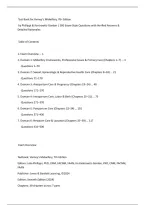
Test Bank for Varney's Midwifery, 7th Edition
by Phillippi & Kantrowitz-Gordon | 500 Exam-Style Questions with Verified Answers &
Detailed Rationales
Table of Contents
1. Exam Overview … 1
2. Domain 1: Midwifery Frameworks, Professional Issues & Primary Care (Chapters 1–7) … 3
- Questions 1–70
3. Domain 2: Sexual, Gynecologic & Reproductive Health Care (Chapters 8–18) … 21
- Questions 71–170
4. Domain 3: Antepartum Care & Pregnancy (Chapters 19–24) … 48
- Questions 171–270
5. Domain 4: Intrapartum Care, Labor & Birth (Chapters 25–31) … 75
- Questions 271–370
6. Domain 5: Postpartum Care (Chapters 32–34) … 101
- Questions 371–430
7. Domain 6: Newborn Care & Lactation (Chapters 35–39) … 117
- Questions 431–500
Exam Overview
Textbook: Varney's Midwifery, 7th Edition
Editors: Julia Phillippi, PhD, CNM, FACNM, FAAN; Ira Kantrowitz-Gordon, PhD, CNM, FACNM,
FAAN
Publisher: Jones & Bartlett Learning, ©2024
Edition: Seventh Edition (2024)
Chapters: 39 chapters across 7 parts
,Certification Exam: AMCB (American Midwifery Certification Board)
Exam Format: Multiple-choice questions
Content Areas & Weightings: Primary Care (12–16%), Antepartum Care (15–25%),
Intrapartum Care (25–35%), Postpartum (5–10%), Newborn Care (10–15%), Well
Woman/Gynecology (15–20%), Professional Issues (1–5%)
Seventh Edition Key Updates:
- Reflects the new ACNM Core Competencies for Basic Midwifery Practice published in 2020
- Includes care of transgender individuals and abortion-related care
- Updated content on health equity, fetal screening, and chronic conditions in pregnancy
- New content on social determinants of health and the changing population midwives serve
Textbook Structure (Parts I–VII):
- Part I: Midwifery (Chapters 1–2)
- Part II: Primary Care (Chapters 3–7)
- Part III: Sexual, Gynecologic, and Reproductive Health Care (Chapters 8–18)
- Part IV: Antepartum (Chapters 19–24)
- Part V: Intrapartum (Chapters 25–31)
- Part VI: Postpartum (Chapters 32–34)
- Part VII: Newborn (Chapters 35–39)
DOMAIN 1: MIDWIFERY FRAMEWORKS, PROFESSIONAL ISSUES & PRIMARY CARE
Chapters 1–7 | Questions 1–70
Question 1. A nurse-midwife is conducting genetic counseling with an Ashkenazi Jewish
couple. Which autosomal recessive genetic disease should the midwife discuss with this
couple?
,A) Thalassemia
B) Cystic fibrosis
C) Sickle cell disease
D) Tay-Sachs disease
Answer: D
Explanation: Tay-Sachs disease is an autosomal recessive condition that is more prevalent in
individuals of Ashkenazi Jewish descent. Genetic screening and counseling for this
population is a standard part of preconception and prenatal care.
---
Question 2. The nurse-midwife is providing prenatal care to a patient who is diagnosed with
cytomegalovirus (CMV) infection. Which birth defect should the midwife include when
educating the patient on the consequences of this infection?
A) Deafness
B) Microcephaly
C) Hydrocephaly
D) Chorioretinitis
Answer: B
Explanation: Congenital CMV infection is a leading cause of birth defects, with microcephaly
being a significant consequence. Patient education should include potential neurological and
developmental impacts.
---
, Question 3. The nurse-midwife provides care to a nonpregnant patient experiencing chronic
gynecologic pain. Which disorder should the midwife assess the patient for during the
physical examination?
A) Ovarian cancer
B) Pelvic inflammatory disease
C) Rupture of endometrioma
D) Intrauterine device imperforation
Answer: A
Explanation: Chronic gynecologic pain is a symptom associated with ovarian cancer.
Midwives should be vigilant in assessing for this and other serious causes of pelvic pain.
---
Question 4. Which patient population has the greatest risk for giving birth to a newborn with
trisomy 21?
A) A 25-year-old Black patient of African descent
B) A 30-year-old white patient of Northern European descent
C) A 35-year-old Black patient of African descent
D) A 40-year-old white patient of Northern European descent
Answer: D
Explanation: Advanced maternal age (≥35 years) is the most significant risk factor for trisomy
21, regardless of race or ethnicity. Risk increases with maternal age.
by Phillippi & Kantrowitz-Gordon | 500 Exam-Style Questions with Verified Answers &
Detailed Rationales
Table of Contents
1. Exam Overview … 1
2. Domain 1: Midwifery Frameworks, Professional Issues & Primary Care (Chapters 1–7) … 3
- Questions 1–70
3. Domain 2: Sexual, Gynecologic & Reproductive Health Care (Chapters 8–18) … 21
- Questions 71–170
4. Domain 3: Antepartum Care & Pregnancy (Chapters 19–24) … 48
- Questions 171–270
5. Domain 4: Intrapartum Care, Labor & Birth (Chapters 25–31) … 75
- Questions 271–370
6. Domain 5: Postpartum Care (Chapters 32–34) … 101
- Questions 371–430
7. Domain 6: Newborn Care & Lactation (Chapters 35–39) … 117
- Questions 431–500
Exam Overview
Textbook: Varney's Midwifery, 7th Edition
Editors: Julia Phillippi, PhD, CNM, FACNM, FAAN; Ira Kantrowitz-Gordon, PhD, CNM, FACNM,
FAAN
Publisher: Jones & Bartlett Learning, ©2024
Edition: Seventh Edition (2024)
Chapters: 39 chapters across 7 parts
,Certification Exam: AMCB (American Midwifery Certification Board)
Exam Format: Multiple-choice questions
Content Areas & Weightings: Primary Care (12–16%), Antepartum Care (15–25%),
Intrapartum Care (25–35%), Postpartum (5–10%), Newborn Care (10–15%), Well
Woman/Gynecology (15–20%), Professional Issues (1–5%)
Seventh Edition Key Updates:
- Reflects the new ACNM Core Competencies for Basic Midwifery Practice published in 2020
- Includes care of transgender individuals and abortion-related care
- Updated content on health equity, fetal screening, and chronic conditions in pregnancy
- New content on social determinants of health and the changing population midwives serve
Textbook Structure (Parts I–VII):
- Part I: Midwifery (Chapters 1–2)
- Part II: Primary Care (Chapters 3–7)
- Part III: Sexual, Gynecologic, and Reproductive Health Care (Chapters 8–18)
- Part IV: Antepartum (Chapters 19–24)
- Part V: Intrapartum (Chapters 25–31)
- Part VI: Postpartum (Chapters 32–34)
- Part VII: Newborn (Chapters 35–39)
DOMAIN 1: MIDWIFERY FRAMEWORKS, PROFESSIONAL ISSUES & PRIMARY CARE
Chapters 1–7 | Questions 1–70
Question 1. A nurse-midwife is conducting genetic counseling with an Ashkenazi Jewish
couple. Which autosomal recessive genetic disease should the midwife discuss with this
couple?
,A) Thalassemia
B) Cystic fibrosis
C) Sickle cell disease
D) Tay-Sachs disease
Answer: D
Explanation: Tay-Sachs disease is an autosomal recessive condition that is more prevalent in
individuals of Ashkenazi Jewish descent. Genetic screening and counseling for this
population is a standard part of preconception and prenatal care.
---
Question 2. The nurse-midwife is providing prenatal care to a patient who is diagnosed with
cytomegalovirus (CMV) infection. Which birth defect should the midwife include when
educating the patient on the consequences of this infection?
A) Deafness
B) Microcephaly
C) Hydrocephaly
D) Chorioretinitis
Answer: B
Explanation: Congenital CMV infection is a leading cause of birth defects, with microcephaly
being a significant consequence. Patient education should include potential neurological and
developmental impacts.
---
, Question 3. The nurse-midwife provides care to a nonpregnant patient experiencing chronic
gynecologic pain. Which disorder should the midwife assess the patient for during the
physical examination?
A) Ovarian cancer
B) Pelvic inflammatory disease
C) Rupture of endometrioma
D) Intrauterine device imperforation
Answer: A
Explanation: Chronic gynecologic pain is a symptom associated with ovarian cancer.
Midwives should be vigilant in assessing for this and other serious causes of pelvic pain.
---
Question 4. Which patient population has the greatest risk for giving birth to a newborn with
trisomy 21?
A) A 25-year-old Black patient of African descent
B) A 30-year-old white patient of Northern European descent
C) A 35-year-old Black patient of African descent
D) A 40-year-old white patient of Northern European descent
Answer: D
Explanation: Advanced maternal age (≥35 years) is the most significant risk factor for trisomy
21, regardless of race or ethnicity. Risk increases with maternal age.