
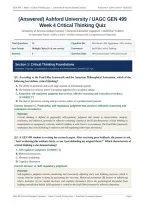
GEN 499 | Week 4 Critical Thinking Quiz | University of Arizona Global Campus Answered • 100% Correct • 2026/2027
(Answered) Ashford University / UAGC GEN 499
Week 4 Critical Thinking Quiz
University of Arizona Global Campus • General Education Capstone • 2026/2027 Edition
All Attempted Points • 100% Correct • Verified Answers with Comprehensive Rationales
Total Questions 25 Cognitive Mix 30% Recall • 50% Application • 20% Analysis
Item Format Multiple Choice (A–D, one correct) Framework Paul-Elder Critical Thinking
Sections 6 Question Style 70% Scenario-based • 30% Direct Recall
Section 1: Critical Thinking Foundations
Definition, Purpose, & Importance in Academic and Professional Contexts | Q1–Q5
Q1: According to the Paul-Elder framework and the American Philosophical Association, which of the
following best defines critical thinking?
A. The ability to memorize and recall large amounts of information quickly.
B. The tendency to criticize others' viewpoints aggressively in academic debate.
C. Purposeful, self-regulatory judgment that involves reflective reasoning and evaluation of evidence.
[CORRECT]
D. The skill of persuasive writing used to convince others of a predetermined position.
Correct Answer: C. Purposeful, self-regulatory judgment that involves reflective reasoning and
evaluation of evidence.
Rationale
Critical thinking is defined as purposeful, self-regulatory judgment that results in interpretation, analysis,
evaluation, and inference, grounded in reflective reasoning. Options A and B mischaracterize critical thinking as
memorization or antagonistic criticism, while D conflates it with rhetoric or persuasion. The Paul-Elder framework
emphasizes that critical thinking is reflective and self-regulating rather than adversarial.
Q2: A GEN 499 student is revising her research paper. After receiving peer feedback, she pauses to ask,
"Am I evaluating this evidence fairly, or am I just defending my original thesis?" Which characteristic of
critical thinking is she demonstrating?
A. Self-regulatory judgment. [CORRECT]
B. Rhetorical persuasion.
C. Heuristic availability.
D. Cognitive dissonance.
Correct Answer: A. Self-regulatory judgment.
Rationale
Self-regulatory judgment involves monitoring and consciously adjusting one's own thinking processes, which is
exactly what the student is doing by questioning her own bias. Rhetorical persuasion (B) focuses on influencing
others, heuristics (C) are mental shortcuts, and cognitive dissonance (D) is the psychological discomfort from
holding contradictory beliefs. Self-regulation is central to the Paul-Elder framework's reflective dimension.
GEN 499 General Education Capstone • Week 4 Critical Thinking Quiz • Paul-Elder Framework Aligned Page 1
, GEN 499 | Week 4 Critical Thinking Quiz | University of Arizona Global Campus Answered • 100% Correct • 2026/2027
Q3: Marcus, a GEN 499 capstone student, is analyzing conflicting sources on climate policy. Which
benefit of critical thinking is MOST directly demonstrated when he identifies the bias in a popular blog
post and selects the peer-reviewed study instead?
A. Memorizing citation formats for the final paper.
B. Achieving academic success through source evaluation and informed judgment. [CORRECT]
C. Building professional networking connections with classmates.
D. Improving his typing speed for timed examinations.
Correct Answer: B. Achieving academic success through source evaluation and informed
judgment.
Rationale
Critical thinking supports academic success by enabling students to evaluate evidence, recognize bias, and select
credible sources—all directly demonstrated by Marcus choosing peer-reviewed scholarship over a biased blog.
Options A, C, and D describe unrelated academic skills. The Paul-Elder framework ties this behavior to the
intellectual standard of accuracy and the disposition of intellectual autonomy.
Q4: After a workplace conflict, Jada writes in her journal: "I assumed my coworker was being hostile,
but I never actually asked her what she meant. I should check my interpretation before reacting." Which
aspect of critical thinking is she practicing?
A. Hasty generalization.
B. Reflective thinking that examines assumptions and interpretations. [CORRECT]
C. Ad hominem reasoning.
D. Confirmation bias.
Correct Answer: B. Reflective thinking that examines assumptions and interpretations.
Rationale
Reflective thinking involves stepping back to examine one's own assumptions, interpretations, and
conclusions—which Jada demonstrates by questioning her interpretation of the coworker's behavior. Options A, C,
and D are fallacies or biases, not reflective practices. The Paul-Elder framework identifies this self-examination as
central to the elements of "assumptions" and "interpretation."
GEN 499 General Education Capstone • Week 4 Critical Thinking Quiz • Paul-Elder Framework Aligned Page 2
(Answered) Ashford University / UAGC GEN 499
Week 4 Critical Thinking Quiz
University of Arizona Global Campus • General Education Capstone • 2026/2027 Edition
All Attempted Points • 100% Correct • Verified Answers with Comprehensive Rationales
Total Questions 25 Cognitive Mix 30% Recall • 50% Application • 20% Analysis
Item Format Multiple Choice (A–D, one correct) Framework Paul-Elder Critical Thinking
Sections 6 Question Style 70% Scenario-based • 30% Direct Recall
Section 1: Critical Thinking Foundations
Definition, Purpose, & Importance in Academic and Professional Contexts | Q1–Q5
Q1: According to the Paul-Elder framework and the American Philosophical Association, which of the
following best defines critical thinking?
A. The ability to memorize and recall large amounts of information quickly.
B. The tendency to criticize others' viewpoints aggressively in academic debate.
C. Purposeful, self-regulatory judgment that involves reflective reasoning and evaluation of evidence.
[CORRECT]
D. The skill of persuasive writing used to convince others of a predetermined position.
Correct Answer: C. Purposeful, self-regulatory judgment that involves reflective reasoning and
evaluation of evidence.
Rationale
Critical thinking is defined as purposeful, self-regulatory judgment that results in interpretation, analysis,
evaluation, and inference, grounded in reflective reasoning. Options A and B mischaracterize critical thinking as
memorization or antagonistic criticism, while D conflates it with rhetoric or persuasion. The Paul-Elder framework
emphasizes that critical thinking is reflective and self-regulating rather than adversarial.
Q2: A GEN 499 student is revising her research paper. After receiving peer feedback, she pauses to ask,
"Am I evaluating this evidence fairly, or am I just defending my original thesis?" Which characteristic of
critical thinking is she demonstrating?
A. Self-regulatory judgment. [CORRECT]
B. Rhetorical persuasion.
C. Heuristic availability.
D. Cognitive dissonance.
Correct Answer: A. Self-regulatory judgment.
Rationale
Self-regulatory judgment involves monitoring and consciously adjusting one's own thinking processes, which is
exactly what the student is doing by questioning her own bias. Rhetorical persuasion (B) focuses on influencing
others, heuristics (C) are mental shortcuts, and cognitive dissonance (D) is the psychological discomfort from
holding contradictory beliefs. Self-regulation is central to the Paul-Elder framework's reflective dimension.
GEN 499 General Education Capstone • Week 4 Critical Thinking Quiz • Paul-Elder Framework Aligned Page 1
, GEN 499 | Week 4 Critical Thinking Quiz | University of Arizona Global Campus Answered • 100% Correct • 2026/2027
Q3: Marcus, a GEN 499 capstone student, is analyzing conflicting sources on climate policy. Which
benefit of critical thinking is MOST directly demonstrated when he identifies the bias in a popular blog
post and selects the peer-reviewed study instead?
A. Memorizing citation formats for the final paper.
B. Achieving academic success through source evaluation and informed judgment. [CORRECT]
C. Building professional networking connections with classmates.
D. Improving his typing speed for timed examinations.
Correct Answer: B. Achieving academic success through source evaluation and informed
judgment.
Rationale
Critical thinking supports academic success by enabling students to evaluate evidence, recognize bias, and select
credible sources—all directly demonstrated by Marcus choosing peer-reviewed scholarship over a biased blog.
Options A, C, and D describe unrelated academic skills. The Paul-Elder framework ties this behavior to the
intellectual standard of accuracy and the disposition of intellectual autonomy.
Q4: After a workplace conflict, Jada writes in her journal: "I assumed my coworker was being hostile,
but I never actually asked her what she meant. I should check my interpretation before reacting." Which
aspect of critical thinking is she practicing?
A. Hasty generalization.
B. Reflective thinking that examines assumptions and interpretations. [CORRECT]
C. Ad hominem reasoning.
D. Confirmation bias.
Correct Answer: B. Reflective thinking that examines assumptions and interpretations.
Rationale
Reflective thinking involves stepping back to examine one's own assumptions, interpretations, and
conclusions—which Jada demonstrates by questioning her interpretation of the coworker's behavior. Options A, C,
and D are fallacies or biases, not reflective practices. The Paul-Elder framework identifies this self-examination as
central to the elements of "assumptions" and "interpretation."
GEN 499 General Education Capstone • Week 4 Critical Thinking Quiz • Paul-Elder Framework Aligned Page 2


