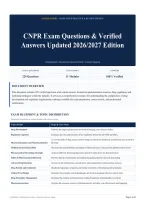
[STUDY GUIDE] • HIGH-YIELD PRACTICE & REVIEW EDITION
CNPR Exam Questions & Verified
Answers Updated 2026/2027 Edition
Comprehensive Examination Question Bank • Concept Mapping
TOTAL QUESTIONS EXAM TOPICS ANSWERS
229 Questions 11 Modules 100% Verified
DOCUMENT OVERVIEW
This document contains 229 verified questions with correct answers focused on pharmaceutical sciences, drug regulation, and
marketing strategies within the industry. It serves as a comprehensive resource for understanding the complexities of drug
development and regulatory requirements, making it suitable for exam preparation, course review, and professional
certification.
EXAM BLUEPRINT & TOPIC DISTRIBUTION
Systematic breakdown of subject domains and exam coverage.
Topic Module Scope & Core Focus
Drug Development Explores the stages and processes involved in bringing a new drug to market.
Regulatory Agencies Examines the roles and functions of key regulatory bodies like the FDA and EMA.
Covers the study of drug actions and how drugs are absorbed, distributed, metabolized, and excreted in
Pharmacodynamics and Pharmacokinetics the body.
Medical Science Liaison Role Discusses the responsibilities and impact of Medical Science Liaisons in the pharmaceutical sector.
Pharmaceutical Marketing Strategies Analyzes different marketing approaches and their implications for drug promotion.
Ethics in Pharmaceutical Research Reviews ethical considerations and regulations guiding clinical trials and drug testing.
Adverse Drug Reactions Focuses on the identification, classification, and management of adverse drug reactions.
Drug Patents and Exclusivity Details the importance of patents and market exclusivity in the pharmaceutical industry.
Clinical Trial Design Examines the principles and methodologies involved in designing effective clinical trials.
Drug Formulary Management Discusses the creation and maintenance of drug formularies within healthcare systems.
Pharmacoeconomics Explores the economic aspects of pharmaceuticals, including cost-effectiveness and budgeting.
Confidential • Student Study Edition • Practice & Review Guide Page 1 of 42
,STUDENT STUDY & MASTERY EDITION PRACTICE & REVIEW GUIDE
Total Exam Coverage 11 Integrated Topic Modules • 229 Examination Questions
HIGH-YIELD: QUESTIONS & VERIFIED ANSWERS
Complete Examination Questions • 229 Questions • Sequential Exam Layout
QUESTION 1
What term denotes the extent to which a test actually measures what it is supposed to be
measuring, or what we think it is measuring?
Answer: Validity.
QUESTION 2
What should be included in the description section of a drug's package insert information?
Answer: The drug's proprietary name and the established name.
QUESTION 3
Which of the following is not a type of hormones
a) amino acid derivatives
b) blood glucose
c) polypeptides
d) steroids?
Answer: Blood glucose.
QUESTION 4
What differentiates a caplet from a tablet?
Answer: Caplets are shaped like capsules and have film coatings to aid in swallowing.
Confidential • Student Study Edition • Practice & Review Guide Page 2 of 42
,STUDENT STUDY & MASTERY EDITION PRACTICE & REVIEW GUIDE
QUESTION 5
Pharmaceutical companies and representatives categorize their customers as
1) acute care vs. chronic care,
2) office-based vs. hospital-based, and
3) ___________ vs. ____________.
Answer: Primary care vs. specialty care.
QUESTION 6
Smoking decreases the effectiveness of some drugs.
Answer: True.
QUESTION 7
According to NIH ethical guidelines, what is the most important criteria in selecting subjects for
clinical studies?
Answer: Scientific objectives.
QUESTION 8
Which components might cause patient's different reactions to brand name and generic drugs?
Answer: Differences in inactive ingredients.
QUESTION 9
Which of the following agencies is industry-based (i.e. run mainly by the companies themselves)?
a) Drug Enforcement Administration
b) European Medicines Agency
c) Pharmaceutical Research and Manufacturers of America (PhRMA)
d) the FDA?
Answer: C) PhRMA.
Confidential • Student Study Edition • Practice & Review Guide Page 3 of 42
, STUDENT STUDY & MASTERY EDITION PRACTICE & REVIEW GUIDE
QUESTION 10
In its broadest definition, a drug is any substance that produces a physical or psychological
change in the body.
Answer: True.
QUESTION 11
According to PhRMA Code, sales reps are allowed to provide modest meals to staff members
attending educational events.
Answer: True.
QUESTION 12
The high price of healthcare is explained by the high price of medicines.
Answer: False.
QUESTION 13
The FDA's Criteria for Equivalency requires the drugs contain identical amounts of the same
inactive ingredients.
Answer: True.
QUESTION 14
Sampling is sometimes the most important factor in a pharmaceutical rep's success.
Answer: True.
QUESTION 15
By FDA law, large chain pharmacies are not allowed to buy directly from drug manufacturers.
Answer: False.
Confidential • Student Study Edition • Practice & Review Guide Page 4 of 42