
[STUDY GUIDE] • HIGH-YIELD PRACTICE & REVIEW EDITION
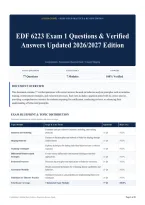
EDF 6223 Exam 1 Questions & Verified
Answers Updated 2026/2027 Edition
Comprehensive Examination Question Bank • Concept Mapping
TOTAL QUESTIONS EXAM TOPICS ANSWERS
77 Questions 7 Modules 100% Verified
DOCUMENT OVERVIEW
This document contains 77 verified questions with correct answers focused on behavior analysis principles such as imitation
training, reinforcement strategies, and extinction processes. Each item includes a question paired with its correct answer,
providing a comprehensive resource for students preparing for certification, conducting reviews, or enhancing their
understanding of behavioral principles.
EXAM BLUEPRINT & TOPIC DISTRIBUTION
Systematic breakdown of subject domains and exam coverage.
Topic Module Scope & Core Focus Questions Share (%)
Examines concepts related to imitation, modeling, and training
Imitation and Modeling protocols. 11 Qs 14.3%
Focuses on the principles and methods of behavior shaping through
Shaping Behavior reinforcement. 11 Qs 14.3%
Explores techniques for linking individual behaviors into a cohesive
Chaining Techniques sequence. 11 Qs 14.3%
Differential Reinforcement Covers various differential reinforcement techniques and their
Strategies applications. 11 Qs 14.3%
Extinction Processes Discusses the principles and implications of behavior extinction. 11 Qs 14.3%
Details assessment techniques for evaluating learner capabilities and
Assessment Methods behaviors. 11 Qs 14.3%
Outlines best practices and guidelines for implementing behavioral
Guidelines for Effective Practice techniques. 11 Qs 14.3%
Total Exam Coverage 7 Integrated Topic Modules 77 Qs 100.0%
Confidential • Student Study Edition • Practice & Review Guide Page 1 of 20
,STUDENT STUDY & MASTERY EDITION PRACTICE & REVIEW GUIDE
TOPIC 1: IMITATION AND MODELING
11 Questions • 14.3% of Exam • Examines concepts related to imitation, modeling, and training protocols.
QUESTION 1
4 criteria of imitation
Answer: 1. The imitative behavior is occasioned by another person's model of the behavior
2. the imitative behavior has formal similarity with the model
3. the imitative behavior follows the modeled behavior closely in time
4. the model is the primary controlling variable for the imitative behavior.
QUESTION 2
Model
Answer: An antecedent stimulus with topographical similarity to the behavior the analyst wants to be imitated.
QUESTION 3
Planned models
Answer: Prearranged demonstrations of behavior that show the learner exactly what to do, be it acquiring new skills or
refining the topography of certain elements of existing skills
-can be live or filmed.
QUESTION 4
Unplanned models
Answer: Occasion imitation in everyday social environments.
QUESTION 5
Formal similarity
Answer: Occurs when the model's and the imitator's behavior physically resemble each other and are in the same mode.
Confidential • Student Study Edition • Practice & Review Guide Page 2 of 20
, STUDENT STUDY & MASTERY EDITION PRACTICE & REVIEW GUIDE
QUESTION 6
What is the most important property defining imitation?
Answer: The controlling relation between a model's demonstration and a learner's performance of topographically
similar behavior.
QUESTION 7
Imitation training
Answer: A systematic, research-based set of steps for teaching a non-imitative learner to imitate models of noel behavior.
QUESTION 8
Imitation training protocol (1): assess, and teach if necessary, prerequisite skills for imitation
training
Answer: Attending to the model is a prerequisite skill for imitation training. assess the skills for a minimum of 3 sessions
and begin training if assessment data shows adequate attending skills.
QUESTION 9
Imitation training protocol (2):
Answer: Practitioners may need to select and use about 25 behaviors as models during imitation training. including gross
motor and fine motor movements as models provides learners with opportunities to develop more refined differentiation
with their imitative skills. initial training usually includes models of the movement of body parts and the manipulation of
physical objects.
QUESTION 10
Modeling
Answer: A behavior change strategy in which learners acquire new skills by imitating demonstrations of the skills by live
or symbolic models. the model shows, demonstrates, or conveys exactly the behavior the learner is expected to convey. can
be live, symbolic, or recorded.
Confidential • Student Study Edition • Practice & Review Guide Page 3 of 20
EDF 6223 Exam 1 Questions & Verified
Answers Updated 2026/2027 Edition
Comprehensive Examination Question Bank • Concept Mapping
TOTAL QUESTIONS EXAM TOPICS ANSWERS
77 Questions 7 Modules 100% Verified
DOCUMENT OVERVIEW
This document contains 77 verified questions with correct answers focused on behavior analysis principles such as imitation
training, reinforcement strategies, and extinction processes. Each item includes a question paired with its correct answer,
providing a comprehensive resource for students preparing for certification, conducting reviews, or enhancing their
understanding of behavioral principles.
EXAM BLUEPRINT & TOPIC DISTRIBUTION
Systematic breakdown of subject domains and exam coverage.
Topic Module Scope & Core Focus Questions Share (%)
Examines concepts related to imitation, modeling, and training
Imitation and Modeling protocols. 11 Qs 14.3%
Focuses on the principles and methods of behavior shaping through
Shaping Behavior reinforcement. 11 Qs 14.3%
Explores techniques for linking individual behaviors into a cohesive
Chaining Techniques sequence. 11 Qs 14.3%
Differential Reinforcement Covers various differential reinforcement techniques and their
Strategies applications. 11 Qs 14.3%
Extinction Processes Discusses the principles and implications of behavior extinction. 11 Qs 14.3%
Details assessment techniques for evaluating learner capabilities and
Assessment Methods behaviors. 11 Qs 14.3%
Outlines best practices and guidelines for implementing behavioral
Guidelines for Effective Practice techniques. 11 Qs 14.3%
Total Exam Coverage 7 Integrated Topic Modules 77 Qs 100.0%
Confidential • Student Study Edition • Practice & Review Guide Page 1 of 20
,STUDENT STUDY & MASTERY EDITION PRACTICE & REVIEW GUIDE
TOPIC 1: IMITATION AND MODELING
11 Questions • 14.3% of Exam • Examines concepts related to imitation, modeling, and training protocols.
QUESTION 1
4 criteria of imitation
Answer: 1. The imitative behavior is occasioned by another person's model of the behavior
2. the imitative behavior has formal similarity with the model
3. the imitative behavior follows the modeled behavior closely in time
4. the model is the primary controlling variable for the imitative behavior.
QUESTION 2
Model
Answer: An antecedent stimulus with topographical similarity to the behavior the analyst wants to be imitated.
QUESTION 3
Planned models
Answer: Prearranged demonstrations of behavior that show the learner exactly what to do, be it acquiring new skills or
refining the topography of certain elements of existing skills
-can be live or filmed.
QUESTION 4
Unplanned models
Answer: Occasion imitation in everyday social environments.
QUESTION 5
Formal similarity
Answer: Occurs when the model's and the imitator's behavior physically resemble each other and are in the same mode.
Confidential • Student Study Edition • Practice & Review Guide Page 2 of 20
, STUDENT STUDY & MASTERY EDITION PRACTICE & REVIEW GUIDE
QUESTION 6
What is the most important property defining imitation?
Answer: The controlling relation between a model's demonstration and a learner's performance of topographically
similar behavior.
QUESTION 7
Imitation training
Answer: A systematic, research-based set of steps for teaching a non-imitative learner to imitate models of noel behavior.
QUESTION 8
Imitation training protocol (1): assess, and teach if necessary, prerequisite skills for imitation
training
Answer: Attending to the model is a prerequisite skill for imitation training. assess the skills for a minimum of 3 sessions
and begin training if assessment data shows adequate attending skills.
QUESTION 9
Imitation training protocol (2):
Answer: Practitioners may need to select and use about 25 behaviors as models during imitation training. including gross
motor and fine motor movements as models provides learners with opportunities to develop more refined differentiation
with their imitative skills. initial training usually includes models of the movement of body parts and the manipulation of
physical objects.
QUESTION 10
Modeling
Answer: A behavior change strategy in which learners acquire new skills by imitating demonstrations of the skills by live
or symbolic models. the model shows, demonstrates, or conveys exactly the behavior the learner is expected to convey. can
be live, symbolic, or recorded.
Confidential • Student Study Edition • Practice & Review Guide Page 3 of 20


