
[STUDY GUIDE] • HIGH-YIELD PRACTICE & REVIEW EDITION
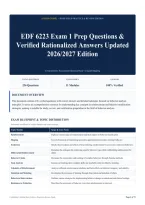
EDF 6223 Exam 1 Prep Questions &
Verified Rationalized Answers Updated
2026/2027 Edition
Comprehensive Examination Question Bank • Concept Mapping
TOTAL QUESTIONS EXAM TOPICS ANSWERS
236 Questions 11 Modules 100% Verified
DOCUMENT OVERVIEW
This document contains 236 verified questions with correct answers and detailed rationales focused on behavior analysis
principles. It serves as a comprehensive resource for understanding key concepts in reinforcement and behavior modification
strategies, making it suitable for study, review, and certification preparation in the field of behavior analysis.
EXAM BLUEPRINT & TOPIC DISTRIBUTION
Systematic breakdown of subject domains and exam coverage.
Topic Module Scope & Core Focus
Reinforcement Explores various types of reinforcement and their impact on behavior modification.
Shaping Covers the process of reinforcing successive approximations toward a terminal behavior.
Extinction Details the procedures and effects of discontinuing reinforcement for previously reinforced behaviors.
Examines the strategies for reinforcing specific behavior types while withholding reinforcement for
Differential Reinforcement others.
Behavior Chains Discusses the composition and teaching of complex behaviors through chaining methods.
Task Analysis Focuses on breaking down complex skills into teachable units for effective learning.
Schedules of Reinforcement Analyzes different reinforcement schedules and their effects on behavior frequency and stability.
Imitation and Modeling Investigates the processes of learning through observation and imitation of others.
Behavioral Interventions Outlines various strategies for implementing behavior change in educational and clinical settings.
Resistance to Extinction Describes the persistence of behavior even when reinforcement is removed.
Confidential • Student Study Edition • Practice & Review Guide Page 1 of 73
,STUDENT STUDY & MASTERY EDITION PRACTICE & REVIEW GUIDE
Functional Behavior Assessment Covers methods for identifying the functions of problem behaviors to inform interventions.
Total Exam Coverage 11 Integrated Topic Modules • 236 Examination Questions
HIGH-YIELD: QUESTIONS & VERIFIED ANSWERS
Complete Examination Questions • 236 Questions • Sequential Exam Layout
QUESTION 1
Is the process of systematically and differentially reinforcing successive approximations to a
terminal behavior
Answer: Shaping.
Rationale: Shaping is the correct answer because it involves reinforcing successive approximations to a terminal behavior, which means
that the behavior is gradually built up through a series of small steps, with each step being reinforced until the desired behavior is
achieved. This process of differential reinforcement, where the behavior is reinforced more strongly for each successive approximation,
is a hallmark of the shaping process and distinguishes it from other forms of reinforcement.
QUESTION 2
Is a procedure in which reinforcement is provided for responses that share a predetermined
dimension or quality, and in which reinforcement is withheld for responses that do not
demonstrate that quality.
Answer: Differential reinforcement.
Rationale: Differential reinforcement is the correct answer because it selectively reinforces responses that possess a specific dimension
or quality, thereby increasing the likelihood of those responses occurring in the future, while withholding reinforcement for responses
that lack that quality. This procedure allows for the shaping of behavior by emphasizing and strengthening desired responses while
ignoring or discouraging undesired ones, which is a fundamental principle of operant conditioning.
Confidential • Student Study Edition • Practice & Review Guide Page 2 of 73
,STUDENT STUDY & MASTERY EDITION PRACTICE & REVIEW GUIDE
QUESTION 3
The end product of shaping - can be claimed when the topography, frequency, latency, duration,
or magnitude of the target behavior reaches the predetermined criterion level.
Answer: Terminal behavior.
Rationale: Terminal behavior is the correct answer because shaping involves gradually modifying a behavior through reinforcement
until it meets a predetermined criterion, and terminal behavior refers to the point at which the behavior has reached that criterion,
ensuring it has stabilized and will persist.
QUESTION 4
Differential reinforcement has two effects: _____ similar to those that have been reinforced occur
with greater frequency, and responses resembling the unreinforced members are emitted less
frequently (also known as ) _____.
Answer: Responses, extinction.
Rationale: Differential reinforcement selectively reinforces desired behaviors, resulting in an increase in responses that are similar to
those previously reinforced, and a decrease in responses that are not reinforced or are similar to the unreinforced members.
This decrease in responses is commonly referred to as extinction, as the responses are no longer supported by reinforcement and
eventually cease to occur.
QUESTION 5
Is a science-based system for shaping behaviors using a handheld device that produces a click
sound to signal reinforcement.
Answer: Clicker training.
Rationale: Clicker training is a science-based system because it utilizes operant conditioning principles, specifically the association
between a specific sound (the click) and the delivery of a reward, to shape behaviors. By using a handheld device that produces a
distinct sound, trainers can precisely mark the exact moment a desired behavior occurs, allowing for accurate reinforcement and
optimal learning.
Confidential • Student Study Edition • Practice & Review Guide Page 3 of 73
, STUDENT STUDY & MASTERY EDITION PRACTICE & REVIEW GUIDE
QUESTION 6
Is a specific sequence of discrete responses where each response is associated with a particular
stimulus condition.
Answer: Behavior chain.
Rationale: A behavior chain is the correct answer because it refers to a specific sequence of discrete responses, which means each
response is distinct and not continuous. This definition also highlights the association between each response and a particular stimulus
condition, which is a crucial aspect of behavior chain, making it a precise match for the given question.
QUESTION 7
Each component in the chain, except the first and last stimulus in the chain, serves as both a
conditioned reinforcer and a
Answer: Discriminative stimulus.
Rationale: Each component in the chain, except the first and last stimulus, serves as both a conditioned reinforcer and a discriminative
stimulus because these components have been previously paired with the reinforcer and the response, respectively, and have acquired
the ability to trigger the response and deliver the reinforcer. As a conditioned reinforcer, they maintain the behavior, and as a
discriminative stimulus, they signal the occasion for the behavior to occur.
QUESTION 8
A behavior chain with ______ requires that each component is done correctly and within a
specified time.
Answer: Limited hold.
Rationale: A limited hold behavior chain requires that each component is done correctly and within a specified time because it involves
a specific sequence of behaviors that must be performed in a particular order, with each behavior building upon the previous one, and
any deviation from this sequence or timing can disrupt the entire chain. This type of chain requires precise timing and accurate
execution of each behavior to maintain the desired sequence and outcome.
Confidential • Student Study Edition • Practice & Review Guide Page 4 of 73
EDF 6223 Exam 1 Prep Questions &
Verified Rationalized Answers Updated
2026/2027 Edition
Comprehensive Examination Question Bank • Concept Mapping
TOTAL QUESTIONS EXAM TOPICS ANSWERS
236 Questions 11 Modules 100% Verified
DOCUMENT OVERVIEW
This document contains 236 verified questions with correct answers and detailed rationales focused on behavior analysis
principles. It serves as a comprehensive resource for understanding key concepts in reinforcement and behavior modification
strategies, making it suitable for study, review, and certification preparation in the field of behavior analysis.
EXAM BLUEPRINT & TOPIC DISTRIBUTION
Systematic breakdown of subject domains and exam coverage.
Topic Module Scope & Core Focus
Reinforcement Explores various types of reinforcement and their impact on behavior modification.
Shaping Covers the process of reinforcing successive approximations toward a terminal behavior.
Extinction Details the procedures and effects of discontinuing reinforcement for previously reinforced behaviors.
Examines the strategies for reinforcing specific behavior types while withholding reinforcement for
Differential Reinforcement others.
Behavior Chains Discusses the composition and teaching of complex behaviors through chaining methods.
Task Analysis Focuses on breaking down complex skills into teachable units for effective learning.
Schedules of Reinforcement Analyzes different reinforcement schedules and their effects on behavior frequency and stability.
Imitation and Modeling Investigates the processes of learning through observation and imitation of others.
Behavioral Interventions Outlines various strategies for implementing behavior change in educational and clinical settings.
Resistance to Extinction Describes the persistence of behavior even when reinforcement is removed.
Confidential • Student Study Edition • Practice & Review Guide Page 1 of 73
,STUDENT STUDY & MASTERY EDITION PRACTICE & REVIEW GUIDE
Functional Behavior Assessment Covers methods for identifying the functions of problem behaviors to inform interventions.
Total Exam Coverage 11 Integrated Topic Modules • 236 Examination Questions
HIGH-YIELD: QUESTIONS & VERIFIED ANSWERS
Complete Examination Questions • 236 Questions • Sequential Exam Layout
QUESTION 1
Is the process of systematically and differentially reinforcing successive approximations to a
terminal behavior
Answer: Shaping.
Rationale: Shaping is the correct answer because it involves reinforcing successive approximations to a terminal behavior, which means
that the behavior is gradually built up through a series of small steps, with each step being reinforced until the desired behavior is
achieved. This process of differential reinforcement, where the behavior is reinforced more strongly for each successive approximation,
is a hallmark of the shaping process and distinguishes it from other forms of reinforcement.
QUESTION 2
Is a procedure in which reinforcement is provided for responses that share a predetermined
dimension or quality, and in which reinforcement is withheld for responses that do not
demonstrate that quality.
Answer: Differential reinforcement.
Rationale: Differential reinforcement is the correct answer because it selectively reinforces responses that possess a specific dimension
or quality, thereby increasing the likelihood of those responses occurring in the future, while withholding reinforcement for responses
that lack that quality. This procedure allows for the shaping of behavior by emphasizing and strengthening desired responses while
ignoring or discouraging undesired ones, which is a fundamental principle of operant conditioning.
Confidential • Student Study Edition • Practice & Review Guide Page 2 of 73
,STUDENT STUDY & MASTERY EDITION PRACTICE & REVIEW GUIDE
QUESTION 3
The end product of shaping - can be claimed when the topography, frequency, latency, duration,
or magnitude of the target behavior reaches the predetermined criterion level.
Answer: Terminal behavior.
Rationale: Terminal behavior is the correct answer because shaping involves gradually modifying a behavior through reinforcement
until it meets a predetermined criterion, and terminal behavior refers to the point at which the behavior has reached that criterion,
ensuring it has stabilized and will persist.
QUESTION 4
Differential reinforcement has two effects: _____ similar to those that have been reinforced occur
with greater frequency, and responses resembling the unreinforced members are emitted less
frequently (also known as ) _____.
Answer: Responses, extinction.
Rationale: Differential reinforcement selectively reinforces desired behaviors, resulting in an increase in responses that are similar to
those previously reinforced, and a decrease in responses that are not reinforced or are similar to the unreinforced members.
This decrease in responses is commonly referred to as extinction, as the responses are no longer supported by reinforcement and
eventually cease to occur.
QUESTION 5
Is a science-based system for shaping behaviors using a handheld device that produces a click
sound to signal reinforcement.
Answer: Clicker training.
Rationale: Clicker training is a science-based system because it utilizes operant conditioning principles, specifically the association
between a specific sound (the click) and the delivery of a reward, to shape behaviors. By using a handheld device that produces a
distinct sound, trainers can precisely mark the exact moment a desired behavior occurs, allowing for accurate reinforcement and
optimal learning.
Confidential • Student Study Edition • Practice & Review Guide Page 3 of 73
, STUDENT STUDY & MASTERY EDITION PRACTICE & REVIEW GUIDE
QUESTION 6
Is a specific sequence of discrete responses where each response is associated with a particular
stimulus condition.
Answer: Behavior chain.
Rationale: A behavior chain is the correct answer because it refers to a specific sequence of discrete responses, which means each
response is distinct and not continuous. This definition also highlights the association between each response and a particular stimulus
condition, which is a crucial aspect of behavior chain, making it a precise match for the given question.
QUESTION 7
Each component in the chain, except the first and last stimulus in the chain, serves as both a
conditioned reinforcer and a
Answer: Discriminative stimulus.
Rationale: Each component in the chain, except the first and last stimulus, serves as both a conditioned reinforcer and a discriminative
stimulus because these components have been previously paired with the reinforcer and the response, respectively, and have acquired
the ability to trigger the response and deliver the reinforcer. As a conditioned reinforcer, they maintain the behavior, and as a
discriminative stimulus, they signal the occasion for the behavior to occur.
QUESTION 8
A behavior chain with ______ requires that each component is done correctly and within a
specified time.
Answer: Limited hold.
Rationale: A limited hold behavior chain requires that each component is done correctly and within a specified time because it involves
a specific sequence of behaviors that must be performed in a particular order, with each behavior building upon the previous one, and
any deviation from this sequence or timing can disrupt the entire chain. This type of chain requires precise timing and accurate
execution of each behavior to maintain the desired sequence and outcome.
Confidential • Student Study Edition • Practice & Review Guide Page 4 of 73


