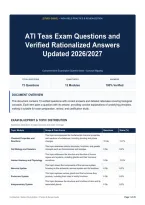
[STUDY GUIDE] • HIGH-YIELD PRACTICE & REVIEW EDITION
ATI Teas Exam Questions and
Verified Rationalized Answers
Updated 2026/2027
Comprehensive Examination Question Bank • Concept Mapping
TOTAL QUESTIONS EXAM TOPICS ANSWERS
73 Questions 12 Modules 100% Verified
DOCUMENT OVERVIEW
This document contains 73 verified questions with correct answers and detailed rationales covering biological
concepts. Each item pairs a question with its answer, providing concise explanations of underlying principles,
making it suitable for exam preparation, review, and certification study.
EXAM BLUEPRINT & TOPIC DISTRIBUTION
Systematic breakdown of subject domains and exam coverage.
Topic Module Scope & Core Focus Questions Share (%)
This topic encompasses the fundamental chemical properties
Chemical Properties and and reactions of substances, including bonding and phase
Reactions changes. 10 Qs 13.7%
This topic examines cellular structures, functions, and genetic
Cell Biology and Genetics concepts such as chromosomes and isotopes. 6 Qs 8.2%
This topic addresses the structure and function of human
organs and systems, including glands and their hormonal
Human Anatomy and Physiology secretions. 9 Qs 12.3%
This topic covers the components of the nervous system,
Nervous System focusing on the autonomic nervous system and its functions. 6 Qs 8.2%
This topic explores various glands and the hormones they
Endocrine System produce, including their roles in bodily functions. 6 Qs 8.2%
This topic discusses the structure and functions of skin and its
Integumentary System associated glands. 6 Qs 8.2%
Confidential • Student Study Edition • Practice & Review Guide Page 1 of 25
,STUDENT STUDY & MASTERY EDITION PRACTICE & REVIEW GUIDE
This topic focuses on the anatomy and functions of the
Respiratory System respiratory system, including air passageways. 5 Qs 6.8%
This topic includes functions and structures related to
digestion, including hormones produced by the small
Digestive System intestine. 5 Qs 6.8%
This topic addresses the role of electrolytes in the body and
Electrolytes and Fluid Balance their regulation by various glands. 5 Qs 6.8%
This topic examines pathogens such as fungi and the immune
Microbiology and Immunology response to antigens. 5 Qs 6.8%
This topic covers the physical and chemical properties of
General Properties of Matter matter and the transitions between states. 5 Qs 6.8%
Hormonal Regulation of This topic focuses on hormones involved in reproductive
Reproduction processes and their physiological effects. 5 Qs 6.8%
Total Exam Coverage 12 Integrated Topic Modules 73 Qs 100.0%
TOPIC 1: CHEMICAL PROPERTIES AND REACTIONS
10 Questions • 13.7% of Exam • This topic encompasses the fundamental chemical properties and reactions of substances, including
bonding and phase changes.
QUESTION 1
What is a chemical property?
Answer: The ability of matter to change into one or more new substances.
Rationale: A chemical property is the ability of matter to change into one or more new substances because it is a
characteristic that defines how a substance will behave in a chemical reaction, and the ability to undergo a change is a
fundamental aspect of chemical reactivity. This definition highlights the dynamic nature of chemical properties, which
distinguish a substance from others and determine its potential to participate in chemical transformations.
QUESTION 2
What is diffusion?
Answer: The movement of atoms from an area of high concentration to low concentation.
Rationale: Diffusion occurs because of the natural tendency of atoms or molecules to move from an area of higher
concentration to an area of lower concentration, as this movement increases the disorder or randomness of the system and
reduces the energy of the particles. This movement is driven by the random thermal motion of the particles, which allows
them to spread out and evenly distribute themselves throughout a given space, resulting in a more uniform concentration.
Confidential • Student Study Edition • Practice & Review Guide Page 2 of 25
, STUDENT STUDY & MASTERY EDITION PRACTICE & REVIEW GUIDE
QUESTION 3
Why are the freezing and melting points the same?
Answer: Because they describe the same transition of matter.
Rationale: The freezing and melting points are the same because both processes involve the transition of a substance from
a solid to a liquid state, or vice versa, which is characterized by the same energy input or output required to break or form
the bonds between molecules. This means that the temperature at which the transition occurs is the same, resulting in
identical freezing and melting points.
QUESTION 4
What is the boiling point?
Answer: The temp at which a liquid turn into vapor.
Rationale: The boiling point refers to the specific temperature at which a liquid transforms into vapor, as it is the point where
the liquid's molecules gain enough energy to break free from the surface tension and turn into gas. This definition is rooted
in the fundamental concept that boiling is a phase transition, where the liquid's molecular bonds are disrupted, allowing it to
change state from liquid to vapor.
QUESTION 5
What is polarity of a substance?
Answer: The way in which atoms of an element bond to each other.
Rationale: Polarity refers to the distribution of electrons in a molecule, and the way in which atoms of an element bond to
each other determines the polarity of a substance. This is because the unequal sharing or unequal transfer of electrons
between atoms creates a partial positive charge on one atom and a partial negative charge on the other, resulting in a
polarity that is dependent on the bonding between atoms.
Confidential • Student Study Edition • Practice & Review Guide Page 3 of 25