[STUDY GUIDE] • HIGH-YIELD PRACTICE & REVIEW EDITION
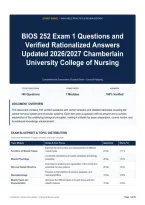
BIOS 252 Exam 1 Questions and
Verified Rationalized Answers
Updated 2026/2027 Chamberlain
University College of Nursing
Comprehensive Examination Question Bank • Concept Mapping
TOTAL QUESTIONS EXAM TOPICS ANSWERS
140 Questions 7 Modules 100% Verified
DOCUMENT OVERVIEW
This document contains 140 verified questions with correct answers and detailed rationales covering the
central nervous system and muscular systems. Each item pairs a question with its answer and a concise
explanation of the underlying biological principles, making it suitable for exam preparation, course review, and
foundational knowledge enhancement.
EXAM BLUEPRINT & TOPIC DISTRIBUTION
Systematic breakdown of subject domains and exam coverage.
Topic Module Scope & Core Focus Questions Share (%)
Explores the various roles and characteristics of different
Functions of Muscle Tissue muscle types. 24 Qs 17.1%
Covers the mechanisms of muscle contraction and energy
Muscle Physiology production. 20 Qs 14.3%
Examines the anatomy and organization of the central and
Nervous System Structure peripheral nervous systems. 20 Qs 14.3%
Focuses on the functions of neurons, synapses, and
Neurophysiology neurotransmitters. 19 Qs 13.6%
Muscle Types and Discusses the different types of muscle tissue and their
Characteristics specific features. 19 Qs 13.6%
Confidential • Student Study Edition • Practice & Review Guide Page 1 of 66
,STUDENT STUDY & MASTERY EDITION PRACTICE & REVIEW GUIDE
Pathophysiology of Muscle Analyzes conditions affecting muscle function, including
Disorders myasthenia gravis. 19 Qs 13.6%
Homeostasis and Muscle Explores the role of muscles in maintaining body temperature
Function and homeostasis. 19 Qs 13.6%
Total Exam Coverage 7 Integrated Topic Modules 140 Qs 100.0%
TOPIC 1: FUNCTIONS OF MUSCLE TISSUE
24 Questions • 17.1% of Exam • Explores the various roles and characteristics of different muscle types.
QUESTION 1
Which is not a function of muscle tissue?
A. Stabilizes body positions
B. Generates heat
C. Produces body movements
D. Fights off infection
Answer: D. Fights off infection.
Rationale: Muscle tissue is responsible for producing body movements, stabilizing body positions, and generating heat, as
it is the primary site for muscle contraction and relaxation. Fighting off infection, on the other hand, is a function of the
immune system, which is a separate tissue type that consists of white blood cells, lymphoid organs, and other
immune-related structures.
QUESTION 2
What are the types of striated muscle?
A. Cardiac and smooth
B. Skeletal and cardiac
C. Smooth only
D. Skeletal and smooth
Answer: B. Skeletal and cardiac.
Rationale: Striated muscles, such as skeletal and cardiac muscles, are characterized by the presence of striations or bands
of actin and myosin filaments within their cells. Since cardiac muscle is a type of striated muscle, it is only logical to include it
alongside skeletal muscle as one of the two correct types of striated muscle.
Confidential • Student Study Edition • Practice & Review Guide Page 2 of 66
,STUDENT STUDY & MASTERY EDITION PRACTICE & REVIEW GUIDE
QUESTION 3
Smooth muscle is responsible for what movements?
A. Contraction of the heart
B. Stretching the arm
C. Moving food with the small intestine
D. Moving the neck to see on the right side
Answer: C. Moving food with the small intestine.
Rationale: Smooth muscle is responsible for moving food with the small intestine because the small intestine is lined with
smooth muscle that contracts and relaxes in a peristaltic manner to propel food through the digestive system. This
movement is essential for the proper digestion and absorption of nutrients, and it is a characteristic function of smooth
muscle, which is found in the walls of hollow organs and blood vessels.
QUESTION 4
Which property means the ability of muscular tissue to stretch, within limits, and not be
damaged?
A. Contractility
B. Hyperplasia
C. Elasticity
D. Extensibility
Answer: D. Extensibility.
Rationale: Muscular tissue's ability to stretch within limits without being damaged is a result of its extensibility, which allows
it to absorb and distribute forces without compromising its structural integrity. In contrast, the other options refer to
properties related to muscle contraction, growth, or the ability to return to its original shape, none of which directly address
the capacity for stretching.
Confidential • Student Study Edition • Practice & Review Guide Page 3 of 66
, STUDENT STUDY & MASTERY EDITION PRACTICE & REVIEW GUIDE
QUESTION 5
Which function of muscle is best described as helping to maintain posture and
preventing unwanted movements?
A. Mobilizing substances within the body
B. Stabilizing body positions
C. Generating heat
D. Storing glucose
Answer: B. Stabilizing body positions.
Rationale: Muscles maintain posture and prevent unwanted movements by stabilizing body positions, ensuring that the
body remains in a stable and balanced state. This is achieved through the contraction of muscles that surround joints, which
helps to counteract the forces of gravity and maintain proper alignment, thereby maintaining posture and preventing
unnecessary movements.
QUESTION 6
Which is a function of skeletal muscle?
A. Moves bones and the skin of the face
B. Moves blood in blood vessels
C. Pumps blood from the heart into the blood vessels
D. Moves substances within a tube (example: peristalsis)
Answer: A. Moves bones and the skin of the face.
Rationale: Skeletal muscles are responsible for moving the skeleton and facial tissues, as they are attached to bones and
enable movements such as smiling, frowning, and blinking. The correct answer, A. Moves bones and the skin of the face,
accurately describes the primary function of skeletal muscles, which is to facilitate voluntary movements of the body's
skeleton and facial structures.
Confidential • Student Study Edition • Practice & Review Guide Page 4 of 66
BIOS 252 Exam 1 Questions and
Verified Rationalized Answers
Updated 2026/2027 Chamberlain
University College of Nursing
Comprehensive Examination Question Bank • Concept Mapping
TOTAL QUESTIONS EXAM TOPICS ANSWERS
140 Questions 7 Modules 100% Verified
DOCUMENT OVERVIEW
This document contains 140 verified questions with correct answers and detailed rationales covering the
central nervous system and muscular systems. Each item pairs a question with its answer and a concise
explanation of the underlying biological principles, making it suitable for exam preparation, course review, and
foundational knowledge enhancement.
EXAM BLUEPRINT & TOPIC DISTRIBUTION
Systematic breakdown of subject domains and exam coverage.
Topic Module Scope & Core Focus Questions Share (%)
Explores the various roles and characteristics of different
Functions of Muscle Tissue muscle types. 24 Qs 17.1%
Covers the mechanisms of muscle contraction and energy
Muscle Physiology production. 20 Qs 14.3%
Examines the anatomy and organization of the central and
Nervous System Structure peripheral nervous systems. 20 Qs 14.3%
Focuses on the functions of neurons, synapses, and
Neurophysiology neurotransmitters. 19 Qs 13.6%
Muscle Types and Discusses the different types of muscle tissue and their
Characteristics specific features. 19 Qs 13.6%
Confidential • Student Study Edition • Practice & Review Guide Page 1 of 66
,STUDENT STUDY & MASTERY EDITION PRACTICE & REVIEW GUIDE
Pathophysiology of Muscle Analyzes conditions affecting muscle function, including
Disorders myasthenia gravis. 19 Qs 13.6%
Homeostasis and Muscle Explores the role of muscles in maintaining body temperature
Function and homeostasis. 19 Qs 13.6%
Total Exam Coverage 7 Integrated Topic Modules 140 Qs 100.0%
TOPIC 1: FUNCTIONS OF MUSCLE TISSUE
24 Questions • 17.1% of Exam • Explores the various roles and characteristics of different muscle types.
QUESTION 1
Which is not a function of muscle tissue?
A. Stabilizes body positions
B. Generates heat
C. Produces body movements
D. Fights off infection
Answer: D. Fights off infection.
Rationale: Muscle tissue is responsible for producing body movements, stabilizing body positions, and generating heat, as
it is the primary site for muscle contraction and relaxation. Fighting off infection, on the other hand, is a function of the
immune system, which is a separate tissue type that consists of white blood cells, lymphoid organs, and other
immune-related structures.
QUESTION 2
What are the types of striated muscle?
A. Cardiac and smooth
B. Skeletal and cardiac
C. Smooth only
D. Skeletal and smooth
Answer: B. Skeletal and cardiac.
Rationale: Striated muscles, such as skeletal and cardiac muscles, are characterized by the presence of striations or bands
of actin and myosin filaments within their cells. Since cardiac muscle is a type of striated muscle, it is only logical to include it
alongside skeletal muscle as one of the two correct types of striated muscle.
Confidential • Student Study Edition • Practice & Review Guide Page 2 of 66
,STUDENT STUDY & MASTERY EDITION PRACTICE & REVIEW GUIDE
QUESTION 3
Smooth muscle is responsible for what movements?
A. Contraction of the heart
B. Stretching the arm
C. Moving food with the small intestine
D. Moving the neck to see on the right side
Answer: C. Moving food with the small intestine.
Rationale: Smooth muscle is responsible for moving food with the small intestine because the small intestine is lined with
smooth muscle that contracts and relaxes in a peristaltic manner to propel food through the digestive system. This
movement is essential for the proper digestion and absorption of nutrients, and it is a characteristic function of smooth
muscle, which is found in the walls of hollow organs and blood vessels.
QUESTION 4
Which property means the ability of muscular tissue to stretch, within limits, and not be
damaged?
A. Contractility
B. Hyperplasia
C. Elasticity
D. Extensibility
Answer: D. Extensibility.
Rationale: Muscular tissue's ability to stretch within limits without being damaged is a result of its extensibility, which allows
it to absorb and distribute forces without compromising its structural integrity. In contrast, the other options refer to
properties related to muscle contraction, growth, or the ability to return to its original shape, none of which directly address
the capacity for stretching.
Confidential • Student Study Edition • Practice & Review Guide Page 3 of 66
, STUDENT STUDY & MASTERY EDITION PRACTICE & REVIEW GUIDE
QUESTION 5
Which function of muscle is best described as helping to maintain posture and
preventing unwanted movements?
A. Mobilizing substances within the body
B. Stabilizing body positions
C. Generating heat
D. Storing glucose
Answer: B. Stabilizing body positions.
Rationale: Muscles maintain posture and prevent unwanted movements by stabilizing body positions, ensuring that the
body remains in a stable and balanced state. This is achieved through the contraction of muscles that surround joints, which
helps to counteract the forces of gravity and maintain proper alignment, thereby maintaining posture and preventing
unnecessary movements.
QUESTION 6
Which is a function of skeletal muscle?
A. Moves bones and the skin of the face
B. Moves blood in blood vessels
C. Pumps blood from the heart into the blood vessels
D. Moves substances within a tube (example: peristalsis)
Answer: A. Moves bones and the skin of the face.
Rationale: Skeletal muscles are responsible for moving the skeleton and facial tissues, as they are attached to bones and
enable movements such as smiling, frowning, and blinking. The correct answer, A. Moves bones and the skin of the face,
accurately describes the primary function of skeletal muscles, which is to facilitate voluntary movements of the body's
skeleton and facial structures.
Confidential • Student Study Edition • Practice & Review Guide Page 4 of 66