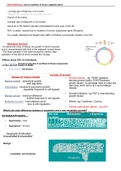
Retinoblastoma- due to mutation of tumor suppress gene
- Average age at Diagnosis is 24 months
- Normal Life expectancy if cured of the eye tumor
Cancer of the retina.
Average age of diagnosis is 24 months.
About 40 to 50 children develop retinoblastoma each year in the UK.
40% of cases, caused due to mutation of tumour suppressor gene (Rb gene).
It is usually detected and treated early (98% of children successfully treated in the UK).
Neoplasia (tumour)
- An abnormal mass of tissue, the growth of which exceeds
and is uncoordinated with that of the adjacent normal tissue.
- The mass persists in the same excessive manner after
cessation of the stimuli which evoked the change.
-Affects about 25% of individuals
• Growth – Increase in size due to synthesis of tissue components.
- is the second cause of death
• Proliferation- Cell division.
• Controls
Differentiation: functional and structural maturity of Growth:
of cells.
Biology of Tumour Growth • Growth factors – eg. PDGF (platelet-
Normal growth - polyclonal growth derived growth factor, FGF(Fibroblast
well regulated growth factor), to stimulate cells to enter the
cell cycle (from G0 to G1) and undergo
Hyperplasia - excessive polyclonal growth mitosis
regulated response to cell signals
• Growth Inhibitors- eg.TGF-a (transforming
Benign tumors - clonal proliferation growth factor)
limited response to cell signals
Malignant tumors - immortalized clone • Others: eg. Cytokines, Cyclins.
loss of cell regulation
• Cancer suppressor genes – eg. p53
What's the main difference between a neoplastic and a non-neoplastic growth?
• Oncogenes – eg. Ras, myc,
*Controlled & Reversible
Non-Neoplastic Proliferation:
• Genes control apoptosis- eg. bcl-2
• Hypertrophy – Size
• Hyperplasia – Number
Neoplastic Proliferation:
Uncontrolled & Irreversible*
Benign
- Localized, non-invasive.
, What is cancer (malignant tumour)?Difference in Benign and Malignant Tumours
Depending on whether or not they can spread by Cancer is a collection of over 100 diseases
invasion and metastasis, tumours are classified as that share common features (transformed phenotypes):
1) defects in cell differentiation- loss cell function
being either benign or malignant. Benign tumours are
tumours that cannot spread by invasion or metastasis; 2) uncontrolled cell proliferation
hence, they only grow locally. Malignant tumours are
tumours that are capable of spreading by invasion and 3) unlimited cellular lifespan
metastasis. By definition, the term "cancer" applies
only to malignant tumours. 4) infiltration and invasion of surrounding tissues
–metastases to secondary place (could be far away from original)
5) genetic instability
MITOTIC ACTIVITY
- Average age at Diagnosis is 24 months
- Normal Life expectancy if cured of the eye tumor
Cancer of the retina.
Average age of diagnosis is 24 months.
About 40 to 50 children develop retinoblastoma each year in the UK.
40% of cases, caused due to mutation of tumour suppressor gene (Rb gene).
It is usually detected and treated early (98% of children successfully treated in the UK).
Neoplasia (tumour)
- An abnormal mass of tissue, the growth of which exceeds
and is uncoordinated with that of the adjacent normal tissue.
- The mass persists in the same excessive manner after
cessation of the stimuli which evoked the change.
-Affects about 25% of individuals
• Growth – Increase in size due to synthesis of tissue components.
- is the second cause of death
• Proliferation- Cell division.
• Controls
Differentiation: functional and structural maturity of Growth:
of cells.
Biology of Tumour Growth • Growth factors – eg. PDGF (platelet-
Normal growth - polyclonal growth derived growth factor, FGF(Fibroblast
well regulated growth factor), to stimulate cells to enter the
cell cycle (from G0 to G1) and undergo
Hyperplasia - excessive polyclonal growth mitosis
regulated response to cell signals
• Growth Inhibitors- eg.TGF-a (transforming
Benign tumors - clonal proliferation growth factor)
limited response to cell signals
Malignant tumors - immortalized clone • Others: eg. Cytokines, Cyclins.
loss of cell regulation
• Cancer suppressor genes – eg. p53
What's the main difference between a neoplastic and a non-neoplastic growth?
• Oncogenes – eg. Ras, myc,
*Controlled & Reversible
Non-Neoplastic Proliferation:
• Genes control apoptosis- eg. bcl-2
• Hypertrophy – Size
• Hyperplasia – Number
Neoplastic Proliferation:
Uncontrolled & Irreversible*
Benign
- Localized, non-invasive.
, What is cancer (malignant tumour)?Difference in Benign and Malignant Tumours
Depending on whether or not they can spread by Cancer is a collection of over 100 diseases
invasion and metastasis, tumours are classified as that share common features (transformed phenotypes):
1) defects in cell differentiation- loss cell function
being either benign or malignant. Benign tumours are
tumours that cannot spread by invasion or metastasis; 2) uncontrolled cell proliferation
hence, they only grow locally. Malignant tumours are
tumours that are capable of spreading by invasion and 3) unlimited cellular lifespan
metastasis. By definition, the term "cancer" applies
only to malignant tumours. 4) infiltration and invasion of surrounding tissues
–metastases to secondary place (could be far away from original)
5) genetic instability
MITOTIC ACTIVITY