
PHARMACOLOOGY, TOXICOLOGY,
PHARMACOKINETICS
PHARMACOLOGY, TOXICOLOGY, PHARMACOKINETICS
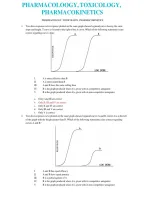
1. Two dose-response curve response plotted on the same graph showed sigmoid curves having the same
slope and height. T curve is located to the right of the A curve. Which of the following statements is/are
correct regarding curves A an:
I. A is more effective than B
II. A is more potent than B
III. A and B have the same ceiling dose
IV. B is the graph produced when A is given with its competitive antagonist
V. B is the graph produced when A is given with its non-competitive antagonist
a. Only I and III are correct
b. Only II, III and IV are correct
c. Only II and IV are correct
d. Only III and V are correct
e. Only V is correct
2. Two dose-response curve plotted on the same graph showed sigmoid curves A and B, where A is at the left
of the graph with the height greater than B. Which of the following statements is/are correct regarding
curves A and B?
I. A and B has equal efficacy
II. A and B have equal potency
III. B is a partial agonist of A
IV. B is the graph produced when A is given with its competitive antagonist
V. B is the graph produced when A is given with its non-competitive antagonist
, a. Only I and III are correct
b. Only II, III and IV are correct
c. Only II and IV are correct
d. Only III and V are correct
e. Only V is correct
3. The cumulative number of subjects who display a certain rersponse or effect to a drug is plotted on a graph
as shown below. The graph on the left represents beneficial effect while the graph on the right represents
toxic effect, what is the therapeutic index of the drug?
a.0.5 b. 1.5 c. 2.5 d.4.0 e. 5.0
4. An administration of one drug leads to a shift in the log dose-response curve of another drug to the left a
range in the maximal efficacy, this is called
a. Agonism
b. Partial agonism
c. Non-competitive antagonism
d. Competitive antagonism
e. Potentiation
5. The action of this drug is dependent on a colligative property
a. Mannitol
b. Cocaine
c. Reserpine
d. Furosemide
e. Losartan
6. Whiich of the following drug groups have mechanisms of aaction that involve binding to enzymes as target
protiens
a. Benzodiazepines
b. Barbiturates
c. Calcium channel blockers
d. Non-steroidal anti-inflammatory agents
e. Phenothiazine antipsychotics
7. Voltage-gated ion channels serve as site of actions for drugs such as
I. Diltiazem and Nifedipine
II. Lidocaine and Procaine
III. Captopril and Losartan
a. I only
b. I and II
c. III only
, d. I and III
e. I, II, and III
8. Drugs with mechanism of action that involves Tubulin-binding leading to loss of function of the structural
protien include
a. Cyclosporine
b. Neostigmine
c. Colchicine
d. Glibenclamide
e. Metformin
9. What type of protien is primarily targeted by Digitalis glycosides when they exert their effect on the heart?
a. Receptors
b. Ion channels
c. Enzymes
d. Transporters
e. Structural protiens
10. Which of the following features cahracterize nicotinic, GABA-A, and Glutamate receptors?
a. Thay control the movements of ions and out of the cell
b. Their action is mediated bysecondary messengers
c. They all have excitatory effect on the cell membrane
d. They are located on the cytoplasm
11. Which of the following drugs bind to receptors located at the cell membrane?
a. Thyroid hormone
b. Prednisone
c. Estrogen
d. Insulin
e. Vitamin D
12. Cyclic Adenosine Monophophate (cAMP) is generated as a secondary messenger by the action of the
enzyme Adenylyl Cyclase. The substrate for the synthesis of cAMP is
a. AMD
b. ADP
c. ATP
d. GTP
e. Adenosine
13. Stimulation of Beta-adrenoceptor, a G-protien-linked receptor involves a generation of a secondary
messenger known as
a. IP3
b. cGTP
c. DAG
d. cAMP
e. Calcium ions
14. What is the mechanism of action of Sildenafil, a drug popularly known as viagra?
a. Inhibits phosphodiesterase (PDE) leading to increase cAMP
b. Inhibits PDE leading to increase cGMP
c. Stimulates adenylyl cyclase leading to increase cAMP
d. Stimulates guanylyl cyclase leading to increase cGMP
e. Inhibits phosphodiesterase leading to increase cGMP
15. Drugs that activate the phospholipase C-inositol phosphate system such as alpha-adrenergic agonists like
phenylephrine primarily cause an increase in the intracellular levels of which ion?
a. Calcium
, b. Magnesium
c. Sodium
d. Potassium
e. Chloride
16. Which of the following stetements characterizes competitive antagonism?
a. There is a shift of the agonist log concentration-effect curve to the right and downwards
b. There is a shift of the agonist log concentration-effect curve to the right without a change on the
slope or amplitude
c. There is an exponential relationship between dose ratio and antagonist concentration
d. There is no competition for the binding sites
e. There is a shift of the agonist log-concentration effect curve to the left without a change in slope
and amplitude
17. The minimum dose that produces the maximum achievable response is known as
a. Potency
b. ED50
c. LD50
d. Ceiling dose
e. Minimum effective dose
18. The medium dose, or the dose of the drug that produces half of the maximum achievable response is called
a. Potency d. Ceiling dose
b. LD50 e. Binding constant
c. Therapeutic index
19. What is described by the equation given as follows:
Response=f (EN total . Xa / (Xa + Ka)
a. Relationship between occupancy of receptor and the dose of the drug
b. Relationship between occupancy of receptor and response to the drug
c. Relationship between the dose of the drug and the response to the drug
d. Relationship between the number of receptors and the dose of the drug
e. Relationship between the response to the drug and the transducer function of the tissues
20. Competitive antagonist of the receptors of Dopamine and Benzodiazepine are expected to produced which
effect?
a. Reversal of the intrinsic activity of the receptors
b. Maintain the consitutive activity of the receptors
c. Stimulate the constitutive activity of the receptors
d. Stimulate the constitutive activity of the recptorsin the absence of any ligand
e. Produce a negative efficacy
21. The PT-INR of a patient with Warfarin has been maintained at 2.5 for the last 3 months. 1 week earlier, the
patient was given Phenobarbital. What can be expected with the PT-INR of the patient?
a. Increased PT-INR
b. Decreased PT-INR
c. Maintained PT-INR
22. Phenobarbital when given to a patient on chronic warfarin is classified as
a. Pharmacodynamic antagonist
b. Pharmacokinetic antagonist
c. Physiologic antagonist
d. Synergistic agonist
e. Additive agonist
23. Digibind which effetively terminates the action of Digitalis glycosides is classified as what type of
antagonist?


