
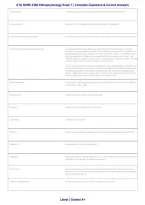
UTA NURS 3366 Pathophysiology Exam 1 | Complete Questions & Correct Answers
Homeostasis maintenance of constant conditions in the body's internal environment
Compensation the return to homeostasis after being challenged by a stressor
How is compensation achieved? by the body's use of control mechanisms, also called compensatory mechanisms
Compensatory mechanisms examples? when exposed to an elevated external temperature (Texas summer) or heavy
exercise -> body temperature rises -> the hypothalamus senses the elevated core
temperature and sends a signal to the skin to produce sweat -> heat loss occurs
through evaporation. Dilation of the superficial blood vessels also occurs -> as
"heated blood" circulates from the core to the periphery -> heat loss occurs through
radiation (heat removed from body into surrounding air).
you've lost a lot of blood (massive bleeding) or water (dehydration), the body uses
certain compensatory techniques to keep the remaining fluid volume circulating as
effectively as possible (temporary measures until the cause of the problem gets
fixed) -> heart rate would increase and arteries in your peripheral would constrict,
shunting whatever blood volume is left to the central areas
Decompensation if the body is unable to appropriately meet the challenge of stressors, the failure to
compensate, heal, adapt
Disease (dz) harmful condition of the body (and/or mind)
Disorder disturbance in the healthiness of the body
Syndrome collection of symptoms
Etiology the cause of a disease; includes all factors that contribute to development of dz
Idiopathic disease with an unidentifiable cause
Iatrogenic occurs as result of medical treatment; ex—if kidney failure is due to improper use of
antibiotics prescribed by a healthcare provider
Nosocomial result as consequence of being in hospital environment; ex- they come in for a
different issue, but due to improper sanitation or use they develop something else
(due to a hospital issue!)
Clinical manifestations the demonstration of a sign and/or symptom of a disease
Latest | Graded A+
, UTA NURS 3366 Pathophysiology Exam 1 | Complete Questions & Correct Answers
Signs manifestations that can be objectively identified by a trained observer
Symptoms subjective manifestations such as pain or weakness
Phenotype think of signs and symptoms, "has the phenotype" means "has the disease", which
means "has the S&S"
Local S&S Redness, swelling, heat, rash, & lymphadenopathy (disease of lymph nodes) in a
particular area
Systemic S&S fever, urticaria (hives), malaise ("I feel dragged out" or "awful all over"), systemic
lymphadenopathy
Urticaria hives
Malaise a vague feeling of physical discomfort or uneasiness
how does acute S&S manifest? rapid appearance of S&S, usually only lasts a short time, can also mean an
increase in severity
how does chronic S&S manifest? develop more slowly; S&S are often insidious (gradual) and
last longer and/or wax and wane over months or years.
Remissions periods when S&S disappear or diminish significantly (wane)
Exacerbations periods when S&S become worse or more severe
Peripheral or periphery refers to problem, situation, etc, that is occurring
towards the outer parts of the body, away from core
Central the body's core, brain and spinal cord, heart, etc.
Shock low blood perfusion to the cells= inadequate oxygen to the cell. Results in abnormal
cell function. S&S may include a low blood pressure and/or confusion from not
getting enough blood/O2 to the brain. Sign is cool, pale extremities
Distal father from the center of the body (can also mean DOWNSTREAM)
Latest | Graded A+
, UTA NURS 3366 Pathophysiology Exam 1 | Complete Questions & Correct Answers
Proximal closer to the center of the body
Prognosis a prediction of the course of a disease
What affects the prognosis? the usual course of a disease, and individual's characteristics such as age and
comorbidities
Comorbidity two or more coexisting medical conditions; this increases chance of poor prognosis
Sequela aftermath of a disease. Synonym= complications. Can be used as "outcome" as
well, but typically has a negative connotation
Sequela of rheumatic fever bad heart valve
Sequela of chicken pox scars/shingles
Sequela of stroke hemiparesis (weakness or the inability to move on one side of the body)
·Precipitating factor a specific event or trigger to the onset of the current problem
·Physiologic normal function of the body
·Pathologic pertaining to disease
RNA assembles the amino acids into functional protein by the process of translation
Gene a segment of the DNA molecule that is composed of an ordered sequence of
nucleotide bases (adenine, guanine, cytosine, thymine)
Main functions of genes: coding for synthesis of proteins that influence all aspects of our traits and functional
characteristics
What happens when a gene mutates? protein it is responsible for often malfunctions (ex-lactose intolerance)
Latest | Graded A+
Homeostasis maintenance of constant conditions in the body's internal environment
Compensation the return to homeostasis after being challenged by a stressor
How is compensation achieved? by the body's use of control mechanisms, also called compensatory mechanisms
Compensatory mechanisms examples? when exposed to an elevated external temperature (Texas summer) or heavy
exercise -> body temperature rises -> the hypothalamus senses the elevated core
temperature and sends a signal to the skin to produce sweat -> heat loss occurs
through evaporation. Dilation of the superficial blood vessels also occurs -> as
"heated blood" circulates from the core to the periphery -> heat loss occurs through
radiation (heat removed from body into surrounding air).
you've lost a lot of blood (massive bleeding) or water (dehydration), the body uses
certain compensatory techniques to keep the remaining fluid volume circulating as
effectively as possible (temporary measures until the cause of the problem gets
fixed) -> heart rate would increase and arteries in your peripheral would constrict,
shunting whatever blood volume is left to the central areas
Decompensation if the body is unable to appropriately meet the challenge of stressors, the failure to
compensate, heal, adapt
Disease (dz) harmful condition of the body (and/or mind)
Disorder disturbance in the healthiness of the body
Syndrome collection of symptoms
Etiology the cause of a disease; includes all factors that contribute to development of dz
Idiopathic disease with an unidentifiable cause
Iatrogenic occurs as result of medical treatment; ex—if kidney failure is due to improper use of
antibiotics prescribed by a healthcare provider
Nosocomial result as consequence of being in hospital environment; ex- they come in for a
different issue, but due to improper sanitation or use they develop something else
(due to a hospital issue!)
Clinical manifestations the demonstration of a sign and/or symptom of a disease
Latest | Graded A+
, UTA NURS 3366 Pathophysiology Exam 1 | Complete Questions & Correct Answers
Signs manifestations that can be objectively identified by a trained observer
Symptoms subjective manifestations such as pain or weakness
Phenotype think of signs and symptoms, "has the phenotype" means "has the disease", which
means "has the S&S"
Local S&S Redness, swelling, heat, rash, & lymphadenopathy (disease of lymph nodes) in a
particular area
Systemic S&S fever, urticaria (hives), malaise ("I feel dragged out" or "awful all over"), systemic
lymphadenopathy
Urticaria hives
Malaise a vague feeling of physical discomfort or uneasiness
how does acute S&S manifest? rapid appearance of S&S, usually only lasts a short time, can also mean an
increase in severity
how does chronic S&S manifest? develop more slowly; S&S are often insidious (gradual) and
last longer and/or wax and wane over months or years.
Remissions periods when S&S disappear or diminish significantly (wane)
Exacerbations periods when S&S become worse or more severe
Peripheral or periphery refers to problem, situation, etc, that is occurring
towards the outer parts of the body, away from core
Central the body's core, brain and spinal cord, heart, etc.
Shock low blood perfusion to the cells= inadequate oxygen to the cell. Results in abnormal
cell function. S&S may include a low blood pressure and/or confusion from not
getting enough blood/O2 to the brain. Sign is cool, pale extremities
Distal father from the center of the body (can also mean DOWNSTREAM)
Latest | Graded A+
, UTA NURS 3366 Pathophysiology Exam 1 | Complete Questions & Correct Answers
Proximal closer to the center of the body
Prognosis a prediction of the course of a disease
What affects the prognosis? the usual course of a disease, and individual's characteristics such as age and
comorbidities
Comorbidity two or more coexisting medical conditions; this increases chance of poor prognosis
Sequela aftermath of a disease. Synonym= complications. Can be used as "outcome" as
well, but typically has a negative connotation
Sequela of rheumatic fever bad heart valve
Sequela of chicken pox scars/shingles
Sequela of stroke hemiparesis (weakness or the inability to move on one side of the body)
·Precipitating factor a specific event or trigger to the onset of the current problem
·Physiologic normal function of the body
·Pathologic pertaining to disease
RNA assembles the amino acids into functional protein by the process of translation
Gene a segment of the DNA molecule that is composed of an ordered sequence of
nucleotide bases (adenine, guanine, cytosine, thymine)
Main functions of genes: coding for synthesis of proteins that influence all aspects of our traits and functional
characteristics
What happens when a gene mutates? protein it is responsible for often malfunctions (ex-lactose intolerance)
Latest | Graded A+


