
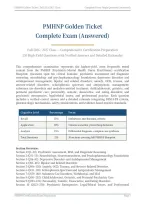
PMHNP Golden Ticket | Fall 2026/2027 Class Complete Every Single Question (Answered)
PMHNP Golden Ticket
Complete Exam (Answered)
Fall Class — Comprehensive Certification Preparation
250 High-Yield Questions with Verified Answers and Detailed Rationales
This comprehensive examination represents the highest-yield, most frequently tested
content from the PMHNP (Psychiatric-Mental Health Nurse Practitioner) certification
blueprint. Questions span ten critical domains: psychiatric assessment and diagnostic
reasoning; neurobiology and psychopharmacology foundations; depressive disorders and
antidepressant management; bipolar and related disorders; anxiety, OCD, trauma, and
stressor-related disorders; schizophrenia spectrum and antipsychotic management;
substance use disorders and medation-assisted treatment; child/adolescent, geriatric, and
perinatal psychiatric care; personality, somatic, dissociative, and eating disorders; and
psychiatric emergencies, legal/ethical issues, and professional practice. Each question
includes a verified correct answer and a detailed rationale integrating DSM-5-TR criteria,
pharmacologic mechanisms, safety considerations, and evidence-based practice standards.
Cognitive Level Percentage Focus
Recall 25% Definitions, mechanisms, criteria
Application 50% Clinical scenarios, prescribing decisions
Analysis 25% Differential diagnosis, complex case synthesis
Total Questions 250 10 sections covering full PMHNP blueprint
Section Overview:
Section 1 (Q1–30): Psychiatric Assessment, MSE, and Diagnostic Reasoning
Section 2 (Q31–55): Neurobiology, Neurotransmitters, and Psychopharmacology Foundations
Section 3 (Q56–82): Depressive Disorders and Antidepressant Management
Section 4 (Q83–105): Bipolar and Related Disorders
Section 5 (Q106–130): Anxiety, OCD, Trauma, and Stressor-Related Disorders
Section 6 (Q131–158): Schizophrenia Spectrum and Antipsychotic Management
Section 7 (Q159–180): Substance Use Disorders, Withdrawal, and MAT
Section 8 (Q181–202): Child/Adolescent, Geriatric, and Perinatal Psychiatric Care
Section 9 (Q203–222): Personality, Somatic, Dissociative, and Eating Disorders
Section 10 (Q223–250): Psychiatric Emergencies, Legal/Ethical Issues, and Professional
PMHNP Certification Exam Preparation Page 1
,PMHNP Golden Ticket | Fall 2026/2027 Class Complete Every Single Question (Answered)
Practice
PMHNP Certification Exam Preparation Page 2
,PMHNP Golden Ticket | Fall 2026/2027 Class Complete Every Single Question (Answered)
Section 1: Psychiatric Assessment, MSE, and Diagnostic
Reasoning (DSM-5-TR, Differential Diagnosis, & Risk
Assessment)
Q1: A 34-year-old female presents with depressed mood, anhedonia, hypersomnia,
increased appetite with carbohydrate craving, leaden paralysis in arms and legs, and
longstanding interpersonal rejection sensitivity. Her BMI is 32 and she reports being "a
sensitive child" with mood swings since adolescence. Which DSM-5-TR specifier best
characterizes this presentation?
A. Major depressive disorder with melancholic features
B. Major depressive disorder with atypical features [CORRECT]
C. Persistent depressive disorder with anxious distress
D. Disruptive mood dysregulation disorder
Correct Answer: B — Major depressive disorder with atypical features
Rationale: DSM-5-TR atypical features require mood reactivity plus 2+ of: hypersomnia,
hyperphagia/weight gain, leaden paralysis, longstanding interpersonal rejection sensitivity.
Melancholic features (A) require anhedonia, early morning awakening, weight loss, and profound
psychomotor changes; this case lacks those. Persistent depressive disorder (C) requires chronicity >=2
years but does not include the reverse vegetative symptoms. DMDD (D) is a childhood-onset disorder
with severe temper outbursts, incompatible with this adult atypical picture.
Q2: During a mental status examination, the PMHNP observes that the patient's speech is
fluent and grammatically correct but contains frequent substitutions of phonemes (e.g.,
"I need to take my fluster instead of my blisters"). The patient does not appear distressed
by these errors. This finding is most consistent with:
A. Wernicke's aphasia with impaired comprehension
B. Paraphasia suggestive of a neurologic lesion [CORRECT]
C. Formal thought disorder of schizophrenia
D. Expressive aphasia of Broca's type
Correct Answer: B — Paraphasia suggestive of a neurologic lesion
Rationale: Phonemic paraphasias (substitution of phonemes producing a nonword or wrong word) are
classic for acquired neurologic lesions, particularly in the perisylvian language cortex. Wernicke's
aphasia (A) includes fluent paraphasic speech PLUS impaired comprehension and anosognosia.
Formal thought disorder in schizophrenia (C) manifests as derailment, tangentiality, or loose
associations, not phoneme substitutions. Broca's aphasia (D) is nonfluent and effortful. New focal
neurologic signs on MSE mandate medical/neurologic workup before psychiatric attribution.
PMHNP Certification Exam Preparation Page 3
, PMHNP Golden Ticket | Fall 2026/2027 Class Complete Every Single Question (Answered)
Q3: A 28-year-old male with no prior psychiatric history is brought to the ED after being
found wandering. On MSE, he is alert but oriented only to person. Speech is notable for
clang associations ("I'm fine, fine like wine, the line is mine"). Affect is blunted and he
exhibits waxy flexibility. Vital signs: T 38.2°C, HR 118, BP 162/96. Creatine kinase is 2,400
U/L. What is the PRIORITY diagnostic consideration?
A. Schizophrenia, acute exacerbation
B. Antipsychotic-induced neuroleptic malignant syndrome
C. Malignant catatonia (lethal catatonia) [CORRECT]
D. Substance intoxication with synthetic cathinone
Correct Answer: C — Malignant catatonia (lethal catatonia)
Rationale: The combination of hyperthermia, autonomic instability, elevated CK, waxy flexibility, and
mutism/excitement is malignant catatonia, a life-threatening emergency. While NMS (B) shares
features, NMS typically follows dopamine antagonist exposure and shows more pronounced lead-pipe
rigidity; malignant catatonia can arise de novo. Schizophrenia (A) does not cause fever or CK elevation.
Cathinone intoxication (D) causes agitation and hyperthermia but not waxy flexibility. The priority is
recognizing catatonia and initiating benzodiazepine challenge and supportive care; ECT is definitive
for malignant cases.
Q4: A PMHNP is evaluating a 19-year-old college student who describes 6 months of social
withdrawal, declining grades, magical thinking, perceptual disturbances, and odd
beliefs about professors reading his thoughts. He has 2 first-degree relatives with
schizophrenia. Which DSM-5-TR diagnosis best fits, recognizing the duration criteria?
A. Schizophrenia
B. Schizophreniform disorder [CORRECT]
C. Brief psychotic disorder
D. Attenuated psychosis syndrome (in Other Specified)
Correct Answer: B — Schizophreniform disorder
Rationale: Schizophreniform disorder requires Criterion A symptoms for 1-6 months with no
functional decline requirement, fitting this 6-month window if total symptom duration does not exceed
6 months. Schizophrenia (A) requires >6 months of continuous signs plus functional decline. Brief
psychotic disorder (C) lasts <1 month with full return to baseline. Attenuated psychosis syndrome (D) is
reserved for sub-threshold symptoms that are not yet fully psychotic; this patient has full Criterion A
symptoms. Family history raises risk but does not change the duration-based diagnosis.
PMHNP Certification Exam Preparation Page 4
PMHNP Golden Ticket
Complete Exam (Answered)
Fall Class — Comprehensive Certification Preparation
250 High-Yield Questions with Verified Answers and Detailed Rationales
This comprehensive examination represents the highest-yield, most frequently tested
content from the PMHNP (Psychiatric-Mental Health Nurse Practitioner) certification
blueprint. Questions span ten critical domains: psychiatric assessment and diagnostic
reasoning; neurobiology and psychopharmacology foundations; depressive disorders and
antidepressant management; bipolar and related disorders; anxiety, OCD, trauma, and
stressor-related disorders; schizophrenia spectrum and antipsychotic management;
substance use disorders and medation-assisted treatment; child/adolescent, geriatric, and
perinatal psychiatric care; personality, somatic, dissociative, and eating disorders; and
psychiatric emergencies, legal/ethical issues, and professional practice. Each question
includes a verified correct answer and a detailed rationale integrating DSM-5-TR criteria,
pharmacologic mechanisms, safety considerations, and evidence-based practice standards.
Cognitive Level Percentage Focus
Recall 25% Definitions, mechanisms, criteria
Application 50% Clinical scenarios, prescribing decisions
Analysis 25% Differential diagnosis, complex case synthesis
Total Questions 250 10 sections covering full PMHNP blueprint
Section Overview:
Section 1 (Q1–30): Psychiatric Assessment, MSE, and Diagnostic Reasoning
Section 2 (Q31–55): Neurobiology, Neurotransmitters, and Psychopharmacology Foundations
Section 3 (Q56–82): Depressive Disorders and Antidepressant Management
Section 4 (Q83–105): Bipolar and Related Disorders
Section 5 (Q106–130): Anxiety, OCD, Trauma, and Stressor-Related Disorders
Section 6 (Q131–158): Schizophrenia Spectrum and Antipsychotic Management
Section 7 (Q159–180): Substance Use Disorders, Withdrawal, and MAT
Section 8 (Q181–202): Child/Adolescent, Geriatric, and Perinatal Psychiatric Care
Section 9 (Q203–222): Personality, Somatic, Dissociative, and Eating Disorders
Section 10 (Q223–250): Psychiatric Emergencies, Legal/Ethical Issues, and Professional
PMHNP Certification Exam Preparation Page 1
,PMHNP Golden Ticket | Fall 2026/2027 Class Complete Every Single Question (Answered)
Practice
PMHNP Certification Exam Preparation Page 2
,PMHNP Golden Ticket | Fall 2026/2027 Class Complete Every Single Question (Answered)
Section 1: Psychiatric Assessment, MSE, and Diagnostic
Reasoning (DSM-5-TR, Differential Diagnosis, & Risk
Assessment)
Q1: A 34-year-old female presents with depressed mood, anhedonia, hypersomnia,
increased appetite with carbohydrate craving, leaden paralysis in arms and legs, and
longstanding interpersonal rejection sensitivity. Her BMI is 32 and she reports being "a
sensitive child" with mood swings since adolescence. Which DSM-5-TR specifier best
characterizes this presentation?
A. Major depressive disorder with melancholic features
B. Major depressive disorder with atypical features [CORRECT]
C. Persistent depressive disorder with anxious distress
D. Disruptive mood dysregulation disorder
Correct Answer: B — Major depressive disorder with atypical features
Rationale: DSM-5-TR atypical features require mood reactivity plus 2+ of: hypersomnia,
hyperphagia/weight gain, leaden paralysis, longstanding interpersonal rejection sensitivity.
Melancholic features (A) require anhedonia, early morning awakening, weight loss, and profound
psychomotor changes; this case lacks those. Persistent depressive disorder (C) requires chronicity >=2
years but does not include the reverse vegetative symptoms. DMDD (D) is a childhood-onset disorder
with severe temper outbursts, incompatible with this adult atypical picture.
Q2: During a mental status examination, the PMHNP observes that the patient's speech is
fluent and grammatically correct but contains frequent substitutions of phonemes (e.g.,
"I need to take my fluster instead of my blisters"). The patient does not appear distressed
by these errors. This finding is most consistent with:
A. Wernicke's aphasia with impaired comprehension
B. Paraphasia suggestive of a neurologic lesion [CORRECT]
C. Formal thought disorder of schizophrenia
D. Expressive aphasia of Broca's type
Correct Answer: B — Paraphasia suggestive of a neurologic lesion
Rationale: Phonemic paraphasias (substitution of phonemes producing a nonword or wrong word) are
classic for acquired neurologic lesions, particularly in the perisylvian language cortex. Wernicke's
aphasia (A) includes fluent paraphasic speech PLUS impaired comprehension and anosognosia.
Formal thought disorder in schizophrenia (C) manifests as derailment, tangentiality, or loose
associations, not phoneme substitutions. Broca's aphasia (D) is nonfluent and effortful. New focal
neurologic signs on MSE mandate medical/neurologic workup before psychiatric attribution.
PMHNP Certification Exam Preparation Page 3
, PMHNP Golden Ticket | Fall 2026/2027 Class Complete Every Single Question (Answered)
Q3: A 28-year-old male with no prior psychiatric history is brought to the ED after being
found wandering. On MSE, he is alert but oriented only to person. Speech is notable for
clang associations ("I'm fine, fine like wine, the line is mine"). Affect is blunted and he
exhibits waxy flexibility. Vital signs: T 38.2°C, HR 118, BP 162/96. Creatine kinase is 2,400
U/L. What is the PRIORITY diagnostic consideration?
A. Schizophrenia, acute exacerbation
B. Antipsychotic-induced neuroleptic malignant syndrome
C. Malignant catatonia (lethal catatonia) [CORRECT]
D. Substance intoxication with synthetic cathinone
Correct Answer: C — Malignant catatonia (lethal catatonia)
Rationale: The combination of hyperthermia, autonomic instability, elevated CK, waxy flexibility, and
mutism/excitement is malignant catatonia, a life-threatening emergency. While NMS (B) shares
features, NMS typically follows dopamine antagonist exposure and shows more pronounced lead-pipe
rigidity; malignant catatonia can arise de novo. Schizophrenia (A) does not cause fever or CK elevation.
Cathinone intoxication (D) causes agitation and hyperthermia but not waxy flexibility. The priority is
recognizing catatonia and initiating benzodiazepine challenge and supportive care; ECT is definitive
for malignant cases.
Q4: A PMHNP is evaluating a 19-year-old college student who describes 6 months of social
withdrawal, declining grades, magical thinking, perceptual disturbances, and odd
beliefs about professors reading his thoughts. He has 2 first-degree relatives with
schizophrenia. Which DSM-5-TR diagnosis best fits, recognizing the duration criteria?
A. Schizophrenia
B. Schizophreniform disorder [CORRECT]
C. Brief psychotic disorder
D. Attenuated psychosis syndrome (in Other Specified)
Correct Answer: B — Schizophreniform disorder
Rationale: Schizophreniform disorder requires Criterion A symptoms for 1-6 months with no
functional decline requirement, fitting this 6-month window if total symptom duration does not exceed
6 months. Schizophrenia (A) requires >6 months of continuous signs plus functional decline. Brief
psychotic disorder (C) lasts <1 month with full return to baseline. Attenuated psychosis syndrome (D) is
reserved for sub-threshold symptoms that are not yet fully psychotic; this patient has full Criterion A
symptoms. Family history raises risk but does not change the duration-based diagnosis.
PMHNP Certification Exam Preparation Page 4


