
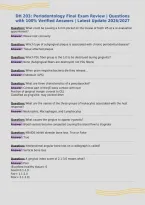
DH 203: Periodontology Final Exam Review | Questions
with 100% Verified Answers | Latest Update 2026/2027
Question: What could be causing a 6 mm pocket on the mesial of tooth #5 at a re-evaluation
appointment?
Answer: Mesial root concavity
Question: Which type of subgingival plaque is associated with chronic periodontal disease?
Answer: Tissue attached plaque
Question: Which PDL fiber group is the 1st to be destroyed during gingivitis?
Answer: None (Subgingival fibers are destroyed; not PDL fibers)
Question: When gram negative bacteria die they release...
Answer: Endotoxin (LPS)
Question: What are three characteristics of a pseudopocket?
Answer: Coronal part of the JE loses contact with root
Position of gingival margin coronal to CEJ
Classified as gingivitis: may exceed 4mm
Question: What are the names of the three groups of leukocytes associated with the host
response?
Answer: Neutrophils, Macrophages, and Lymphocytes
Question: What causes the gingiva to appear cyanotic?
Answer: Blood vessels become congested causing the blood flow to stagnate
Question: NSAIDS inhibit alveolar bone loss. True or False
Answer: True
Question: Interproximal angular bone loss on a radiograph is called?
Answer: Vertical bone loss
Question: A gingival index score of 2.1-3.0 means what?
Answer: Poor
(Excellent-healthy tissue= 0
Good=0.1-1.0
Fair= 1.1-2.0
Poor= 2.1-3.0)
,Question: Bleeding upon probing is a sign of?
Answer: Sulcular epithelium ulcerations, inflammation
Question: What clinical conditions do we see in AIDS- associated with NUP?
Answer: Rapid destruction of PDL and alveolar bone
Linear gingival erythema may be present
Less prevalent than non-AIDS associated NUP
Question: In health, where is the location of the gingival margin?
Answer: At or slightly above CEJ
Question: What stage of the gingival lesion development is NOT reversible?
Answer: Advanced
Question: During which stage of plaque development do motile vibrios and spirochetes begin
to colonize biofilm?
Answer: Plaque maturation
Question: Why is calculus an important local risk factor?
Answer: Surface is porous, rough and increases plaque accumulation
Question: After completion of initial periodontal therapy, pocket reduction occurs because of?
Answer: Formation of a long junctional epithelium
Question: Name 4 chemical inflammatory mediators of periodontitis.
Answer: Prostaglandin
Interleukin
TNF
Cytokine
Question: What type of abscess only involves the gingival margin with no radiographic
appearance?
Answer: Gingival
Question: In what condition do we see the production of gram negative to gram positive
species about equal? Health, gingivitis, or periodontitis?
Answer: Gingivitis
Question: What is the definition of iatrogenic?
Answer: Caused by the dentist
, Question: Name 4 characteristics of necrotizing ulcerative gingivitis.
Answer: Pseudomembrane layer
Sudden onset
Spontaneous bleeding
Cratered papillae
Question: Which periodontal ligament fibers make up the bulk of the PDL?
Answer: Oblique
Question: What type of bone loss do we see associated with an infrabony pocket?
Answer: Vertical
Question: What type of medications cause gingival enlargement?
Answer: Dilantin (phenytoin)
Nifedipine (procardia)
Verapamil (calan)
Diltiazem (Cardizem)
Question: What is an endotoxin?
Answer: Lipopolysaccharide (LPS);
Component of gram negative cell walls virulence factor responsible for initiating the
host
response
Question: What are the 2 ways bacterial enzymes function?
Answer: Invade into tissues directly (collagenase)
Stimulate signal host cells to make chemicals (cytokine)
Question: People who are positive for the IL-1 genotype are more likely to have advanced
periodontal disease. True or False
Answer: True
Question: Coaggregation occurs during which stage of plaque formation?
Answer: Secondary colonization
Question: Free-floating periodontal pathogens cannot cause periodontal disease. True or False
Answer: True (Have to attach to tooth surfaces to cause destruction)
Question: Fibroblasts produce?
Answer: Collagen
with 100% Verified Answers | Latest Update 2026/2027
Question: What could be causing a 6 mm pocket on the mesial of tooth #5 at a re-evaluation
appointment?
Answer: Mesial root concavity
Question: Which type of subgingival plaque is associated with chronic periodontal disease?
Answer: Tissue attached plaque
Question: Which PDL fiber group is the 1st to be destroyed during gingivitis?
Answer: None (Subgingival fibers are destroyed; not PDL fibers)
Question: When gram negative bacteria die they release...
Answer: Endotoxin (LPS)
Question: What are three characteristics of a pseudopocket?
Answer: Coronal part of the JE loses contact with root
Position of gingival margin coronal to CEJ
Classified as gingivitis: may exceed 4mm
Question: What are the names of the three groups of leukocytes associated with the host
response?
Answer: Neutrophils, Macrophages, and Lymphocytes
Question: What causes the gingiva to appear cyanotic?
Answer: Blood vessels become congested causing the blood flow to stagnate
Question: NSAIDS inhibit alveolar bone loss. True or False
Answer: True
Question: Interproximal angular bone loss on a radiograph is called?
Answer: Vertical bone loss
Question: A gingival index score of 2.1-3.0 means what?
Answer: Poor
(Excellent-healthy tissue= 0
Good=0.1-1.0
Fair= 1.1-2.0
Poor= 2.1-3.0)
,Question: Bleeding upon probing is a sign of?
Answer: Sulcular epithelium ulcerations, inflammation
Question: What clinical conditions do we see in AIDS- associated with NUP?
Answer: Rapid destruction of PDL and alveolar bone
Linear gingival erythema may be present
Less prevalent than non-AIDS associated NUP
Question: In health, where is the location of the gingival margin?
Answer: At or slightly above CEJ
Question: What stage of the gingival lesion development is NOT reversible?
Answer: Advanced
Question: During which stage of plaque development do motile vibrios and spirochetes begin
to colonize biofilm?
Answer: Plaque maturation
Question: Why is calculus an important local risk factor?
Answer: Surface is porous, rough and increases plaque accumulation
Question: After completion of initial periodontal therapy, pocket reduction occurs because of?
Answer: Formation of a long junctional epithelium
Question: Name 4 chemical inflammatory mediators of periodontitis.
Answer: Prostaglandin
Interleukin
TNF
Cytokine
Question: What type of abscess only involves the gingival margin with no radiographic
appearance?
Answer: Gingival
Question: In what condition do we see the production of gram negative to gram positive
species about equal? Health, gingivitis, or periodontitis?
Answer: Gingivitis
Question: What is the definition of iatrogenic?
Answer: Caused by the dentist
, Question: Name 4 characteristics of necrotizing ulcerative gingivitis.
Answer: Pseudomembrane layer
Sudden onset
Spontaneous bleeding
Cratered papillae
Question: Which periodontal ligament fibers make up the bulk of the PDL?
Answer: Oblique
Question: What type of bone loss do we see associated with an infrabony pocket?
Answer: Vertical
Question: What type of medications cause gingival enlargement?
Answer: Dilantin (phenytoin)
Nifedipine (procardia)
Verapamil (calan)
Diltiazem (Cardizem)
Question: What is an endotoxin?
Answer: Lipopolysaccharide (LPS);
Component of gram negative cell walls virulence factor responsible for initiating the
host
response
Question: What are the 2 ways bacterial enzymes function?
Answer: Invade into tissues directly (collagenase)
Stimulate signal host cells to make chemicals (cytokine)
Question: People who are positive for the IL-1 genotype are more likely to have advanced
periodontal disease. True or False
Answer: True
Question: Coaggregation occurs during which stage of plaque formation?
Answer: Secondary colonization
Question: Free-floating periodontal pathogens cannot cause periodontal disease. True or False
Answer: True (Have to attach to tooth surfaces to cause destruction)
Question: Fibroblasts produce?
Answer: Collagen


