
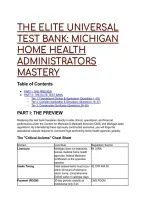
THE ELITE UNIVERSAL
TEST BANK: MICHIGAN
HOME HEALTH
ADMINISTRATORS
MASTERY
Table of Contents
● PART I: THE PREVIEW
● PART II: THE ELITE TEST BANK
○ Tier 1: Foundational Syntax & Application (Questions 1–18)
○ Tier 2: Complex Application & Simulation (Questions 19–37)
○ Tier 3: Grandmaster Synthesis (Questions 38–55)
PART I: THE PREVIEW
Mastering this test bank translates directly to elite clinical, operational, and financial
performance under the Centers for Medicare & Medicaid Services (CMS) and Michigan state
regulations. By internalizing these rigorously constructed scenarios, you will forge the
operational instincts required to command high-performing home health agencies globally.
The "Critical Axioms" Cheat Sheet
Domain Core Rule Regulatory Source
Licensure Michigan does not statutorily MI LARA
license medical home health
agencies; federal Medicare
certification is the operative
baseline.
Intake Timing Initial assessments must occur 42 CFR 484.55
within 48 hours of referral or
return home; comprehensive
OASIS within 5 calendar days.
Payment (PDGM) 30-day periods classify as CMS PDGM
institutional only if an
,Domain Core Rule Regulatory Source
acute/post-acute inpatient stay
occurred within the prior 14
days.
Outliers Medicare outlier payments HH PPS
trigger beyond the fixed-dollar
loss threshold, strictly capped
at 10% of total annual PDGM
payments.
Aide Supervision Aides require 75 hours of initial 42 CFR 484.80
training and must be
supervised onsite by a skilled
professional every 14 days.
PART II: THE ELITE TEST BANK
Tier 1: Foundational Syntax & Application (Questions 1–18)
Q1: An ownership group in Detroit plans to establish a skilled home health agency serving
dual-eligible beneficiaries. The compliance officer insists on filing for a state home health license
before seeking federal accreditation. Based on the principles of the Michigan Public Health
Code (MCL 333), which conclusion regarding this strategy is the MOST ACCURATE?
A) The agency must secure a Michigan Adult Foster Care license to legally administer skilled
nursing in residential settings. B) Michigan requires a distinct state home health license, which
is prerequisite to federal Medicare certification. C) Michigan does not issue a state license for
home health agencies; Medicare certification is the operative quality marker. D) The agency
must register under the Homes for the Aged provisions before admitting dual-eligible patients.
● Answer: C (Michigan does not issue a state license for home health agencies; Medicare
certification is the operative quality marker.)
● Distractor Analysis:
○ A is incorrect: Adult Foster Care licenses (MCL 400.701) apply to residential
supervision and personal care, not intermittent skilled home health visits.
○ B is incorrect: There is no state licensure statute for medical home health agencies
in Michigan; LARA acts exclusively as the CMS survey agency.
○ D is incorrect: Homes for the Aged (HFA) regulates specific continuous supervised
personal care facilities, distinct from skilled home health agencies.
The Mentor's Analysis: Regulatory mapping dictates the baseline barrier to entry in any
jurisdiction. When establishing an agency in Michigan, the immediate priority is pursuing federal
Medicare certification and Medicaid enrollment, as Michigan's Public Health Code lacks a
distinct home health licensure category. By targeting 42 CFR Part 484, you bypass the common
trap of delaying operations for non-existent state licensure. Professional Intuition: In Michigan,
federal Medicare certification functionally replaces state licensure for skilled home health
agencies.
Q2: A Michigan home health agency hires a new Administrator on June 1, 2024. The candidate
holds an Associate Degree in Nursing and has two years of supervisory experience in a certified
home health agency. Based on the principles of 42 CFR 484.115(a), which conclusion regarding
the candidate's qualifications is CORRECT?
A) The candidate is non-compliant because an administrator hired after January 13, 2018, must
, hold a Baccalaureate degree. B) The candidate is compliant because an undergraduate degree,
which includes an associate degree, fulfills the educational mandate. C) The candidate is
non-compliant because clinical managers, not administrators, are permitted to hold associate
degrees. D) The candidate is compliant solely because they possess more than one year of
supervisory experience, overriding the degree requirement.
● Answer: B (The candidate is compliant because an undergraduate degree, which includes
an associate degree, fulfills the educational mandate.)
● Distractor Analysis:
○ A is incorrect: CMS officially clarified in SOM Appendix B that an "undergraduate
degree" satisfies the requirement, explicitly defining it to include an associate
degree.
○ C is incorrect: The standard for administrators directly permits an undergraduate
degree alongside the required experience.
○ D is incorrect: Experience does not override the educational requirement for
administrators hired on or after January 13, 2018; both must be met.
The Mentor's Analysis: Personnel standards form the legal backbone of agency operations,
distinguishing between legacy and post-2018 hires. When auditing leadership credentials, the
immediate priority is matching the exact hire date against the bifurcated regulatory standard. By
leveraging the expanded CMS definition of an undergraduate degree, you bypass the common
trap of unnecessarily disqualifying competent clinical leaders. Professional Intuition:
Administrators hired after January 13, 2018, must possess at least an associate degree
and one year of relevant supervisory experience.
Q3: A home health agency receives a referral for a complex wound care patient. The agency's
current caseload is maximized. Based on the principles of 42 CFR 484.105(i) Acceptance to
Service, which action is the FIRST requirement before declining the referral?
A) Consult the physician to downgrade the wound care orders to a basic skilled nursing level. B)
Evaluate the agency's capacity based on anticipated needs, caseload, staffing levels, and
specific staff competencies. C) Immediately issue a Medicare Advance Beneficiary Notice of
Noncoverage (ABN) to the patient. D) Transfer the referral to a skilled nursing facility without
notifying the referring provider.
● Answer: B (Evaluate the agency's capacity based on anticipated needs, caseload, staffing
levels, and specific staff competencies.)
● Distractor Analysis:
○ A is incorrect: Altering physician orders to match inadequate agency staffing is a
dangerous violation of clinical standards and patient safety.
○ C is incorrect: An ABN is used for non-covered services, not as a mechanism to
decline a referral due to capacity issues.
○ D is incorrect: The agency cannot unilaterally redirect a referral to an SNF; they
must inform the referring entity of their inability to accept.
The Mentor's Analysis: Intake decisions must be systematically governed by objective capacity
limits to prevent patient neglect. When facing a complex referral, the immediate priority is
applying the four criteria of the CMS Acceptance-to-Service policy. By formalizing a documented
capacity review, you bypass the common trap of accepting patients whose acuity exceeds your
clinical bandwidth. Professional Intuition: Agencies must formally evaluate anticipated
needs, caseload, staffing levels, and competencies prior to accepting any referral.
Q4: During an initial evaluation visit, an admitting Registered Nurse provides a verbal
explanation of the patient's rights but delays providing the written notice until the second visit on
Day 6. Based on the principles of 42 CFR 484.50 Patient Rights, which conclusion regarding
TEST BANK: MICHIGAN
HOME HEALTH
ADMINISTRATORS
MASTERY
Table of Contents
● PART I: THE PREVIEW
● PART II: THE ELITE TEST BANK
○ Tier 1: Foundational Syntax & Application (Questions 1–18)
○ Tier 2: Complex Application & Simulation (Questions 19–37)
○ Tier 3: Grandmaster Synthesis (Questions 38–55)
PART I: THE PREVIEW
Mastering this test bank translates directly to elite clinical, operational, and financial
performance under the Centers for Medicare & Medicaid Services (CMS) and Michigan state
regulations. By internalizing these rigorously constructed scenarios, you will forge the
operational instincts required to command high-performing home health agencies globally.
The "Critical Axioms" Cheat Sheet
Domain Core Rule Regulatory Source
Licensure Michigan does not statutorily MI LARA
license medical home health
agencies; federal Medicare
certification is the operative
baseline.
Intake Timing Initial assessments must occur 42 CFR 484.55
within 48 hours of referral or
return home; comprehensive
OASIS within 5 calendar days.
Payment (PDGM) 30-day periods classify as CMS PDGM
institutional only if an
,Domain Core Rule Regulatory Source
acute/post-acute inpatient stay
occurred within the prior 14
days.
Outliers Medicare outlier payments HH PPS
trigger beyond the fixed-dollar
loss threshold, strictly capped
at 10% of total annual PDGM
payments.
Aide Supervision Aides require 75 hours of initial 42 CFR 484.80
training and must be
supervised onsite by a skilled
professional every 14 days.
PART II: THE ELITE TEST BANK
Tier 1: Foundational Syntax & Application (Questions 1–18)
Q1: An ownership group in Detroit plans to establish a skilled home health agency serving
dual-eligible beneficiaries. The compliance officer insists on filing for a state home health license
before seeking federal accreditation. Based on the principles of the Michigan Public Health
Code (MCL 333), which conclusion regarding this strategy is the MOST ACCURATE?
A) The agency must secure a Michigan Adult Foster Care license to legally administer skilled
nursing in residential settings. B) Michigan requires a distinct state home health license, which
is prerequisite to federal Medicare certification. C) Michigan does not issue a state license for
home health agencies; Medicare certification is the operative quality marker. D) The agency
must register under the Homes for the Aged provisions before admitting dual-eligible patients.
● Answer: C (Michigan does not issue a state license for home health agencies; Medicare
certification is the operative quality marker.)
● Distractor Analysis:
○ A is incorrect: Adult Foster Care licenses (MCL 400.701) apply to residential
supervision and personal care, not intermittent skilled home health visits.
○ B is incorrect: There is no state licensure statute for medical home health agencies
in Michigan; LARA acts exclusively as the CMS survey agency.
○ D is incorrect: Homes for the Aged (HFA) regulates specific continuous supervised
personal care facilities, distinct from skilled home health agencies.
The Mentor's Analysis: Regulatory mapping dictates the baseline barrier to entry in any
jurisdiction. When establishing an agency in Michigan, the immediate priority is pursuing federal
Medicare certification and Medicaid enrollment, as Michigan's Public Health Code lacks a
distinct home health licensure category. By targeting 42 CFR Part 484, you bypass the common
trap of delaying operations for non-existent state licensure. Professional Intuition: In Michigan,
federal Medicare certification functionally replaces state licensure for skilled home health
agencies.
Q2: A Michigan home health agency hires a new Administrator on June 1, 2024. The candidate
holds an Associate Degree in Nursing and has two years of supervisory experience in a certified
home health agency. Based on the principles of 42 CFR 484.115(a), which conclusion regarding
the candidate's qualifications is CORRECT?
A) The candidate is non-compliant because an administrator hired after January 13, 2018, must
, hold a Baccalaureate degree. B) The candidate is compliant because an undergraduate degree,
which includes an associate degree, fulfills the educational mandate. C) The candidate is
non-compliant because clinical managers, not administrators, are permitted to hold associate
degrees. D) The candidate is compliant solely because they possess more than one year of
supervisory experience, overriding the degree requirement.
● Answer: B (The candidate is compliant because an undergraduate degree, which includes
an associate degree, fulfills the educational mandate.)
● Distractor Analysis:
○ A is incorrect: CMS officially clarified in SOM Appendix B that an "undergraduate
degree" satisfies the requirement, explicitly defining it to include an associate
degree.
○ C is incorrect: The standard for administrators directly permits an undergraduate
degree alongside the required experience.
○ D is incorrect: Experience does not override the educational requirement for
administrators hired on or after January 13, 2018; both must be met.
The Mentor's Analysis: Personnel standards form the legal backbone of agency operations,
distinguishing between legacy and post-2018 hires. When auditing leadership credentials, the
immediate priority is matching the exact hire date against the bifurcated regulatory standard. By
leveraging the expanded CMS definition of an undergraduate degree, you bypass the common
trap of unnecessarily disqualifying competent clinical leaders. Professional Intuition:
Administrators hired after January 13, 2018, must possess at least an associate degree
and one year of relevant supervisory experience.
Q3: A home health agency receives a referral for a complex wound care patient. The agency's
current caseload is maximized. Based on the principles of 42 CFR 484.105(i) Acceptance to
Service, which action is the FIRST requirement before declining the referral?
A) Consult the physician to downgrade the wound care orders to a basic skilled nursing level. B)
Evaluate the agency's capacity based on anticipated needs, caseload, staffing levels, and
specific staff competencies. C) Immediately issue a Medicare Advance Beneficiary Notice of
Noncoverage (ABN) to the patient. D) Transfer the referral to a skilled nursing facility without
notifying the referring provider.
● Answer: B (Evaluate the agency's capacity based on anticipated needs, caseload, staffing
levels, and specific staff competencies.)
● Distractor Analysis:
○ A is incorrect: Altering physician orders to match inadequate agency staffing is a
dangerous violation of clinical standards and patient safety.
○ C is incorrect: An ABN is used for non-covered services, not as a mechanism to
decline a referral due to capacity issues.
○ D is incorrect: The agency cannot unilaterally redirect a referral to an SNF; they
must inform the referring entity of their inability to accept.
The Mentor's Analysis: Intake decisions must be systematically governed by objective capacity
limits to prevent patient neglect. When facing a complex referral, the immediate priority is
applying the four criteria of the CMS Acceptance-to-Service policy. By formalizing a documented
capacity review, you bypass the common trap of accepting patients whose acuity exceeds your
clinical bandwidth. Professional Intuition: Agencies must formally evaluate anticipated
needs, caseload, staffing levels, and competencies prior to accepting any referral.
Q4: During an initial evaluation visit, an admitting Registered Nurse provides a verbal
explanation of the patient's rights but delays providing the written notice until the second visit on
Day 6. Based on the principles of 42 CFR 484.50 Patient Rights, which conclusion regarding


