
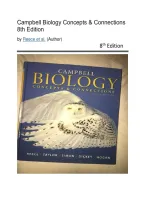
Campbell Biology Concepts & Connections
8th Edition
by Reece et al. (Author)
8th Edition
,TABLE OF CONTENTS
1. Biology: Exploring Life
I. THE LIFE OF THE CELL
2. The Chemical Basis of Life
3. The Molecules of Cells
4. A Tour of the Cell
5. The Working Cell
6. How Cells Harvest Chemical Energy
7. Photosynthesis: Using Light to Make Food
II. CELLULAR REPRODUCTION AND GENETICS
8. The Cellular Basis of Reproduction and Inheritance
9. Patterns of Inheritance
10. Molecular Biology of the Gene
11. How Genes Are Controlled
12. DNA Technology and Genomics
III. CONCEPTS OF EVOLUTION
13. How Populations Evolve
14. The Origin of Species
15. Tracing Evolutionary History
IV. THE EVOLUTION OF BIOLOGICAL DIVERSITY
16. Microbial Life: Prokaryotes and Protists
17. The Evolution of Plant and Fungal Diversity
18. The Evolution of Invertebrate Diversity
19. The Evolution of Vertebrate Diversity
,V. ANIMALS: FORM AND FUNCTION
20. Unifying Concepts of Animal Structure and Function
21. Nutrition and Digestion
22. Gas Exchange
23. Circulation
24. The Immune System
25. Control of Body Temperature and Water Balance
26. Hormones and the Endocrine System
27. Reproduction and Embryonic Development
28. Nervous Systems
29. The Senses
30. How Animals Move
VI. PLANTS: FORM AND FUNCTION
31. Plant Structure, Growth, and Reproduction
32. Plant Nutrition and Transport
33. Control Systems in Plants
VII. ECOLOGY
34. The Biosphere: An Introduction to Earth's Diverse Environments
35. Behavioral Adaptations to the Environment
36. Population Ecology
37. Communities and Ecosystems
38. Conservation Biology
, TEST BANK
Campbell Biology: Concepts & Connections, 8th Edition
(Reece, 2014)
Chapters 1–38
CHAPTER 1: BIOLOGY: EXPLORING LIFE
Multiple Choice
1. Which of the following is NOT a property of life?
A) Evolutionary adaptation
B) Response to the environment
C) Energy processing
D) Maintaining a constant external temperature regardless of surroundings
E) Reproduction
Answer: D
Explanation: Living things regulate their internal environment (homeostasis), but they do not necessarily
maintain a constant external temperature. The other options are all recognized properties of life.
2. The smallest unit of life is the:
A) atom
B) molecule
C) cell
D) organ
E) organelle
Answer: C
Explanation: The cell is the lowest level of structure that can perform all activities required for life.
3. Which of the following represents the correct sequence of biological organization from simplest to
most complex?
A) cell → tissue → organ → organ system → organism → population → community → ecosystem →
biosphere
B) cell → organ → tissue → organ system → organism → population → ecosystem → community →
8th Edition
by Reece et al. (Author)
8th Edition
,TABLE OF CONTENTS
1. Biology: Exploring Life
I. THE LIFE OF THE CELL
2. The Chemical Basis of Life
3. The Molecules of Cells
4. A Tour of the Cell
5. The Working Cell
6. How Cells Harvest Chemical Energy
7. Photosynthesis: Using Light to Make Food
II. CELLULAR REPRODUCTION AND GENETICS
8. The Cellular Basis of Reproduction and Inheritance
9. Patterns of Inheritance
10. Molecular Biology of the Gene
11. How Genes Are Controlled
12. DNA Technology and Genomics
III. CONCEPTS OF EVOLUTION
13. How Populations Evolve
14. The Origin of Species
15. Tracing Evolutionary History
IV. THE EVOLUTION OF BIOLOGICAL DIVERSITY
16. Microbial Life: Prokaryotes and Protists
17. The Evolution of Plant and Fungal Diversity
18. The Evolution of Invertebrate Diversity
19. The Evolution of Vertebrate Diversity
,V. ANIMALS: FORM AND FUNCTION
20. Unifying Concepts of Animal Structure and Function
21. Nutrition and Digestion
22. Gas Exchange
23. Circulation
24. The Immune System
25. Control of Body Temperature and Water Balance
26. Hormones and the Endocrine System
27. Reproduction and Embryonic Development
28. Nervous Systems
29. The Senses
30. How Animals Move
VI. PLANTS: FORM AND FUNCTION
31. Plant Structure, Growth, and Reproduction
32. Plant Nutrition and Transport
33. Control Systems in Plants
VII. ECOLOGY
34. The Biosphere: An Introduction to Earth's Diverse Environments
35. Behavioral Adaptations to the Environment
36. Population Ecology
37. Communities and Ecosystems
38. Conservation Biology
, TEST BANK
Campbell Biology: Concepts & Connections, 8th Edition
(Reece, 2014)
Chapters 1–38
CHAPTER 1: BIOLOGY: EXPLORING LIFE
Multiple Choice
1. Which of the following is NOT a property of life?
A) Evolutionary adaptation
B) Response to the environment
C) Energy processing
D) Maintaining a constant external temperature regardless of surroundings
E) Reproduction
Answer: D
Explanation: Living things regulate their internal environment (homeostasis), but they do not necessarily
maintain a constant external temperature. The other options are all recognized properties of life.
2. The smallest unit of life is the:
A) atom
B) molecule
C) cell
D) organ
E) organelle
Answer: C
Explanation: The cell is the lowest level of structure that can perform all activities required for life.
3. Which of the following represents the correct sequence of biological organization from simplest to
most complex?
A) cell → tissue → organ → organ system → organism → population → community → ecosystem →
biosphere
B) cell → organ → tissue → organ system → organism → population → ecosystem → community →


