
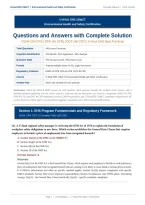
U-Haul EHS 138aCT | Environmental Health and Safety Certification Complete Solution | 100% Verified
U-HAUL EHS 138aCT
Environmental Health and Safety Certification
Questions and Answers with Complete Solution
OSHA (29 CFR) | EPA (40 CFR) | DOT (49 CFR) | U-Haul EHS Best Practices
Total Questions 100 (across 8 sections)
Cognitive Distribution 35% Recall / 45% Application / 20% Analysis
Question Style 70% Scenario-based / 30% Direct recall
Format 4-option multiple choice (A-D), single best answer
Regulatory Citations OSHA 29 CFR, EPA 40 CFR, DOT 49 CFR
Course U-Haul EHS 138aCT Environmental Health and Safety Certification
Answer Key Inline with rationale for each question
Instructions: Select the SINGLE BEST answer for each question. Each question includes the verified correct answer with a
detailed rationale explaining why the correct option is right and why the distractors are incorrect, integrating OSHA 29 CFR,
EPA 40 CFR, and DOT 49 CFR regulatory citations, EHS best practices, and U-Haul EHS 138aCT compliance requirements. All
content has been verified against current federal regulatory standards and U-Haul corporate EHS policies.
Section 1: EHS Program Fundamentals and Regulatory Framework
OSHA, EPA, DOT, & Company Policy (Q1-Q14)
Q1. A U-Haul regional safety manager is reviewing the OSH Act of 1970 to explain the foundation of
workplace safety obligations to new hires. Which section establishes the General Duty Clause that requires
employers to furnish a place of employment free from recognized hazards?
A. Section 5(a)(1) of the OSH Act [CORRECT]
B. Section 5(a)(2) of the OSH Act
C. Section 5(b) of the OSH Act
D. Section 18 of the OSH Act
Correct Answer: A
Rationale:
Section 5(a)(1) of the OSH Act is the General Duty Clause, which requires each employer to furnish to each employee a
place of employment free from recognized hazards that are causing or are likely to cause death or serious physical harm.
It is OSHA's enforcement tool when no specific standard applies. Section 5(a)(2) requires compliance with specific
OSHA standards; Section 5(b) covers employee responsibilities; Section 18 authorizes state OSHA plans. Test-taking
strategy: 5(a)(1) = the General Duty Clause (catch-all); 5(a)(2) = specific standards compliance.
Page 1 | 100 Questions | U-Haul EHS 138aCT Certification
,U-Haul EHS 138aCT | Environmental Health and Safety Certification Complete Solution | 100% Verified
Q2. A U-Haul storage facility stores cleaning chemicals, batteries, and used oil. The OSHA standard codified
at 29 CFR 1910.1200 applies to which workplace component?
A. Bloodborne pathogen exposure control
B. Hazard Communication Standard (HazCom / GHS) for chemical hazard evaluation and communication
[CORRECT]
C. Lockout/Tagout of hazardous energy sources
D. Respiratory protection program administration
Correct Answer: B
Rationale:
29 CFR 1910.1200 is OSHA's Hazard Communication Standard (HazCom 2012, aligned with GHS Rev. 3). It requires
chemical manufacturers/importers to classify hazards, and employers to maintain Safety Data Sheets, ensure labels and
pictograms, and train employees on chemical hazards. Choice A refers to 29 CFR 1910.1030; Choice C refers to 29 CFR
1910.147; Choice D refers to 29 CFR 1910.134. Test-taking strategy: 1910.1200 = HazCom/GHS/SDS; 1910.1030 =
Bloodborne pathogens; 1910.147 = LOTO; 1910.134 = Respiratory protection.
Q3. Under the Resource Conservation and Recovery Act (RCRA), 40 CFR 260-279, the framework that
establishes 'cradle-to-grave' tracking for hazardous waste places primary legal accountability on which
party?
A. The transporter who moves the waste offsite
B. The treatment, storage, and disposal facility (TSDF) receiving the waste
C. The generator of the hazardous waste [CORRECT]
D. The state environmental agency that oversees the site
Correct Answer: C
Rationale:
RCRA's cradle-to-grave liability makes the GENERATOR (the U-Haul facility that creates the hazardous waste)
ultimately responsible for proper management from creation through final disposal, even after the waste leaves the site.
A manifest (EPA Form 8700-22) signed by the generator documents this chain of custody. Choices A and B have
transporter/TSDF responsibilities but not generator-level cradle-to-grave liability; Choice D enforces but does not own
liability. Test-taking strategy: generator = cradle-to-grave; signed manifest = chain of custody.
Q4. A U-Haul tow truck driver transports a 55-gallon drum of used motor oil from a maintenance shop to a
recycling center. Under 49 CFR 171-180, the shipping paper must list the basic description in which required
order?
A. Identification Number (UN/NA), Proper Shipping Name, Hazard Class and Division, Packing Group
B. Proper Shipping Name, Hazard Class and Division, Identification Number (UN/NA), Packing Group
[CORRECT]
C. Hazard Class, Packing Group, Proper Shipping Name, Identification Number
D. Packing Group, Proper Shipping Name, Identification Number, Hazard Class
Correct Answer: B
Rationale:
Per 49 CFR 172.202, the shipping paper basic description order is: (1) Proper Shipping Name; (2) Hazard Class and
Division (with subsidiary in parentheses); (3) Identification Number (UN/NA); (4) Packing Group (Roman numeral).
Used oil (UN3082, Environmentally Hazardous Substance, Liquid, N.O.S., Class 9, PG III) must follow this exact
Page 2 | 100 Questions | U-Haul EHS 138aCT Certification
,U-Haul EHS 138aCT | Environmental Health and Safety Certification Complete Solution | 100% Verified
sequence. The order shown in Choice A reverses items 1 and 3, which is the most common exam error. Test-taking
strategy: PSN - Class - UN - PG is the required sequence on HAZMAT shipping papers.
Q5. A new U-Haul area field manager asks the EHS coordinator to define the company hierarchy of controls
when selecting hazard mitigation strategies. According to OSHA/NIOSH, which option represents the correct
order from MOST effective to LEAST effective?
A. PPE - Administrative controls - Engineering controls - Substitution - Elimination
B. Elimination - Substitution - Engineering controls - Administrative controls - PPE [CORRECT]
C. Engineering controls - Elimination - Substitution - Administrative controls - PPE
D. Elimination - Engineering controls - Substitution - Administrative controls - PPE
Correct Answer: B
Rationale:
Per OSHA/NIOSH Hierarchy of Controls: (1) Elimination - physically remove the hazard; (2) Substitution - replace the
hazard with a safer alternative; (3) Engineering Controls - isolate people from the hazard (guards, ventilation); (4)
Administrative Controls - change the way people work (procedures, training, rotation); (5) PPE - protect the worker with
equipment (last line of defense). PPE is the LEAST effective because it does not eliminate or reduce the hazard itself.
Test-taking strategy: 'Every Sunday I eat apple pie' = Elimination, Substitution, Isolation/Engineering, Administrative,
PPE.
Q6. An OSHA inspection is initiated at a U-Haul moving equipment service center. According to OSHA
inspection priorities under CPL 02-00.160, which situation receives the HIGHEST inspection priority?
A. A scheduled programmed inspection targeting high-hazard industries
B. A worker complaint alleging an imminent danger condition
C. A follow-up inspection verifying abatement of a prior citation
D. An inspection triggered by a fatality or catastrophic event (3+ hospitalizations) [CORRECT]
Correct Answer: D
Rationale:
OSHA inspection priority order is: (1) Imminent danger situations; (2) Fatalities/catastrophes (hospitalization of 3 or
more workers, inpatient hospitalization of any worker, amputation, loss of an eye); (3) Worker complaints/referrals; (4)
Scheduled programmed inspections; (5) Follow-ups. Choice B (imminent danger complaint) is highest as a class, but
Choice D (fatality/catastrophe) triggers mandatory OSHA notification within 8 hours and immediate inspection
response. Imminent danger complaint is typically equivalent. Test-taking strategy: imminent danger and
fatalities/catastrophes are highest priority; complaints and programmed inspections follow.
Q7. A U-Haul employee records coordinator is completing the OSHA Form 300 Log of Work-Related
Injuries and Illnesses. According to 29 CFR 1904, which case is recordable but NOT necessarily reportable to
OSHA within 8 hours?
A. An employee suffers a work-related fatality
B. An employee's work-related injury results in overnight hospitalization of 3 or more workers
C. An employee receives a work-related laceration requiring stitches but returns to work the next day
[CORRECT]
D. An employee suffers a work-related amputation
Correct Answer: C
Page 3 | 100 Questions | U-Haul EHS 138aCT Certification
, U-Haul EHS 138aCT | Environmental Health and Safety Certification Complete Solution | 100% Verified
Rationale:
Per 29 CFR 1904.7, any work-related injury meeting general recording criteria (days away from work, restricted duty,
job transfer, medical treatment beyond first aid, loss of consciousness, significant diagnosis) is recordable on the OSHA
300 Log. However, fatalities and catastrophes (3+ hospitalizations), amputations, and loss of an eye must be
REPORTED to OSHA within specific timeframes (8 hours for fatality; 24 hours for amputation, eye loss, or inpatient
hospitalization). Choice C is recordable (stitches = medical treatment beyond first aid) but not reportable because it does
not meet the fatality/catastrophe/amputation/eye loss criteria. Choices A, B, and D are all reportable. Test-taking
strategy: recordable = on the 300 Log; reportable = phone call to OSHA within 8/24 hours.
Q8. Under the Clean Air Act (42 U.S.C. 7401 et seq.) and EPA's Title V operating permit program, a U-Haul
maintenance shop operates a paint booth. The shop is subject to which regulatory requirement for hazardous
air pollutant (HAP) emissions?
A. Submission of a Tier II form to the state emergency response commission by March 1 of each year
B. Compliance with a National Emission Standard for Hazardous Air Pollutants (NESHAP), 40 CFR 63
Subpart HHHHHH, for surface coating operations [CORRECT]
C. Filing of a Toxic Release Inventory (TRI) Form R report annually to EPA by July 1
D. Reporting of all hazardous chemical inventory above 500 pounds to the local fire department
Correct Answer: B
Rationale:
Paint booths emitting HAPs (e.g., toluene, xylene, methyl ethyl ketone) are subject to the NESHAP 6H standard, 40
CFR 63 Subpart HHHHHH (Miscellaneous Surface Coating of Metal and Plastic Parts), which requires spray booth
enclosures, filter efficiency, and VOC/HAP emission limits. Choice A (Tier II, 40 CFR 370) covers hazardous chemical
inventory reporting; Choice C (TRI Form R, EPCRA 313) applies to facilities manufacturing or using over a threshold
quantity of listed chemicals; Choice D is a paraphrased SARA Title III provision but not the CAA rule. Test-taking
strategy: paint booth + HAPs = 6H NESHAP; storage chemicals inventory = Tier II; chronic chemical use = TRI Form
R.
Q9. Under the Clean Water Act (33 U.S.C. 1251 et seq.), a U-Haul truck wash facility discharges process
wastewater to a storm sewer. Which permit is required for this discharge?
A. No permit is needed if the discharge contains only biodegradable detergents
B. A National Pollutant Discharge Elimination System (NPDES) permit under 40 CFR 122 [CORRECT]
C. A RCRA hazardous waste permit under 40 CFR 270
D. A Toxic Substances Control Act (TSCA) registration under 15 U.S.C. 2601
Correct Answer: B
Rationale:
The Clean Water Act prohibits discharge of any pollutant from a point source to waters of the United States except
under an NPDES permit (40 CFR 122). Truck wash facilities discharging process wastewater (which contains oil,
grease, dirt, detergents) to a storm sewer must obtain an NPDES permit, often via a Multi-Sector General Permit
(MSGP) for industrial stormwater. Choice A is incorrect; biodegradable detergents do not exempt a discharge from
NPDES requirements. Choice C (RCRA permit) is for treatment, storage, and disposal facilities, not wastewater
discharge. Choice D (TSCA) regulates chemical manufacture/import, not water discharge. Test-taking strategy: process
water to storm sewer = NPDES permit; stormwater runoff from industrial activity = MSGP coverage.
Page 4 | 100 Questions | U-Haul EHS 138aCT Certification
U-HAUL EHS 138aCT
Environmental Health and Safety Certification
Questions and Answers with Complete Solution
OSHA (29 CFR) | EPA (40 CFR) | DOT (49 CFR) | U-Haul EHS Best Practices
Total Questions 100 (across 8 sections)
Cognitive Distribution 35% Recall / 45% Application / 20% Analysis
Question Style 70% Scenario-based / 30% Direct recall
Format 4-option multiple choice (A-D), single best answer
Regulatory Citations OSHA 29 CFR, EPA 40 CFR, DOT 49 CFR
Course U-Haul EHS 138aCT Environmental Health and Safety Certification
Answer Key Inline with rationale for each question
Instructions: Select the SINGLE BEST answer for each question. Each question includes the verified correct answer with a
detailed rationale explaining why the correct option is right and why the distractors are incorrect, integrating OSHA 29 CFR,
EPA 40 CFR, and DOT 49 CFR regulatory citations, EHS best practices, and U-Haul EHS 138aCT compliance requirements. All
content has been verified against current federal regulatory standards and U-Haul corporate EHS policies.
Section 1: EHS Program Fundamentals and Regulatory Framework
OSHA, EPA, DOT, & Company Policy (Q1-Q14)
Q1. A U-Haul regional safety manager is reviewing the OSH Act of 1970 to explain the foundation of
workplace safety obligations to new hires. Which section establishes the General Duty Clause that requires
employers to furnish a place of employment free from recognized hazards?
A. Section 5(a)(1) of the OSH Act [CORRECT]
B. Section 5(a)(2) of the OSH Act
C. Section 5(b) of the OSH Act
D. Section 18 of the OSH Act
Correct Answer: A
Rationale:
Section 5(a)(1) of the OSH Act is the General Duty Clause, which requires each employer to furnish to each employee a
place of employment free from recognized hazards that are causing or are likely to cause death or serious physical harm.
It is OSHA's enforcement tool when no specific standard applies. Section 5(a)(2) requires compliance with specific
OSHA standards; Section 5(b) covers employee responsibilities; Section 18 authorizes state OSHA plans. Test-taking
strategy: 5(a)(1) = the General Duty Clause (catch-all); 5(a)(2) = specific standards compliance.
Page 1 | 100 Questions | U-Haul EHS 138aCT Certification
,U-Haul EHS 138aCT | Environmental Health and Safety Certification Complete Solution | 100% Verified
Q2. A U-Haul storage facility stores cleaning chemicals, batteries, and used oil. The OSHA standard codified
at 29 CFR 1910.1200 applies to which workplace component?
A. Bloodborne pathogen exposure control
B. Hazard Communication Standard (HazCom / GHS) for chemical hazard evaluation and communication
[CORRECT]
C. Lockout/Tagout of hazardous energy sources
D. Respiratory protection program administration
Correct Answer: B
Rationale:
29 CFR 1910.1200 is OSHA's Hazard Communication Standard (HazCom 2012, aligned with GHS Rev. 3). It requires
chemical manufacturers/importers to classify hazards, and employers to maintain Safety Data Sheets, ensure labels and
pictograms, and train employees on chemical hazards. Choice A refers to 29 CFR 1910.1030; Choice C refers to 29 CFR
1910.147; Choice D refers to 29 CFR 1910.134. Test-taking strategy: 1910.1200 = HazCom/GHS/SDS; 1910.1030 =
Bloodborne pathogens; 1910.147 = LOTO; 1910.134 = Respiratory protection.
Q3. Under the Resource Conservation and Recovery Act (RCRA), 40 CFR 260-279, the framework that
establishes 'cradle-to-grave' tracking for hazardous waste places primary legal accountability on which
party?
A. The transporter who moves the waste offsite
B. The treatment, storage, and disposal facility (TSDF) receiving the waste
C. The generator of the hazardous waste [CORRECT]
D. The state environmental agency that oversees the site
Correct Answer: C
Rationale:
RCRA's cradle-to-grave liability makes the GENERATOR (the U-Haul facility that creates the hazardous waste)
ultimately responsible for proper management from creation through final disposal, even after the waste leaves the site.
A manifest (EPA Form 8700-22) signed by the generator documents this chain of custody. Choices A and B have
transporter/TSDF responsibilities but not generator-level cradle-to-grave liability; Choice D enforces but does not own
liability. Test-taking strategy: generator = cradle-to-grave; signed manifest = chain of custody.
Q4. A U-Haul tow truck driver transports a 55-gallon drum of used motor oil from a maintenance shop to a
recycling center. Under 49 CFR 171-180, the shipping paper must list the basic description in which required
order?
A. Identification Number (UN/NA), Proper Shipping Name, Hazard Class and Division, Packing Group
B. Proper Shipping Name, Hazard Class and Division, Identification Number (UN/NA), Packing Group
[CORRECT]
C. Hazard Class, Packing Group, Proper Shipping Name, Identification Number
D. Packing Group, Proper Shipping Name, Identification Number, Hazard Class
Correct Answer: B
Rationale:
Per 49 CFR 172.202, the shipping paper basic description order is: (1) Proper Shipping Name; (2) Hazard Class and
Division (with subsidiary in parentheses); (3) Identification Number (UN/NA); (4) Packing Group (Roman numeral).
Used oil (UN3082, Environmentally Hazardous Substance, Liquid, N.O.S., Class 9, PG III) must follow this exact
Page 2 | 100 Questions | U-Haul EHS 138aCT Certification
,U-Haul EHS 138aCT | Environmental Health and Safety Certification Complete Solution | 100% Verified
sequence. The order shown in Choice A reverses items 1 and 3, which is the most common exam error. Test-taking
strategy: PSN - Class - UN - PG is the required sequence on HAZMAT shipping papers.
Q5. A new U-Haul area field manager asks the EHS coordinator to define the company hierarchy of controls
when selecting hazard mitigation strategies. According to OSHA/NIOSH, which option represents the correct
order from MOST effective to LEAST effective?
A. PPE - Administrative controls - Engineering controls - Substitution - Elimination
B. Elimination - Substitution - Engineering controls - Administrative controls - PPE [CORRECT]
C. Engineering controls - Elimination - Substitution - Administrative controls - PPE
D. Elimination - Engineering controls - Substitution - Administrative controls - PPE
Correct Answer: B
Rationale:
Per OSHA/NIOSH Hierarchy of Controls: (1) Elimination - physically remove the hazard; (2) Substitution - replace the
hazard with a safer alternative; (3) Engineering Controls - isolate people from the hazard (guards, ventilation); (4)
Administrative Controls - change the way people work (procedures, training, rotation); (5) PPE - protect the worker with
equipment (last line of defense). PPE is the LEAST effective because it does not eliminate or reduce the hazard itself.
Test-taking strategy: 'Every Sunday I eat apple pie' = Elimination, Substitution, Isolation/Engineering, Administrative,
PPE.
Q6. An OSHA inspection is initiated at a U-Haul moving equipment service center. According to OSHA
inspection priorities under CPL 02-00.160, which situation receives the HIGHEST inspection priority?
A. A scheduled programmed inspection targeting high-hazard industries
B. A worker complaint alleging an imminent danger condition
C. A follow-up inspection verifying abatement of a prior citation
D. An inspection triggered by a fatality or catastrophic event (3+ hospitalizations) [CORRECT]
Correct Answer: D
Rationale:
OSHA inspection priority order is: (1) Imminent danger situations; (2) Fatalities/catastrophes (hospitalization of 3 or
more workers, inpatient hospitalization of any worker, amputation, loss of an eye); (3) Worker complaints/referrals; (4)
Scheduled programmed inspections; (5) Follow-ups. Choice B (imminent danger complaint) is highest as a class, but
Choice D (fatality/catastrophe) triggers mandatory OSHA notification within 8 hours and immediate inspection
response. Imminent danger complaint is typically equivalent. Test-taking strategy: imminent danger and
fatalities/catastrophes are highest priority; complaints and programmed inspections follow.
Q7. A U-Haul employee records coordinator is completing the OSHA Form 300 Log of Work-Related
Injuries and Illnesses. According to 29 CFR 1904, which case is recordable but NOT necessarily reportable to
OSHA within 8 hours?
A. An employee suffers a work-related fatality
B. An employee's work-related injury results in overnight hospitalization of 3 or more workers
C. An employee receives a work-related laceration requiring stitches but returns to work the next day
[CORRECT]
D. An employee suffers a work-related amputation
Correct Answer: C
Page 3 | 100 Questions | U-Haul EHS 138aCT Certification
, U-Haul EHS 138aCT | Environmental Health and Safety Certification Complete Solution | 100% Verified
Rationale:
Per 29 CFR 1904.7, any work-related injury meeting general recording criteria (days away from work, restricted duty,
job transfer, medical treatment beyond first aid, loss of consciousness, significant diagnosis) is recordable on the OSHA
300 Log. However, fatalities and catastrophes (3+ hospitalizations), amputations, and loss of an eye must be
REPORTED to OSHA within specific timeframes (8 hours for fatality; 24 hours for amputation, eye loss, or inpatient
hospitalization). Choice C is recordable (stitches = medical treatment beyond first aid) but not reportable because it does
not meet the fatality/catastrophe/amputation/eye loss criteria. Choices A, B, and D are all reportable. Test-taking
strategy: recordable = on the 300 Log; reportable = phone call to OSHA within 8/24 hours.
Q8. Under the Clean Air Act (42 U.S.C. 7401 et seq.) and EPA's Title V operating permit program, a U-Haul
maintenance shop operates a paint booth. The shop is subject to which regulatory requirement for hazardous
air pollutant (HAP) emissions?
A. Submission of a Tier II form to the state emergency response commission by March 1 of each year
B. Compliance with a National Emission Standard for Hazardous Air Pollutants (NESHAP), 40 CFR 63
Subpart HHHHHH, for surface coating operations [CORRECT]
C. Filing of a Toxic Release Inventory (TRI) Form R report annually to EPA by July 1
D. Reporting of all hazardous chemical inventory above 500 pounds to the local fire department
Correct Answer: B
Rationale:
Paint booths emitting HAPs (e.g., toluene, xylene, methyl ethyl ketone) are subject to the NESHAP 6H standard, 40
CFR 63 Subpart HHHHHH (Miscellaneous Surface Coating of Metal and Plastic Parts), which requires spray booth
enclosures, filter efficiency, and VOC/HAP emission limits. Choice A (Tier II, 40 CFR 370) covers hazardous chemical
inventory reporting; Choice C (TRI Form R, EPCRA 313) applies to facilities manufacturing or using over a threshold
quantity of listed chemicals; Choice D is a paraphrased SARA Title III provision but not the CAA rule. Test-taking
strategy: paint booth + HAPs = 6H NESHAP; storage chemicals inventory = Tier II; chronic chemical use = TRI Form
R.
Q9. Under the Clean Water Act (33 U.S.C. 1251 et seq.), a U-Haul truck wash facility discharges process
wastewater to a storm sewer. Which permit is required for this discharge?
A. No permit is needed if the discharge contains only biodegradable detergents
B. A National Pollutant Discharge Elimination System (NPDES) permit under 40 CFR 122 [CORRECT]
C. A RCRA hazardous waste permit under 40 CFR 270
D. A Toxic Substances Control Act (TSCA) registration under 15 U.S.C. 2601
Correct Answer: B
Rationale:
The Clean Water Act prohibits discharge of any pollutant from a point source to waters of the United States except
under an NPDES permit (40 CFR 122). Truck wash facilities discharging process wastewater (which contains oil,
grease, dirt, detergents) to a storm sewer must obtain an NPDES permit, often via a Multi-Sector General Permit
(MSGP) for industrial stormwater. Choice A is incorrect; biodegradable detergents do not exempt a discharge from
NPDES requirements. Choice C (RCRA permit) is for treatment, storage, and disposal facilities, not wastewater
discharge. Choice D (TSCA) regulates chemical manufacture/import, not water discharge. Test-taking strategy: process
water to storm sewer = NPDES permit; stormwater runoff from industrial activity = MSGP coverage.
Page 4 | 100 Questions | U-Haul EHS 138aCT Certification


