
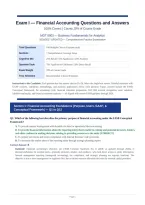
Exam I — Financial Accounting Questions and Answers
100% Correct | Counts 20% of Course Grade
MGT 8803 — Business Fundamentals for Analytics
2026/2027 UPDATED — Comprehensive Practice Examination
Total Questions 100 Multiple Choice (4 options each)
Sections 7 Comprehensive Coverage Areas
Cognitive Mix 25% Recall | 55% Application | 20% Analysis
Question Style 70% Application/Calculation | 30% Direct Recall
Exam Weight 20% of Course Grade
Time Allotment Recommended: 2 hours 30 minutes
Instructions to the Candidate: Each question has four answer choices (A–D). Select the single best answer. Detailed rationales with
GAAP citations, calculation methodology, and analytics applications follow each question. Topics covered include the FASB
Conceptual Framework, the accounting cycle, financial statement preparation, ASC 606 revenue recognition, asset valuation,
liabilities and equity, and financial statement analytics — all aligned with current FASB guidance through 2026.
Section 1: Financial Accounting Foundations (Purpose, Users, GAAP, &
Conceptual Framework) — Q1 to Q12
Q1: Which of the following best describes the primary purpose of financial accounting under the FASB Conceptual
Framework?
A. To provide internal management with detailed cost data for operational decision-making
B. To provide financial information about the reporting entity that is useful to existing and potential investors, lenders,
and other creditors in making decisions relating to providing resources to the entity [CORRECT]
C. To prepare tax returns and ensure compliance with Internal Revenue Code provisions
D. To maximize the market share of the reporting entity through strategic planning reports
Correct Answer: B
Rationale: Financial accounting's objective, per FASB Concepts Statement No. 8 (2018, as updated through 2026), is
decision-usefulness for external users—primarily investors, lenders, and creditors—who lack direct access to entity information.
Internal management reporting (managerial accounting), tax compliance, and strategic planning are separate functions. The
objective is not to serve management or regulators first, but to inform resource-allocation decisions by external capital providers.
Page 1
,MGT 8803 Business Fundamentals for Analytics | Exam I Financial Accounting Counts 20% of Course Grade | 2026/2027 UPDATED
Q2: Under GAAP, which standard-setting body has statutory authority to establish accounting principles for U.S.
public companies?
A. The Financial Accounting Standards Board (FASB), through direct congressional mandate
B. The Securities and Exchange Commission (SEC), which has delegated standard-setting to the FASB while retaining
oversight authority [CORRECT]
C. The American Institute of Certified Public Accountants (AICPA), under the Securities Act of 1933
D. The Public Company Accounting Oversight Board (PCAOB), as created by the Sarbanes-Oxley Act of 2002
Correct Answer: B
Rationale: The SEC possesses statutory authority under the Securities Exchange Act of 1934 to prescribe accounting principles for
public companies, but has historically delegated this responsibility to the private-sector FASB (recognized via ASU 2024-02
reaffirmation and the FAF-FASB oversight model). The AICPA formerly set standards pre-1973; the PCAOB oversees auditors, not
accounting standards. Understanding this delegation chain is foundational for analytics professionals assessing which guidance
governs a given reporting issue.
Q3: An investor comparing a U.S. company reporting under GAAP with a European competitor reporting under
IFRS would most likely find which of the following differences?
A. IFRS prohibits the use of the LIFO inventory costing method, while GAAP permits it [CORRECT]
B. GAAP requires all research and development costs to be expensed, while IFRS allows capitalization of all R&D;
C. IFRS requires the use of the direct method for the statement of cash flows, while GAAP requires the indirect method
D. GAAP prohibits the recognition of goodwill, while IFRS requires its immediate recognition on acquisition
Correct Answer: A
Rationale: A long-standing GAAP–IFRS distinction is that LIFO is permitted under U.S. GAAP but prohibited under IAS 2
Inventories. The other options misstate the standards: IFRS requires development costs (not research) to be capitalized when criteria
are met (IAS 38); both standards allow either direct or indirect methods for cash flows, with indirect being more common; both
recognize goodwill on acquisition, with subsequent amortization differing (GAAP tests for impairment, IFRS also tests impairment
but uses different methodology).
Q4: Which qualitative characteristic of useful financial information is most directly served when a company
consistently applies the same depreciation method across reporting periods?
A. Verifiability
B. Comparability [CORRECT]
C. Materiality
D. Conservatism
Correct Answer: B
Rationale: Comparability—the enabling characteristic identified in FASB Concepts Statement No. 8—is served when an entity
applies accounting policies consistently, allowing users to identify similarities and differences between items across periods and
across entities. Verifiability means independent observers would reach consensus; materiality is an entity-specific threshold;
conservatism (or prudence) is not a standalone characteristic in the current Conceptual Framework, although asymmetric caution is
embedded in certain standards.
Page 2
,MGT 8803 Business Fundamentals for Analytics | Exam I Financial Accounting Counts 20% of Course Grade | 2026/2027 UPDATED
Q5: The accounting equation (Assets = Liabilities + Stockholders' Equity) reflects which foundational assumption?
A. The going concern assumption, because assets must exceed liabilities in perpetuity
B. The economic entity assumption, because the equation isolates a single reporting unit's claims and resources
[CORRECT]
C. The monetary unit assumption, because all elements are measured in nominal currency
D. The periodicity assumption, because the equation is computed at each balance sheet date
Correct Answer: B
Rationale: While several assumptions underlie the equation, the economic entity assumption is the most directly relevant: the
equation holds because we distinguish the entity's resources (assets) from claims held by external parties (liabilities) and residual
owners (stockholders' equity). The going concern, monetary unit, and periodicity assumptions support measurement and reporting
but do not define the equation's structure. Analytics applications of the equation (e.g., DuPont decomposition) rely on a clearly
defined reporting entity.
Q6: Which of the following is NOT an enhancing qualitative characteristic under FASB Concepts Statement No. 8 (as
updated)?
A. Comparability
B. Verifiability
C. Timeliness
D. Conservatism [CORRECT]
Correct Answer: D
Rationale: Conservatism is not listed as an enhancing characteristic. The four enhancing characteristics are comparability,
verifiability, timeliness, and understandability. The fundamental qualitative characteristics are relevance and faithful representation
(which includes completeness, neutrality, and freedom from error). Conservatism, while historically influential, is excluded because
it can bias representation toward unfavorable outcomes and conflict with neutrality.
Q7: A creditor evaluating a company's ability to repay a short-term loan would primarily rely on which financial
statement?
A. Income statement, to assess profitability trends
B. Balance sheet and statement of cash flows, to assess liquidity and available cash resources [CORRECT]
C. Statement of stockholders' equity, to assess dividend distribution capacity
D. Notes to the financial statements, to assess contingent liability disclosures only
Correct Answer: B
Rationale: Short-term creditors prioritize liquidity—whether the entity has sufficient current assets and operating cash flow to meet
near-term obligations. The balance sheet provides working capital and current ratio data, while the statement of cash flows reveals
operating cash generation. Profitability (income statement) matters but is secondary for short-term repayment capacity. Dividend
capacity and contingency disclosures are relevant but not primary indicators of short-term liquidity.
Q8: Which of the following transactions does NOT affect stockholders' equity at the time it occurs?
A. Declaration of a cash dividend
B. Purchase of treasury stock
C. Collection of an account receivable [CORRECT]
D. Recognition of net income at year-end
Correct Answer: C
Rationale: Collection of an account receivable exchanges one asset (cash) for another (accounts receivable), leaving total assets and
stockholders' equity unchanged. Dividend declarations reduce retained earnings (equity); treasury stock purchases reduce equity
contra-asset; net income increases retained earnings. Analytics professionals must distinguish transactions that merely reshape the
asset side from those that flow through equity, which is critical for ratio trend interpretation.
Page 3
, MGT 8803 Business Fundamentals for Analytics | Exam I Financial Accounting Counts 20% of Course Grade | 2026/2027 UPDATED
Q9: Under the FASB/IASB joint conceptual framework, which of the following is identified as an element of financial
statements representing a residual interest?
A. Asset
B. Liability
C. Equity [CORRECT]
D. Comprehensive income
Correct Answer: C
Rationale: Equity is defined in Concepts Statement No. 8 as the residual interest in the assets of the entity after deducting all its
liabilities. Unlike assets (probable future economic benefits) and liabilities (probable future sacrifices), equity is not an independent
resource but a residual calculation. This residual nature explains why equity balances change with every asset or liability
revaluation, which is essential for analytics models linking equity volatility to asset/liability re-measurement.
Q10: Which standard-setting organization issues International Financial Reporting Standards (IFRS)?
A. The International Accounting Standards Committee Foundation (IASC Foundation)
B. The International Accounting Standards Board (IASB) [CORRECT]
C. The Financial Accounting Standards Board (FASB) International Subcommittee
D. The Organization for Economic Cooperation and Development (OECD)
Correct Answer: B
Rationale: The IASB, an independent standard-setting body based in London and operating under the IFRS Foundation, issues
IFRS Accounting Standards. The predecessor IASC issued older IAS standards (many still valid). The FASB sets U.S. GAAP, and
the OECD is a policy forum, not an accounting standard-setter. As of the 2026 IFRS Foundation constitution update, the IASB
continues to issue standards adopted by over 140 jurisdictions.
Q11: Which of the following best illustrates the application of the cost constraint (cost-benefit constraint) in financial
reporting?
A. A company expense a $75 office supply purchase because tracking it as an asset would cost more than the benefit
B. A company chooses not to disclose proprietary customer-level margin data because the cost of preparing it for
external users exceeds the benefits to those users [CORRECT]
C. A company defers revenue recognition because the cost of customer collection is uncertain
D. A company capitalizes marketing costs because the benefits extend beyond the current period
Correct Answer: B
Rationale: The cost constraint in Concepts Statement No. 8 acknowledges that the benefits of providing financial information
should justify the costs of doing so. Option B reflects this constraint by weighing the cost of producing proprietary customer-level
disclosures against their benefits to external users. Option A is materiality (an entity-specific aspect of relevance), not the cost
constraint. Options C and D involve revenue and expense recognition principles, not cost-benefit trade-offs in disclosure.
Page 4
100% Correct | Counts 20% of Course Grade
MGT 8803 — Business Fundamentals for Analytics
2026/2027 UPDATED — Comprehensive Practice Examination
Total Questions 100 Multiple Choice (4 options each)
Sections 7 Comprehensive Coverage Areas
Cognitive Mix 25% Recall | 55% Application | 20% Analysis
Question Style 70% Application/Calculation | 30% Direct Recall
Exam Weight 20% of Course Grade
Time Allotment Recommended: 2 hours 30 minutes
Instructions to the Candidate: Each question has four answer choices (A–D). Select the single best answer. Detailed rationales with
GAAP citations, calculation methodology, and analytics applications follow each question. Topics covered include the FASB
Conceptual Framework, the accounting cycle, financial statement preparation, ASC 606 revenue recognition, asset valuation,
liabilities and equity, and financial statement analytics — all aligned with current FASB guidance through 2026.
Section 1: Financial Accounting Foundations (Purpose, Users, GAAP, &
Conceptual Framework) — Q1 to Q12
Q1: Which of the following best describes the primary purpose of financial accounting under the FASB Conceptual
Framework?
A. To provide internal management with detailed cost data for operational decision-making
B. To provide financial information about the reporting entity that is useful to existing and potential investors, lenders,
and other creditors in making decisions relating to providing resources to the entity [CORRECT]
C. To prepare tax returns and ensure compliance with Internal Revenue Code provisions
D. To maximize the market share of the reporting entity through strategic planning reports
Correct Answer: B
Rationale: Financial accounting's objective, per FASB Concepts Statement No. 8 (2018, as updated through 2026), is
decision-usefulness for external users—primarily investors, lenders, and creditors—who lack direct access to entity information.
Internal management reporting (managerial accounting), tax compliance, and strategic planning are separate functions. The
objective is not to serve management or regulators first, but to inform resource-allocation decisions by external capital providers.
Page 1
,MGT 8803 Business Fundamentals for Analytics | Exam I Financial Accounting Counts 20% of Course Grade | 2026/2027 UPDATED
Q2: Under GAAP, which standard-setting body has statutory authority to establish accounting principles for U.S.
public companies?
A. The Financial Accounting Standards Board (FASB), through direct congressional mandate
B. The Securities and Exchange Commission (SEC), which has delegated standard-setting to the FASB while retaining
oversight authority [CORRECT]
C. The American Institute of Certified Public Accountants (AICPA), under the Securities Act of 1933
D. The Public Company Accounting Oversight Board (PCAOB), as created by the Sarbanes-Oxley Act of 2002
Correct Answer: B
Rationale: The SEC possesses statutory authority under the Securities Exchange Act of 1934 to prescribe accounting principles for
public companies, but has historically delegated this responsibility to the private-sector FASB (recognized via ASU 2024-02
reaffirmation and the FAF-FASB oversight model). The AICPA formerly set standards pre-1973; the PCAOB oversees auditors, not
accounting standards. Understanding this delegation chain is foundational for analytics professionals assessing which guidance
governs a given reporting issue.
Q3: An investor comparing a U.S. company reporting under GAAP with a European competitor reporting under
IFRS would most likely find which of the following differences?
A. IFRS prohibits the use of the LIFO inventory costing method, while GAAP permits it [CORRECT]
B. GAAP requires all research and development costs to be expensed, while IFRS allows capitalization of all R&D;
C. IFRS requires the use of the direct method for the statement of cash flows, while GAAP requires the indirect method
D. GAAP prohibits the recognition of goodwill, while IFRS requires its immediate recognition on acquisition
Correct Answer: A
Rationale: A long-standing GAAP–IFRS distinction is that LIFO is permitted under U.S. GAAP but prohibited under IAS 2
Inventories. The other options misstate the standards: IFRS requires development costs (not research) to be capitalized when criteria
are met (IAS 38); both standards allow either direct or indirect methods for cash flows, with indirect being more common; both
recognize goodwill on acquisition, with subsequent amortization differing (GAAP tests for impairment, IFRS also tests impairment
but uses different methodology).
Q4: Which qualitative characteristic of useful financial information is most directly served when a company
consistently applies the same depreciation method across reporting periods?
A. Verifiability
B. Comparability [CORRECT]
C. Materiality
D. Conservatism
Correct Answer: B
Rationale: Comparability—the enabling characteristic identified in FASB Concepts Statement No. 8—is served when an entity
applies accounting policies consistently, allowing users to identify similarities and differences between items across periods and
across entities. Verifiability means independent observers would reach consensus; materiality is an entity-specific threshold;
conservatism (or prudence) is not a standalone characteristic in the current Conceptual Framework, although asymmetric caution is
embedded in certain standards.
Page 2
,MGT 8803 Business Fundamentals for Analytics | Exam I Financial Accounting Counts 20% of Course Grade | 2026/2027 UPDATED
Q5: The accounting equation (Assets = Liabilities + Stockholders' Equity) reflects which foundational assumption?
A. The going concern assumption, because assets must exceed liabilities in perpetuity
B. The economic entity assumption, because the equation isolates a single reporting unit's claims and resources
[CORRECT]
C. The monetary unit assumption, because all elements are measured in nominal currency
D. The periodicity assumption, because the equation is computed at each balance sheet date
Correct Answer: B
Rationale: While several assumptions underlie the equation, the economic entity assumption is the most directly relevant: the
equation holds because we distinguish the entity's resources (assets) from claims held by external parties (liabilities) and residual
owners (stockholders' equity). The going concern, monetary unit, and periodicity assumptions support measurement and reporting
but do not define the equation's structure. Analytics applications of the equation (e.g., DuPont decomposition) rely on a clearly
defined reporting entity.
Q6: Which of the following is NOT an enhancing qualitative characteristic under FASB Concepts Statement No. 8 (as
updated)?
A. Comparability
B. Verifiability
C. Timeliness
D. Conservatism [CORRECT]
Correct Answer: D
Rationale: Conservatism is not listed as an enhancing characteristic. The four enhancing characteristics are comparability,
verifiability, timeliness, and understandability. The fundamental qualitative characteristics are relevance and faithful representation
(which includes completeness, neutrality, and freedom from error). Conservatism, while historically influential, is excluded because
it can bias representation toward unfavorable outcomes and conflict with neutrality.
Q7: A creditor evaluating a company's ability to repay a short-term loan would primarily rely on which financial
statement?
A. Income statement, to assess profitability trends
B. Balance sheet and statement of cash flows, to assess liquidity and available cash resources [CORRECT]
C. Statement of stockholders' equity, to assess dividend distribution capacity
D. Notes to the financial statements, to assess contingent liability disclosures only
Correct Answer: B
Rationale: Short-term creditors prioritize liquidity—whether the entity has sufficient current assets and operating cash flow to meet
near-term obligations. The balance sheet provides working capital and current ratio data, while the statement of cash flows reveals
operating cash generation. Profitability (income statement) matters but is secondary for short-term repayment capacity. Dividend
capacity and contingency disclosures are relevant but not primary indicators of short-term liquidity.
Q8: Which of the following transactions does NOT affect stockholders' equity at the time it occurs?
A. Declaration of a cash dividend
B. Purchase of treasury stock
C. Collection of an account receivable [CORRECT]
D. Recognition of net income at year-end
Correct Answer: C
Rationale: Collection of an account receivable exchanges one asset (cash) for another (accounts receivable), leaving total assets and
stockholders' equity unchanged. Dividend declarations reduce retained earnings (equity); treasury stock purchases reduce equity
contra-asset; net income increases retained earnings. Analytics professionals must distinguish transactions that merely reshape the
asset side from those that flow through equity, which is critical for ratio trend interpretation.
Page 3
, MGT 8803 Business Fundamentals for Analytics | Exam I Financial Accounting Counts 20% of Course Grade | 2026/2027 UPDATED
Q9: Under the FASB/IASB joint conceptual framework, which of the following is identified as an element of financial
statements representing a residual interest?
A. Asset
B. Liability
C. Equity [CORRECT]
D. Comprehensive income
Correct Answer: C
Rationale: Equity is defined in Concepts Statement No. 8 as the residual interest in the assets of the entity after deducting all its
liabilities. Unlike assets (probable future economic benefits) and liabilities (probable future sacrifices), equity is not an independent
resource but a residual calculation. This residual nature explains why equity balances change with every asset or liability
revaluation, which is essential for analytics models linking equity volatility to asset/liability re-measurement.
Q10: Which standard-setting organization issues International Financial Reporting Standards (IFRS)?
A. The International Accounting Standards Committee Foundation (IASC Foundation)
B. The International Accounting Standards Board (IASB) [CORRECT]
C. The Financial Accounting Standards Board (FASB) International Subcommittee
D. The Organization for Economic Cooperation and Development (OECD)
Correct Answer: B
Rationale: The IASB, an independent standard-setting body based in London and operating under the IFRS Foundation, issues
IFRS Accounting Standards. The predecessor IASC issued older IAS standards (many still valid). The FASB sets U.S. GAAP, and
the OECD is a policy forum, not an accounting standard-setter. As of the 2026 IFRS Foundation constitution update, the IASB
continues to issue standards adopted by over 140 jurisdictions.
Q11: Which of the following best illustrates the application of the cost constraint (cost-benefit constraint) in financial
reporting?
A. A company expense a $75 office supply purchase because tracking it as an asset would cost more than the benefit
B. A company chooses not to disclose proprietary customer-level margin data because the cost of preparing it for
external users exceeds the benefits to those users [CORRECT]
C. A company defers revenue recognition because the cost of customer collection is uncertain
D. A company capitalizes marketing costs because the benefits extend beyond the current period
Correct Answer: B
Rationale: The cost constraint in Concepts Statement No. 8 acknowledges that the benefits of providing financial information
should justify the costs of doing so. Option B reflects this constraint by weighing the cost of producing proprietary customer-level
disclosures against their benefits to external users. Option A is materiality (an entity-specific aspect of relevance), not the cost
constraint. Options C and D involve revenue and expense recognition principles, not cost-benefit trade-offs in disclosure.
Page 4


