
1|P a g e
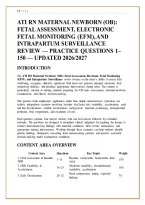
ATI RN MATERNAL NEWBORN (OB):
FETAL ASSESSMENT, ELECTRONIC
FETAL MONITORING (EFM), AND
INTRAPARTUM SURVEILLANCE
REVIEW — PRACTICE QUESTIONS 1–
150 — UPDATED 2026/2027
INTRODUCTION
The ATI RN Maternal Newborn (OB): Fetal Assessment, Electronic Fetal Monitoring
(EFM), and Intrapartum Surveillance review focuses on the nurse’s ability to assess fetal
well-being, recognize clinically significant fetal heart-rate patterns, interpret electronic fetal
monitoring findings, and prioritize appropriate interventions during labor. The content is
particularly relevant to nursing students preparing for ATI-style assessments, maternal-newborn
examinations, and clinical decision-making.
This practice bank emphasizes application rather than simple memorization. Questions use
realistic intrapartum scenarios involving baseline fetal heart rate, variability, accelerations, early
and late decelerations, variable decelerations, tachysystole, maternal positioning, uteroplacental
perfusion, fetal oxygenation, and escalation of care.
Each question contains four answer choices with one best answer followed by a detailed
rationale. The questions are designed to strengthen clinical judgment by requiring the learner to
connect fetal-monitoring findings with maternal conditions, labor events, medications, and
appropriate nursing interventions. Working through these scenarios can help students identify
priority findings, distinguish reassuring from nonreassuring patterns, and practice systematic
decision-making under examination conditions.
CONTENT AREA OVERVIEW
Content Area Questions Key Topics Weight
1. Fetal Assessment & Baseline Baseline, tachycardia, bradycardia, fetal
1–15 15%
FHR status
2. FHR Variability & Moderate variability, absent/minimal
16–25 10%
Accelerations variability, accelerations
Head compression, timing, expected
3. Early Decelerations 26–32 7%
findings
,2|P a g e
Content Area Questions Key Topics Weight
Cord compression, repositioning,
4. Variable Decelerations 33–45 13%
amnioinfusion
5. Late Decelerations 46–60 Uteroplacental insufficiency, interventions 15%
6. EFM Interpretation &
61–75 Category I, II, III, clinical prioritization 15%
Classification
7. Intrapartum Surveillance &
76–90 Position, hypotension, fever, oxygenation 10%
Maternal Factors
8. Oxytocin & Fetal Response 91–105 Tachysystole, decelerations, interventions 10%
9. High-Risk Intrapartum
106–125 Cord prolapse, abruption, uterine rupture 10%
Situations
10. Integrated Clinical Judgment 126–150 Complex EFM scenarios and prioritization 5%
QUESTIONS 1–100
Fetal Assessment & Baseline FHR
Q1: A client at 39 weeks of gestation is in active labor. The fetal heart rate (FHR) has remained
between 135 and 145/min for 10 minutes, with moderate variability and no recurrent
decelerations. Which interpretation should the nurse make?
A) The fetus is demonstrating persistent tachycardia
B) The fetus is demonstrating persistent bradycardia
C) The tracing demonstrates a reassuring baseline FHR
D) The tracing indicates immediate fetal hypoxemia
Rationale: A baseline of 110–160/min is generally reassuring when accompanied by moderate
variability and no concerning recurrent decelerations. Option A is incorrect because
tachycardia is generally above 160/min. Option B is incorrect because bradycardia is generally
below 110/min. Option D is incorrect because the described tracing does not demonstrate
evidence of significant fetal compromise.
Q2: A laboring client has an FHR baseline of 172/min for 15 minutes. Maternal temperature is
38.4°C (101.1°F). Which action should the nurse take first?
A) Increase the oxytocin infusion
B) Place the client supine
C) Assess the client for infection and initiate appropriate measures for maternal fever
D) Encourage the client to begin pushing
Rationale: Maternal fever can contribute to fetal tachycardia and may indicate intrauterine
infection. The nurse should assess and address the maternal temperature while continuing fetal
surveillance. Option A could worsen fetal stress if uterine activity becomes excessive. Option B
, 3|P a g e
can decrease venous return and uteroplacental perfusion. Option D is inappropriate unless
complete dilation and other criteria for pushing are present.
Q3: A fetal monitor shows a baseline FHR of 105/min for 12 minutes with minimal variability.
Which finding should concern the nurse most?
A) The client reports mild back discomfort
B) The client has intact membranes
C) The persistent low baseline combined with minimal variability
D) The client requests a different labor position
Rationale: A baseline below 110/min that persists for at least 10 minutes meets the definition of
fetal bradycardia, and minimal variability further reduces reassurance. Option A is not the
priority finding. Option B does not itself indicate fetal compromise. Option D is not as urgent as
the abnormal FHR pattern.
Q4: A client receiving an epidural develops a blood pressure of 82/46 mm Hg. The FHR
subsequently decreases from 140/min to 105/min. Which intervention is the priority?
A) Encourage pushing
B) Place the client in a supine position
C) Reposition the client laterally and address the maternal hypotension
D) Increase the oxytocin infusion
Rationale: Epidural-related sympathetic blockade can cause maternal hypotension, reducing
uteroplacental perfusion and potentially producing fetal bradycardia or decelerations. Lateral
positioning and correction of hypotension are appropriate priorities. Option B can worsen
venous compression. Option D can increase uterine activity and worsen fetal compromise.
Option A is inappropriate without complete cervical dilation and readiness for delivery.
Q5: During labor, the fetal monitor displays a baseline of 150/min with moderate variability and
occasional accelerations. What should the nurse do?
A) Prepare for emergency cesarean birth
B) Stop all fetal monitoring
C) Continue routine intrapartum surveillance
D) Administer a medication to reduce the FHR
Rationale: A baseline of 150/min with moderate variability and accelerations is reassuring.
Continued surveillance is appropriate. Option A is not justified by a reassuring pattern. Option
B is unsafe because fetal monitoring remains clinically indicated. Option D is unnecessary.
Q6: A client reports decreased fetal movement before labor. The nurse obtains a nonstress test
showing no accelerations during the observation period. Which interpretation is most
appropriate?


