
PM and Cabinet:
HOW POLICY IS MADE:
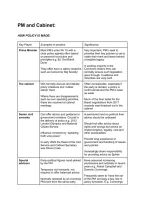
Key Player Examples in practice Significance
Prime Minister Most PM’s enter No 10 with a Very important, PM’s seek to
clear policy agenda often based prioritise their key policies so as to
on personal conviction and make their mark and leave behind
principles e.g. BJ ‘Get Brexit a tangible legacy
Done’
A working majority in the
They often have a catchy strapline Commons means they can
such as Camerons ‘Big Society’ normally ensure such legislation
goes through. Coalitions and
minorities are very hard
The cabinet Will normally discuss and debate Often considerable, especially if
policy initiatives and ‘rubber the party is divided, a policy is
stamp’ them controversial and the PM is seen
as weak
Where there are disagreements,
such as over spending priorities, Much of the finer detail for the
these are received at cabinet Brexit negotiations from 2017
meetings onwards was thrashed out in the
cabinet
Senior civil Can offer advice and guidance to A permanent and no political their
servants government ministers. Crucial in advice should be unbiased
the delivery of policy e.g. 2012
London Olympics and National Should not offer advice about
Citizen Service rights and wrongs but advice on
implementation, legality, cost and
Influence ministers by ‘speaking other practicalities
truth unto power’
Provide long experience of
In early 2022 the Head of the Civil government and handling of issues
Service and Cabinet Secretary and policies
was Simon Case
Increasingly share responsibility
for providing advice as SpAds
Special Party-political figures hand-picked Have assumed increasing
advisors by the PM prominence and notoriety in recent
years e.g. Alatair Campbell and
Temporary civil servants, not Dominic Cummings
required to offer balanced advice
Frequently seem to ‘have the ear
Normally replaced by an incoming of the PM’ and play a key role in
PM even from the same party policy formation. E.g. Cummings
, had much influence on BJ’s
126 advisers in March 2022 hardline to Brexit
0.03% of civil service
Can also be controversial,
Cumminngs broke Covid-19 rules
and was later sacked, he criticised
BJ after
WHY POLICY IS MADE:
● Fulfilling a manifesto pledge
- Extending free childcare, 2017 manifesto Conservatives promised to
offer working parents of 3 and 4 year olds 30 hours of free childcare a
week instead of 15 hours. This was primarily designed to increase the
number of parents in work- economy boosting
● Personal convictions of the PM:
- Privatisation and the sale of council houses- Thatcher 1979-1990.
Property-owning democracy, Council houses ‘right to buy’ scheme.
Privatised telecom, gas, electricity, coal mines
● Outcome of a referendum:
- Brexit: manifesto pledge David Cameron 2015. 52-48%, forced to leave
EU, May had to implement it, even though she voted remain- failed
replaced by Boris
● Results of deals with minority/other coalition parties:
- 2011 AV Referendum. 2010 hung parliament, coalition between
Conservatives and Lib Dems. Had to compromise for Lib Dem wishes,
for example alternative vote system which would be more proportional,
voted on it, lost 67%-33%, FPTP remained
● Responses to national crisis and emergency
- COVID-19. Unprecedented, the government needed swift responses.
Pragmatism, what would work, what did work, the large role of SpAds
and science groups like SaGe in dictating policy. Track and trace
criticised, vaccine roll out good. Limited to only dictate policy in
England not devolved assemblies
● Mounting pressure from the public and media: climate change policy
, - Climate change, Extinction rebellion, direct action to draw attention to
the issue. Greta Thunberg etc… - School walkouts in the UK for
example. Led to 2019 UK GOV pledged to cut greenhouse gas
emissions to almost zero by 2050
● Changing social and cultural attitudes: the 1960’s and liberalisation of public
attitudes
- 1960’s rapid social change in the UK. swinging sixties characterised by
the liberalisation of attitudes towards sex, marriage and women’s
rights. Gov embraced: Divorce reform act 1969, legalised abortion up
to 24 weeks of pregnancy. Ending the death penalty. Enacted by
Private members bills but with gov support. Can therefore reflect wider
social changes
ABILITY TO DICTATE POLICY:
● Poll Tax 1990
- Thatcher, calls to reduce high spending labour councils where many
people weren’t paying taxes in the first place. Wanted to reform local
government taxation 1987 manifesto pledge. Introduced a flat tax
regardless of housing or employment
- Was passed, but large rioting in Scotland where it was trialled, and
huge riots in London March 1990, and then lots in South Yorkshire.
Proved difficult to collect and highly resented. Led to Thatcher’s
resignation and the introduction of the council tax 1993, leadership
election with Michael Heseltine- Tax personally associated with
Thatcher
● Decision to invade Iraq 2003
- Coloured Blair’s legacy. Bush invaded and Blair justified UK
involvement on the moral grounds of the removal of weapons of mass
destruction. 180 British lives lost, bloody civil war, no WMDs were
found.
- Large scale anti-war protests took place in the UK, decreased trust in
Blair
- No pressure for the UK to join, no threat on Uk national security, Blair
just wanted to strengthen the relationship with Bush. Resignation of
Robin Cook and Clare Short (cabinet ministers) weakened Blair’s
position further. Legacy made it harder to deploy forces in Syria +
Afghanistan
● Decision to call an early election 2017
- Snap election June 2017, traditional prerogative power. Fixed Term
Parliament act 2011, another general election was not due till 2020.
, - May decided to call an election anyway, her motives being a mixture of
capitalising on perceived political advantage and enabling her Brexit
strategy to be implemented. Policy backfired and Conservatives lost
rather than gained seats.
- May ended up wanting to have her own mandate, convinced she
needed it to push through Brexit, polls suggested she would win, but
failed, weakening Conservative manifesto- ‘dementia tax’
- Was too overconfident by spending too much time in labour held seats.
Led to her premiership becoming increasingly strained and she failed
to deliver Brexit
● Liz Truss budget October 2022.
- Did not have a mandate from the people, or much backing from MP’s
with 13 votes of no confidence as soon as she entered office. Her
proposed budget was very unpopular, with a cut in the top band rate of
income tax during a recession. Led to U-turn on the budget and her
resignation in 49 days
CABINET/SpAd RESIGNATIONS:
● Personal scandal- breaks of Ministerial code 2010
- Matt Hancock 2020, breaking COVID 19 laws and resigned as Health
Secretary
- Dominic Cummings, drove over 200 miles to Durham, breaking COVID
regulations
- Priti Pratel- meeting with foreign governments without civil servants
present. Failed to tell May about 14 meetings with Israeli ministers.
Was reinstated in Boris’s government in 2019 as home secretary.
- On occasion even the PM has been accused of breaching ministerial
code 2010- E.g. BJ in 2021 received an anonymous donation of
£60,000 to help fund the refurbishment of his private Downing Street
flat
ministerial code:
- Avoid any conflict of interest between private interests and public duties
- Not accepting gifts or offers of hospitality that could be construed as bribery or
influencing decisions
- Uphold principle of civil service impartiality
- Abiding by the principles of collective cabinet responsibility
- Not meeting foreign dignitaries or politicians without the PM’s permission and civil
servants present
● Disagreeing with collective responsibility over policy
HOW POLICY IS MADE:
Key Player Examples in practice Significance
Prime Minister Most PM’s enter No 10 with a Very important, PM’s seek to
clear policy agenda often based prioritise their key policies so as to
on personal conviction and make their mark and leave behind
principles e.g. BJ ‘Get Brexit a tangible legacy
Done’
A working majority in the
They often have a catchy strapline Commons means they can
such as Camerons ‘Big Society’ normally ensure such legislation
goes through. Coalitions and
minorities are very hard
The cabinet Will normally discuss and debate Often considerable, especially if
policy initiatives and ‘rubber the party is divided, a policy is
stamp’ them controversial and the PM is seen
as weak
Where there are disagreements,
such as over spending priorities, Much of the finer detail for the
these are received at cabinet Brexit negotiations from 2017
meetings onwards was thrashed out in the
cabinet
Senior civil Can offer advice and guidance to A permanent and no political their
servants government ministers. Crucial in advice should be unbiased
the delivery of policy e.g. 2012
London Olympics and National Should not offer advice about
Citizen Service rights and wrongs but advice on
implementation, legality, cost and
Influence ministers by ‘speaking other practicalities
truth unto power’
Provide long experience of
In early 2022 the Head of the Civil government and handling of issues
Service and Cabinet Secretary and policies
was Simon Case
Increasingly share responsibility
for providing advice as SpAds
Special Party-political figures hand-picked Have assumed increasing
advisors by the PM prominence and notoriety in recent
years e.g. Alatair Campbell and
Temporary civil servants, not Dominic Cummings
required to offer balanced advice
Frequently seem to ‘have the ear
Normally replaced by an incoming of the PM’ and play a key role in
PM even from the same party policy formation. E.g. Cummings
, had much influence on BJ’s
126 advisers in March 2022 hardline to Brexit
0.03% of civil service
Can also be controversial,
Cumminngs broke Covid-19 rules
and was later sacked, he criticised
BJ after
WHY POLICY IS MADE:
● Fulfilling a manifesto pledge
- Extending free childcare, 2017 manifesto Conservatives promised to
offer working parents of 3 and 4 year olds 30 hours of free childcare a
week instead of 15 hours. This was primarily designed to increase the
number of parents in work- economy boosting
● Personal convictions of the PM:
- Privatisation and the sale of council houses- Thatcher 1979-1990.
Property-owning democracy, Council houses ‘right to buy’ scheme.
Privatised telecom, gas, electricity, coal mines
● Outcome of a referendum:
- Brexit: manifesto pledge David Cameron 2015. 52-48%, forced to leave
EU, May had to implement it, even though she voted remain- failed
replaced by Boris
● Results of deals with minority/other coalition parties:
- 2011 AV Referendum. 2010 hung parliament, coalition between
Conservatives and Lib Dems. Had to compromise for Lib Dem wishes,
for example alternative vote system which would be more proportional,
voted on it, lost 67%-33%, FPTP remained
● Responses to national crisis and emergency
- COVID-19. Unprecedented, the government needed swift responses.
Pragmatism, what would work, what did work, the large role of SpAds
and science groups like SaGe in dictating policy. Track and trace
criticised, vaccine roll out good. Limited to only dictate policy in
England not devolved assemblies
● Mounting pressure from the public and media: climate change policy
, - Climate change, Extinction rebellion, direct action to draw attention to
the issue. Greta Thunberg etc… - School walkouts in the UK for
example. Led to 2019 UK GOV pledged to cut greenhouse gas
emissions to almost zero by 2050
● Changing social and cultural attitudes: the 1960’s and liberalisation of public
attitudes
- 1960’s rapid social change in the UK. swinging sixties characterised by
the liberalisation of attitudes towards sex, marriage and women’s
rights. Gov embraced: Divorce reform act 1969, legalised abortion up
to 24 weeks of pregnancy. Ending the death penalty. Enacted by
Private members bills but with gov support. Can therefore reflect wider
social changes
ABILITY TO DICTATE POLICY:
● Poll Tax 1990
- Thatcher, calls to reduce high spending labour councils where many
people weren’t paying taxes in the first place. Wanted to reform local
government taxation 1987 manifesto pledge. Introduced a flat tax
regardless of housing or employment
- Was passed, but large rioting in Scotland where it was trialled, and
huge riots in London March 1990, and then lots in South Yorkshire.
Proved difficult to collect and highly resented. Led to Thatcher’s
resignation and the introduction of the council tax 1993, leadership
election with Michael Heseltine- Tax personally associated with
Thatcher
● Decision to invade Iraq 2003
- Coloured Blair’s legacy. Bush invaded and Blair justified UK
involvement on the moral grounds of the removal of weapons of mass
destruction. 180 British lives lost, bloody civil war, no WMDs were
found.
- Large scale anti-war protests took place in the UK, decreased trust in
Blair
- No pressure for the UK to join, no threat on Uk national security, Blair
just wanted to strengthen the relationship with Bush. Resignation of
Robin Cook and Clare Short (cabinet ministers) weakened Blair’s
position further. Legacy made it harder to deploy forces in Syria +
Afghanistan
● Decision to call an early election 2017
- Snap election June 2017, traditional prerogative power. Fixed Term
Parliament act 2011, another general election was not due till 2020.
, - May decided to call an election anyway, her motives being a mixture of
capitalising on perceived political advantage and enabling her Brexit
strategy to be implemented. Policy backfired and Conservatives lost
rather than gained seats.
- May ended up wanting to have her own mandate, convinced she
needed it to push through Brexit, polls suggested she would win, but
failed, weakening Conservative manifesto- ‘dementia tax’
- Was too overconfident by spending too much time in labour held seats.
Led to her premiership becoming increasingly strained and she failed
to deliver Brexit
● Liz Truss budget October 2022.
- Did not have a mandate from the people, or much backing from MP’s
with 13 votes of no confidence as soon as she entered office. Her
proposed budget was very unpopular, with a cut in the top band rate of
income tax during a recession. Led to U-turn on the budget and her
resignation in 49 days
CABINET/SpAd RESIGNATIONS:
● Personal scandal- breaks of Ministerial code 2010
- Matt Hancock 2020, breaking COVID 19 laws and resigned as Health
Secretary
- Dominic Cummings, drove over 200 miles to Durham, breaking COVID
regulations
- Priti Pratel- meeting with foreign governments without civil servants
present. Failed to tell May about 14 meetings with Israeli ministers.
Was reinstated in Boris’s government in 2019 as home secretary.
- On occasion even the PM has been accused of breaching ministerial
code 2010- E.g. BJ in 2021 received an anonymous donation of
£60,000 to help fund the refurbishment of his private Downing Street
flat
ministerial code:
- Avoid any conflict of interest between private interests and public duties
- Not accepting gifts or offers of hospitality that could be construed as bribery or
influencing decisions
- Uphold principle of civil service impartiality
- Abiding by the principles of collective cabinet responsibility
- Not meeting foreign dignitaries or politicians without the PM’s permission and civil
servants present
● Disagreeing with collective responsibility over policy


