Fertilizer
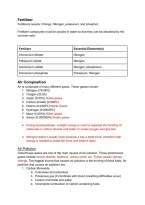
Fertilizers require 3 things, Nitrogen, potassium, and phosphor.
Fertilizer compounds must be soluble in water so that they can be absorbed by the
root hair cells.
Fertilizer Essential Elements(s)
Ammonium Nitrate Nitrogen
Potassium nitrate Nitrogen
Ammonium sulfate Nitrogen, phosphorus
Ammonium phosphate Potassium, Nitrogen
Air Composition
Air is composed of many different gases. These gases include:
1. Nitrogen (78.08%)
2. Oxygen (20.95)
3. Argon (0.93%) Noble gases
4. Carbon dioxide (0.038%)
5. Helium (0.0005%) Noble Gases
6. Hydrogen (0.00005%)
7. Neon (0.0018) Noble gases
8. Xenon (0.000009%) Noble gases
● During photosynthesis, sunlight energy is used to separate the bonding of
molecules in carbon dioxide and water, to create oxygen and glucose.
● NItrogen doesn’t usually react because it has a triple bond, therefore high
energy is needed to break the bond and make it react.
Air Pollution
Greenhouse gases are one of the main causes of air pollution. These greenhouse
gases include carbon dioxide, methane, nitrous oxide, etc. These causes climate
change. The biggest source that causes air pollution is the burning of fossil fuels. Air
particles that causes air pollution are:
1. Carbon Monoxide
a. Colourless and odourless
b. Poisonous gas (if combines with blood, breathing difficulties occur)
c. Carbon monoxide and water
d. Incomplete combustion of carbon-containing fuels.
, 2. Oxides of nitrogen
a. Includes nitrogen monoxide (NO) and Nitrogen dioxide (NO2)
Produced in 2 ways:
a. Thunderstorms
b. Cars (combustion)
3. Sulphur dioxide
a. Combustion of fossil fuels such as coal and crude oil
b. During volcanic eruptions
Acid Rain
Oxides of nitrogen also contribute to acid rain. In the presence of oxygen and water,
nitrogen dioxide is converted to nitric acid (NHO3). Can also be caused by sulphur
dioxide, but creates sulfuric acid.
● Reacts with metals and carbonates
● Will kill fish and other aquatic life
● Leaches important nutrient from the soil destroying plants
To reduce air pollution, in Singapore they:
1. Prohibit the use of open fires
2. Introduction of unleaded petrol
3. Reduce the permissible level of sulphur in diesel
Catalytic Converters - Attached to the exhaust system of a car. Contains platinum
and rhodium.
- Carbon monoxide is oxidised to carbon dioxide
- Oxides of nitrogen are reduced to nitrogen
Desulphurisation
As sulphur dioxide passes through a plant, it reacts with aqueous suspension of
calcium carbonate to form solid calcium sulphite. Calcium sulphite is further
oxidised to for Calcium sulphate.
Ozone Layer
The ozone layer is located at the stratosphere. When releasing CFC gases, it will
affect the ozone layer creating oxygen and Chlorine monoxide.
Carbon Cycle
If the atmosphere is to maintain a constant amount of carbon dioxide, the rate of
removal of atmospheric carbon dioxide must be balanced by the rate of return of the
gas.
,Endothermic
Heat is taken in. Always If the temperature of the “Air” has decreased, this means
that the heat is taken from the surroundings to the system. When the system
absorbs heat. You need energy to carry out.
Bond breaking
The product takes energy from the surroundings making itself hotter and the
surroundings colder/ positive.
Ex. Boiling, Photosynthesis, decomposition
Exothermic
Heat is given out. If the temperature of the “Air” increases after the reaction, this
means that heat is given out from the system to the surroundings.
Bond formation
The heat from the product is given out to the surroundings making the surroundings
hotter and making itself colder / Negative.
Ex. Burning / Combustion, rusting, corrosion, respiration
Combustion - the process of burning something
Heat changes in a reaction
Heat is measured in kilojoules.
An energy level diagram shows the energy change in a reaction.
If exothermic the arrow will go down
, If endothermic the arrow will go up
Enthalpy - heat change
Chemical bonding
A molecule - two or more atoms combine chemically
Molecule of element - Two or more atoms of the same elements join together
A element - A substance that consists of two or more of the same types of atoms
Compound - Made up of three or more different atoms combine (compound is a
Molecule, but from different elements)
Atoms - the smallest particle of matter (made of proton, neutron, electron)
Mixture - made of multiple compounds. Is not chemically combined.
Particle - the range of particles can be atoms, molecules, compounds, mixtures.
Photosynthesis
Carbon dioxide + water (sunlight)-> Glucose + oxygen
Bonds
Single bond C-C
Double bond C=C
Exothermic is always negative
Endothermic is always positive
In a hydrogen atom, it has an outer layering called a shell. Inside the shell there is a
nucleus that contains protons and neutrons. Outside the shell it contains electrons
and protons.
Neutral atom = when the number of proton is equal with the number of electron
Ion = When neutral atom loses electron -> proton > electron -> “+” / positive charge
Ion = negative when the neutral atom gains electrons; proton<electron = “-” /
negative charge
Nucleon = proton and neutron / particles inside the nucleus
Fertilizers require 3 things, Nitrogen, potassium, and phosphor.
Fertilizer compounds must be soluble in water so that they can be absorbed by the
root hair cells.
Fertilizer Essential Elements(s)
Ammonium Nitrate Nitrogen
Potassium nitrate Nitrogen
Ammonium sulfate Nitrogen, phosphorus
Ammonium phosphate Potassium, Nitrogen
Air Composition
Air is composed of many different gases. These gases include:
1. Nitrogen (78.08%)
2. Oxygen (20.95)
3. Argon (0.93%) Noble gases
4. Carbon dioxide (0.038%)
5. Helium (0.0005%) Noble Gases
6. Hydrogen (0.00005%)
7. Neon (0.0018) Noble gases
8. Xenon (0.000009%) Noble gases
● During photosynthesis, sunlight energy is used to separate the bonding of
molecules in carbon dioxide and water, to create oxygen and glucose.
● NItrogen doesn’t usually react because it has a triple bond, therefore high
energy is needed to break the bond and make it react.
Air Pollution
Greenhouse gases are one of the main causes of air pollution. These greenhouse
gases include carbon dioxide, methane, nitrous oxide, etc. These causes climate
change. The biggest source that causes air pollution is the burning of fossil fuels. Air
particles that causes air pollution are:
1. Carbon Monoxide
a. Colourless and odourless
b. Poisonous gas (if combines with blood, breathing difficulties occur)
c. Carbon monoxide and water
d. Incomplete combustion of carbon-containing fuels.
, 2. Oxides of nitrogen
a. Includes nitrogen monoxide (NO) and Nitrogen dioxide (NO2)
Produced in 2 ways:
a. Thunderstorms
b. Cars (combustion)
3. Sulphur dioxide
a. Combustion of fossil fuels such as coal and crude oil
b. During volcanic eruptions
Acid Rain
Oxides of nitrogen also contribute to acid rain. In the presence of oxygen and water,
nitrogen dioxide is converted to nitric acid (NHO3). Can also be caused by sulphur
dioxide, but creates sulfuric acid.
● Reacts with metals and carbonates
● Will kill fish and other aquatic life
● Leaches important nutrient from the soil destroying plants
To reduce air pollution, in Singapore they:
1. Prohibit the use of open fires
2. Introduction of unleaded petrol
3. Reduce the permissible level of sulphur in diesel
Catalytic Converters - Attached to the exhaust system of a car. Contains platinum
and rhodium.
- Carbon monoxide is oxidised to carbon dioxide
- Oxides of nitrogen are reduced to nitrogen
Desulphurisation
As sulphur dioxide passes through a plant, it reacts with aqueous suspension of
calcium carbonate to form solid calcium sulphite. Calcium sulphite is further
oxidised to for Calcium sulphate.
Ozone Layer
The ozone layer is located at the stratosphere. When releasing CFC gases, it will
affect the ozone layer creating oxygen and Chlorine monoxide.
Carbon Cycle
If the atmosphere is to maintain a constant amount of carbon dioxide, the rate of
removal of atmospheric carbon dioxide must be balanced by the rate of return of the
gas.
,Endothermic
Heat is taken in. Always If the temperature of the “Air” has decreased, this means
that the heat is taken from the surroundings to the system. When the system
absorbs heat. You need energy to carry out.
Bond breaking
The product takes energy from the surroundings making itself hotter and the
surroundings colder/ positive.
Ex. Boiling, Photosynthesis, decomposition
Exothermic
Heat is given out. If the temperature of the “Air” increases after the reaction, this
means that heat is given out from the system to the surroundings.
Bond formation
The heat from the product is given out to the surroundings making the surroundings
hotter and making itself colder / Negative.
Ex. Burning / Combustion, rusting, corrosion, respiration
Combustion - the process of burning something
Heat changes in a reaction
Heat is measured in kilojoules.
An energy level diagram shows the energy change in a reaction.
If exothermic the arrow will go down
, If endothermic the arrow will go up
Enthalpy - heat change
Chemical bonding
A molecule - two or more atoms combine chemically
Molecule of element - Two or more atoms of the same elements join together
A element - A substance that consists of two or more of the same types of atoms
Compound - Made up of three or more different atoms combine (compound is a
Molecule, but from different elements)
Atoms - the smallest particle of matter (made of proton, neutron, electron)
Mixture - made of multiple compounds. Is not chemically combined.
Particle - the range of particles can be atoms, molecules, compounds, mixtures.
Photosynthesis
Carbon dioxide + water (sunlight)-> Glucose + oxygen
Bonds
Single bond C-C
Double bond C=C
Exothermic is always negative
Endothermic is always positive
In a hydrogen atom, it has an outer layering called a shell. Inside the shell there is a
nucleus that contains protons and neutrons. Outside the shell it contains electrons
and protons.
Neutral atom = when the number of proton is equal with the number of electron
Ion = When neutral atom loses electron -> proton > electron -> “+” / positive charge
Ion = negative when the neutral atom gains electrons; proton<electron = “-” /
negative charge
Nucleon = proton and neutron / particles inside the nucleus