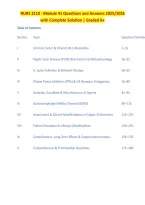
NURS 3110 - Module 41 Questions and Answers 2025/2026
with Complete Solution | Graded A+
Table of Contents
Section Topic Question Number
I Intrinsic Factor & Vitamin B12 Absorption 1–15
II Peptic Ulcer Disease (PUD): Risk Factors & Pathophysiology 16–35
III H. pylori Infection & Bismuth Therapy 36–55
IV Proton Pump Inhibitors (PPIs) & H2 Receptor Antagonists 56–80
V Antacids, Sucralfate & Miscellaneous GI Agents 81–95
VI Gastroesophageal Reflux Disease (GERD) 96–115
VII Assessment & Clinical Manifestations of Upper GI Disorders 116–135
VIII Patient Education & Lifestyle Modifications 136–155
IX Complications, Long-Term Effects & Surgical Interventions 156–170
X Comprehensive & Prioritization Questions 171–180
,Section I: Intrinsic Factor & Vitamin B12 Absorption
1. The nurse has provided a client with education about intrinsic factor. Which statement
indicates an understanding of the information?
A. "Intrinsic factor aids in the secretion of mucus to protect the stomach."
B. "Intrinsic factor is necessary for absorption of vitamin B6."
C. "Intrinsic factor is necessary for absorption of vitamin B12."
D. "Intrinsic factor is secreted by the chief cells of the stomach."
Answer: C. "Intrinsic factor is necessary for absorption of vitamin B12."
Rationale: Parietal cells secrete intrinsic factor, which is essential for the absorption of vitamin
B12 in the terminal ileum. Without intrinsic factor, vitamin B12 cannot be absorbed, leading to
pernicious anemia. Option A is incorrect because mucus secretion is a function of goblet cells,
not intrinsic factor. Option B is incorrect because intrinsic factor is specific to vitamin B12, not
B6. Option D is incorrect because chief cells secrete pepsinogen, not intrinsic factor.
2. A client asks the nurse which cells are responsible for producing intrinsic factor. What is the
nurse's best response?
A. Chief cells
B. Parietal cells
C. Goblet cells
D. G-cells
Answer: B. Parietal cells
Rationale: Parietal cells, located in the gastric mucosa, produce both hydrochloric acid and
intrinsic factor. Chief cells produce pepsinogen. Goblet cells produce mucus. G-cells produce
gastrin.
3. Which clients are at risk for decreased intrinsic factor production? Select all that apply.
A. A client who has undergone gastric bypass surgery
B. A client with chronic atrophic gastritis
C. A client taking long-term proton pump inhibitors
D. A client with a duodenal ulcer
E. A client with pernicious anemia
Answer: A, B, C, E
Rationale: Intrinsic factor is produced by parietal cells in the stomach. Gastric bypass surgery
removes or bypasses the stomach, reducing parietal cell mass. Chronic atrophic gastritis
destroys parietal cells. Long-term PPIs reduce gastric acid and can indirectly affect intrinsic
,factor production. Pernicious anemia is caused by a lack of intrinsic factor. Duodenal ulcers do
not directly affect intrinsic factor production.
4. The nurse is teaching a client newly diagnosed with pernicious anemia about vitamin B12
replacement. Which statement by the client indicates a need for further teaching?
A. "I will need to receive vitamin B12 injections for the rest of my life."
B. "I can take an oral vitamin B12 supplement instead of injections."
C. "My body cannot absorb vitamin B12 from food because I lack intrinsic factor."
D. "I should eat more red meat to increase my vitamin B12 levels."
Answer: D. "I should eat more red meat to increase my vitamin B12 levels."
Rationale: Clients with pernicious anemia lack intrinsic factor and cannot absorb vitamin B12
from food, regardless of intake. Injections or high-dose oral supplements are required. Option A
is correct. Option B is correct because high-dose oral B12 can be absorbed passively. Option C is
correct. Option D is incorrect because dietary intake alone will not correct the deficiency.
5. A client with a history of gastric resection asks the nurse why they need vitamin B12
injections. What is the nurse's best response?
A. "Your stomach no longer produces acid, which is needed to activate vitamin B12."
B. "Your stomach no longer produces intrinsic factor, which is needed to absorb vitamin B12."
C. "Your intestines cannot absorb any vitamins after surgery."
D. "You need vitamin B12 to replace blood loss during surgery."
Answer: B. "Your stomach no longer produces intrinsic factor, which is needed to absorb
vitamin B12."
Rationale: Gastric resection removes the parietal cells that produce intrinsic factor. Without
intrinsic factor, vitamin B12 cannot be absorbed in the terminal ileum. Option A is incorrect
because acid is not the primary factor; intrinsic factor is. Option C is incorrect because intestinal
absorption of other nutrients may be affected but not all vitamins. Option D is incorrect because
B12 is not given for blood loss.
6. Which laboratory finding is most consistent with a vitamin B12 deficiency?
A. Elevated serum folate
B. Macrocytic anemia with elevated MCV
C. Microcytic anemia with low MCV
D. Elevated serum iron
Answer: B. Macrocytic anemia with elevated MCV
Rationale: Vitamin B12 deficiency causes macrocytic (megaloblastic) anemia, characterized by
large, immature red blood cells and an elevated mean corpuscular volume (MCV). Microcytic
anemia is associated with iron deficiency. Folate deficiency also causes macrocytic anemia, but
, the question asks for the most consistent finding with B12 deficiency. Elevated serum iron is not
typical.
7. A client with pernicious anemia is receiving cyanocobalamin injections. Which assessment
finding indicates a therapeutic response?
A. Increased appetite and weight gain
B. Improved hemoglobin and hematocrit
C. Decreased heart rate
D. All of the above
Answer: D. All of the above
Rationale: Treatment of pernicious anemia with vitamin B12 replacement leads to correction of
anemia, which improves hemoglobin and hematocrit, increases appetite and weight gain, and
normalizes heart rate (tachycardia resolves as anemia improves). Therefore, all options are
indicators of a therapeutic response.
8. The nurse is reviewing the medication history of a client with vitamin B12 deficiency. Which
medication is most likely contributing to the deficiency?
A. Metformin
B. Lisinopril
C. Atorvastatin
D. Levothyroxine
Answer: A. Metformin
Rationale: Long-term use of metformin can interfere with vitamin B12 absorption and is a
common cause of B12 deficiency in diabetic clients. The other medications do not typically
cause B12 deficiency.
9. Which statement by a client with pernicious anemia indicates a need for immediate
intervention?
A. "I feel tired all the time."
B. "My tongue feels sore and smooth."
C. "I have been having numbness and tingling in my feet."
D. "I have been having episodes of confusion."
Answer: D. "I have been having episodes of confusion."
Rationale: Neurological symptoms such as confusion, memory loss, and dementia can occur
with severe vitamin B12 deficiency and require immediate intervention to prevent irreversible
neurological damage. Fatigue, sore tongue (glossitis), and paresthesias are also symptoms, but
confusion indicates more severe neurological involvement.
with Complete Solution | Graded A+
Table of Contents
Section Topic Question Number
I Intrinsic Factor & Vitamin B12 Absorption 1–15
II Peptic Ulcer Disease (PUD): Risk Factors & Pathophysiology 16–35
III H. pylori Infection & Bismuth Therapy 36–55
IV Proton Pump Inhibitors (PPIs) & H2 Receptor Antagonists 56–80
V Antacids, Sucralfate & Miscellaneous GI Agents 81–95
VI Gastroesophageal Reflux Disease (GERD) 96–115
VII Assessment & Clinical Manifestations of Upper GI Disorders 116–135
VIII Patient Education & Lifestyle Modifications 136–155
IX Complications, Long-Term Effects & Surgical Interventions 156–170
X Comprehensive & Prioritization Questions 171–180
,Section I: Intrinsic Factor & Vitamin B12 Absorption
1. The nurse has provided a client with education about intrinsic factor. Which statement
indicates an understanding of the information?
A. "Intrinsic factor aids in the secretion of mucus to protect the stomach."
B. "Intrinsic factor is necessary for absorption of vitamin B6."
C. "Intrinsic factor is necessary for absorption of vitamin B12."
D. "Intrinsic factor is secreted by the chief cells of the stomach."
Answer: C. "Intrinsic factor is necessary for absorption of vitamin B12."
Rationale: Parietal cells secrete intrinsic factor, which is essential for the absorption of vitamin
B12 in the terminal ileum. Without intrinsic factor, vitamin B12 cannot be absorbed, leading to
pernicious anemia. Option A is incorrect because mucus secretion is a function of goblet cells,
not intrinsic factor. Option B is incorrect because intrinsic factor is specific to vitamin B12, not
B6. Option D is incorrect because chief cells secrete pepsinogen, not intrinsic factor.
2. A client asks the nurse which cells are responsible for producing intrinsic factor. What is the
nurse's best response?
A. Chief cells
B. Parietal cells
C. Goblet cells
D. G-cells
Answer: B. Parietal cells
Rationale: Parietal cells, located in the gastric mucosa, produce both hydrochloric acid and
intrinsic factor. Chief cells produce pepsinogen. Goblet cells produce mucus. G-cells produce
gastrin.
3. Which clients are at risk for decreased intrinsic factor production? Select all that apply.
A. A client who has undergone gastric bypass surgery
B. A client with chronic atrophic gastritis
C. A client taking long-term proton pump inhibitors
D. A client with a duodenal ulcer
E. A client with pernicious anemia
Answer: A, B, C, E
Rationale: Intrinsic factor is produced by parietal cells in the stomach. Gastric bypass surgery
removes or bypasses the stomach, reducing parietal cell mass. Chronic atrophic gastritis
destroys parietal cells. Long-term PPIs reduce gastric acid and can indirectly affect intrinsic
,factor production. Pernicious anemia is caused by a lack of intrinsic factor. Duodenal ulcers do
not directly affect intrinsic factor production.
4. The nurse is teaching a client newly diagnosed with pernicious anemia about vitamin B12
replacement. Which statement by the client indicates a need for further teaching?
A. "I will need to receive vitamin B12 injections for the rest of my life."
B. "I can take an oral vitamin B12 supplement instead of injections."
C. "My body cannot absorb vitamin B12 from food because I lack intrinsic factor."
D. "I should eat more red meat to increase my vitamin B12 levels."
Answer: D. "I should eat more red meat to increase my vitamin B12 levels."
Rationale: Clients with pernicious anemia lack intrinsic factor and cannot absorb vitamin B12
from food, regardless of intake. Injections or high-dose oral supplements are required. Option A
is correct. Option B is correct because high-dose oral B12 can be absorbed passively. Option C is
correct. Option D is incorrect because dietary intake alone will not correct the deficiency.
5. A client with a history of gastric resection asks the nurse why they need vitamin B12
injections. What is the nurse's best response?
A. "Your stomach no longer produces acid, which is needed to activate vitamin B12."
B. "Your stomach no longer produces intrinsic factor, which is needed to absorb vitamin B12."
C. "Your intestines cannot absorb any vitamins after surgery."
D. "You need vitamin B12 to replace blood loss during surgery."
Answer: B. "Your stomach no longer produces intrinsic factor, which is needed to absorb
vitamin B12."
Rationale: Gastric resection removes the parietal cells that produce intrinsic factor. Without
intrinsic factor, vitamin B12 cannot be absorbed in the terminal ileum. Option A is incorrect
because acid is not the primary factor; intrinsic factor is. Option C is incorrect because intestinal
absorption of other nutrients may be affected but not all vitamins. Option D is incorrect because
B12 is not given for blood loss.
6. Which laboratory finding is most consistent with a vitamin B12 deficiency?
A. Elevated serum folate
B. Macrocytic anemia with elevated MCV
C. Microcytic anemia with low MCV
D. Elevated serum iron
Answer: B. Macrocytic anemia with elevated MCV
Rationale: Vitamin B12 deficiency causes macrocytic (megaloblastic) anemia, characterized by
large, immature red blood cells and an elevated mean corpuscular volume (MCV). Microcytic
anemia is associated with iron deficiency. Folate deficiency also causes macrocytic anemia, but
, the question asks for the most consistent finding with B12 deficiency. Elevated serum iron is not
typical.
7. A client with pernicious anemia is receiving cyanocobalamin injections. Which assessment
finding indicates a therapeutic response?
A. Increased appetite and weight gain
B. Improved hemoglobin and hematocrit
C. Decreased heart rate
D. All of the above
Answer: D. All of the above
Rationale: Treatment of pernicious anemia with vitamin B12 replacement leads to correction of
anemia, which improves hemoglobin and hematocrit, increases appetite and weight gain, and
normalizes heart rate (tachycardia resolves as anemia improves). Therefore, all options are
indicators of a therapeutic response.
8. The nurse is reviewing the medication history of a client with vitamin B12 deficiency. Which
medication is most likely contributing to the deficiency?
A. Metformin
B. Lisinopril
C. Atorvastatin
D. Levothyroxine
Answer: A. Metformin
Rationale: Long-term use of metformin can interfere with vitamin B12 absorption and is a
common cause of B12 deficiency in diabetic clients. The other medications do not typically
cause B12 deficiency.
9. Which statement by a client with pernicious anemia indicates a need for immediate
intervention?
A. "I feel tired all the time."
B. "My tongue feels sore and smooth."
C. "I have been having numbness and tingling in my feet."
D. "I have been having episodes of confusion."
Answer: D. "I have been having episodes of confusion."
Rationale: Neurological symptoms such as confusion, memory loss, and dementia can occur
with severe vitamin B12 deficiency and require immediate intervention to prevent irreversible
neurological damage. Fatigue, sore tongue (glossitis), and paresthesias are also symptoms, but
confusion indicates more severe neurological involvement.