
Topic 6: Immunity, Infection and Forensics | Pearson Edexcel Biology A (Salters-Nuffield) / 9BN0
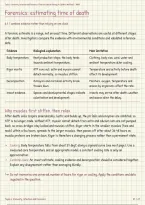
Forensics: estimating time of death
6.1 / combine evidence rather than relying on one clock
A forensic estimate is a range, not an exact time. Different observations are useful at different stages
after death. Investigators compare the evidence with environmental conditions and validated reference
data.
Evidence Biological explanation Main limitation
Body temperature Heat production stops; the body tends Clothing, body size, wind, water and
towards ambient temperature. ambient temperature alter cooling.
Rigor mortis ATP runs out; actin and myosin cannot Temperature and activity before death
detach normally, so muscles stiffen. affect its development.
Decomposition Autolysis and microbial activity break Moisture, oxygen, temperature and
tissues down. access by organisms affect the rate.
Insect evidence Species and developmental stages indicate Insects may arrive after death; weather
colonisation and development. and access alter the delay.
Why muscles first stiffen, then relax
After death, cells respire anaerobically: lactic acid builds up, the pH falls and enzymes are inhibited, so
ATP is no longer made. Without ATP, myosin cannot detach from actin and calcium ions are not pumped
back, so cross-bridges stay locked and muscles stiffen. Rigor starts in the smaller muscles (face and
neck) within a few hours, spreads to the larger muscles, then passes off after about 36-48 hours as
muscle proteins are broken down. Rigor is therefore a changing process rather than a permanent state.
Cooling: Body temperature falls from about 37 degC along a sigmoid curve (see next page). Use a
measured core temperature and an appropriate model; a constant cooling rate is only an
approximation.
Combine clues: An insect estimate, cooling evidence and decomposition should be considered together.
Explain any disagreement rather than averaging blindly.
Do not memorise one universal number of hours for rigor or cooling. Apply the conditions and data
supplied in the question.
Topic 6: Immunity, Infection and Forensics
,Topic 6: Immunity, Infection and Forensics | Pearson Edexcel Biology A (Salters-Nuffield) / 9BN0
Body cooling and decomposition
6.1 / a sigmoid cooling curve and a sequence of visible changes
Core body temperature is about 37 degC in life. After death it falls towards the temperature of the
surroundings, following a sigmoid (S-shaped) curve.
Core body temperature
1
37 degC
1 plateau: little cooling at first
2 2 steady, faster fall
3 levels off near ambient
3
ambient
Time since death
Plateau: for a short time after death the core temperature hardly falls.
Steady fall: heat is then lost fastest while the body is much warmer than its surroundings.
Levelling off: cooling slows as the body approaches ambient temperature, so body temperature is only
useful for about the first 24 hours.
Faster cooling: small body size (large surface area to volume ratio), little body fat or clothing, air
movement, immersion in water and a low ambient temperature.
Decomposition follows a sequence
1. Autolysis: the body's own enzymes, from lysosomes and the gut, start to break down cells.
2. Bacteria from the gut invade the tissues. A greenish discolouration of the skin of the lower abdomen
appears within the first few days and spreads.
3. The skin darkens to reddish-green, then purple-black. Gases produced by bacteria (such as hydrogen
sulfide, methane and carbon dioxide) make the body bloat.
4. Tissues liquefy; gases and fluids escape and the body deflates.
5. Soft tissue is lost until only dry remains and the skeleton are left.
Warm conditions speed these stages up; cold, dry or oxygen-poor conditions slow them down. Use any
timings given in the question.
Topic 6: Immunity, Infection and Forensics
, Topic 6: Immunity, Infection and Forensics | Pearson Edexcel Biology A (Salters-Nuffield) / 9BN0
Forensic entomology and succession
6.1 / insects provide evidence about colonisation
Blowflies may lay eggs on exposed remains. Larvae hatch, feed, moult through developmental stages,
pupate and emerge as adults. Identification and the oldest stage present can help estimate a minimum
time since colonisation.
Eggs Larvae Pupae Adults
Several larval stages
1. Identify the insect species: different species develop at different rates.
2. Measure larval length or identify the stage. The oldest insects generally provide the longest
development interval.
3. Use the temperature history and species-specific development data. Development depends on
accumulated warmth, not just calendar time.
4. Consider delayed access, wrapped remains, burial, refrigeration and changes in location. These may
delay colonisation or alter development.
Succession provides a second kind of clue
As remains change, different organisms exploit the available resources, so the community changes in a
predictable order. For example: bacteria are present from the start; blowflies arrive within hours and lay
eggs; as the tissues dry, beetles and other species that feed on drier tissue take over; when no soft tissue
is left, most insects leave. The stage reached can be compared with local reference evidence, but
succession varies with habitat and season.
Illustrative calculation
If reference data show that the oldest larvae needed 72 hours to reach their stage under the recorded
conditions, this supports at least about 72 hours since those eggs were laid. It does not automatically
prove that death occurred exactly 72 hours ago.
Time since insect colonisation and time since death are related, but they are not necessarily identical.
Topic 6: Immunity, Infection and Forensics
Forensics: estimating time of death
6.1 / combine evidence rather than relying on one clock
A forensic estimate is a range, not an exact time. Different observations are useful at different stages
after death. Investigators compare the evidence with environmental conditions and validated reference
data.
Evidence Biological explanation Main limitation
Body temperature Heat production stops; the body tends Clothing, body size, wind, water and
towards ambient temperature. ambient temperature alter cooling.
Rigor mortis ATP runs out; actin and myosin cannot Temperature and activity before death
detach normally, so muscles stiffen. affect its development.
Decomposition Autolysis and microbial activity break Moisture, oxygen, temperature and
tissues down. access by organisms affect the rate.
Insect evidence Species and developmental stages indicate Insects may arrive after death; weather
colonisation and development. and access alter the delay.
Why muscles first stiffen, then relax
After death, cells respire anaerobically: lactic acid builds up, the pH falls and enzymes are inhibited, so
ATP is no longer made. Without ATP, myosin cannot detach from actin and calcium ions are not pumped
back, so cross-bridges stay locked and muscles stiffen. Rigor starts in the smaller muscles (face and
neck) within a few hours, spreads to the larger muscles, then passes off after about 36-48 hours as
muscle proteins are broken down. Rigor is therefore a changing process rather than a permanent state.
Cooling: Body temperature falls from about 37 degC along a sigmoid curve (see next page). Use a
measured core temperature and an appropriate model; a constant cooling rate is only an
approximation.
Combine clues: An insect estimate, cooling evidence and decomposition should be considered together.
Explain any disagreement rather than averaging blindly.
Do not memorise one universal number of hours for rigor or cooling. Apply the conditions and data
supplied in the question.
Topic 6: Immunity, Infection and Forensics
,Topic 6: Immunity, Infection and Forensics | Pearson Edexcel Biology A (Salters-Nuffield) / 9BN0
Body cooling and decomposition
6.1 / a sigmoid cooling curve and a sequence of visible changes
Core body temperature is about 37 degC in life. After death it falls towards the temperature of the
surroundings, following a sigmoid (S-shaped) curve.
Core body temperature
1
37 degC
1 plateau: little cooling at first
2 2 steady, faster fall
3 levels off near ambient
3
ambient
Time since death
Plateau: for a short time after death the core temperature hardly falls.
Steady fall: heat is then lost fastest while the body is much warmer than its surroundings.
Levelling off: cooling slows as the body approaches ambient temperature, so body temperature is only
useful for about the first 24 hours.
Faster cooling: small body size (large surface area to volume ratio), little body fat or clothing, air
movement, immersion in water and a low ambient temperature.
Decomposition follows a sequence
1. Autolysis: the body's own enzymes, from lysosomes and the gut, start to break down cells.
2. Bacteria from the gut invade the tissues. A greenish discolouration of the skin of the lower abdomen
appears within the first few days and spreads.
3. The skin darkens to reddish-green, then purple-black. Gases produced by bacteria (such as hydrogen
sulfide, methane and carbon dioxide) make the body bloat.
4. Tissues liquefy; gases and fluids escape and the body deflates.
5. Soft tissue is lost until only dry remains and the skeleton are left.
Warm conditions speed these stages up; cold, dry or oxygen-poor conditions slow them down. Use any
timings given in the question.
Topic 6: Immunity, Infection and Forensics
, Topic 6: Immunity, Infection and Forensics | Pearson Edexcel Biology A (Salters-Nuffield) / 9BN0
Forensic entomology and succession
6.1 / insects provide evidence about colonisation
Blowflies may lay eggs on exposed remains. Larvae hatch, feed, moult through developmental stages,
pupate and emerge as adults. Identification and the oldest stage present can help estimate a minimum
time since colonisation.
Eggs Larvae Pupae Adults
Several larval stages
1. Identify the insect species: different species develop at different rates.
2. Measure larval length or identify the stage. The oldest insects generally provide the longest
development interval.
3. Use the temperature history and species-specific development data. Development depends on
accumulated warmth, not just calendar time.
4. Consider delayed access, wrapped remains, burial, refrigeration and changes in location. These may
delay colonisation or alter development.
Succession provides a second kind of clue
As remains change, different organisms exploit the available resources, so the community changes in a
predictable order. For example: bacteria are present from the start; blowflies arrive within hours and lay
eggs; as the tissues dry, beetles and other species that feed on drier tissue take over; when no soft tissue
is left, most insects leave. The stage reached can be compared with local reference evidence, but
succession varies with habitat and season.
Illustrative calculation
If reference data show that the oldest larvae needed 72 hours to reach their stage under the recorded
conditions, this supports at least about 72 hours since those eggs were laid. It does not automatically
prove that death occurred exactly 72 hours ago.
Time since insect colonisation and time since death are related, but they are not necessarily identical.
Topic 6: Immunity, Infection and Forensics


