
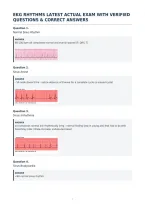
EKG RHYTHMS LATEST ACTUAL EXAM WITH VERIFIED
QUESTIONS & CORRECT ANSWERS
Question 1.
Normal Sinus Rhythm
ANSWER
60-100 bpm all complexes normal and evenly spaced (P, QRS, T)
Question 2.
Sinus Arrest
ANSWER
- SA node doesn't fire - notice absence of P-wave for a complete cycle (a missed cycle)
Question 3.
Sinus arrhythmia
ANSWER
all complexes normal but rhythmically irreg - normal finding (esp in young pts) that has to do with
breathing (rate: inhale-increase, exhale-decrease)
Question 4.
Sinus Bradycardia
ANSWER
<60 normal sinus rhythm
1
,Question 5.
Sinus Tachycardia
ANSWER
>100 (100-150) normal sinus rhythm
Question 6.
Wandering atrial pacemaker
ANSWER
Hint: try never to pick this - impulse originate from varying points in atria - variation in P wave
contour, PR-I, PP-I and thus RR-I
Question 7.
P wave vs T wave
ANSWER
P generally smaller than T
Question 8.
atrial tachy)
ANSWER
be consistent - assoc w/ severe pulm dz
2
, Question 9.
Atrial Fibrillation
ANSWER
A: 350-450 (atria quivering) - irreg-irreg rhythm (R-RI=irreg) **unsure/no P-wave
(non-distinguishable)** - irreg rhythm BUT reg QRS! Danger: increase the risk of thromboemoblic
events don't convert unless occurring less than 48 hrs, if don't know pt need to be put on
thrombolytics)
Question 10.
Atrial Flutter
ANSWER
A: 250-350 - "saw tooth" p-waves - a continuous rapid sequence of atrial complexes from a single
rapid-firing atrial focus (hint: if see 2 P waves and QRS think A Flutter)
Question 11.
Junctional Escape beats
ANSWER
retrograde atrial depolarization P' is inverted
Question 12.
Junctional rhythm
ANSWER
40-60 Regular! -impulse from AV node w/ retro/antegrade transmission - P wave often
inverted/buried/follow QRS - slow rate - narrow QRS (not wide like ventricular)
3
QUESTIONS & CORRECT ANSWERS
Question 1.
Normal Sinus Rhythm
ANSWER
60-100 bpm all complexes normal and evenly spaced (P, QRS, T)
Question 2.
Sinus Arrest
ANSWER
- SA node doesn't fire - notice absence of P-wave for a complete cycle (a missed cycle)
Question 3.
Sinus arrhythmia
ANSWER
all complexes normal but rhythmically irreg - normal finding (esp in young pts) that has to do with
breathing (rate: inhale-increase, exhale-decrease)
Question 4.
Sinus Bradycardia
ANSWER
<60 normal sinus rhythm
1
,Question 5.
Sinus Tachycardia
ANSWER
>100 (100-150) normal sinus rhythm
Question 6.
Wandering atrial pacemaker
ANSWER
Hint: try never to pick this - impulse originate from varying points in atria - variation in P wave
contour, PR-I, PP-I and thus RR-I
Question 7.
P wave vs T wave
ANSWER
P generally smaller than T
Question 8.
atrial tachy)
ANSWER
be consistent - assoc w/ severe pulm dz
2
, Question 9.
Atrial Fibrillation
ANSWER
A: 350-450 (atria quivering) - irreg-irreg rhythm (R-RI=irreg) **unsure/no P-wave
(non-distinguishable)** - irreg rhythm BUT reg QRS! Danger: increase the risk of thromboemoblic
events don't convert unless occurring less than 48 hrs, if don't know pt need to be put on
thrombolytics)
Question 10.
Atrial Flutter
ANSWER
A: 250-350 - "saw tooth" p-waves - a continuous rapid sequence of atrial complexes from a single
rapid-firing atrial focus (hint: if see 2 P waves and QRS think A Flutter)
Question 11.
Junctional Escape beats
ANSWER
retrograde atrial depolarization P' is inverted
Question 12.
Junctional rhythm
ANSWER
40-60 Regular! -impulse from AV node w/ retro/antegrade transmission - P wave often
inverted/buried/follow QRS - slow rate - narrow QRS (not wide like ventricular)
3


