
Topic 2: Genes and Health | Pearson Edexcel Biology A (Salters-Nuffield) / 9BN0
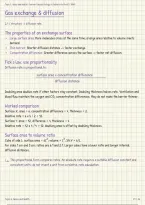
Gas exchange & diffusion
2.1 / structure -> diffusion rate
The properties of an exchange surface
Large surface area: More molecules cross at the same time; a large area relative to volume meets
demand.
Thin barrier: Shorter diffusion distance -> faster exchange.
Concentration difference: Greater difference across the surface -> faster net diffusion.
Fick's law: use proportionality
Diffusion rate is proportional to:
surface area x concentration difference
diffusion distance
Doubling area doubles rate if other factors stay constant. Doubling thickness halves rate. Ventilation and
blood flow maintain the oxygen and CO2 concentration differences; they do not make the barrier thinner.
Worked comparison
Surface X: area = 6, concentration difference = 4, thickness = 2.
Relative rate = 6 x = 12.
Surface Y: area = 12, difference = 4, thickness = 4.
Relative rate = 12 x = 12: doubling area is offset by doubling thickness.
Surface area to volume ratio
Cube of side L: surface area = 6L2; volume = L3; SA:V = 6/L.
For sides 1 cm and 3 cm: ratios are 6:1 and 2:1. Larger cubes have a lower ratio and longer internal
diffusion distances.
This proportional form compares rates. An absolute rate requires a suitable diffusion constant and
consistent units; do not invent a unit from a relative-rate calculation.
Topic 2: Genes and Health
,Topic 2: Genes and Health | Pearson Edexcel Biology A (Salters-Nuffield) / 9BN0
The mammalian lung
2.1 / alveoli provide a large, thin exchange surface
Follow the air pathway
1. Trachea -> bronchi -> smaller bronchioles -> alveoli.
2. Ventilation renews alveolar air: oxygen remains higher and CO2 lower than in arriving blood.
3. Blood flow renews the capillary contents, maintaining both diffusion gradients.
Alveolus and capillary: a structure comparison
Many alveoli: Very large total surface area for exchange.
Squamous epithelium: Thin alveolar wall; capillary endothelium is also one cell thick.
Close contact: Very short distance between alveolar air and capillary blood.
Moist surface: Gases dissolve before crossing cell membranes.
Elastic tissue: Stretching and recoil help ventilation; surfactant reduces collapse tendency.
Two directions of net diffusion
Oxygen: alveolar air -> alveolar epithelium -> capillary endothelium -> blood.
CO2: blood -> capillary wall -> alveolar wall -> alveolar air.
Oxygen binding to haemoglobin keeps the dissolved oxygen concentration in the capillary plasma low,
maintaining the gradient.
Explain rapid exchange by linking each feature to area, diffusion distance or concentration difference.
Ventilation moves air; diffusion moves gases across the exchange barrier.
Topic 2: Genes and Health
, Topic 2: Genes and Health | Pearson Edexcel Biology A (Salters-Nuffield) / 9BN0
Alveoli & their blood supply
2.1 / identify structures and explain their functions
Across the thin barrier
Oxygen diffuses from alveolar air into blood. Carbon
Bronchiole
dioxide diffuses from blood into alveolar air. Each moves
down its own concentration gradient.
Why exchange is rapid
Alveoli Many air sacs: Large total surface area.
Two thin cell layers: Alveolar epithelium and
capillary endothelium give a short diffusion
Capillary distance.
network Air and blood renewed: Ventilation and blood flow
maintain concentration differences.
Read the drawing
The capillary network surrounds the air sacs. Red and
blue distinguish oxygenation; deoxygenated blood is dark
Alveolus = one air sac. red, not blue. The drawing does not show the microscopic
Alveoli = several air sacs. thickness of the barrier.
The gases cross the alveolar wall and capillary
wall, not the bronchiole wall.
Topic 2: Genes and Health
Gas exchange & diffusion
2.1 / structure -> diffusion rate
The properties of an exchange surface
Large surface area: More molecules cross at the same time; a large area relative to volume meets
demand.
Thin barrier: Shorter diffusion distance -> faster exchange.
Concentration difference: Greater difference across the surface -> faster net diffusion.
Fick's law: use proportionality
Diffusion rate is proportional to:
surface area x concentration difference
diffusion distance
Doubling area doubles rate if other factors stay constant. Doubling thickness halves rate. Ventilation and
blood flow maintain the oxygen and CO2 concentration differences; they do not make the barrier thinner.
Worked comparison
Surface X: area = 6, concentration difference = 4, thickness = 2.
Relative rate = 6 x = 12.
Surface Y: area = 12, difference = 4, thickness = 4.
Relative rate = 12 x = 12: doubling area is offset by doubling thickness.
Surface area to volume ratio
Cube of side L: surface area = 6L2; volume = L3; SA:V = 6/L.
For sides 1 cm and 3 cm: ratios are 6:1 and 2:1. Larger cubes have a lower ratio and longer internal
diffusion distances.
This proportional form compares rates. An absolute rate requires a suitable diffusion constant and
consistent units; do not invent a unit from a relative-rate calculation.
Topic 2: Genes and Health
,Topic 2: Genes and Health | Pearson Edexcel Biology A (Salters-Nuffield) / 9BN0
The mammalian lung
2.1 / alveoli provide a large, thin exchange surface
Follow the air pathway
1. Trachea -> bronchi -> smaller bronchioles -> alveoli.
2. Ventilation renews alveolar air: oxygen remains higher and CO2 lower than in arriving blood.
3. Blood flow renews the capillary contents, maintaining both diffusion gradients.
Alveolus and capillary: a structure comparison
Many alveoli: Very large total surface area for exchange.
Squamous epithelium: Thin alveolar wall; capillary endothelium is also one cell thick.
Close contact: Very short distance between alveolar air and capillary blood.
Moist surface: Gases dissolve before crossing cell membranes.
Elastic tissue: Stretching and recoil help ventilation; surfactant reduces collapse tendency.
Two directions of net diffusion
Oxygen: alveolar air -> alveolar epithelium -> capillary endothelium -> blood.
CO2: blood -> capillary wall -> alveolar wall -> alveolar air.
Oxygen binding to haemoglobin keeps the dissolved oxygen concentration in the capillary plasma low,
maintaining the gradient.
Explain rapid exchange by linking each feature to area, diffusion distance or concentration difference.
Ventilation moves air; diffusion moves gases across the exchange barrier.
Topic 2: Genes and Health
, Topic 2: Genes and Health | Pearson Edexcel Biology A (Salters-Nuffield) / 9BN0
Alveoli & their blood supply
2.1 / identify structures and explain their functions
Across the thin barrier
Oxygen diffuses from alveolar air into blood. Carbon
Bronchiole
dioxide diffuses from blood into alveolar air. Each moves
down its own concentration gradient.
Why exchange is rapid
Alveoli Many air sacs: Large total surface area.
Two thin cell layers: Alveolar epithelium and
capillary endothelium give a short diffusion
Capillary distance.
network Air and blood renewed: Ventilation and blood flow
maintain concentration differences.
Read the drawing
The capillary network surrounds the air sacs. Red and
blue distinguish oxygenation; deoxygenated blood is dark
Alveolus = one air sac. red, not blue. The drawing does not show the microscopic
Alveoli = several air sacs. thickness of the barrier.
The gases cross the alveolar wall and capillary
wall, not the bronchiole wall.
Topic 2: Genes and Health


