)))____________ACSM
)))____________ACSM
)))____________ACSM
CEP-Testing
CEP-Testing
CEP-Testing
and and
Prescription.pdf*!@^#T&^TEV&^^R%^R^E&^UGS&^EFS*&S@(*EOILKSN@>(*ACSM
and
Prescription.pdf*!@^#T&^TEV&^^R%^R^E&^UGS&^EFS*&S@(*EOILKSN@>(*ACSM
Prescription.pdf*!@^#T&^TEV&^^R%^R^E&^UGS&^EFS*&S@(*EOILKSN@>(*ACSM
CEP-Testing
CEP-Testing
CEP-Testing
and and
Prescription.pdf
and
Prescription.pdf
Prescription.pdf
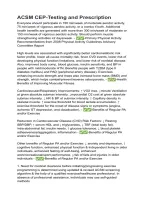
ACSM CEP-Testing and Prescription
Everyone should participate in 150 min/week of moderate aerobic activity,
75 min/week of vigorous aerobic activity, or a combo if both. Additional
health benefits are generated with more than 300 min/week of moderate or
✅
150 min/week of vigorous aerobic activity. Should perform muscle
strengthening activities ≥2 days/week. - -Primary Physical Activity
Recommendations from 2008 Physical Activity Guidelines Advisory
Committee Report
High levels are associated with significantly better cardiometabolic risk
factor profile, lower all-cause mortality risk, fever CVD events, lower risk of
developing physical function limitations, and lower risk of nonfatal disease.
Also, improved body comp, blood glucose, insulin sensitivity, and BP in
people with mild/moderate HTN. Benefits people with T2DM (type II
diabetes mellitus) and PAD (peripheral artery disease). Exercises
enhancing muscle strength and mass also increase bone mass (BMD) and
strength, which helps combat/prevent/reverse osteoporosis. - -Health
Benefits of Improving Muscular Fitness
Cardiovascular/Respiratory Improvements: ↑ VO2 max. ↓minute Ventilation
at given absolute submax intensity. ↓myocardial O2 cost at given absolute
submax intensity. ↓ HR & BP at submax intensity. ↑ Capillary density in
skeletal muscle. ↑ exercise threshold for blood lactate accumulation. ↑
exercise threshold for the onset of disease signs or symptoms (angina,
ischemic ST depression, and claudication). - -Benefits of Regular PA
and/or Exercise
Reduction in Cardiovascular Disease (CVD) Risk Factors: ↓ Resting
SBP/DBP, ↑ serum HDL and ↓ triglycerides, ↓ TBF (total body fat),
intra-abdominal fat, insulin needs, ↑ glucose tolerance, ↓ blood platelet
adhesiveness/aggregation, inflammation - -Benefits of Regular PA
and/or Exercise
Other benefits of Regular PA and/or Exercise: ↓ anxiety and depression, ↑
cognitive function, enhanced physical function & independent living in older
individuals, enhanced feeling of well-being, enhanced
work/recreational/sport performance, ↓risk of falls and injuries in older
individuals - -Benefits of Regular PA and/or Exercise
1. Need for medical clearance before initiating/progressing exercise
programming is determined using updated & revised ACSM screening
algorithm & the help of a qualified exercise/healthcare professional. In
absence of professional assistance, individuals may use self-guided
methods
)))____________ACSM
)))____________ACSM
)))____________ACSM
CEP-Testing
CEP-Testing
CEP-Testing
and and
Prescription.pdf*!@^#T&^TEV&^^R%^R^E&^UGS&^EFS*&S@(*EOILKSN@>(*ACSM
and
Prescription.pdf*!@^#T&^TEV&^^R%^R^E&^UGS&^EFS*&S@(*EOILKSN@>(*ACSM
Prescription.pdf*!@^#T&^TEV&^^R%^R^E&^UGS&^EFS*&S@(*EOILKSN@>(*ACSM
CEP-Testing
CEP-Testing
CEP-Testing
and and
Prescription.pdf
and
Prescription.pdf
Prescription.pdf
,)))____________ACSM
)))____________ACSM
)))____________ACSM
CEP-Testing
CEP-Testing
CEP-Testing
and and
Prescription.pdf*!@^#T&^TEV&^^R%^R^E&^UGS&^EFS*&S@(*EOILKSN@>(*ACSM
and
Prescription.pdf*!@^#T&^TEV&^^R%^R^E&^UGS&^EFS*&S@(*EOILKSN@>(*ACSM
Prescription.pdf*!@^#T&^TEV&^^R%^R^E&^UGS&^EFS*&S@(*EOILKSN@>(*ACSM
CEP-Testing
CEP-Testing
CEP-Testing
and and
Prescription.pdf
and
Prescription.pdf
Prescription.pdf
2. If indicated during screening, medical clearance should be sought from
respective healthcare providers (primary care/cardiologist, etc.). Manner of
✅
clearance should be determined by clinical judgement and discretion of
provider. - -Preparticipation health screening: 2 Stage Process
Shortness of breath (dyspnea) @ rest or with mild exertion
Dyspnea (abnormally uncomfortable awareness of breathing). Commonly
occurs during strenuous exercise in healthy/well-trained people & in
moderate exercise in healthy/untrained people. *should be regarded as
abnormal if experienced at level of exertion not expected to evoke
symptom*
Abnormal exertional dyspnea suggests presence of Cardiopulmonary.
disorders, in particular left ventricular (LV) dysfunction (LVD) or COPD -
-Signs/Symptoms Suggestive of CVD, Metabolic, and Renal Disease
Pain; discomfort (or other anginal equivalent) in the chest, neck, jaw, arms,
or other areas typical of myocardial ischemia
Key features favoring ischemic origin:
Character: constricting, squeezing, burning, "heaviness" or "heavy feeling"
Location: substernal, across midthorax, anteriorly; one/both arms,
shoulders; in neck, cheeks, teeth; in forearms, fingers
Provoking factors: exercise/exertion, excitement, stress, cold weather,
post-meals
Key features against ischemic origin:
Character: dull ache; "knife-like", "sharp, stabbing pain"; "jabs" aggravated
by respiration
Location: left submammary area; left hemithorax
Provoking factors: post-exercise, provoked by a specific body motion -
-Signs/Symptoms Suggestive of CVD, Metabolic, and Renal Disease
Dizziness/Syncope
Syncope (loss of consciousness). Dizziness or Syncope during exercise
may result from cardiac disorders that prevent normal rise of CO.
Potentially life-threatening & include severe CAD, Hypertrophic
Cardiomyopathy (HCM), Aortic Stenosis (AS) [narrowing/aortic valve
doesn't open fully], & Ventricular Dysrhythmias (Ven DysRhyth)
Post Exercise: dizziness/syncope should not be ignored, but these
symptoms may occur even in healthy individuals due to ↓ venous return to
heart - -Signs/Symptoms Suggestive of CVD, Metabolic, and Renal
Disease
)))____________ACSM
)))____________ACSM
)))____________ACSM
CEP-Testing
CEP-Testing
CEP-Testing
and and
Prescription.pdf*!@^#T&^TEV&^^R%^R^E&^UGS&^EFS*&S@(*EOILKSN@>(*ACSM
and
Prescription.pdf*!@^#T&^TEV&^^R%^R^E&^UGS&^EFS*&S@(*EOILKSN@>(*ACSM
Prescription.pdf*!@^#T&^TEV&^^R%^R^E&^UGS&^EFS*&S@(*EOILKSN@>(*ACSM
CEP-Testing
CEP-Testing
CEP-Testing
and and
Prescription.pdf
and
Prescription.pdf
Prescription.pdf
,)))____________ACSM
)))____________ACSM
)))____________ACSM
CEP-Testing
CEP-Testing
CEP-Testing
and and
Prescription.pdf*!@^#T&^TEV&^^R%^R^E&^UGS&^EFS*&S@(*EOILKSN@>(*ACSM
and
Prescription.pdf*!@^#T&^TEV&^^R%^R^E&^UGS&^EFS*&S@(*EOILKSN@>(*ACSM
Prescription.pdf*!@^#T&^TEV&^^R%^R^E&^UGS&^EFS*&S@(*EOILKSN@>(*ACSM
CEP-Testing
CEP-Testing
CEP-Testing
and and
Prescription.pdf
and
Prescription.pdf
Prescription.pdf
Orthopnea/Paroxysmal Nocturnal Dyspnea (PND)
Orthopnea (dyspnea at rest in recumbent position.) Usually relived by
standing/sitting upright. PND begins 2-5 hours after onset of sleep (relieved
by sitting on side of bed/getting out of bed). Both are symptoms of LVD.
Nocturnal Dyspnea may occur in patient's w/ COPD, it differs because it is
✅
relieved after a bowl movement rather than sitting up. -
-Signs/Symptoms Suggestive of CVD, Metabolic, and Renal Disease
Ankle Edema (AE)
Bilateral AE most evident at night is *a characteristic sign of heart failure
(HF) or bilateral chronic venous insufficiency. Unilateral AE of limb often
results from venous thrombosis (clot) or lymphatic blockage in limb.
Generalized edema (anasarca) occurs in individuals w/ nephrotic syndrome
(kidney disorder; too much protein in urine), severe HF, or hepatic (liver)
cirrhosis. - -Signs/Symptoms Suggestive of CVD, Metabolic, and
Renal Disease
Palpitations/Tachycardia
Palpitations (unpleasant awareness of forceful/rapid beating of the heart).
Can be induced by various disorders of cardiac rhythm. I.E. Tachycardia
(Tachy [HR >100 bpm]), Sudden onset Bradycardia (Brady [HR <60 bpm]),
Ectopic beats (disturbance of the cardiac rhythm related to electrical
conduction of heart) [PAC or PVC], compensatory pauses, & accentuated
(more prominent) SV from valvular regurgitation.
Can also see palpitations anxiety, ↑ CO states (such as anemia, fever,
thyrotoxicosis [overactive thyroid], arteriovenous fistula [abnormal
connection between artery and vein], and idiopathic hyperkinetic heart
syndrome [hyperactivity of the heart]) - -Signs/Symptoms Suggestive
of CVD, Metabolic, and Renal Disease
Intermittent Claudication (IC)
IC refers to pain occurring in lower extremities (LE) w/ an inadequate blood
supply (typically from atherosclerosis [hardening/narrowing of arteries]) that
is brought on by exercise. Pain doesn't occur w/ sitting or standing,
reproducible from day to day, more severe when walking @ incline (stairs,
hill) & is described as a cramp, which disappears 1-2 min after exercise.
CAD is more prevalent in individuals with IC. Patients w/ Diabetes Mellitus
(DM) are more at risk for IC. - -Signs/Symptoms Suggestive of CVD,
Metabolic, and Renal Disease
)))____________ACSM
)))____________ACSM
)))____________ACSM
CEP-Testing
CEP-Testing
CEP-Testing
and and
Prescription.pdf*!@^#T&^TEV&^^R%^R^E&^UGS&^EFS*&S@(*EOILKSN@>(*ACSM
and
Prescription.pdf*!@^#T&^TEV&^^R%^R^E&^UGS&^EFS*&S@(*EOILKSN@>(*ACSM
Prescription.pdf*!@^#T&^TEV&^^R%^R^E&^UGS&^EFS*&S@(*EOILKSN@>(*ACSM
CEP-Testing
CEP-Testing
CEP-Testing
and and
Prescription.pdf
and
Prescription.pdf
Prescription.pdf
, )))____________ACSM
)))____________ACSM
)))____________ACSM
CEP-Testing
CEP-Testing
CEP-Testing
and and
Prescription.pdf*!@^#T&^TEV&^^R%^R^E&^UGS&^EFS*&S@(*EOILKSN@>(*ACSM
and
Prescription.pdf*!@^#T&^TEV&^^R%^R^E&^UGS&^EFS*&S@(*EOILKSN@>(*ACSM
Prescription.pdf*!@^#T&^TEV&^^R%^R^E&^UGS&^EFS*&S@(*EOILKSN@>(*ACSM
CEP-Testing
CEP-Testing
CEP-Testing
and and
Prescription.pdf
and
Prescription.pdf
Prescription.pdf
Known Heart Murmur
Some may be innocent, but heart murmurs (HM) may indicate valvular or
other types of CVD. From an exercise safety standpoint, it's important to
exclude hypertrophic cardiomyopathy (HCM) and aortic stenosis (AO)
[narrowing of aortic valve] as underlying causes because these are among
✅
the more common causes or exertion-related Sudden Cardiac Death
(SCD). - -Signs/Symptoms Suggestive of CVD, Metabolic, and Renal
Disease
Unusual Fatigue or Dyspnea with usual activities
May be benign origins for symptoms, they may also signal the onset/or
change in status of CVD or Metabolic Disease - -Signs/Symptoms
Suggestive of CVD, Metabolic, and Renal Disease
No CV, Metabolic, or Renal Disease AND no S/S suggestive of CV,
Metabolic, or Renal disease
Medical Clearance Not Necessary
Light - Moderate Intensity Exercise Recommended May gradually ↑ to
Vigorous Intensity Exercise following ACSM Guidelines - -ACSM
Preparticipation Screening Algorithm - Doesn't Participate in Regular
Exercise
Known CV, Metabolic, or Renal Disease AND Asymptomatic (showing no
signs/symptoms)
Medical Clearance Recommended
Following Medical Clearance, Light - Moderate Intensity Exercise
Recommended May gradually ↑ as tolerated following ACSM Guidelines -
-ACSM Preparticipation Screening Algorithm - Doesn't Participate in
Regular Exercise
Any S/S or Symptoms Suggestive of CV, Metabolic, or Renal Disease *
Regardless of disease status
Medical Clearance Recommended
Following Medical Clearance, Light - Moderate Intensity Exercise
Recommended May gradually ↑ as tolerated following ACSM Guidelines -
-ACSM Preparticipation Screening Algorithm - Doesn't Participate in
Regular Exercise
)))____________ACSM
)))____________ACSM
)))____________ACSM
CEP-Testing
CEP-Testing
CEP-Testing
and and
Prescription.pdf*!@^#T&^TEV&^^R%^R^E&^UGS&^EFS*&S@(*EOILKSN@>(*ACSM
and
Prescription.pdf*!@^#T&^TEV&^^R%^R^E&^UGS&^EFS*&S@(*EOILKSN@>(*ACSM
Prescription.pdf*!@^#T&^TEV&^^R%^R^E&^UGS&^EFS*&S@(*EOILKSN@>(*ACSM
CEP-Testing
CEP-Testing
CEP-Testing
and and
Prescription.pdf
and
Prescription.pdf
Prescription.pdf
)))____________ACSM
)))____________ACSM
CEP-Testing
CEP-Testing
CEP-Testing
and and
Prescription.pdf*!@^#T&^TEV&^^R%^R^E&^UGS&^EFS*&S@(*EOILKSN@>(*ACSM
and
Prescription.pdf*!@^#T&^TEV&^^R%^R^E&^UGS&^EFS*&S@(*EOILKSN@>(*ACSM
Prescription.pdf*!@^#T&^TEV&^^R%^R^E&^UGS&^EFS*&S@(*EOILKSN@>(*ACSM
CEP-Testing
CEP-Testing
CEP-Testing
and and
Prescription.pdf
and
Prescription.pdf
Prescription.pdf
ACSM CEP-Testing and Prescription
Everyone should participate in 150 min/week of moderate aerobic activity,
75 min/week of vigorous aerobic activity, or a combo if both. Additional
health benefits are generated with more than 300 min/week of moderate or
✅
150 min/week of vigorous aerobic activity. Should perform muscle
strengthening activities ≥2 days/week. - -Primary Physical Activity
Recommendations from 2008 Physical Activity Guidelines Advisory
Committee Report
High levels are associated with significantly better cardiometabolic risk
factor profile, lower all-cause mortality risk, fever CVD events, lower risk of
developing physical function limitations, and lower risk of nonfatal disease.
Also, improved body comp, blood glucose, insulin sensitivity, and BP in
people with mild/moderate HTN. Benefits people with T2DM (type II
diabetes mellitus) and PAD (peripheral artery disease). Exercises
enhancing muscle strength and mass also increase bone mass (BMD) and
strength, which helps combat/prevent/reverse osteoporosis. - -Health
Benefits of Improving Muscular Fitness
Cardiovascular/Respiratory Improvements: ↑ VO2 max. ↓minute Ventilation
at given absolute submax intensity. ↓myocardial O2 cost at given absolute
submax intensity. ↓ HR & BP at submax intensity. ↑ Capillary density in
skeletal muscle. ↑ exercise threshold for blood lactate accumulation. ↑
exercise threshold for the onset of disease signs or symptoms (angina,
ischemic ST depression, and claudication). - -Benefits of Regular PA
and/or Exercise
Reduction in Cardiovascular Disease (CVD) Risk Factors: ↓ Resting
SBP/DBP, ↑ serum HDL and ↓ triglycerides, ↓ TBF (total body fat),
intra-abdominal fat, insulin needs, ↑ glucose tolerance, ↓ blood platelet
adhesiveness/aggregation, inflammation - -Benefits of Regular PA
and/or Exercise
Other benefits of Regular PA and/or Exercise: ↓ anxiety and depression, ↑
cognitive function, enhanced physical function & independent living in older
individuals, enhanced feeling of well-being, enhanced
work/recreational/sport performance, ↓risk of falls and injuries in older
individuals - -Benefits of Regular PA and/or Exercise
1. Need for medical clearance before initiating/progressing exercise
programming is determined using updated & revised ACSM screening
algorithm & the help of a qualified exercise/healthcare professional. In
absence of professional assistance, individuals may use self-guided
methods
)))____________ACSM
)))____________ACSM
)))____________ACSM
CEP-Testing
CEP-Testing
CEP-Testing
and and
Prescription.pdf*!@^#T&^TEV&^^R%^R^E&^UGS&^EFS*&S@(*EOILKSN@>(*ACSM
and
Prescription.pdf*!@^#T&^TEV&^^R%^R^E&^UGS&^EFS*&S@(*EOILKSN@>(*ACSM
Prescription.pdf*!@^#T&^TEV&^^R%^R^E&^UGS&^EFS*&S@(*EOILKSN@>(*ACSM
CEP-Testing
CEP-Testing
CEP-Testing
and and
Prescription.pdf
and
Prescription.pdf
Prescription.pdf
,)))____________ACSM
)))____________ACSM
)))____________ACSM
CEP-Testing
CEP-Testing
CEP-Testing
and and
Prescription.pdf*!@^#T&^TEV&^^R%^R^E&^UGS&^EFS*&S@(*EOILKSN@>(*ACSM
and
Prescription.pdf*!@^#T&^TEV&^^R%^R^E&^UGS&^EFS*&S@(*EOILKSN@>(*ACSM
Prescription.pdf*!@^#T&^TEV&^^R%^R^E&^UGS&^EFS*&S@(*EOILKSN@>(*ACSM
CEP-Testing
CEP-Testing
CEP-Testing
and and
Prescription.pdf
and
Prescription.pdf
Prescription.pdf
2. If indicated during screening, medical clearance should be sought from
respective healthcare providers (primary care/cardiologist, etc.). Manner of
✅
clearance should be determined by clinical judgement and discretion of
provider. - -Preparticipation health screening: 2 Stage Process
Shortness of breath (dyspnea) @ rest or with mild exertion
Dyspnea (abnormally uncomfortable awareness of breathing). Commonly
occurs during strenuous exercise in healthy/well-trained people & in
moderate exercise in healthy/untrained people. *should be regarded as
abnormal if experienced at level of exertion not expected to evoke
symptom*
Abnormal exertional dyspnea suggests presence of Cardiopulmonary.
disorders, in particular left ventricular (LV) dysfunction (LVD) or COPD -
-Signs/Symptoms Suggestive of CVD, Metabolic, and Renal Disease
Pain; discomfort (or other anginal equivalent) in the chest, neck, jaw, arms,
or other areas typical of myocardial ischemia
Key features favoring ischemic origin:
Character: constricting, squeezing, burning, "heaviness" or "heavy feeling"
Location: substernal, across midthorax, anteriorly; one/both arms,
shoulders; in neck, cheeks, teeth; in forearms, fingers
Provoking factors: exercise/exertion, excitement, stress, cold weather,
post-meals
Key features against ischemic origin:
Character: dull ache; "knife-like", "sharp, stabbing pain"; "jabs" aggravated
by respiration
Location: left submammary area; left hemithorax
Provoking factors: post-exercise, provoked by a specific body motion -
-Signs/Symptoms Suggestive of CVD, Metabolic, and Renal Disease
Dizziness/Syncope
Syncope (loss of consciousness). Dizziness or Syncope during exercise
may result from cardiac disorders that prevent normal rise of CO.
Potentially life-threatening & include severe CAD, Hypertrophic
Cardiomyopathy (HCM), Aortic Stenosis (AS) [narrowing/aortic valve
doesn't open fully], & Ventricular Dysrhythmias (Ven DysRhyth)
Post Exercise: dizziness/syncope should not be ignored, but these
symptoms may occur even in healthy individuals due to ↓ venous return to
heart - -Signs/Symptoms Suggestive of CVD, Metabolic, and Renal
Disease
)))____________ACSM
)))____________ACSM
)))____________ACSM
CEP-Testing
CEP-Testing
CEP-Testing
and and
Prescription.pdf*!@^#T&^TEV&^^R%^R^E&^UGS&^EFS*&S@(*EOILKSN@>(*ACSM
and
Prescription.pdf*!@^#T&^TEV&^^R%^R^E&^UGS&^EFS*&S@(*EOILKSN@>(*ACSM
Prescription.pdf*!@^#T&^TEV&^^R%^R^E&^UGS&^EFS*&S@(*EOILKSN@>(*ACSM
CEP-Testing
CEP-Testing
CEP-Testing
and and
Prescription.pdf
and
Prescription.pdf
Prescription.pdf
,)))____________ACSM
)))____________ACSM
)))____________ACSM
CEP-Testing
CEP-Testing
CEP-Testing
and and
Prescription.pdf*!@^#T&^TEV&^^R%^R^E&^UGS&^EFS*&S@(*EOILKSN@>(*ACSM
and
Prescription.pdf*!@^#T&^TEV&^^R%^R^E&^UGS&^EFS*&S@(*EOILKSN@>(*ACSM
Prescription.pdf*!@^#T&^TEV&^^R%^R^E&^UGS&^EFS*&S@(*EOILKSN@>(*ACSM
CEP-Testing
CEP-Testing
CEP-Testing
and and
Prescription.pdf
and
Prescription.pdf
Prescription.pdf
Orthopnea/Paroxysmal Nocturnal Dyspnea (PND)
Orthopnea (dyspnea at rest in recumbent position.) Usually relived by
standing/sitting upright. PND begins 2-5 hours after onset of sleep (relieved
by sitting on side of bed/getting out of bed). Both are symptoms of LVD.
Nocturnal Dyspnea may occur in patient's w/ COPD, it differs because it is
✅
relieved after a bowl movement rather than sitting up. -
-Signs/Symptoms Suggestive of CVD, Metabolic, and Renal Disease
Ankle Edema (AE)
Bilateral AE most evident at night is *a characteristic sign of heart failure
(HF) or bilateral chronic venous insufficiency. Unilateral AE of limb often
results from venous thrombosis (clot) or lymphatic blockage in limb.
Generalized edema (anasarca) occurs in individuals w/ nephrotic syndrome
(kidney disorder; too much protein in urine), severe HF, or hepatic (liver)
cirrhosis. - -Signs/Symptoms Suggestive of CVD, Metabolic, and
Renal Disease
Palpitations/Tachycardia
Palpitations (unpleasant awareness of forceful/rapid beating of the heart).
Can be induced by various disorders of cardiac rhythm. I.E. Tachycardia
(Tachy [HR >100 bpm]), Sudden onset Bradycardia (Brady [HR <60 bpm]),
Ectopic beats (disturbance of the cardiac rhythm related to electrical
conduction of heart) [PAC or PVC], compensatory pauses, & accentuated
(more prominent) SV from valvular regurgitation.
Can also see palpitations anxiety, ↑ CO states (such as anemia, fever,
thyrotoxicosis [overactive thyroid], arteriovenous fistula [abnormal
connection between artery and vein], and idiopathic hyperkinetic heart
syndrome [hyperactivity of the heart]) - -Signs/Symptoms Suggestive
of CVD, Metabolic, and Renal Disease
Intermittent Claudication (IC)
IC refers to pain occurring in lower extremities (LE) w/ an inadequate blood
supply (typically from atherosclerosis [hardening/narrowing of arteries]) that
is brought on by exercise. Pain doesn't occur w/ sitting or standing,
reproducible from day to day, more severe when walking @ incline (stairs,
hill) & is described as a cramp, which disappears 1-2 min after exercise.
CAD is more prevalent in individuals with IC. Patients w/ Diabetes Mellitus
(DM) are more at risk for IC. - -Signs/Symptoms Suggestive of CVD,
Metabolic, and Renal Disease
)))____________ACSM
)))____________ACSM
)))____________ACSM
CEP-Testing
CEP-Testing
CEP-Testing
and and
Prescription.pdf*!@^#T&^TEV&^^R%^R^E&^UGS&^EFS*&S@(*EOILKSN@>(*ACSM
and
Prescription.pdf*!@^#T&^TEV&^^R%^R^E&^UGS&^EFS*&S@(*EOILKSN@>(*ACSM
Prescription.pdf*!@^#T&^TEV&^^R%^R^E&^UGS&^EFS*&S@(*EOILKSN@>(*ACSM
CEP-Testing
CEP-Testing
CEP-Testing
and and
Prescription.pdf
and
Prescription.pdf
Prescription.pdf
, )))____________ACSM
)))____________ACSM
)))____________ACSM
CEP-Testing
CEP-Testing
CEP-Testing
and and
Prescription.pdf*!@^#T&^TEV&^^R%^R^E&^UGS&^EFS*&S@(*EOILKSN@>(*ACSM
and
Prescription.pdf*!@^#T&^TEV&^^R%^R^E&^UGS&^EFS*&S@(*EOILKSN@>(*ACSM
Prescription.pdf*!@^#T&^TEV&^^R%^R^E&^UGS&^EFS*&S@(*EOILKSN@>(*ACSM
CEP-Testing
CEP-Testing
CEP-Testing
and and
Prescription.pdf
and
Prescription.pdf
Prescription.pdf
Known Heart Murmur
Some may be innocent, but heart murmurs (HM) may indicate valvular or
other types of CVD. From an exercise safety standpoint, it's important to
exclude hypertrophic cardiomyopathy (HCM) and aortic stenosis (AO)
[narrowing of aortic valve] as underlying causes because these are among
✅
the more common causes or exertion-related Sudden Cardiac Death
(SCD). - -Signs/Symptoms Suggestive of CVD, Metabolic, and Renal
Disease
Unusual Fatigue or Dyspnea with usual activities
May be benign origins for symptoms, they may also signal the onset/or
change in status of CVD or Metabolic Disease - -Signs/Symptoms
Suggestive of CVD, Metabolic, and Renal Disease
No CV, Metabolic, or Renal Disease AND no S/S suggestive of CV,
Metabolic, or Renal disease
Medical Clearance Not Necessary
Light - Moderate Intensity Exercise Recommended May gradually ↑ to
Vigorous Intensity Exercise following ACSM Guidelines - -ACSM
Preparticipation Screening Algorithm - Doesn't Participate in Regular
Exercise
Known CV, Metabolic, or Renal Disease AND Asymptomatic (showing no
signs/symptoms)
Medical Clearance Recommended
Following Medical Clearance, Light - Moderate Intensity Exercise
Recommended May gradually ↑ as tolerated following ACSM Guidelines -
-ACSM Preparticipation Screening Algorithm - Doesn't Participate in
Regular Exercise
Any S/S or Symptoms Suggestive of CV, Metabolic, or Renal Disease *
Regardless of disease status
Medical Clearance Recommended
Following Medical Clearance, Light - Moderate Intensity Exercise
Recommended May gradually ↑ as tolerated following ACSM Guidelines -
-ACSM Preparticipation Screening Algorithm - Doesn't Participate in
Regular Exercise
)))____________ACSM
)))____________ACSM
)))____________ACSM
CEP-Testing
CEP-Testing
CEP-Testing
and and
Prescription.pdf*!@^#T&^TEV&^^R%^R^E&^UGS&^EFS*&S@(*EOILKSN@>(*ACSM
and
Prescription.pdf*!@^#T&^TEV&^^R%^R^E&^UGS&^EFS*&S@(*EOILKSN@>(*ACSM
Prescription.pdf*!@^#T&^TEV&^^R%^R^E&^UGS&^EFS*&S@(*EOILKSN@>(*ACSM
CEP-Testing
CEP-Testing
CEP-Testing
and and
Prescription.pdf
and
Prescription.pdf
Prescription.pdf