
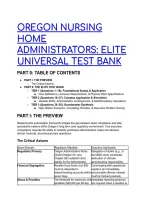
OREGON NURSING
HOME
ADMINISTRATORS: ELITE
UNIVERSAL TEST BANK
PART 0: TABLE OF CONTENTS
● PART I: THE PREVIEW
○ The Critical Axioms
● PART II: THE ELITE TEST BANK
○ TIER 1 (Questions 1–18): Foundational Syntax & Application
■ Core Definitions, Licensure Requirements, & Physical Plant Specifications
○ TIER 2 (Questions 19–37): Complex Application & Simulation
■ Variable Shifts, Administrative Contingencies, & Multidisciplinary Operations
○ TIER 3 (Questions 38–55): Grandmaster Synthesis
■ High-Stakes Scenarios, Competing Priorities, & Executive Problem Solving
PART I: THE PREVIEW
Mastering this examination framework bridges the gap between basic compliance and elite,
operational mastery within Oregon's long-term care regulatory environment. True executive
competence requires the ability to instantly synthesize administrative codes into decisive
clinical, financial, and physical plant operations.
The Critical Axioms
Axiom Domain Regulatory Mandate Executive Application
Regulatory Primacy Oregon Administrative Rules Delegation of duties (e.g., to
(OAR) Chapter 411 and the DNS) never constitutes
Chapter 853 establish strict abdication of ultimate
liability for the Administrator. administrative responsibility.
Financial Segregation Resident trust funds over $50 Commingling with operational
must be deposited in capital is an immediately
interest-bearing accounts within sanctionable offense; interest
seven days. must be tracked precisely.
Abuse & Penalties The threshold for maximum civil Immediate reporting protocols
penalties ($40,000 per 90-day are required when a resident is
,Axiom Domain Regulatory Mandate Executive Application
period) relies on establishing endangered; failure to report
deliberate or non-accidental triggers maximum liability.
harm.
Environmental Hard-Deck Physical environment These are absolute,
parameters dictate 75°F non-negotiable safety
ambient design temperatures standards overriding all other
and 105°F–120°F water limits. operational conveniences or
budgetary constraints.
PART II: THE ELITE TEST BANK
TIER 1: Foundational Syntax & Application
Q1: An unexpected emergency forces a licensed nursing home administrator to vacate their
position without standard notice. The governing body must install a provisionally authorized
administrator. Based on the principles of OAR 853-030-0010, which action is the CORRECT
parameter regarding this provisional license?
A) It remains valid universally across all nursing homes managed by the governing corporate
entity. B) It may be granted when a departing administrator provides a standard two-week
resignation notice. C) It remains valid only for the specific facility experiencing the emergency,
lasting until a licensed administrator is employed or for six months. D) It can be renewed
indefinitely so long as the facility is actively interviewing prospective licensed candidates.
● Answer: C (It remains valid only for the specific facility experiencing the emergency,
lasting until a licensed administrator is employed or for six months)
● Distractor Analysis:
○ A is incorrect: The provisional license is strictly bound to the specific nursing home
where the emergency exists, lacking portability.
○ B is incorrect: An administrator resigning with standard notice is explicitly defined by
OAR as not constituting an emergency.
○ D is incorrect: Provisional licenses expire strictly upon the employment of a licensed
administrator or at the six-month mark, whichever occurs first; there are no
indefinite extensions permitted by the board.
The Mentor's Analysis: Provisional licensure is a temporary bridge, not a permanent corporate
strategy. Regulators isolate provisional authority to the exact site of the emergency to limit
systemic risk, ensuring unqualified individuals do not establish permanent footholds in executive
healthcare management. Professional Intuition: A provisional license is site-specific and
strictly time-boxed to six months maximum.
Q2: An applicant for a Nursing Home Administrator license is pursuing licensure through
Pathway 3 (Advanced Education and Experience). Based on the principles of Oregon Long
Term Care Administrators Board rules, what specific evidence is the REQUIRED documentation
to bypass the Administrator-in-Training (AIT) program?
A) A bachelor’s degree in nursing and five years of charge nurse experience. B) An official
transcript demonstrating attainment of a postgraduate degree in management and proof of 10
years of experience in health-care management. C) One year of experience as an administrator
of a dual facility and a passing score on the NAB exam. D) Proof of active licensure in another
state prior to January 1, 1990.
● Answer: B (An official transcript demonstrating attainment of a postgraduate degree in
, management and proof of 10 years of experience in health-care management)
● Distractor Analysis:
○ A is incorrect: Clinical nursing degrees and mid-level clinical experience do not
satisfy the specific executive management criteria of Pathway 3.
○ C is incorrect: This specific dual-facility timeline describes Pathway 2, not Pathway
3.
○ D is incorrect: This references legacy reciprocity (Pathway 5), which requires
original licensure prior to January 1, 1983, not 1990.
The Mentor's Analysis: Advanced degree waivers demand stringent, prolonged executive
experience to offset the lack of a standardized AIT program. Ten years of specialized
health-care management paired with a postgraduate management degree proves an equivalent
operational and academic competency. Professional Intuition: Pathway 3 demands an elite
academic and professional pedigree: Postgraduate Management Degree + 10 Years
Health-Care Management.
Q3: During a routine Department inspection, surveyors assess the facility’s hot water safety in
resident bathing areas. Based on the principles of OAR 411-087-0310, which outcome is the
MANDATORY temperature range at shower, bathing, and handwash sink areas?
A) Not lower than 100 degrees Fahrenheit or higher than 115 degrees Fahrenheit. B) Not lower
than 105 degrees Fahrenheit or higher than 120 degrees Fahrenheit. C) Not lower than 110
degrees Fahrenheit or higher than 125 degrees Fahrenheit. D) Precisely 120 degrees
Fahrenheit across all points of access.
● Answer: B (Not lower than 105 degrees Fahrenheit or higher than 120 degrees
Fahrenheit)
● Distractor Analysis:
○ A is incorrect: This range falls below the statutory minimum required for proper
sanitation and resident comfort.
○ C is incorrect: 125 degrees creates an immediate scald hazard, violating the upper
safety limit of 120 degrees and triggering immediate jeopardy.
○ D is incorrect: Physical system dynamics make a precise 120-degree lock
impossible across all spouts simultaneously; a managed operational range is
statutorily required.
The Mentor's Analysis: Water temperature is a classic high-risk regulatory marker that impacts
physical safety directly. Temperatures below 105°F risk resident discomfort and improper
hygiene, while temperatures above 120°F pose an immediate, severe burn hazard to frail skin.
Professional Intuition: Memorize the physical plant burn threshold: 105°F minimum, 120°F
absolute maximum.
Q4: A resident deposits $300 in personal funds with the nursing facility for safekeeping. Based
on the principles of OAR 411-085-0350, which action is the FIRST financial step the facility must
take with the excess funds?
A) Place all $300 in a pooled, non-interest-bearing petty cash account. B) Deposit $250 into an
interest-bearing account within seven days. C) Deposit $300 into the facility's general
operational account until requested. D) Deposit $250 into a non-interest-bearing checking
account for immediate access.
● Answer: B (Deposit $250 into an interest-bearing account within seven days)
● Distractor Analysis:
○ A is incorrect: A facility may only hold up to a maximum of $50 in a
non-interest-bearing petty cash fund; holding $300 violates this strict limit.
○ C is incorrect: Commingling resident trust funds with facility operating funds is
HOME
ADMINISTRATORS: ELITE
UNIVERSAL TEST BANK
PART 0: TABLE OF CONTENTS
● PART I: THE PREVIEW
○ The Critical Axioms
● PART II: THE ELITE TEST BANK
○ TIER 1 (Questions 1–18): Foundational Syntax & Application
■ Core Definitions, Licensure Requirements, & Physical Plant Specifications
○ TIER 2 (Questions 19–37): Complex Application & Simulation
■ Variable Shifts, Administrative Contingencies, & Multidisciplinary Operations
○ TIER 3 (Questions 38–55): Grandmaster Synthesis
■ High-Stakes Scenarios, Competing Priorities, & Executive Problem Solving
PART I: THE PREVIEW
Mastering this examination framework bridges the gap between basic compliance and elite,
operational mastery within Oregon's long-term care regulatory environment. True executive
competence requires the ability to instantly synthesize administrative codes into decisive
clinical, financial, and physical plant operations.
The Critical Axioms
Axiom Domain Regulatory Mandate Executive Application
Regulatory Primacy Oregon Administrative Rules Delegation of duties (e.g., to
(OAR) Chapter 411 and the DNS) never constitutes
Chapter 853 establish strict abdication of ultimate
liability for the Administrator. administrative responsibility.
Financial Segregation Resident trust funds over $50 Commingling with operational
must be deposited in capital is an immediately
interest-bearing accounts within sanctionable offense; interest
seven days. must be tracked precisely.
Abuse & Penalties The threshold for maximum civil Immediate reporting protocols
penalties ($40,000 per 90-day are required when a resident is
,Axiom Domain Regulatory Mandate Executive Application
period) relies on establishing endangered; failure to report
deliberate or non-accidental triggers maximum liability.
harm.
Environmental Hard-Deck Physical environment These are absolute,
parameters dictate 75°F non-negotiable safety
ambient design temperatures standards overriding all other
and 105°F–120°F water limits. operational conveniences or
budgetary constraints.
PART II: THE ELITE TEST BANK
TIER 1: Foundational Syntax & Application
Q1: An unexpected emergency forces a licensed nursing home administrator to vacate their
position without standard notice. The governing body must install a provisionally authorized
administrator. Based on the principles of OAR 853-030-0010, which action is the CORRECT
parameter regarding this provisional license?
A) It remains valid universally across all nursing homes managed by the governing corporate
entity. B) It may be granted when a departing administrator provides a standard two-week
resignation notice. C) It remains valid only for the specific facility experiencing the emergency,
lasting until a licensed administrator is employed or for six months. D) It can be renewed
indefinitely so long as the facility is actively interviewing prospective licensed candidates.
● Answer: C (It remains valid only for the specific facility experiencing the emergency,
lasting until a licensed administrator is employed or for six months)
● Distractor Analysis:
○ A is incorrect: The provisional license is strictly bound to the specific nursing home
where the emergency exists, lacking portability.
○ B is incorrect: An administrator resigning with standard notice is explicitly defined by
OAR as not constituting an emergency.
○ D is incorrect: Provisional licenses expire strictly upon the employment of a licensed
administrator or at the six-month mark, whichever occurs first; there are no
indefinite extensions permitted by the board.
The Mentor's Analysis: Provisional licensure is a temporary bridge, not a permanent corporate
strategy. Regulators isolate provisional authority to the exact site of the emergency to limit
systemic risk, ensuring unqualified individuals do not establish permanent footholds in executive
healthcare management. Professional Intuition: A provisional license is site-specific and
strictly time-boxed to six months maximum.
Q2: An applicant for a Nursing Home Administrator license is pursuing licensure through
Pathway 3 (Advanced Education and Experience). Based on the principles of Oregon Long
Term Care Administrators Board rules, what specific evidence is the REQUIRED documentation
to bypass the Administrator-in-Training (AIT) program?
A) A bachelor’s degree in nursing and five years of charge nurse experience. B) An official
transcript demonstrating attainment of a postgraduate degree in management and proof of 10
years of experience in health-care management. C) One year of experience as an administrator
of a dual facility and a passing score on the NAB exam. D) Proof of active licensure in another
state prior to January 1, 1990.
● Answer: B (An official transcript demonstrating attainment of a postgraduate degree in
, management and proof of 10 years of experience in health-care management)
● Distractor Analysis:
○ A is incorrect: Clinical nursing degrees and mid-level clinical experience do not
satisfy the specific executive management criteria of Pathway 3.
○ C is incorrect: This specific dual-facility timeline describes Pathway 2, not Pathway
3.
○ D is incorrect: This references legacy reciprocity (Pathway 5), which requires
original licensure prior to January 1, 1983, not 1990.
The Mentor's Analysis: Advanced degree waivers demand stringent, prolonged executive
experience to offset the lack of a standardized AIT program. Ten years of specialized
health-care management paired with a postgraduate management degree proves an equivalent
operational and academic competency. Professional Intuition: Pathway 3 demands an elite
academic and professional pedigree: Postgraduate Management Degree + 10 Years
Health-Care Management.
Q3: During a routine Department inspection, surveyors assess the facility’s hot water safety in
resident bathing areas. Based on the principles of OAR 411-087-0310, which outcome is the
MANDATORY temperature range at shower, bathing, and handwash sink areas?
A) Not lower than 100 degrees Fahrenheit or higher than 115 degrees Fahrenheit. B) Not lower
than 105 degrees Fahrenheit or higher than 120 degrees Fahrenheit. C) Not lower than 110
degrees Fahrenheit or higher than 125 degrees Fahrenheit. D) Precisely 120 degrees
Fahrenheit across all points of access.
● Answer: B (Not lower than 105 degrees Fahrenheit or higher than 120 degrees
Fahrenheit)
● Distractor Analysis:
○ A is incorrect: This range falls below the statutory minimum required for proper
sanitation and resident comfort.
○ C is incorrect: 125 degrees creates an immediate scald hazard, violating the upper
safety limit of 120 degrees and triggering immediate jeopardy.
○ D is incorrect: Physical system dynamics make a precise 120-degree lock
impossible across all spouts simultaneously; a managed operational range is
statutorily required.
The Mentor's Analysis: Water temperature is a classic high-risk regulatory marker that impacts
physical safety directly. Temperatures below 105°F risk resident discomfort and improper
hygiene, while temperatures above 120°F pose an immediate, severe burn hazard to frail skin.
Professional Intuition: Memorize the physical plant burn threshold: 105°F minimum, 120°F
absolute maximum.
Q4: A resident deposits $300 in personal funds with the nursing facility for safekeeping. Based
on the principles of OAR 411-085-0350, which action is the FIRST financial step the facility must
take with the excess funds?
A) Place all $300 in a pooled, non-interest-bearing petty cash account. B) Deposit $250 into an
interest-bearing account within seven days. C) Deposit $300 into the facility's general
operational account until requested. D) Deposit $250 into a non-interest-bearing checking
account for immediate access.
● Answer: B (Deposit $250 into an interest-bearing account within seven days)
● Distractor Analysis:
○ A is incorrect: A facility may only hold up to a maximum of $50 in a
non-interest-bearing petty cash fund; holding $300 violates this strict limit.
○ C is incorrect: Commingling resident trust funds with facility operating funds is


