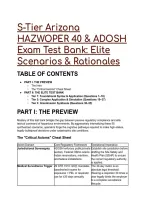
S-Tier Arizona
HAZWOPER 40 & ADOSH
Exam Test Bank: Elite
Scenarios & Rationales
TABLE OF CONTENTS
● PART I: THE PREVIEW
○ The Intro
○ The "Critical Axioms" Cheat Sheet
● PART II: THE ELITE TEST BANK
○ Tier 1: Foundational Syntax & Application (Questions 1–18)
○ Tier 2: Complex Application & Simulation (Questions 19–37)
○ Tier 3: Grandmaster Synthesis (Questions 38–55)
PART I: THE PREVIEW
Mastery of this test bank bridges the gap between passive regulatory compliance and elite
tactical command of hazardous environments. By aggressively internalizing these 55
synthesized scenarios, operators forge the cognitive pathways required to make high-stakes,
legally bulletproof decisions under catastrophic site conditions.
The "Critical Axioms" Cheat Sheet
Axiom Domain Core Regulatory Framework Operational Imperative
Jurisdictional Sovereignty ADOSH enforces public/private
Establish site jurisdiction before
sectors; Federal OSHA retains
drafting the Site Safety and
Indian reservations, maritime,
Health Plan (SSHP) to ensure
and federal installations. the correct regulatory authority
is applied.
Medical Surveillance Trigger 29 CFR 1910.120(f) mandates The 30-day metric is an
baseline/exit exams for absolute legal threshold.
exposures > PEL or respirator Wearing a respirator 30 times a
use for ≥30 days annually. year legally binds the employer
to a complete surveillance
lifecycle.
,Axiom Domain Core Regulatory Framework Operational Imperative
Thermal Hazard Mitigation ADOSH Heat SEP mandates Heat is treated as an
intervention at 80°F: >2 gals enforceable hazard under the
cool water/employee/day, General Duty Clause.
documented written plans, and Hardware (shade/water) must
acclimatization protocols. be supported by software
(written plans).
Atmospheric Detection CGIs require O2 to read Lower Trust the physical limitations of
Limits Explosive Limits (LEL); PIDs the meter over the visual
cannot identify compounds with readings. A 0% LEL in an
an Ionization Potential (IP) > oxygen-deficient trench is a
lamp energy. false negative.
Accumulation Thresholds A.A.C. Title 18 restricts Satellite Exceeding the volume ceiling
Accumulation Areas (SAAs) to instantly triggers the 72-hour
55 gallons of hazardous waste countdown to transfer the
or 1 quart of acute waste. waste to a central accumulation
area.
PART II: THE ELITE TEST BANK
Tier 1: Foundational Syntax & Application
Q1: An environmental remediation firm is contracted to mitigate a legacy uncontrolled
hazardous waste site situated entirely within a federally recognized Native American reservation
in Arizona. Based on the principles of occupational jurisdiction, which regulatory agency
possesses PRIMARY enforcement authority over the workers' health and safety? A) The
Arizona Division of Occupational Safety and Health (ADOSH) B) The Industrial Commission of
Arizona (ICA) C) Federal OSHA D) The Arizona Department of Environmental Quality (ADEQ)
● Answer: C (Federal OSHA)
● Distractor Analysis:
○ A is incorrect: The ADOSH State Plan explicitly excludes jurisdiction over Indian
reservations, mining operations, and federal government employers.
○ B is incorrect: The ICA manages ADOSH, meaning it shares the exact same
territorial and demographic exemptions.
○ D is incorrect: ADEQ enforces environmental standards (Title 18) regarding waste
management, not occupational safety and health enforcement for workers.
The Mentor's Analysis: Jurisdictional boundaries dictate the standard of application. While
ADOSH aggressively governs private and state/local government employees in Arizona,
Federal OSHA retains absolute authority over specific carve-outs, including reservations and
federal installations. Professional Intuition: Always establish geographic and demographic
jurisdiction before drafting an SSHP; the wrong standard invalidates the compliance
architecture.
Q2: Pursuant to 29 CFR 1910.120, a site worker is assigned to an exclusion zone and logs 35
days per year wearing a half-mask air-purifying respirator (APR). Based on the principles of
medical surveillance, which action is MANDATORY? A) An annual physical exam only if the
worker complains of exposure symptoms. B) A fit-test and medical surveillance provided at the
employee's financial expense. C) Baseline, annual, and termination medical examinations
, provided at no cost to the employee. D) A termination examination solely upon retiring from the
industry.
● Answer: C (Baseline, annual, and termination medical examinations provided at no cost to
the employee)
● Distractor Analysis:
○ A is incorrect: Symptomatic development is an independent trigger. The 30-day
respirator rule automatically forces surveillance regardless of subjective symptoms.
○ B is incorrect: The employer is strictly mandated to bear the total financial and
administrative burden of the medical surveillance program.
○ D is incorrect: A termination exam is required, but it is legally invalid if not preceded
by baseline and annual exams to track degradation.
The Mentor's Analysis: The 30-day metric is an absolute operational tripwire. Wearing a
respirator or being exposed at or above the Permissible Exposure Limit (PEL) for 30 days per
year legally binds the employer to a complete, three-phase medical surveillance lifecycle.
Professional Intuition: Medical surveillance is a liability shield: Baseline establishes ground
zero, Annual tracks degradation, and Exit closes the exposure record.
Q3: The Site Safety and Health Supervisor (SSHS) is preparing an initial entry team to
characterize a recently discovered, uncontrolled chemical dumping ground. Atmospheric
concentrations and specific hazards are completely unknown, though severe skin-destructive
properties are not suspected. Based on the principles of PPE selection, which minimum level of
protection is the REQUIRED default? A) Level A B) Level B C) Level C D) Level D
● Answer: B (Level B)
● Distractor Analysis:
○ A is incorrect: Level A (fully encapsulating) is the default if severe skin absorption or
destruction is known or suspected. Absent this suspicion, Level B is the standard
initial entry minimum.
○ C is incorrect: Level C utilizes APRs, which cannot protect against unknown
Immediately Dangerous to Life or Health (IDLH) atmospheres or oxygen deficiency.
○ D is incorrect: Level D offers zero chemical or respiratory protection, representing a
lethal failure of hazard assessment.
The Mentor's Analysis: For initial entry into an unknown environment, respiratory protection is
the paramount concern. Level B provides maximum respiratory defense (positive-pressure
SCBA) while avoiding the thermal and mobility burdens of Level A, provided severe dermal
hazards are not suspected. Professional Intuition: Unknown atmosphere = SCBA. You can
only downgrade to air-purifying respirators once you have quantified the enemy.
Q4: Under the ADOSH Heat Illness Prevention State Emphasis Program (SEP), a crew of six
workers is performing manual labor in 95°F ambient heat. Based on the principles of thermal
hazard mitigation, what is the MINIMUM daily requirement for potable drinking water provision?
A) 6 gallons of water at any ambient temperature. B) 12 gallons of suitably cool water (no
warmer than 80°F). C) 1 liter of fluid per hour, supplied exclusively as electrolyte sports drinks.
D) Access to a municipal tap located two miles away from the excavation.
● Answer: B (12 gallons of suitably cool water (no warmer than 80°F))
● Distractor Analysis:
○ A is incorrect: Water left in the Arizona sun quickly heats to dangerous
temperatures. The SEP explicitly mandates it be "suitably cool".
○ C is incorrect: Electrolytes are beneficial but not regulatory replacements for the
mandated minimum volume of suitably cool potable water.
○ D is incorrect: Water must be highly accessible, usually required to be placed as
HAZWOPER 40 & ADOSH
Exam Test Bank: Elite
Scenarios & Rationales
TABLE OF CONTENTS
● PART I: THE PREVIEW
○ The Intro
○ The "Critical Axioms" Cheat Sheet
● PART II: THE ELITE TEST BANK
○ Tier 1: Foundational Syntax & Application (Questions 1–18)
○ Tier 2: Complex Application & Simulation (Questions 19–37)
○ Tier 3: Grandmaster Synthesis (Questions 38–55)
PART I: THE PREVIEW
Mastery of this test bank bridges the gap between passive regulatory compliance and elite
tactical command of hazardous environments. By aggressively internalizing these 55
synthesized scenarios, operators forge the cognitive pathways required to make high-stakes,
legally bulletproof decisions under catastrophic site conditions.
The "Critical Axioms" Cheat Sheet
Axiom Domain Core Regulatory Framework Operational Imperative
Jurisdictional Sovereignty ADOSH enforces public/private
Establish site jurisdiction before
sectors; Federal OSHA retains
drafting the Site Safety and
Indian reservations, maritime,
Health Plan (SSHP) to ensure
and federal installations. the correct regulatory authority
is applied.
Medical Surveillance Trigger 29 CFR 1910.120(f) mandates The 30-day metric is an
baseline/exit exams for absolute legal threshold.
exposures > PEL or respirator Wearing a respirator 30 times a
use for ≥30 days annually. year legally binds the employer
to a complete surveillance
lifecycle.
,Axiom Domain Core Regulatory Framework Operational Imperative
Thermal Hazard Mitigation ADOSH Heat SEP mandates Heat is treated as an
intervention at 80°F: >2 gals enforceable hazard under the
cool water/employee/day, General Duty Clause.
documented written plans, and Hardware (shade/water) must
acclimatization protocols. be supported by software
(written plans).
Atmospheric Detection CGIs require O2 to read Lower Trust the physical limitations of
Limits Explosive Limits (LEL); PIDs the meter over the visual
cannot identify compounds with readings. A 0% LEL in an
an Ionization Potential (IP) > oxygen-deficient trench is a
lamp energy. false negative.
Accumulation Thresholds A.A.C. Title 18 restricts Satellite Exceeding the volume ceiling
Accumulation Areas (SAAs) to instantly triggers the 72-hour
55 gallons of hazardous waste countdown to transfer the
or 1 quart of acute waste. waste to a central accumulation
area.
PART II: THE ELITE TEST BANK
Tier 1: Foundational Syntax & Application
Q1: An environmental remediation firm is contracted to mitigate a legacy uncontrolled
hazardous waste site situated entirely within a federally recognized Native American reservation
in Arizona. Based on the principles of occupational jurisdiction, which regulatory agency
possesses PRIMARY enforcement authority over the workers' health and safety? A) The
Arizona Division of Occupational Safety and Health (ADOSH) B) The Industrial Commission of
Arizona (ICA) C) Federal OSHA D) The Arizona Department of Environmental Quality (ADEQ)
● Answer: C (Federal OSHA)
● Distractor Analysis:
○ A is incorrect: The ADOSH State Plan explicitly excludes jurisdiction over Indian
reservations, mining operations, and federal government employers.
○ B is incorrect: The ICA manages ADOSH, meaning it shares the exact same
territorial and demographic exemptions.
○ D is incorrect: ADEQ enforces environmental standards (Title 18) regarding waste
management, not occupational safety and health enforcement for workers.
The Mentor's Analysis: Jurisdictional boundaries dictate the standard of application. While
ADOSH aggressively governs private and state/local government employees in Arizona,
Federal OSHA retains absolute authority over specific carve-outs, including reservations and
federal installations. Professional Intuition: Always establish geographic and demographic
jurisdiction before drafting an SSHP; the wrong standard invalidates the compliance
architecture.
Q2: Pursuant to 29 CFR 1910.120, a site worker is assigned to an exclusion zone and logs 35
days per year wearing a half-mask air-purifying respirator (APR). Based on the principles of
medical surveillance, which action is MANDATORY? A) An annual physical exam only if the
worker complains of exposure symptoms. B) A fit-test and medical surveillance provided at the
employee's financial expense. C) Baseline, annual, and termination medical examinations
, provided at no cost to the employee. D) A termination examination solely upon retiring from the
industry.
● Answer: C (Baseline, annual, and termination medical examinations provided at no cost to
the employee)
● Distractor Analysis:
○ A is incorrect: Symptomatic development is an independent trigger. The 30-day
respirator rule automatically forces surveillance regardless of subjective symptoms.
○ B is incorrect: The employer is strictly mandated to bear the total financial and
administrative burden of the medical surveillance program.
○ D is incorrect: A termination exam is required, but it is legally invalid if not preceded
by baseline and annual exams to track degradation.
The Mentor's Analysis: The 30-day metric is an absolute operational tripwire. Wearing a
respirator or being exposed at or above the Permissible Exposure Limit (PEL) for 30 days per
year legally binds the employer to a complete, three-phase medical surveillance lifecycle.
Professional Intuition: Medical surveillance is a liability shield: Baseline establishes ground
zero, Annual tracks degradation, and Exit closes the exposure record.
Q3: The Site Safety and Health Supervisor (SSHS) is preparing an initial entry team to
characterize a recently discovered, uncontrolled chemical dumping ground. Atmospheric
concentrations and specific hazards are completely unknown, though severe skin-destructive
properties are not suspected. Based on the principles of PPE selection, which minimum level of
protection is the REQUIRED default? A) Level A B) Level B C) Level C D) Level D
● Answer: B (Level B)
● Distractor Analysis:
○ A is incorrect: Level A (fully encapsulating) is the default if severe skin absorption or
destruction is known or suspected. Absent this suspicion, Level B is the standard
initial entry minimum.
○ C is incorrect: Level C utilizes APRs, which cannot protect against unknown
Immediately Dangerous to Life or Health (IDLH) atmospheres or oxygen deficiency.
○ D is incorrect: Level D offers zero chemical or respiratory protection, representing a
lethal failure of hazard assessment.
The Mentor's Analysis: For initial entry into an unknown environment, respiratory protection is
the paramount concern. Level B provides maximum respiratory defense (positive-pressure
SCBA) while avoiding the thermal and mobility burdens of Level A, provided severe dermal
hazards are not suspected. Professional Intuition: Unknown atmosphere = SCBA. You can
only downgrade to air-purifying respirators once you have quantified the enemy.
Q4: Under the ADOSH Heat Illness Prevention State Emphasis Program (SEP), a crew of six
workers is performing manual labor in 95°F ambient heat. Based on the principles of thermal
hazard mitigation, what is the MINIMUM daily requirement for potable drinking water provision?
A) 6 gallons of water at any ambient temperature. B) 12 gallons of suitably cool water (no
warmer than 80°F). C) 1 liter of fluid per hour, supplied exclusively as electrolyte sports drinks.
D) Access to a municipal tap located two miles away from the excavation.
● Answer: B (12 gallons of suitably cool water (no warmer than 80°F))
● Distractor Analysis:
○ A is incorrect: Water left in the Arizona sun quickly heats to dangerous
temperatures. The SEP explicitly mandates it be "suitably cool".
○ C is incorrect: Electrolytes are beneficial but not regulatory replacements for the
mandated minimum volume of suitably cool potable water.
○ D is incorrect: Water must be highly accessible, usually required to be placed as