
lOMoARcPSD|64109549
:05:22 AMA&P
10/6/2026,
Final 4:05:22
Exam Study
AMA&P
Guide_removed.pdf)(#UUNDS*(HN
Final Exam Study Guide_removed.pdf)(#UUNDS*(HN
(*OIUJE(**&EHUH(*&OIUEH*&E*&YE(E*E*(*EII&UA&P
(*OIUJE(**&EHUH(*&OIUEH*&E*&YE(E*E*(*EII&UA&P
Final Exam Study Guide_removed.pdf
Final Exam Study Guide_
Final Exam Study Guide
1- Know the levels of organization
Chemical, cellular, tissue, organ, organ system, organism
2- Know the cavities and what belongs in each
Dorsal body cavity–the cranial cavity and the spinal cavity in combination.
Cranial cavity–the space occupied by the brain, enclosed by the skull bones.
Spinal cavity–the space occupied by the spinal cord enclosed by the vertebrae column making up the
backbone. The spinal cavity is continuous with the cranial cavity.
Ventral body cavity–the thoracic cavity, the abdominal cavity, and the pelvic cavity in combination.
Thoracic cavity–the space occupied by the ventral internal organs superior to the diaphragm.
Abdominopelvic cavity–the abdominal cavity and the pelvic cavity in combination.
Abdominal cavity–the space occupied by the ventral internal organs inferior to the diaphragm and superior to
the pelvic cavity.
Pelvic cavity–the space occupied by the ventral internal organs that are bordered by the bones of the pelvic
girdle.
3- What are the needs of the body?
Oxygen, Water, Temperature, Atmospheric pressure, nutrients.
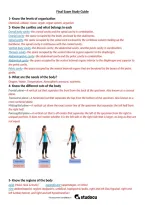
4- Know the different cuts of the body
Frontal plane—A vertical cut that separates the front from the back of the specimen. Also known as a coronal
plane.
Transverse plane—A horizontal cut that separates the top from the bottom of the specimen. Also known as a
cross-sectional plane.
Midsagittal plane—A vertical cut down the exact center line of the specimen that separates the left half from
the right half.
Parasagittal plane—A vertical cut that is off-center that separates the left of the specimen from the right in
unequal portions. It does not matter whether it is the left side or the right side that is larger, as long as they are
not equal.
5- Know the regions of the body
axial (Head, neck & trunk) appendicular (appendages, or limbs)
nine abdominopelvic regions (epigastric, umbilical, hypogastric/pubic, right and left iliac/inguinal, right and
left lumbar/lateral, and right and left hypochondriac)
0/6/2026,
:05:22 AMA&P
10/6/2026,
4:05:22
Final
AMA&P
4:05:22
ExamFinal
Study
AMA&P
Exam Final
StudyExam Downloaded
Guide_removed.pdf)(#UUNDS*(HN by Aplus(*OIUJE(**&EHUH(*&OIUEH*&E*&YE(E*E*(*EII&UA&P
Guide_removed.pdf)(#UUNDS*(HN Grade ()
Study Guide_removed.pdf)(#UUNDS*(HN
(*OIUJE(**&EHUH(*&OIUEH*&E*&YE(E*E*(*EII&UA&P
(*OIUJE(**&EHUH(*&OIUEH*&E*&YE(E*E*(*EII&UA&P
Final ExamFinal
StudyExam
Guide_removed.pdf
Final
StudyExam
Guide_removed.p
Study Guide_
, lOMoARcPSD|64109549
:05:22 AMA&P
10/6/2026,
Final 4:05:22
Exam Study
AMA&P
Guide_removed.pdf)(#UUNDS*(HN
Final Exam Study Guide_removed.pdf)(#UUNDS*(HN
(*OIUJE(**&EHUH(*&OIUEH*&E*&YE(E*E*(*EII&UA&P
(*OIUJE(**&EHUH(*&OIUEH*&E*&YE(E*E*(*EII&UA&P
Final Exam Study Guide_removed.pdf
Final Exam Study Guide_
6- What is anatomical position?
the body is erect, facing forward, feet slightly apart, arms at sides with palms forward.
7- Know positive feedback, negative feedback, and examples of both
conserved by negative feedback (Sweating when too hot, insulin)
& Positive feedback (childbirth, bp)
8- Know the major elements of the body.
*Oxygen (O), *Carbon (C), *Hydrogen (H), *Nitrogen (N), *Sodium (Na), *Magnesium (Mg) *Chloride
(Cl), *Potassium (K), *Calcium (Ca).
9- Know organic vs. inorganic
Inorganic compounds: Do not contain carbon. Water, salts, and many acids and bases.
*Water: The most important and abundant inorganic molecule and makes up 60-80% of the volume of most
living cells.
Organic compounds: Molecules unique to living systems, contain carbon. Carbohydrates, Lipids, Proteins,
Nucleic Acids.
10- Know proteins, nucleic acids.
*Protein: Compose 20-30% of cell mass, cell function. Peptide bonds
-Amino acids (Building blocks of protein), containing an amino group and a carboxyl group. 50 amino acids
-Structure of protein: Primary: linear sequence of amino acids (order)
Secondary: how primary amino acids interact with each other.
Tertiary: how secondary structures interact
Quaternary: how 2 or more different polypeptides interact with each other
-Fibrous proteins- Structural proteins – mechanical support (collagen)
-Globular proteins- Functional proteins - Water soluble, chemically active molecules play critical role in all
biological processes. examples: enzymes, transport, antibodies (immunoglobulins)
*Nucleic Acids: pentose sugar, and a phosphate group, largest molecule in body.
- Five nitrogen bases contribute to nucleotide structure – adenine (A), guanine (G), cytosine (C),
thymine (T), and uracil (U)
Types of nucleic acids – DNA, RNA, ATP
Deoxyribonucleic acid (DNA): Double stranded. Replicates itself before the cell divides, ensuring genetic
continuity
Ribonucleic acid (RNA): Single-stranded molecule found in both the nucleus and the cytoplasm of a cell
Adenosine triphosphate (ATP): Source of immediately usable energy for the cell.
11- Know enzymes and their function.
Enzymes- Create chemical reactions in the body. Speed up the rate of a chemical reaction to help support life.
Functions- These include building muscle, destroying toxins, and breaking down food particles during
digestion.
12- Know mitosis and its stages
Mitosis (M phase): One division forming 2 identical cells (clones), needs 1 parental cell (IPROMATC)
Prophase: Nucleoli disappear, Nuclear envelope fragments, Centriole pairs separate and the mitotic spindle
is formed.
Metaphase: nuclear membrane disintegrates, nucleolus disappears, Chromatin coils into chromosomes,
spindle fibers begin to form between the poles.
Anaphase: chromatids separate when the centromere of each chromosome splits
Telophase: nuclear membrane re-forms, nucleoli reappear, centrioles and spindle fibers disappear. Two new
sets of chromosomes uncoil into chromatin.
Cytokinesis: Two daughter cells are formed containing nucleus identical to the original.
0/6/2026,
:05:22 AMA&P
10/6/2026,
4:05:22
Final
AMA&P
4:05:22
ExamFinal
Study
AMA&P
Exam Final
StudyExam Downloaded
Guide_removed.pdf)(#UUNDS*(HN by Aplus(*OIUJE(**&EHUH(*&OIUEH*&E*&YE(E*E*(*EII&UA&P
Guide_removed.pdf)(#UUNDS*(HN Grade ()
Study Guide_removed.pdf)(#UUNDS*(HN
(*OIUJE(**&EHUH(*&OIUEH*&E*&YE(E*E*(*EII&UA&P
(*OIUJE(**&EHUH(*&OIUEH*&E*&YE(E*E*(*EII&UA&P
Final ExamFinal
StudyExam
Guide_removed.pdf
Final
StudyExam
Guide_removed.p
Study Guide_
:05:22 AMA&P
10/6/2026,
Final 4:05:22
Exam Study
AMA&P
Guide_removed.pdf)(#UUNDS*(HN
Final Exam Study Guide_removed.pdf)(#UUNDS*(HN
(*OIUJE(**&EHUH(*&OIUEH*&E*&YE(E*E*(*EII&UA&P
(*OIUJE(**&EHUH(*&OIUEH*&E*&YE(E*E*(*EII&UA&P
Final Exam Study Guide_removed.pdf
Final Exam Study Guide_
Final Exam Study Guide
1- Know the levels of organization
Chemical, cellular, tissue, organ, organ system, organism
2- Know the cavities and what belongs in each
Dorsal body cavity–the cranial cavity and the spinal cavity in combination.
Cranial cavity–the space occupied by the brain, enclosed by the skull bones.
Spinal cavity–the space occupied by the spinal cord enclosed by the vertebrae column making up the
backbone. The spinal cavity is continuous with the cranial cavity.
Ventral body cavity–the thoracic cavity, the abdominal cavity, and the pelvic cavity in combination.
Thoracic cavity–the space occupied by the ventral internal organs superior to the diaphragm.
Abdominopelvic cavity–the abdominal cavity and the pelvic cavity in combination.
Abdominal cavity–the space occupied by the ventral internal organs inferior to the diaphragm and superior to
the pelvic cavity.
Pelvic cavity–the space occupied by the ventral internal organs that are bordered by the bones of the pelvic
girdle.
3- What are the needs of the body?
Oxygen, Water, Temperature, Atmospheric pressure, nutrients.
4- Know the different cuts of the body
Frontal plane—A vertical cut that separates the front from the back of the specimen. Also known as a coronal
plane.
Transverse plane—A horizontal cut that separates the top from the bottom of the specimen. Also known as a
cross-sectional plane.
Midsagittal plane—A vertical cut down the exact center line of the specimen that separates the left half from
the right half.
Parasagittal plane—A vertical cut that is off-center that separates the left of the specimen from the right in
unequal portions. It does not matter whether it is the left side or the right side that is larger, as long as they are
not equal.
5- Know the regions of the body
axial (Head, neck & trunk) appendicular (appendages, or limbs)
nine abdominopelvic regions (epigastric, umbilical, hypogastric/pubic, right and left iliac/inguinal, right and
left lumbar/lateral, and right and left hypochondriac)
0/6/2026,
:05:22 AMA&P
10/6/2026,
4:05:22
Final
AMA&P
4:05:22
ExamFinal
Study
AMA&P
Exam Final
StudyExam Downloaded
Guide_removed.pdf)(#UUNDS*(HN by Aplus(*OIUJE(**&EHUH(*&OIUEH*&E*&YE(E*E*(*EII&UA&P
Guide_removed.pdf)(#UUNDS*(HN Grade ()
Study Guide_removed.pdf)(#UUNDS*(HN
(*OIUJE(**&EHUH(*&OIUEH*&E*&YE(E*E*(*EII&UA&P
(*OIUJE(**&EHUH(*&OIUEH*&E*&YE(E*E*(*EII&UA&P
Final ExamFinal
StudyExam
Guide_removed.pdf
Final
StudyExam
Guide_removed.p
Study Guide_
, lOMoARcPSD|64109549
:05:22 AMA&P
10/6/2026,
Final 4:05:22
Exam Study
AMA&P
Guide_removed.pdf)(#UUNDS*(HN
Final Exam Study Guide_removed.pdf)(#UUNDS*(HN
(*OIUJE(**&EHUH(*&OIUEH*&E*&YE(E*E*(*EII&UA&P
(*OIUJE(**&EHUH(*&OIUEH*&E*&YE(E*E*(*EII&UA&P
Final Exam Study Guide_removed.pdf
Final Exam Study Guide_
6- What is anatomical position?
the body is erect, facing forward, feet slightly apart, arms at sides with palms forward.
7- Know positive feedback, negative feedback, and examples of both
conserved by negative feedback (Sweating when too hot, insulin)
& Positive feedback (childbirth, bp)
8- Know the major elements of the body.
*Oxygen (O), *Carbon (C), *Hydrogen (H), *Nitrogen (N), *Sodium (Na), *Magnesium (Mg) *Chloride
(Cl), *Potassium (K), *Calcium (Ca).
9- Know organic vs. inorganic
Inorganic compounds: Do not contain carbon. Water, salts, and many acids and bases.
*Water: The most important and abundant inorganic molecule and makes up 60-80% of the volume of most
living cells.
Organic compounds: Molecules unique to living systems, contain carbon. Carbohydrates, Lipids, Proteins,
Nucleic Acids.
10- Know proteins, nucleic acids.
*Protein: Compose 20-30% of cell mass, cell function. Peptide bonds
-Amino acids (Building blocks of protein), containing an amino group and a carboxyl group. 50 amino acids
-Structure of protein: Primary: linear sequence of amino acids (order)
Secondary: how primary amino acids interact with each other.
Tertiary: how secondary structures interact
Quaternary: how 2 or more different polypeptides interact with each other
-Fibrous proteins- Structural proteins – mechanical support (collagen)
-Globular proteins- Functional proteins - Water soluble, chemically active molecules play critical role in all
biological processes. examples: enzymes, transport, antibodies (immunoglobulins)
*Nucleic Acids: pentose sugar, and a phosphate group, largest molecule in body.
- Five nitrogen bases contribute to nucleotide structure – adenine (A), guanine (G), cytosine (C),
thymine (T), and uracil (U)
Types of nucleic acids – DNA, RNA, ATP
Deoxyribonucleic acid (DNA): Double stranded. Replicates itself before the cell divides, ensuring genetic
continuity
Ribonucleic acid (RNA): Single-stranded molecule found in both the nucleus and the cytoplasm of a cell
Adenosine triphosphate (ATP): Source of immediately usable energy for the cell.
11- Know enzymes and their function.
Enzymes- Create chemical reactions in the body. Speed up the rate of a chemical reaction to help support life.
Functions- These include building muscle, destroying toxins, and breaking down food particles during
digestion.
12- Know mitosis and its stages
Mitosis (M phase): One division forming 2 identical cells (clones), needs 1 parental cell (IPROMATC)
Prophase: Nucleoli disappear, Nuclear envelope fragments, Centriole pairs separate and the mitotic spindle
is formed.
Metaphase: nuclear membrane disintegrates, nucleolus disappears, Chromatin coils into chromosomes,
spindle fibers begin to form between the poles.
Anaphase: chromatids separate when the centromere of each chromosome splits
Telophase: nuclear membrane re-forms, nucleoli reappear, centrioles and spindle fibers disappear. Two new
sets of chromosomes uncoil into chromatin.
Cytokinesis: Two daughter cells are formed containing nucleus identical to the original.
0/6/2026,
:05:22 AMA&P
10/6/2026,
4:05:22
Final
AMA&P
4:05:22
ExamFinal
Study
AMA&P
Exam Final
StudyExam Downloaded
Guide_removed.pdf)(#UUNDS*(HN by Aplus(*OIUJE(**&EHUH(*&OIUEH*&E*&YE(E*E*(*EII&UA&P
Guide_removed.pdf)(#UUNDS*(HN Grade ()
Study Guide_removed.pdf)(#UUNDS*(HN
(*OIUJE(**&EHUH(*&OIUEH*&E*&YE(E*E*(*EII&UA&P
(*OIUJE(**&EHUH(*&OIUEH*&E*&YE(E*E*(*EII&UA&P
Final ExamFinal
StudyExam
Guide_removed.pdf
Final
StudyExam
Guide_removed.p
Study Guide_


