
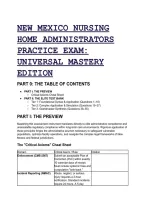
NEW MEXICO NURSING
HOME ADMINISTRATORS
PRACTICE EXAM:
UNIVERSAL MASTERY
EDITION
PART 0: THE TABLE OF CONTENTS
● PART I: THE PREVIEW
○ Critical Axioms Cheat Sheet
● PART II: THE ELITE TEST BANK
○ Tier 1: Foundational Syntax & Application (Questions 1–18)
○ Tier 2: Complex Application & Simulation (Questions 19–37)
○ Tier 3: Grandmaster Synthesis (Questions 38–55)
PART I: THE PREVIEW
Mastering this assessment instrument translates directly to elite administrative competence and
unassailable regulatory compliance within long-term care environments. Rigorous application of
these principles forges the administrative acumen necessary to safeguard vulnerable
populations, optimize facility operations, and navigate the complex legal frameworks of New
Mexico and federal jurisdictions.
The "Critical Axioms" Cheat Sheet
Domain Critical Axiom / Rule Citation
Enforcement (CMS-2567) Submit an acceptable Plan of
Correction (PoC) within exactly
10 calendar days of receipt.
Must include systemic fixes and
a population "look-back."
Incident Reporting (NMAC) Abuse, neglect, or serious
injury requires a 2-hour
notification. Standard incidents
require 24 hours. A 5-day
,Domain Critical Axiom / Rule Citation
written follow-up is mandatory.
Reimbursement (PDPM) Payment relies on 5 case-mix
components (PT, OT, SLP,
NTA, Nursing) + 1 fixed rate.
Therapy minutes no longer
dictate primary reimbursement.
Life Safety (NFPA 101/110) Monthly generator tests require
30 minutes at 30% load.
Corridors must not store idle
equipment over 30 minutes.
Water temps must not exceed
120°F.
NHA Licensure (NMAC 16.13) Initial licensure requires a
1,000-hour AIT program.
Biennial renewal demands 24
CEU hours (maximum 6-hour
carryover permitted).
PART II: THE ELITE TEST BANK
Tier 1 - Foundational Syntax & Application
Q1: An applicant is seeking initial licensure as a Nursing Home Administrator in New Mexico.
Based on the principles of NMAC 16.13, which action is a MANDATORY prerequisite prior to
licensure? A) Completion of a 500-hour Administrator-in-Training (AIT) program. B)
Accumulation of 24 contact hours of continuing education. C) Proof of completion of at least
1,000 hours in a board-approved AIT program. D) A master's degree in healthcare
administration or a related field.
● Answer: C (Proof of completion of at least 1,000 hours in a board-approved AIT program.)
● Distractor Analysis:
○ A is incorrect: The AIT requirement in New Mexico mandates 1,000 hours, not 500
hours, under a NAB-certified preceptor.
○ B is incorrect: The 24 contact hours of continuing education are required for license
renewal, not initial licensure.
○ D is incorrect: A bachelor's degree is the minimum educational requirement in New
Mexico.
The Mentor's Analysis: Establishing baseline operational competency requires extensive,
supervised immersion in the facility environment. When facing licensure verification, the
immediate priority is confirming the 1,000-hour practicum. By utilizing strict regulatory review,
you bypass the common trap of confusing renewal standards with initial qualifications.
Professional Intuition: Always verify the 1,000-hour AIT threshold for new administrators to
ensure foundational compliance.
Q2: A licensed Nursing Home Administrator is preparing for their biennial license renewal in
New Mexico. Based on the principles of NMAC 16.13.13, what is the EXACT continuing
education requirement? A) 48 contact hours every two years, with no carryover permitted. B) 24
contact hours accrued within the 12 months immediately preceding expiration. C) 30 contact
hours every two years, matching the state's registered nursing requirements. D) 24 contact
, hours, of which up to 6 hours may be carried over to the next period.
● Answer: D (24 contact hours, of which up to 6 hours may be carried over to the next
period.)
● Distractor Analysis:
○ A is incorrect: The requirement is 24 hours, not 48, and carryover is explicitly
permitted .
○ B is incorrect: The hours must be accrued over the renewal period, but a 6-hour
carryover is permitted.
○ C is incorrect: Thirty hours is the requirement for New Mexico RNs, not NHAs.
The Mentor's Analysis: Maintaining active administrative licensure requires precise tracking of
educational credits. When facing biennial renewal, the immediate priority is validating the
24-hour minimum. By utilizing the 6-hour carryover allowance, you bypass the common trap of
losing surplus educational investments. Professional Intuition: NHA continuing education is 24
hours per cycle; leverage the 6-hour carryover strategically.
Q3: A facility must comply with structural Life Safety Code mandates. Based on the principles of
NFPA 101, what is the MINIMUM allowable square footage for a multi-resident bedroom? A)
120 square feet per bed. B) 100 square feet per bed. C) 80 square feet per bed. D) 60 square
feet per bed.
● Answer: C (80 square feet per bed.)
● Distractor Analysis:
○ A is incorrect: 120 sq ft is occasionally referenced for specialized rooms or specific
state guidelines, but the federal/NFPA baseline for multi-bed is 80 sq ft.
○ B is incorrect: 100 square feet is the minimum requirement for a single-resident
room.
○ D is incorrect: 60 square feet is grossly insufficient and violates spacing guidelines
for nursing facilities.
The Mentor's Analysis: Environmental quality directly impacts resident dignity and safety. When
facing room capacity audits, the immediate priority is ensuring adequate physical space for
mobility and care. By utilizing the 80 square feet per bed metric for shared rooms, you bypass
the common trap of overcrowding and immediate LSC citations. Professional Intuition:
Multi-resident rooms mandate 80 square feet per bed; single rooms mandate 100 square
feet.
Q4: A resident in a New Mexico skilled nursing facility sustains a serious bodily injury following
an altercation with another resident. Based on the principles of the Incident Management
Bureau (IMB), what is the MAXIMUM timeframe allowed for the initial report? A) 24 hours from
the time of discovery. B) 2 hours from the time of the incident. C) 5 calendar days via a written
summary. D) By the end of the next administrative business day.
● Answer: B (2 hours from the time of the incident.)
● Distractor Analysis:
○ A is incorrect: 24 hours is for standard incidents, but cases involving abuse or
serious bodily injury require reporting no later than 2 hours.
○ C is incorrect: The 5-day timeframe applies to the follow-up investigation report, not
the initial notification.
○ D is incorrect: Reporting deadlines are measured in absolute hours, regardless of
business days.
The Mentor's Analysis: Protecting vulnerable adults requires immediate intervention and
transparency. When facing serious bodily injury, the immediate priority is securing the resident
and notifying the state within 2 hours. By utilizing the immediate-reporting protocol, you bypass
HOME ADMINISTRATORS
PRACTICE EXAM:
UNIVERSAL MASTERY
EDITION
PART 0: THE TABLE OF CONTENTS
● PART I: THE PREVIEW
○ Critical Axioms Cheat Sheet
● PART II: THE ELITE TEST BANK
○ Tier 1: Foundational Syntax & Application (Questions 1–18)
○ Tier 2: Complex Application & Simulation (Questions 19–37)
○ Tier 3: Grandmaster Synthesis (Questions 38–55)
PART I: THE PREVIEW
Mastering this assessment instrument translates directly to elite administrative competence and
unassailable regulatory compliance within long-term care environments. Rigorous application of
these principles forges the administrative acumen necessary to safeguard vulnerable
populations, optimize facility operations, and navigate the complex legal frameworks of New
Mexico and federal jurisdictions.
The "Critical Axioms" Cheat Sheet
Domain Critical Axiom / Rule Citation
Enforcement (CMS-2567) Submit an acceptable Plan of
Correction (PoC) within exactly
10 calendar days of receipt.
Must include systemic fixes and
a population "look-back."
Incident Reporting (NMAC) Abuse, neglect, or serious
injury requires a 2-hour
notification. Standard incidents
require 24 hours. A 5-day
,Domain Critical Axiom / Rule Citation
written follow-up is mandatory.
Reimbursement (PDPM) Payment relies on 5 case-mix
components (PT, OT, SLP,
NTA, Nursing) + 1 fixed rate.
Therapy minutes no longer
dictate primary reimbursement.
Life Safety (NFPA 101/110) Monthly generator tests require
30 minutes at 30% load.
Corridors must not store idle
equipment over 30 minutes.
Water temps must not exceed
120°F.
NHA Licensure (NMAC 16.13) Initial licensure requires a
1,000-hour AIT program.
Biennial renewal demands 24
CEU hours (maximum 6-hour
carryover permitted).
PART II: THE ELITE TEST BANK
Tier 1 - Foundational Syntax & Application
Q1: An applicant is seeking initial licensure as a Nursing Home Administrator in New Mexico.
Based on the principles of NMAC 16.13, which action is a MANDATORY prerequisite prior to
licensure? A) Completion of a 500-hour Administrator-in-Training (AIT) program. B)
Accumulation of 24 contact hours of continuing education. C) Proof of completion of at least
1,000 hours in a board-approved AIT program. D) A master's degree in healthcare
administration or a related field.
● Answer: C (Proof of completion of at least 1,000 hours in a board-approved AIT program.)
● Distractor Analysis:
○ A is incorrect: The AIT requirement in New Mexico mandates 1,000 hours, not 500
hours, under a NAB-certified preceptor.
○ B is incorrect: The 24 contact hours of continuing education are required for license
renewal, not initial licensure.
○ D is incorrect: A bachelor's degree is the minimum educational requirement in New
Mexico.
The Mentor's Analysis: Establishing baseline operational competency requires extensive,
supervised immersion in the facility environment. When facing licensure verification, the
immediate priority is confirming the 1,000-hour practicum. By utilizing strict regulatory review,
you bypass the common trap of confusing renewal standards with initial qualifications.
Professional Intuition: Always verify the 1,000-hour AIT threshold for new administrators to
ensure foundational compliance.
Q2: A licensed Nursing Home Administrator is preparing for their biennial license renewal in
New Mexico. Based on the principles of NMAC 16.13.13, what is the EXACT continuing
education requirement? A) 48 contact hours every two years, with no carryover permitted. B) 24
contact hours accrued within the 12 months immediately preceding expiration. C) 30 contact
hours every two years, matching the state's registered nursing requirements. D) 24 contact
, hours, of which up to 6 hours may be carried over to the next period.
● Answer: D (24 contact hours, of which up to 6 hours may be carried over to the next
period.)
● Distractor Analysis:
○ A is incorrect: The requirement is 24 hours, not 48, and carryover is explicitly
permitted .
○ B is incorrect: The hours must be accrued over the renewal period, but a 6-hour
carryover is permitted.
○ C is incorrect: Thirty hours is the requirement for New Mexico RNs, not NHAs.
The Mentor's Analysis: Maintaining active administrative licensure requires precise tracking of
educational credits. When facing biennial renewal, the immediate priority is validating the
24-hour minimum. By utilizing the 6-hour carryover allowance, you bypass the common trap of
losing surplus educational investments. Professional Intuition: NHA continuing education is 24
hours per cycle; leverage the 6-hour carryover strategically.
Q3: A facility must comply with structural Life Safety Code mandates. Based on the principles of
NFPA 101, what is the MINIMUM allowable square footage for a multi-resident bedroom? A)
120 square feet per bed. B) 100 square feet per bed. C) 80 square feet per bed. D) 60 square
feet per bed.
● Answer: C (80 square feet per bed.)
● Distractor Analysis:
○ A is incorrect: 120 sq ft is occasionally referenced for specialized rooms or specific
state guidelines, but the federal/NFPA baseline for multi-bed is 80 sq ft.
○ B is incorrect: 100 square feet is the minimum requirement for a single-resident
room.
○ D is incorrect: 60 square feet is grossly insufficient and violates spacing guidelines
for nursing facilities.
The Mentor's Analysis: Environmental quality directly impacts resident dignity and safety. When
facing room capacity audits, the immediate priority is ensuring adequate physical space for
mobility and care. By utilizing the 80 square feet per bed metric for shared rooms, you bypass
the common trap of overcrowding and immediate LSC citations. Professional Intuition:
Multi-resident rooms mandate 80 square feet per bed; single rooms mandate 100 square
feet.
Q4: A resident in a New Mexico skilled nursing facility sustains a serious bodily injury following
an altercation with another resident. Based on the principles of the Incident Management
Bureau (IMB), what is the MAXIMUM timeframe allowed for the initial report? A) 24 hours from
the time of discovery. B) 2 hours from the time of the incident. C) 5 calendar days via a written
summary. D) By the end of the next administrative business day.
● Answer: B (2 hours from the time of the incident.)
● Distractor Analysis:
○ A is incorrect: 24 hours is for standard incidents, but cases involving abuse or
serious bodily injury require reporting no later than 2 hours.
○ C is incorrect: The 5-day timeframe applies to the follow-up investigation report, not
the initial notification.
○ D is incorrect: Reporting deadlines are measured in absolute hours, regardless of
business days.
The Mentor's Analysis: Protecting vulnerable adults requires immediate intervention and
transparency. When facing serious bodily injury, the immediate priority is securing the resident
and notifying the state within 2 hours. By utilizing the immediate-reporting protocol, you bypass


