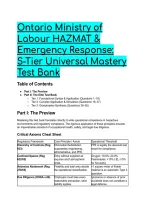
Ontario Ministry of
Labour HAZMAT &
Emergency Response:
S-Tier Universal Mastery
Test Bank
Table of Contents
● Part I: The Preview
● Part II: The Elite Test Bank
○ Tier 1: Foundational Syntax & Application (Questions 1–18)
○ Tier 2: Complex Application & Simulation (Questions 19–37)
○ Tier 3: Grandmaster Synthesis (Questions 38–55)
Part I: The Preview
Mastering this test bank translates directly to elite operational competence in hazardous
environments and regulatory compliance. The rigorous application of these principles ensures
an impenetrable standard of occupational health, safety, and legal due diligence.
Critical Axioms Cheat Sheet
Regulatory Framework Core Principle / Axiom Operational Threshold
Hierarchy of Controls (Reg Elimination/Substitution PPE is legally the absolute last
833) supersedes engineering, resort for compliance.
administrative, and PPE.
Confined Spaces (Reg Entry without supplied air Oxygen: 19.5%–23.0%.
632/05) requires strict atmospheric Flammables: <10% LEL (<5%
limits. for hot work).
Asbestos Abatement (Reg Friability and total area dictate >1 square meter of friable
278/05) the operational classification. material is an automatic Type 3
operation.
Due Diligence (OHSA s.66) Employers must take every Ignorance or absence of prior
reasonable precaution; strict accidents does not constitute a
liability applies. legal defense.
,Regulatory Framework Core Principle / Axiom Operational Threshold
Spill Reporting (EPA Part X) Any discharge causing adverse Immediate notification is
effects must be reported to the non-negotiable and transcends
Spills Action Centre. internal protocols.
ERAP (TDG Act) High-risk dangerous goods Implementation must be rapid,
require specialized industry providing 24/7
emergency response. technical/physical response.
Part II: The Elite Test Bank
Tier 1: Foundational Syntax & Application
Q1: An industrial maintenance team plans to enter a partially enclosed tank to repair a valve.
The tank is not designed for continuous human occupancy and contained toluene. Based on the
principles of Ontario Regulation 632/05 (Confined Spaces), which atmospheric oxygen
concentration is the ONLY acceptable baseline for entry without supplied-air respirators? A)
18.5% B) 19.0% C) 20.5% D) 23.5%
● Answer: C (20.5%)
● Distractor Analysis:
○ A is incorrect: This falls below the mandatory 19.5% threshold, constituting an
oxygen-deficient atmosphere leading to asphyxiation.
○ B is incorrect: At 19.0%, the atmosphere remains legally oxygen-deficient according
to strict Ontario standards.
○ D is incorrect: A level of 23.5% exceeds the 23.0% maximum threshold, creating an
oxygen-enriched environment with severe explosive risks.
The Mentor's Analysis: The foundational limits for oxygen in a confined space are rigidly set
between 19.5% and 23.0% by volume. When facing atmospheric hazards, the immediate
priority is utilizing calibrated direct-reading instruments. By verifying the exact percentage, you
bypass the common trap of assuming a well-ventilated space is inherently safe. Professional
Intuition: Never enter an enclosed space without verifying oxygen levels sit strictly
between 19.5% and 23.0%.
Q2: A chemical manufacturing facility identifies a high airborne concentration of a toxic solvent.
Based on the principles of Ontario Regulation 833, which action is the FIRST legally mandated
priority? A) Implementing local exhaust ventilation systems B) Providing workers with full-face
respirators C) Rotating worker schedules to limit exposure time D) Substituting the solvent with
a less hazardous chemical
● Answer: D (Substituting the solvent with a less hazardous chemical)
● Distractor Analysis:
○ A is incorrect: Engineering controls like ventilation are secondary to elimination or
substitution.
○ B is incorrect: Personal Protective Equipment (PPE) is the absolute lowest tier in
the hierarchy of controls.
○ C is incorrect: Administrative controls manage exposure duration but do not
address the hazard at its source.
The Mentor's Analysis: Ontario Regulation 833 strictly dictates the hierarchy of hazard
mitigation. When facing hazardous exposures, the immediate priority is applying the Hierarchy
of Controls. By utilizing substitution, you bypass the novice error of immediately relying on
fallible PPE. Professional Intuition: The law demands elimination or substitution before
, resorting to engineering, administrative, or PPE controls.
Q3: A worker is tasked with handling a newly imported chemical compound but has not received
training on its specific hazards. Based on the principles of the Occupational Health and Safety
Act (OHSA), which fundamental right is the MOST APPROPRIATE to invoke? A) The right to
stop work as a certified JHSC member B) The right to know C) The right to environmental
remediation D) The right to independent medical surveillance
● Answer: B (The right to know)
● Distractor Analysis:
○ A is incorrect: The right to stop work applies to certified JHSC members facing
imminent danger, not the general right to hazard information.
○ C is incorrect: Environmental remediation is governed by the Environmental
Protection Act, not basic worker rights.
○ D is incorrect: Medical surveillance is mandated under designated substances
regulations, not universally for all unknown products.
The Mentor's Analysis: The OHSA guarantees three fundamental rights: to know, to participate,
and to refuse. When facing unknown hazardous materials, the immediate priority is exercising
the Right to Know. By utilizing WHMIS data and mandatory training, you bypass the trap of
handling unidentified agents. Professional Intuition: A worker's Right to Know is legally
actualized through WHMIS labels, Safety Data Sheets (SDS), and comprehensive
employer instruction.
Q4: A worker is critically injured in a manufacturing plant due to a chemical pipe rupture. Based
on the principles of OHSA Section 51, who MUST receive the FIRST immediate notice of this
incident? A) The Spills Action Centre, the local municipality, and the fire department B) The
Ministry of Labour Inspector, the JHSC, and the trade union C) The Ministry of the Environment,
the employer's legal counsel, and the WSIB D) The Ministry of Labour, Immigration, Training
and Skills Development (MLITSD), the JHSC, and the trade union
● Answer: D (The Ministry of Labour, Immigration, Training and Skills Development
(MLITSD), the JHSC, and the trade union)
● Distractor Analysis:
○ A is incorrect: The Spills Action Centre must be notified for environmental spills, but
OHSA critical injury reporting specifically demands MLITSD notification.
○ B is incorrect: Notice goes to a Director at the MLITSD via the central system, not
directly to an individual inspector.
○ C is incorrect: While WSIB requires a Form 7, the immediate statutory notice for a
critical injury under s.51 must go to the MLITSD, JHSC, and union.
The Mentor's Analysis: Section 51 of the OHSA strictly outlines fatality and critical injury
reporting. When facing a critical injury, the immediate priority is securing the scene and initiating
immediate statutory reporting. By utilizing the formal MLITSD notification channels, you bypass
the trap of obstruction or delayed compliance. Professional Intuition: Critical injuries demand
immediate, documented notification to the MLITSD, JHSC, and trade union, followed by a
written report within 48 hours.
Q5: A contractor needs to remove a 5-square-meter section of intact asbestos-containing vinyl
floor tiles using non-powered hand tools and wetting agents. Based on the principles of Ontario
Regulation 278/05, which classification is the CORRECT designation for this operation? A) Type
1 Operation B) Type 2 Operation C) Type 3 Operation D) Designated Substance Operation
● Answer: A (Type 1 Operation)
● Distractor Analysis:
○ B is incorrect: Type 2 applies to breaking non-friable materials with un-shrouded
Labour HAZMAT &
Emergency Response:
S-Tier Universal Mastery
Test Bank
Table of Contents
● Part I: The Preview
● Part II: The Elite Test Bank
○ Tier 1: Foundational Syntax & Application (Questions 1–18)
○ Tier 2: Complex Application & Simulation (Questions 19–37)
○ Tier 3: Grandmaster Synthesis (Questions 38–55)
Part I: The Preview
Mastering this test bank translates directly to elite operational competence in hazardous
environments and regulatory compliance. The rigorous application of these principles ensures
an impenetrable standard of occupational health, safety, and legal due diligence.
Critical Axioms Cheat Sheet
Regulatory Framework Core Principle / Axiom Operational Threshold
Hierarchy of Controls (Reg Elimination/Substitution PPE is legally the absolute last
833) supersedes engineering, resort for compliance.
administrative, and PPE.
Confined Spaces (Reg Entry without supplied air Oxygen: 19.5%–23.0%.
632/05) requires strict atmospheric Flammables: <10% LEL (<5%
limits. for hot work).
Asbestos Abatement (Reg Friability and total area dictate >1 square meter of friable
278/05) the operational classification. material is an automatic Type 3
operation.
Due Diligence (OHSA s.66) Employers must take every Ignorance or absence of prior
reasonable precaution; strict accidents does not constitute a
liability applies. legal defense.
,Regulatory Framework Core Principle / Axiom Operational Threshold
Spill Reporting (EPA Part X) Any discharge causing adverse Immediate notification is
effects must be reported to the non-negotiable and transcends
Spills Action Centre. internal protocols.
ERAP (TDG Act) High-risk dangerous goods Implementation must be rapid,
require specialized industry providing 24/7
emergency response. technical/physical response.
Part II: The Elite Test Bank
Tier 1: Foundational Syntax & Application
Q1: An industrial maintenance team plans to enter a partially enclosed tank to repair a valve.
The tank is not designed for continuous human occupancy and contained toluene. Based on the
principles of Ontario Regulation 632/05 (Confined Spaces), which atmospheric oxygen
concentration is the ONLY acceptable baseline for entry without supplied-air respirators? A)
18.5% B) 19.0% C) 20.5% D) 23.5%
● Answer: C (20.5%)
● Distractor Analysis:
○ A is incorrect: This falls below the mandatory 19.5% threshold, constituting an
oxygen-deficient atmosphere leading to asphyxiation.
○ B is incorrect: At 19.0%, the atmosphere remains legally oxygen-deficient according
to strict Ontario standards.
○ D is incorrect: A level of 23.5% exceeds the 23.0% maximum threshold, creating an
oxygen-enriched environment with severe explosive risks.
The Mentor's Analysis: The foundational limits for oxygen in a confined space are rigidly set
between 19.5% and 23.0% by volume. When facing atmospheric hazards, the immediate
priority is utilizing calibrated direct-reading instruments. By verifying the exact percentage, you
bypass the common trap of assuming a well-ventilated space is inherently safe. Professional
Intuition: Never enter an enclosed space without verifying oxygen levels sit strictly
between 19.5% and 23.0%.
Q2: A chemical manufacturing facility identifies a high airborne concentration of a toxic solvent.
Based on the principles of Ontario Regulation 833, which action is the FIRST legally mandated
priority? A) Implementing local exhaust ventilation systems B) Providing workers with full-face
respirators C) Rotating worker schedules to limit exposure time D) Substituting the solvent with
a less hazardous chemical
● Answer: D (Substituting the solvent with a less hazardous chemical)
● Distractor Analysis:
○ A is incorrect: Engineering controls like ventilation are secondary to elimination or
substitution.
○ B is incorrect: Personal Protective Equipment (PPE) is the absolute lowest tier in
the hierarchy of controls.
○ C is incorrect: Administrative controls manage exposure duration but do not
address the hazard at its source.
The Mentor's Analysis: Ontario Regulation 833 strictly dictates the hierarchy of hazard
mitigation. When facing hazardous exposures, the immediate priority is applying the Hierarchy
of Controls. By utilizing substitution, you bypass the novice error of immediately relying on
fallible PPE. Professional Intuition: The law demands elimination or substitution before
, resorting to engineering, administrative, or PPE controls.
Q3: A worker is tasked with handling a newly imported chemical compound but has not received
training on its specific hazards. Based on the principles of the Occupational Health and Safety
Act (OHSA), which fundamental right is the MOST APPROPRIATE to invoke? A) The right to
stop work as a certified JHSC member B) The right to know C) The right to environmental
remediation D) The right to independent medical surveillance
● Answer: B (The right to know)
● Distractor Analysis:
○ A is incorrect: The right to stop work applies to certified JHSC members facing
imminent danger, not the general right to hazard information.
○ C is incorrect: Environmental remediation is governed by the Environmental
Protection Act, not basic worker rights.
○ D is incorrect: Medical surveillance is mandated under designated substances
regulations, not universally for all unknown products.
The Mentor's Analysis: The OHSA guarantees three fundamental rights: to know, to participate,
and to refuse. When facing unknown hazardous materials, the immediate priority is exercising
the Right to Know. By utilizing WHMIS data and mandatory training, you bypass the trap of
handling unidentified agents. Professional Intuition: A worker's Right to Know is legally
actualized through WHMIS labels, Safety Data Sheets (SDS), and comprehensive
employer instruction.
Q4: A worker is critically injured in a manufacturing plant due to a chemical pipe rupture. Based
on the principles of OHSA Section 51, who MUST receive the FIRST immediate notice of this
incident? A) The Spills Action Centre, the local municipality, and the fire department B) The
Ministry of Labour Inspector, the JHSC, and the trade union C) The Ministry of the Environment,
the employer's legal counsel, and the WSIB D) The Ministry of Labour, Immigration, Training
and Skills Development (MLITSD), the JHSC, and the trade union
● Answer: D (The Ministry of Labour, Immigration, Training and Skills Development
(MLITSD), the JHSC, and the trade union)
● Distractor Analysis:
○ A is incorrect: The Spills Action Centre must be notified for environmental spills, but
OHSA critical injury reporting specifically demands MLITSD notification.
○ B is incorrect: Notice goes to a Director at the MLITSD via the central system, not
directly to an individual inspector.
○ C is incorrect: While WSIB requires a Form 7, the immediate statutory notice for a
critical injury under s.51 must go to the MLITSD, JHSC, and union.
The Mentor's Analysis: Section 51 of the OHSA strictly outlines fatality and critical injury
reporting. When facing a critical injury, the immediate priority is securing the scene and initiating
immediate statutory reporting. By utilizing the formal MLITSD notification channels, you bypass
the trap of obstruction or delayed compliance. Professional Intuition: Critical injuries demand
immediate, documented notification to the MLITSD, JHSC, and trade union, followed by a
written report within 48 hours.
Q5: A contractor needs to remove a 5-square-meter section of intact asbestos-containing vinyl
floor tiles using non-powered hand tools and wetting agents. Based on the principles of Ontario
Regulation 278/05, which classification is the CORRECT designation for this operation? A) Type
1 Operation B) Type 2 Operation C) Type 3 Operation D) Designated Substance Operation
● Answer: A (Type 1 Operation)
● Distractor Analysis:
○ B is incorrect: Type 2 applies to breaking non-friable materials with un-shrouded