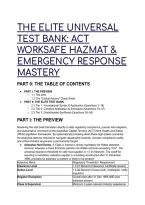
THE ELITE UNIVERSAL
TEST BANK: ACT
WORKSAFE HAZMAT &
EMERGENCY RESPONSE
MASTERY
PART 0: THE TABLE OF CONTENTS
● PART I: THE PREVIEW
○ 1.1 The Intro
○ 1.2 The "Critical Axioms" Cheat Sheet
● PART II: THE ELITE TEST BANK
○ 2.1 Tier 1: Foundational Syntax & Application (Questions 1–18)
○ 2.2 Tier 2: Complex Application & Simulation (Questions 19–37)
○ 2.3 Tier 3: Grandmaster Synthesis (Questions 38–55)
PART I: THE PREVIEW
Mastering this test bank translates directly to elite regulatory compliance, precise risk mitigation,
and authoritative command of the Australian Capital Territory (ACT) Work Health and Safety
(WHS) legislative frameworks. By systematically breaking down these high-stakes scenarios,
the analytical stamina required to navigate catastrophic hazards, complex compliance audits,
and critical incident responses is permanently forged.
● Asbestos Hard Decks: A Class A license is strictly mandatory for friable asbestos
removal, whereas a Class B license permits non-friable removal exceeding 10m². The
universal clearance threshold for safe reoccupation is < 0.01 fibres/ml. The cutoff for
requiring a mandatory asbestos register is a building constructed after 31 December
1989, provided no asbestos is present or likely to be present.
Asbestos Metric Regulatory Threshold / Requirement
Clearance Level < 0.01 fibres/ml (Clearance Certificate issued)
Action Level > 0.02 fibres/ml (Cease work, investigate, notify
regulator)
Register Exemption Constructed after 31 Dec 1989 AND zero
asbestos present
Class A Supervisor Minimum 3 years relevant industry experience
, ● Enforcement Hierarchy: Improvement notices mandate the remediation of a compliance
breach by a specified deadline, whereas Prohibition notices demand the immediate
cessation of a high-risk activity presenting a serious threat. Enforceable undertakings
operate as legally binding alternatives to prosecution but are strictly prohibited for
Category 1 offences involving reckless conduct.
● Storage & Spill Axioms (AS 1940:2017): Secondary containment (bunding) for
flammable and combustible liquids must accommodate 100% of the capacity of the
largest package plus 25% of the total storage capacity. The safe fill level is legally capped
at 95% of tank capacity, requiring high-level alarms for tanks exceeding 25,000 L.
Emergency Equipment AS 1940:2017 Proximity Mandate
Spill Response Kit Positioned within 15 meters of the tank fill point
or hazard
Safety Shower/Eyewash Accessible within 10 seconds of unhindered
travel (approx. 55 feet)
● HAZMAT Zoning: The Hot zone completely isolates the contaminant and hazard; the
Warm zone functions exclusively as the contamination reduction and decontamination
corridor; the Cold zone safely houses command, medical triage, and support
infrastructure.
● Health Monitoring (Schedule 14): A person conducting a business or undertaking
(PCBU) bears the financial responsibility for statutory medical examinations. Health
records for exposure to hazardous chemicals must be retained confidentially for 30 years,
whereas asbestos exposure records mandate a 40-year retention period.
PART II: THE ELITE TEST BANK
Tier 1: Foundational Syntax & Application
Q1: An ACT-based commercial facility constructed in 1995 is undergoing a compliance audit.
The site manager asserts that an asbestos register is not required due to the building's age.
Based on the principles of the ACT Work Health and Safety Regulation 2011, which conclusion
is the MOST APPROPRIATE? A) The manager is correct, as buildings constructed after 31
December 1989 are universally exempt from maintaining a register. B) The manager is
incorrect; all commercial buildings, regardless of age, must maintain an active asbestos register.
C) The manager is correct only if there are reasonable grounds to believe that no asbestos or
asbestos-containing material is present at the workplace. D) The manager is incorrect, as the
national ban on asbestos did not take effect until 31 December 2003, mandating registers for all
buildings built prior to 2004.
● Answer: C (The manager is correct only if there are reasonable grounds to believe that no
asbestos or asbestos-containing material is present at the workplace.)
● Distractor Analysis:
○ A is incorrect: The 1989 cutoff applies strictly conditionally; if asbestos is identified
or likely to be present, a register remains mandatory regardless of the construction
date.
○ B is incorrect: The legislation expressly exempts buildings built after 31 December
1989 provided no asbestos is present.
○ D is incorrect: While the total national prohibition occurred on 31 December 2003,
the specific threshold for the register exemption utilizes the 1989 construction date.
, The Mentor's Analysis: The 1989 date acts as a legislative pivot point, not an absolute shield.
When facing asbestos register compliance, the immediate priority is confirming both the
construction date and the absolute absence of the material. By utilizing the reasonable grounds
provision, the common trap of assuming a simple date threshold guarantees exemption is
successfully bypassed. Professional Intuition: An asbestos register exemption requires both
a post-1989 construction date AND the verified absence of asbestos.
Q2: A licensed removalist is completing an abatement project. Prior to reoccupation, air
monitoring is conducted. Based on the principles of asbestos clearance protocols, which
airborne fibre concentration level represents the maximum allowable limit to issue a clearance
certificate? A) < 0.05 fibres/ml B) < 0.02 fibres/ml C) < 0.01 fibres/ml D) < 0.10 fibres/ml
● Answer: C (< 0.01 fibres/ml)
● Distractor Analysis:
○ A is incorrect: This exceeds the acceptable clearance limit and represents a
dangerous trace level preventing legal reoccupation.
○ B is incorrect: An action level of 0.02 fibres/ml requires work to stop and
investigations to commence, but it is never the clearance threshold.
○ D is incorrect: This mirrors historical time-weighted average exposure standards,
not the clearance threshold for safe reoccupation.
The Mentor's Analysis: Safe reoccupation demands rigorous, quantitative air quality metrics.
When facing clearance certification, the immediate priority is verifying fibre counts fall below the
lowest reliable detection threshold. By utilizing the 0.01 fibres/ml standard, the common trap of
confusing the action level with the clearance level is successfully bypassed. Professional
Intuition: The ultimate hard deck for asbestos clearance is always < 0.01 fibres/ml.
Q3: A WorkSafe ACT inspector discovers an immediate and severe risk to worker safety due to
unsupported trenching. Based on the principles of the WHS Act 2011, which enforcement action
is the FIRST appropriate response? A) Issue an improvement notice with a 24-hour compliance
window. B) Negotiate an enforceable undertaking with the PCBU. C) Issue a prohibition notice
to immediately halt the trenching activity. D) Issue an infringement notice directly to the site
supervisor.
● Answer: C (Issue a prohibition notice to immediately halt the trenching activity.)
● Distractor Analysis:
○ A is incorrect: Improvement notices are reserved for breaches that do not pose an
immediate and serious risk to life or health.
○ B is incorrect: Undertakings are long-term, legally binding alternatives to
prosecution, not immediate tactical responses.
○ D is incorrect: Infringement notices act as on-the-spot fines for identifiable offences
but do not legally compel the cessation of dangerous work.
The Mentor's Analysis: Immediate threats require immediate cessation commands. When facing
severe, imminent risks, the immediate priority is halting the activity entirely. By utilizing the
prohibition notice, the common trap of relying on administrative fines while a lethal hazard
remains active is successfully bypassed. Professional Intuition: Prohibition notices are the
exclusive regulatory tool designed to instantly freeze operations presenting a serious
risk.
Q4: A PCBU is storing 1,500 L of Category 3 Flammable Liquids in a single compound.
According to AS 1940:2017, the secondary containment (bunding) must be calculated precisely.
Based on the principles of spill retention capacity, what is the REQUIRED minimum capacity if
the largest single package is 1,000 L? A) 1,100 L B) 1,250 L C) 1,375 L D) 1,500 L
● Answer: C (1,375 L)
TEST BANK: ACT
WORKSAFE HAZMAT &
EMERGENCY RESPONSE
MASTERY
PART 0: THE TABLE OF CONTENTS
● PART I: THE PREVIEW
○ 1.1 The Intro
○ 1.2 The "Critical Axioms" Cheat Sheet
● PART II: THE ELITE TEST BANK
○ 2.1 Tier 1: Foundational Syntax & Application (Questions 1–18)
○ 2.2 Tier 2: Complex Application & Simulation (Questions 19–37)
○ 2.3 Tier 3: Grandmaster Synthesis (Questions 38–55)
PART I: THE PREVIEW
Mastering this test bank translates directly to elite regulatory compliance, precise risk mitigation,
and authoritative command of the Australian Capital Territory (ACT) Work Health and Safety
(WHS) legislative frameworks. By systematically breaking down these high-stakes scenarios,
the analytical stamina required to navigate catastrophic hazards, complex compliance audits,
and critical incident responses is permanently forged.
● Asbestos Hard Decks: A Class A license is strictly mandatory for friable asbestos
removal, whereas a Class B license permits non-friable removal exceeding 10m². The
universal clearance threshold for safe reoccupation is < 0.01 fibres/ml. The cutoff for
requiring a mandatory asbestos register is a building constructed after 31 December
1989, provided no asbestos is present or likely to be present.
Asbestos Metric Regulatory Threshold / Requirement
Clearance Level < 0.01 fibres/ml (Clearance Certificate issued)
Action Level > 0.02 fibres/ml (Cease work, investigate, notify
regulator)
Register Exemption Constructed after 31 Dec 1989 AND zero
asbestos present
Class A Supervisor Minimum 3 years relevant industry experience
, ● Enforcement Hierarchy: Improvement notices mandate the remediation of a compliance
breach by a specified deadline, whereas Prohibition notices demand the immediate
cessation of a high-risk activity presenting a serious threat. Enforceable undertakings
operate as legally binding alternatives to prosecution but are strictly prohibited for
Category 1 offences involving reckless conduct.
● Storage & Spill Axioms (AS 1940:2017): Secondary containment (bunding) for
flammable and combustible liquids must accommodate 100% of the capacity of the
largest package plus 25% of the total storage capacity. The safe fill level is legally capped
at 95% of tank capacity, requiring high-level alarms for tanks exceeding 25,000 L.
Emergency Equipment AS 1940:2017 Proximity Mandate
Spill Response Kit Positioned within 15 meters of the tank fill point
or hazard
Safety Shower/Eyewash Accessible within 10 seconds of unhindered
travel (approx. 55 feet)
● HAZMAT Zoning: The Hot zone completely isolates the contaminant and hazard; the
Warm zone functions exclusively as the contamination reduction and decontamination
corridor; the Cold zone safely houses command, medical triage, and support
infrastructure.
● Health Monitoring (Schedule 14): A person conducting a business or undertaking
(PCBU) bears the financial responsibility for statutory medical examinations. Health
records for exposure to hazardous chemicals must be retained confidentially for 30 years,
whereas asbestos exposure records mandate a 40-year retention period.
PART II: THE ELITE TEST BANK
Tier 1: Foundational Syntax & Application
Q1: An ACT-based commercial facility constructed in 1995 is undergoing a compliance audit.
The site manager asserts that an asbestos register is not required due to the building's age.
Based on the principles of the ACT Work Health and Safety Regulation 2011, which conclusion
is the MOST APPROPRIATE? A) The manager is correct, as buildings constructed after 31
December 1989 are universally exempt from maintaining a register. B) The manager is
incorrect; all commercial buildings, regardless of age, must maintain an active asbestos register.
C) The manager is correct only if there are reasonable grounds to believe that no asbestos or
asbestos-containing material is present at the workplace. D) The manager is incorrect, as the
national ban on asbestos did not take effect until 31 December 2003, mandating registers for all
buildings built prior to 2004.
● Answer: C (The manager is correct only if there are reasonable grounds to believe that no
asbestos or asbestos-containing material is present at the workplace.)
● Distractor Analysis:
○ A is incorrect: The 1989 cutoff applies strictly conditionally; if asbestos is identified
or likely to be present, a register remains mandatory regardless of the construction
date.
○ B is incorrect: The legislation expressly exempts buildings built after 31 December
1989 provided no asbestos is present.
○ D is incorrect: While the total national prohibition occurred on 31 December 2003,
the specific threshold for the register exemption utilizes the 1989 construction date.
, The Mentor's Analysis: The 1989 date acts as a legislative pivot point, not an absolute shield.
When facing asbestos register compliance, the immediate priority is confirming both the
construction date and the absolute absence of the material. By utilizing the reasonable grounds
provision, the common trap of assuming a simple date threshold guarantees exemption is
successfully bypassed. Professional Intuition: An asbestos register exemption requires both
a post-1989 construction date AND the verified absence of asbestos.
Q2: A licensed removalist is completing an abatement project. Prior to reoccupation, air
monitoring is conducted. Based on the principles of asbestos clearance protocols, which
airborne fibre concentration level represents the maximum allowable limit to issue a clearance
certificate? A) < 0.05 fibres/ml B) < 0.02 fibres/ml C) < 0.01 fibres/ml D) < 0.10 fibres/ml
● Answer: C (< 0.01 fibres/ml)
● Distractor Analysis:
○ A is incorrect: This exceeds the acceptable clearance limit and represents a
dangerous trace level preventing legal reoccupation.
○ B is incorrect: An action level of 0.02 fibres/ml requires work to stop and
investigations to commence, but it is never the clearance threshold.
○ D is incorrect: This mirrors historical time-weighted average exposure standards,
not the clearance threshold for safe reoccupation.
The Mentor's Analysis: Safe reoccupation demands rigorous, quantitative air quality metrics.
When facing clearance certification, the immediate priority is verifying fibre counts fall below the
lowest reliable detection threshold. By utilizing the 0.01 fibres/ml standard, the common trap of
confusing the action level with the clearance level is successfully bypassed. Professional
Intuition: The ultimate hard deck for asbestos clearance is always < 0.01 fibres/ml.
Q3: A WorkSafe ACT inspector discovers an immediate and severe risk to worker safety due to
unsupported trenching. Based on the principles of the WHS Act 2011, which enforcement action
is the FIRST appropriate response? A) Issue an improvement notice with a 24-hour compliance
window. B) Negotiate an enforceable undertaking with the PCBU. C) Issue a prohibition notice
to immediately halt the trenching activity. D) Issue an infringement notice directly to the site
supervisor.
● Answer: C (Issue a prohibition notice to immediately halt the trenching activity.)
● Distractor Analysis:
○ A is incorrect: Improvement notices are reserved for breaches that do not pose an
immediate and serious risk to life or health.
○ B is incorrect: Undertakings are long-term, legally binding alternatives to
prosecution, not immediate tactical responses.
○ D is incorrect: Infringement notices act as on-the-spot fines for identifiable offences
but do not legally compel the cessation of dangerous work.
The Mentor's Analysis: Immediate threats require immediate cessation commands. When facing
severe, imminent risks, the immediate priority is halting the activity entirely. By utilizing the
prohibition notice, the common trap of relying on administrative fines while a lethal hazard
remains active is successfully bypassed. Professional Intuition: Prohibition notices are the
exclusive regulatory tool designed to instantly freeze operations presenting a serious
risk.
Q4: A PCBU is storing 1,500 L of Category 3 Flammable Liquids in a single compound.
According to AS 1940:2017, the secondary containment (bunding) must be calculated precisely.
Based on the principles of spill retention capacity, what is the REQUIRED minimum capacity if
the largest single package is 1,000 L? A) 1,100 L B) 1,250 L C) 1,375 L D) 1,500 L
● Answer: C (1,375 L)