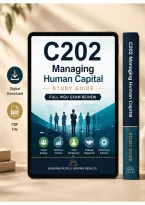
, Study Guide
C202 Managing Human Capital
Instructions: Read each chapter for the purpose of
understanding key concepts below. Apply your
knowledge by answering the accompanying questions.
CHAPTER 1
Question Answer
1. What is human resource management (HRM)? Human resource management - The organizational function
responsible for attracting, hiring, developing, rewarding, and
retaining talent.
2. List the 6 HRM functional areas, and what each area is Staffing, Performance Management, Training and Development,
about in only 1 sentence.
Rewards and Benefits, Employee Management Relations, Health
and Safety
3. In addition to managing risk, what are several other ways 1. Efficiency – doing what we do without wasting processes
effective HRM systems influence performance of an entire
organization? 2. Revenue Growth and save money or grow revenue
3. Risk Management minimize risk
4. Explain HRM’s role in executing an organization’s business business strategy - Defines how the firm will compete in its
strategy.
marketplace.
Concept Reference Notes
Human resource management 1.1 – 1.3 Human resource management - The organizational
function responsible for attracting, hiring, developing,
rewarding, and retaining talent.
competitive advantage - Doing something differently from the
competition that leads to outperformance and success.
,HRM functions (6) 1.4 – 1.10
he main functions within HRM are staffing,
performance management, training and
development, rewards and benefits, health and
safety, and employee-management relations.
total rewards - The sum of all of the rewards employees receive
in exchange for their time, efforts, and performance.
Direct financial compensation - Compensation received in the
form of salary, wages, commissions, stock options, or bonuses.
Indirect financial compensation - All the tangible and financially
valued rewards that are not included in direct compensation,
including free meals, vacation time, and health insurance.
Nonfinancial compensation - Rewards and incentives given to
employees that are not financial in nature, including intrinsic
rewards received from the job itself or from the work
environment.
HRM & organizational performance 1.11 Doing something differently from the competition that
leads to outperformance and success.
Effective HRM systems 1.11
HRM & business strategy 1.12 – 1.14 business strategy - Defines how the firm will compete in its
marketplace.
HRM responsibility 1.15 – 1.16
Talent philosophy 1.12 & 1.15 talent philosophy - A system of beliefs about how its employees
should be treated.
human resource strategy - Links the entire human resource
function with the firm’s business strategy.
Employee handbook 1.15 Print or online materials that document the organization’s
HRM policies and procedures.
HRM systems 1.17 – 1.18
Human resource management systems
(HRMS) are technology-based platforms that
help human resource management
professionals securely house sensitive
employee records, including benefits and
payroll information; monitor the performance of
the recruiting and staffing process; conduct
analytics, and more.
CHAPTER 2
Question Answer
, 1. What are 3 specific ways HR can support the organization ethics, organizational culture, and change
should it choose to shift its culture?
2. Explain 2 situations/reasons that managers across various
departments might seek out HR’s guidance.
3. How can HR support and reinforce ethical behavior in the
workplace?
4. Provide an example of what these ethical standards might
look like at your workplace:
a. Virtue –
b. Fairness –
c. Utilitarian –
d. Common good –
e. Rights –
5. What are a few of the most common change initiatives
that HR manages?
6. In addition to a lack of planning, what other factors can
hinder the success of a merger or acquisition?
7. Explain the connection between performance metrics,
employee behavior, and the organization’s goals.
Concept Reference Notes
HRM role in business 2.1 – 2.2
HRM affects the performance of any business
Organizational culture 2.3 & 2.14 Organizational culture - The norms, values, and assumptions of
organizational members that guide members’ attitudes and
behaviors.
Entrepreneurial Emphasizes creativity, innovation, and risk
taking.
Bureaucratic Emphasizes formal structure and correct
implementation of organizational procedures, norms, and rules;
has consistent, high, and ethical standards.
Consensual Emphasizes loyalty and tradition and encourages
employees to stay with the company for a long time; promotion
from within is common.
Competitive Emphasizes competitive advantage and market
superiority; large amounts of stress tend to be involved.
Types of culture 2.3 Entrepreneurial, Bureaucratic: Consensual Competitive:
Culture & HRM 2.4 & 2.6 Culture and HRM work together to influence employees’
performance and behaviors.
Ethics - The standards of moral behavior that define socially
accepted behaviors that are right as opposed to wrong.
C202 Managing Human Capital
Instructions: Read each chapter for the purpose of
understanding key concepts below. Apply your
knowledge by answering the accompanying questions.
CHAPTER 1
Question Answer
1. What is human resource management (HRM)? Human resource management - The organizational function
responsible for attracting, hiring, developing, rewarding, and
retaining talent.
2. List the 6 HRM functional areas, and what each area is Staffing, Performance Management, Training and Development,
about in only 1 sentence.
Rewards and Benefits, Employee Management Relations, Health
and Safety
3. In addition to managing risk, what are several other ways 1. Efficiency – doing what we do without wasting processes
effective HRM systems influence performance of an entire
organization? 2. Revenue Growth and save money or grow revenue
3. Risk Management minimize risk
4. Explain HRM’s role in executing an organization’s business business strategy - Defines how the firm will compete in its
strategy.
marketplace.
Concept Reference Notes
Human resource management 1.1 – 1.3 Human resource management - The organizational
function responsible for attracting, hiring, developing,
rewarding, and retaining talent.
competitive advantage - Doing something differently from the
competition that leads to outperformance and success.
,HRM functions (6) 1.4 – 1.10
he main functions within HRM are staffing,
performance management, training and
development, rewards and benefits, health and
safety, and employee-management relations.
total rewards - The sum of all of the rewards employees receive
in exchange for their time, efforts, and performance.
Direct financial compensation - Compensation received in the
form of salary, wages, commissions, stock options, or bonuses.
Indirect financial compensation - All the tangible and financially
valued rewards that are not included in direct compensation,
including free meals, vacation time, and health insurance.
Nonfinancial compensation - Rewards and incentives given to
employees that are not financial in nature, including intrinsic
rewards received from the job itself or from the work
environment.
HRM & organizational performance 1.11 Doing something differently from the competition that
leads to outperformance and success.
Effective HRM systems 1.11
HRM & business strategy 1.12 – 1.14 business strategy - Defines how the firm will compete in its
marketplace.
HRM responsibility 1.15 – 1.16
Talent philosophy 1.12 & 1.15 talent philosophy - A system of beliefs about how its employees
should be treated.
human resource strategy - Links the entire human resource
function with the firm’s business strategy.
Employee handbook 1.15 Print or online materials that document the organization’s
HRM policies and procedures.
HRM systems 1.17 – 1.18
Human resource management systems
(HRMS) are technology-based platforms that
help human resource management
professionals securely house sensitive
employee records, including benefits and
payroll information; monitor the performance of
the recruiting and staffing process; conduct
analytics, and more.
CHAPTER 2
Question Answer
, 1. What are 3 specific ways HR can support the organization ethics, organizational culture, and change
should it choose to shift its culture?
2. Explain 2 situations/reasons that managers across various
departments might seek out HR’s guidance.
3. How can HR support and reinforce ethical behavior in the
workplace?
4. Provide an example of what these ethical standards might
look like at your workplace:
a. Virtue –
b. Fairness –
c. Utilitarian –
d. Common good –
e. Rights –
5. What are a few of the most common change initiatives
that HR manages?
6. In addition to a lack of planning, what other factors can
hinder the success of a merger or acquisition?
7. Explain the connection between performance metrics,
employee behavior, and the organization’s goals.
Concept Reference Notes
HRM role in business 2.1 – 2.2
HRM affects the performance of any business
Organizational culture 2.3 & 2.14 Organizational culture - The norms, values, and assumptions of
organizational members that guide members’ attitudes and
behaviors.
Entrepreneurial Emphasizes creativity, innovation, and risk
taking.
Bureaucratic Emphasizes formal structure and correct
implementation of organizational procedures, norms, and rules;
has consistent, high, and ethical standards.
Consensual Emphasizes loyalty and tradition and encourages
employees to stay with the company for a long time; promotion
from within is common.
Competitive Emphasizes competitive advantage and market
superiority; large amounts of stress tend to be involved.
Types of culture 2.3 Entrepreneurial, Bureaucratic: Consensual Competitive:
Culture & HRM 2.4 & 2.6 Culture and HRM work together to influence employees’
performance and behaviors.
Ethics - The standards of moral behavior that define socially
accepted behaviors that are right as opposed to wrong.