
)uiz Submissions - Quiz 3 - MGMT 650
UNIVERSITY NARYLAND
MGMT 650 9049 Statistics for Managerial Decisio...
Course Home Content Discussions Assignments My Tools v Resources Classlist Help
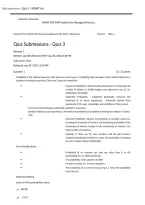
Quiz Submissions - Quiz 3
Attempt 1
Written: sep 30t 2026 6:45 PM • sep 30, 2026 8:28 PM
Submission View
Released: sep 30, 2026 11:59 PM
Question 1 points
Probability is the relative frequency with which an event occurs. Probability helps managers make rational decisions in
situations involving uncertainty. There are 3 types of probability:
• Empirical Probability is determined by observation. For example, the
number of defects in 10,000 widgets was observed to be 25. So.
P(defective) 25/10.000.
• Subjective Probability - Subjective probability measures the
likelihood of an event subjectively. Rationally derived from
experience of the past. knowledge, and conditions of the present.
A 'personal belief allowing substantial variation In measures.
Example: Based on past experience, I feel that the probability of candidate A winning the election is about
60%.
• Classical Probability requires enumerating all possible outcomes,
counting the outcomes of interest, and computing probability of the
outcome(s) of interest number of the outcome(s) of interest / the
total number of outcomes.
• Example: If there are 40 even numbers and 60 odd numbers
randomly distributed randomly in a box, the probability of drawing
an even number, P(even) 40/(40+60).
The Probability Rules:
• Probability of an outcome can take any value from O or 0%
(impossible) to 1 or 100% (certainty).
• The probability of all outcomes Is 100K
• An event consists of 1 or more outcomes.
• The probability of an event not occurring is 1 minus the probability
that it occuCs.
Additional Reading
Select all VALID probabilities values.
49/50
110%
, Quiz Submissions - Quiz 3 MGMT 650 9049 Statistics for Manageri.,.
1
50/49
1.01
• https://leam.umuc.edu/ül/lms!quizzing/user/quiz_submissions_att
em...
0%
-0.25
Question 2 points
The Law of Large Numbers means that as the number of observations of an outcome of a trial becomes larger.
the running mean of the relative frequency of the outcome of interest appears to settle down to a constant vatue,
the probability of the outcome.
You have just flipped a fair coin 7 times getting all heads. Does the coin owe you a tail? The Law of Averages predicts
you are due for a tail. but it is a myth. So, if using the same fair coin, no because the probability of a head on the next
toss hasn't changed.
Is a good hitter in baseball who has struck out the last six times due for a hit his next time up?
The Law of Large Numbers predicts the hitter is not due for a hit.
The Law of Large Numbers predicts the hitter is due for a hit.
This is an example of the Law of Averages. Yes, the hitter is not due for a hit.
V C) This is an example of the so-called Law of Averages. No, the hitter is not due for a hit because the Law of Averages
is non-existent and doesnt predict anything.
Question 3 points
After many observations, the relative frequency - # of events of interest / total # events appears to settle down to a
constant value.
This is an example of the
Law of Averages.
V (t) Law of Large Numbers
Question 4 O / 6 points
A sequence where order distinguishes one sequence of things from another order of the same things ts called a
permutation. Suppose we have things at b, and c. Drawing without replacement 3 times produces the permutations (abc,
acb, bac, bca. cab, and cba). We see 3 things have 6 permutations or orders.
Let's generalize. For a sequence of n things drawn from N things without replacement, there are N ways the 1st draw
occurs. For each of the N outcomes of 1st draw, there are N-l ways the 2nd draw can occur. So, for 2 draws, there are N
x (N • 1) possible permutations. Continuing, there are N x (N-l) x (N•2) permutations for 3 draws.
In general, it's N x (N - 1) x (N - 2) x x (N n +1) = N! / (N • n)! , or using Excel functions, =PERMUT( N, n)
UNIVERSITY NARYLAND
MGMT 650 9049 Statistics for Managerial Decisio...
Course Home Content Discussions Assignments My Tools v Resources Classlist Help
Quiz Submissions - Quiz 3
Attempt 1
Written: sep 30t 2026 6:45 PM • sep 30, 2026 8:28 PM
Submission View
Released: sep 30, 2026 11:59 PM
Question 1 points
Probability is the relative frequency with which an event occurs. Probability helps managers make rational decisions in
situations involving uncertainty. There are 3 types of probability:
• Empirical Probability is determined by observation. For example, the
number of defects in 10,000 widgets was observed to be 25. So.
P(defective) 25/10.000.
• Subjective Probability - Subjective probability measures the
likelihood of an event subjectively. Rationally derived from
experience of the past. knowledge, and conditions of the present.
A 'personal belief allowing substantial variation In measures.
Example: Based on past experience, I feel that the probability of candidate A winning the election is about
60%.
• Classical Probability requires enumerating all possible outcomes,
counting the outcomes of interest, and computing probability of the
outcome(s) of interest number of the outcome(s) of interest / the
total number of outcomes.
• Example: If there are 40 even numbers and 60 odd numbers
randomly distributed randomly in a box, the probability of drawing
an even number, P(even) 40/(40+60).
The Probability Rules:
• Probability of an outcome can take any value from O or 0%
(impossible) to 1 or 100% (certainty).
• The probability of all outcomes Is 100K
• An event consists of 1 or more outcomes.
• The probability of an event not occurring is 1 minus the probability
that it occuCs.
Additional Reading
Select all VALID probabilities values.
49/50
110%
, Quiz Submissions - Quiz 3 MGMT 650 9049 Statistics for Manageri.,.
1
50/49
1.01
• https://leam.umuc.edu/ül/lms!quizzing/user/quiz_submissions_att
em...
0%
-0.25
Question 2 points
The Law of Large Numbers means that as the number of observations of an outcome of a trial becomes larger.
the running mean of the relative frequency of the outcome of interest appears to settle down to a constant vatue,
the probability of the outcome.
You have just flipped a fair coin 7 times getting all heads. Does the coin owe you a tail? The Law of Averages predicts
you are due for a tail. but it is a myth. So, if using the same fair coin, no because the probability of a head on the next
toss hasn't changed.
Is a good hitter in baseball who has struck out the last six times due for a hit his next time up?
The Law of Large Numbers predicts the hitter is not due for a hit.
The Law of Large Numbers predicts the hitter is due for a hit.
This is an example of the Law of Averages. Yes, the hitter is not due for a hit.
V C) This is an example of the so-called Law of Averages. No, the hitter is not due for a hit because the Law of Averages
is non-existent and doesnt predict anything.
Question 3 points
After many observations, the relative frequency - # of events of interest / total # events appears to settle down to a
constant value.
This is an example of the
Law of Averages.
V (t) Law of Large Numbers
Question 4 O / 6 points
A sequence where order distinguishes one sequence of things from another order of the same things ts called a
permutation. Suppose we have things at b, and c. Drawing without replacement 3 times produces the permutations (abc,
acb, bac, bca. cab, and cba). We see 3 things have 6 permutations or orders.
Let's generalize. For a sequence of n things drawn from N things without replacement, there are N ways the 1st draw
occurs. For each of the N outcomes of 1st draw, there are N-l ways the 2nd draw can occur. So, for 2 draws, there are N
x (N • 1) possible permutations. Continuing, there are N x (N-l) x (N•2) permutations for 3 draws.
In general, it's N x (N - 1) x (N - 2) x x (N n +1) = N! / (N • n)! , or using Excel functions, =PERMUT( N, n)


